#supernova remnant
2 wallpapers tagged "supernova remnant"
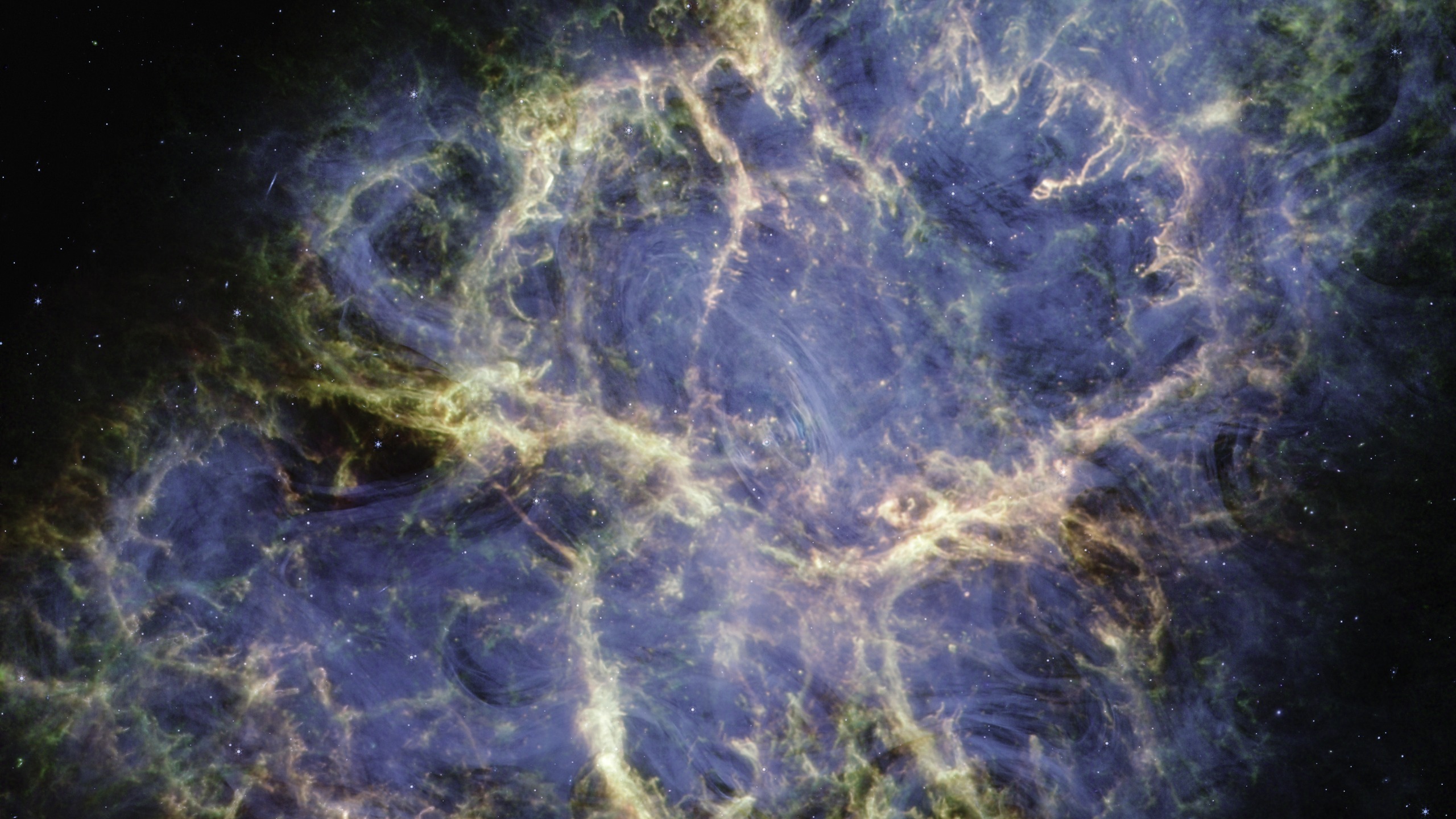
NASA’s James Webb Space Telescope dissected the Crab Nebula’s structure, aiding astronomers as they continue to evaluate leading theories about the supernova remnant’s origins. With the data collected by Webb’s NIRCam (Near-Infrared Camera) and MIRI (Mid-Infrared Instrument), a team of scientists were able to closely inspect some of the Crab Nebula’s major components. For the first time ever, astronomers mapped the warm dust emission throughout this supernova remnant. Represented as fluffy magenta material, the dust grains form a cage-like structure that is most apparent toward the lower left and upper right portions of the remnant. Filaments of dust are also threaded throughout the Crab’s interior and sometimes coincide with regions of doubly ionized sulfur (sulfur III) colored in green. Yellow-white mottled filaments, which form large loop-like structures around the supernova remnant’s center, represent areas where dust and doubly ionized sulfur overlap. The dust’s cage-like structure helps constrain some, but not all of the ghostly synchrotron emission represented in blue. The emission resembles wisps of smoke, most notable toward the Crab’s center. The thin blue ribbons follow the magnetic field lines created by the Crab’s pulsar heart — a rapidly rotating neutron star.
13.1k downloads
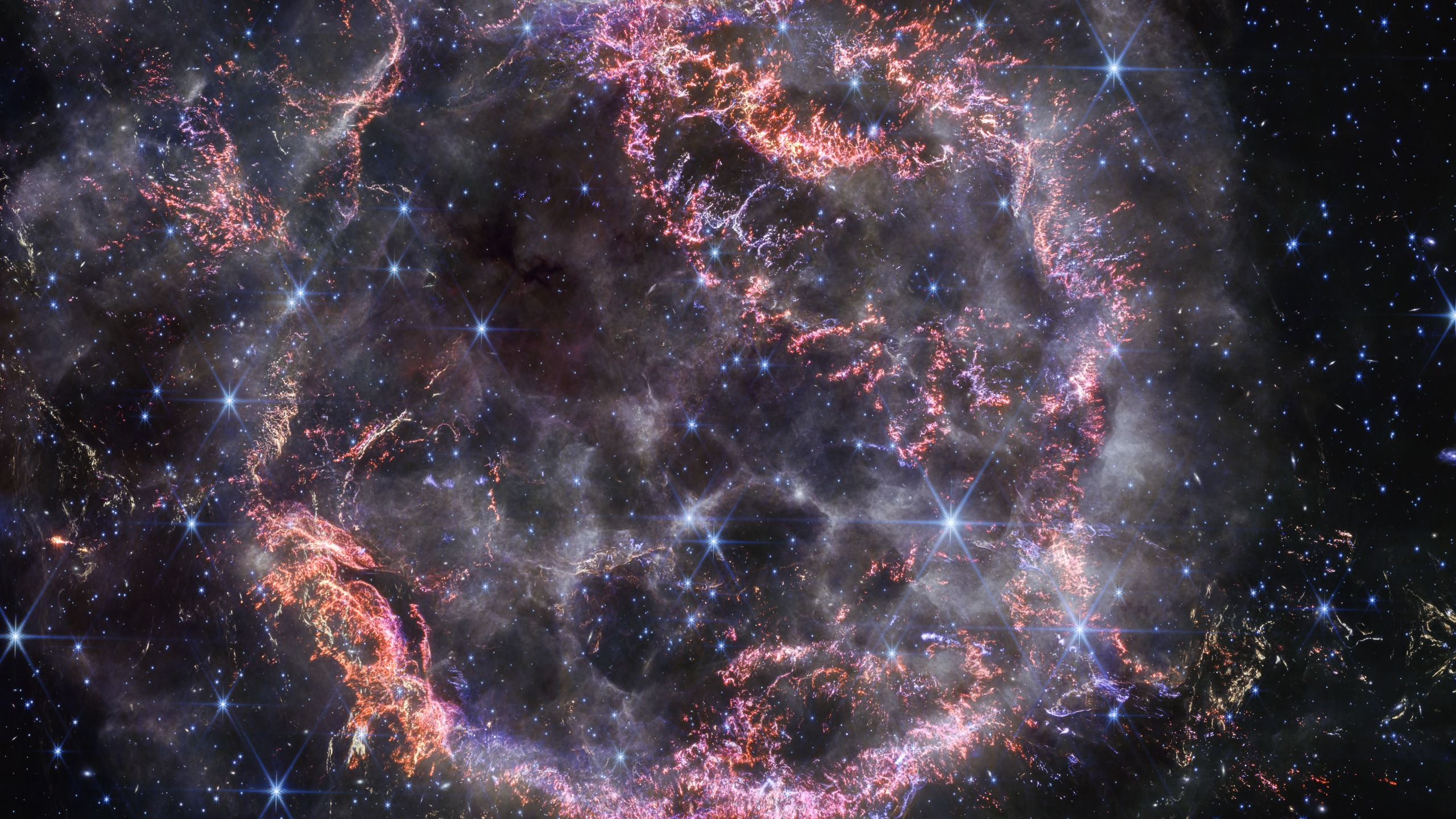
A new high-definition image from NASA’s James Webb Space Telescope’s NIRCam (Near-Infrared Camera) unveils intricate details of supernova remnant Cassiopeia A (Cas A), and shows the expanding shell of material slamming into the gas shed by the star before it exploded. The most noticeable colors in Webb’s newest image are clumps of bright orange and light pink that make up the inner shell of the supernova remnant. These tiny knots of gas, comprised of sulfur, oxygen, argon, and neon from the star itself, are only detectable by NIRCam’s exquisite resolution, and give researchers a hint at how the dying star shattered like glass when it exploded. The outskirts of the main inner shell looks like smoke from a campfire. This marks where ejected material from the exploded star is ramming into surrounding circumstellar material. Researchers say this white color is light from synchrotron radiation, which is generated by charged particles traveling at extremely high speeds spiraling around magnetic field lines. There are also several light echoes visible in this image, most notably in the bottom right corner. This is where light from the star’s long-ago explosion has reached, and is warming distant dust, which is glowing as it cools down.
31.3k downloads