All Wallpapers
65 JWST wallpapers, pre-sized for every device.
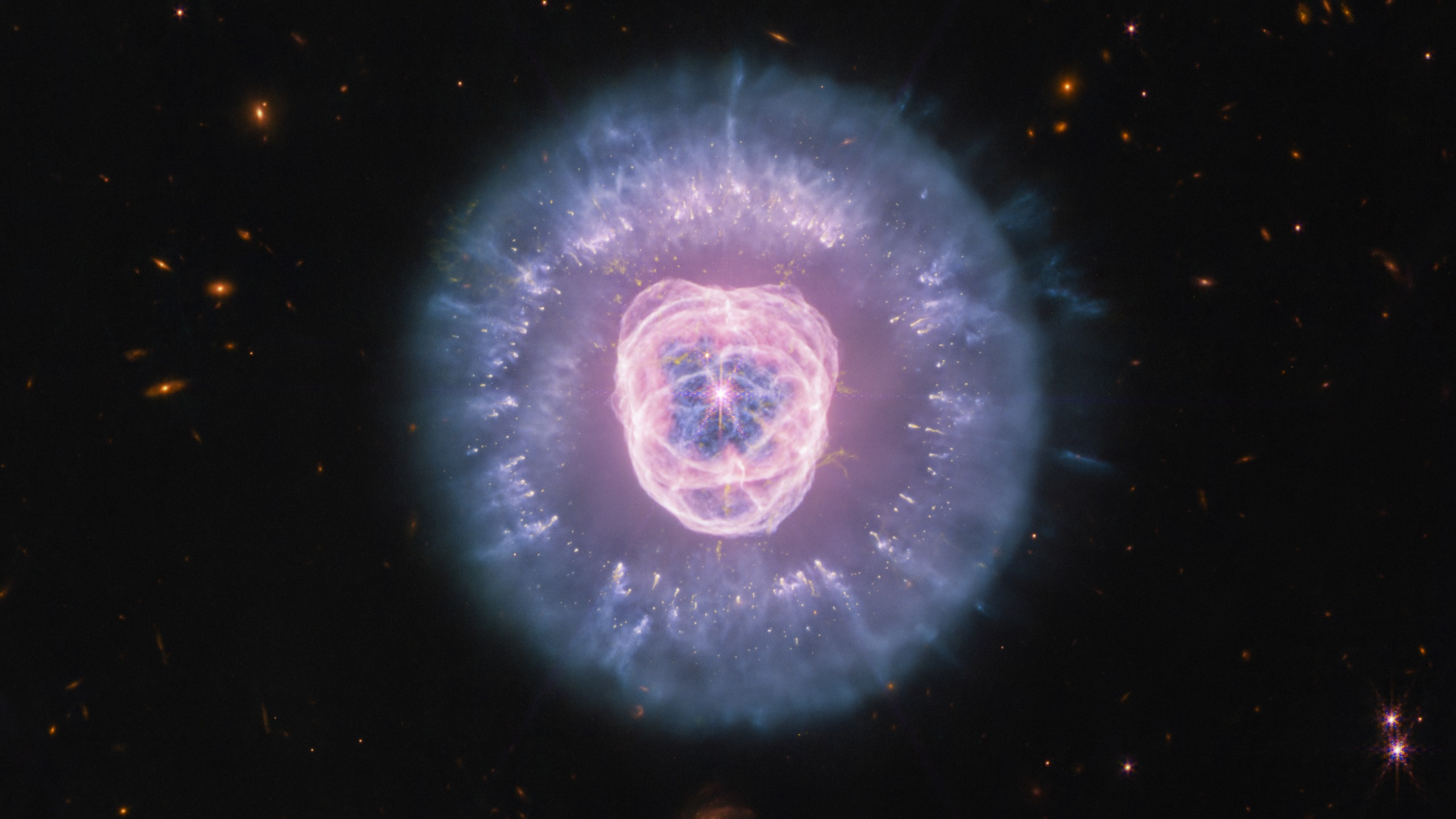
NASA’s James Webb Space Telescope’s NIRCam (Near Infrared Camera) and MIRI (Mid Infrared Instrument) instruments recently imaged planetary nebula NGC 2392, which is nicknamed the Lion Nebula due to its distinct shape. This near- and mid-infrared composite image reveals the complex structure of the nebula, which has formed and continues to be sculpted by the remains of a dying star. The stellar core, also known as a white dwarf, is located at the center and looks like the button nose of the lion. The central dying star is so hot that its radiation is “cooking” everything from the inside and producing a bubble of ionized hydrogen gas as it does. The gas bubble, which is the lion’s “face,” features cavernous shells and rings with tendrils that are expanding and destroying dust upon encounter. However, not all dust is obliterated from the scene. The lion’s mane is the interior of a dust shell that is being illuminated by the central star’s core. Within the mane some compact clumps of dust (red and orange) have managed to survive so far and are protecting the material that lies behind them. Additional clumps of molecular hydrogen appear yellow. The Lion Nebula is a snapshot in time. It’s taken several thousand years for the gas and dust to be shaped in this way, and it continues to change as the star drives away the material. Astronomers estimate NGC 2392 will eventually disperse in about 10,000 years, which is a relatively short period in astronomical terms.
40.5k downloads
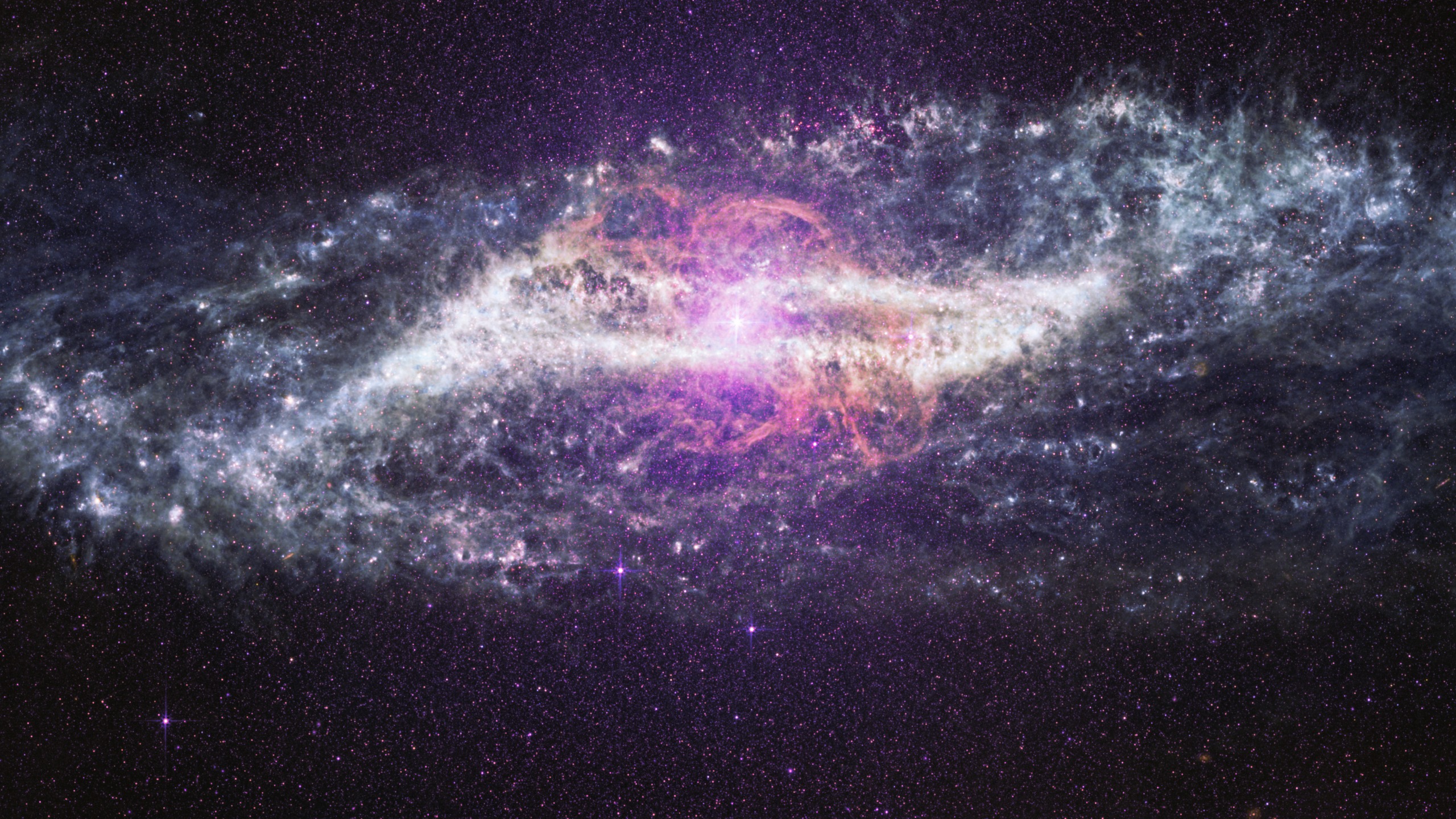
NASA’s James Webb Space Telescope’s Mid-Infrared Instrument (MIRI) reveals the nearby galaxy Centaurus A, exposing the dusty structures and hidden activity that shape this unusual system. Webb’s infrared vision unveils intricate filaments, loops, and glowing clouds of warm dust stretching across its center. At the heart of the galaxy, an actively feeding supermassive black hole shines brightly, surrounded by complex structures sculpted by a past galactic collision and ongoing activity. Deeper Dive Explore tours and points of interest in the interactive map below.
27.3k downloads
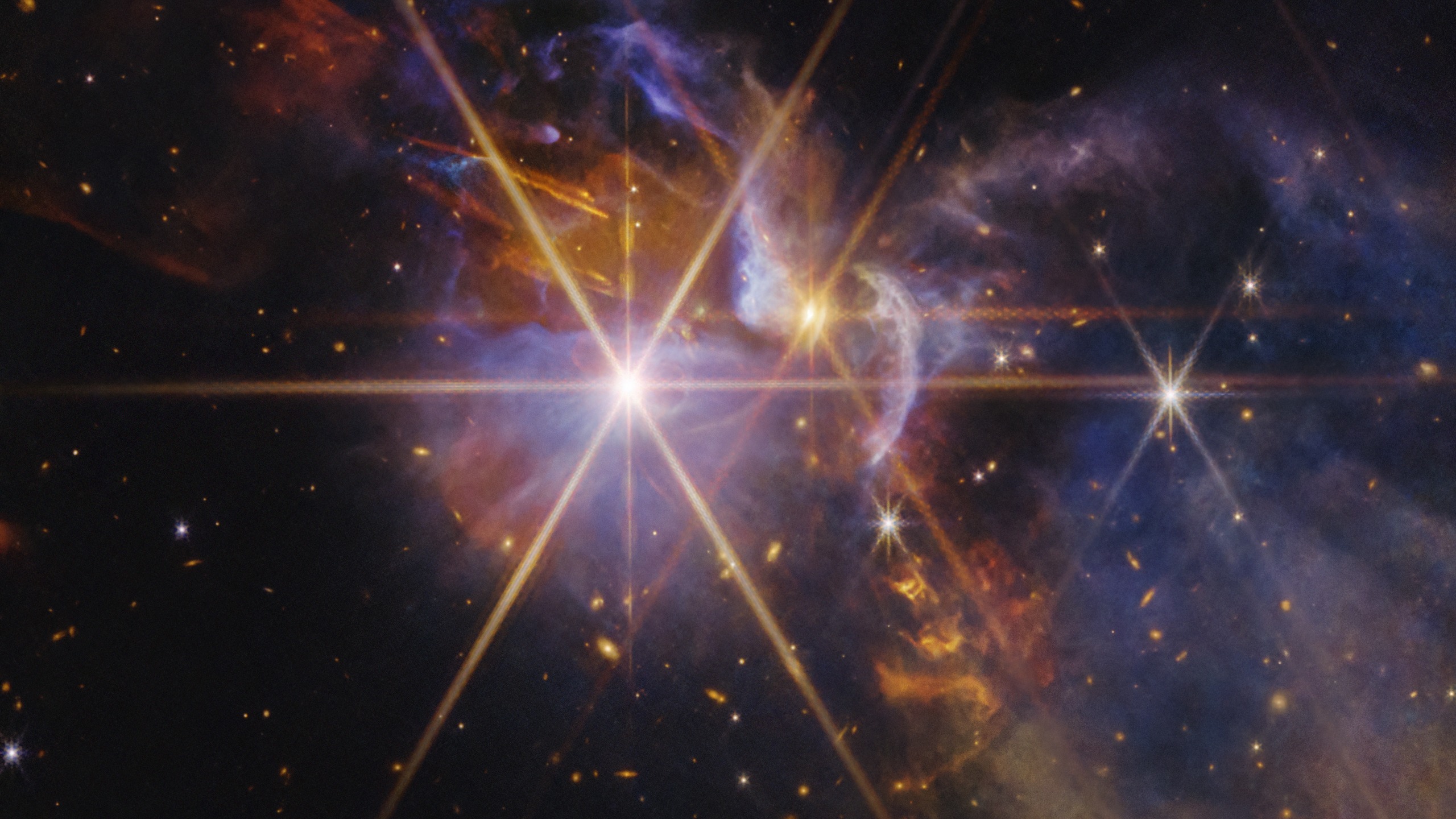
NASA's James Webb Space Telescope captures the infrared light from bright protostars in young star system FS Tau. FS Tau A, a pair of protostars that creates the largest diffraction pattern slightly to the left of center, is about half the mass of our Sun. FS Tau B, the orange protostar slightly right of center, is thought to be responsible for the red (molecular hydrogen) and orange (soot-like molecules known as polycyclic aromatic hydrocarbons) outflows that we see amid the dusty region. The blue ridges are areas where light has been scattered by dust.
12.3k downloads
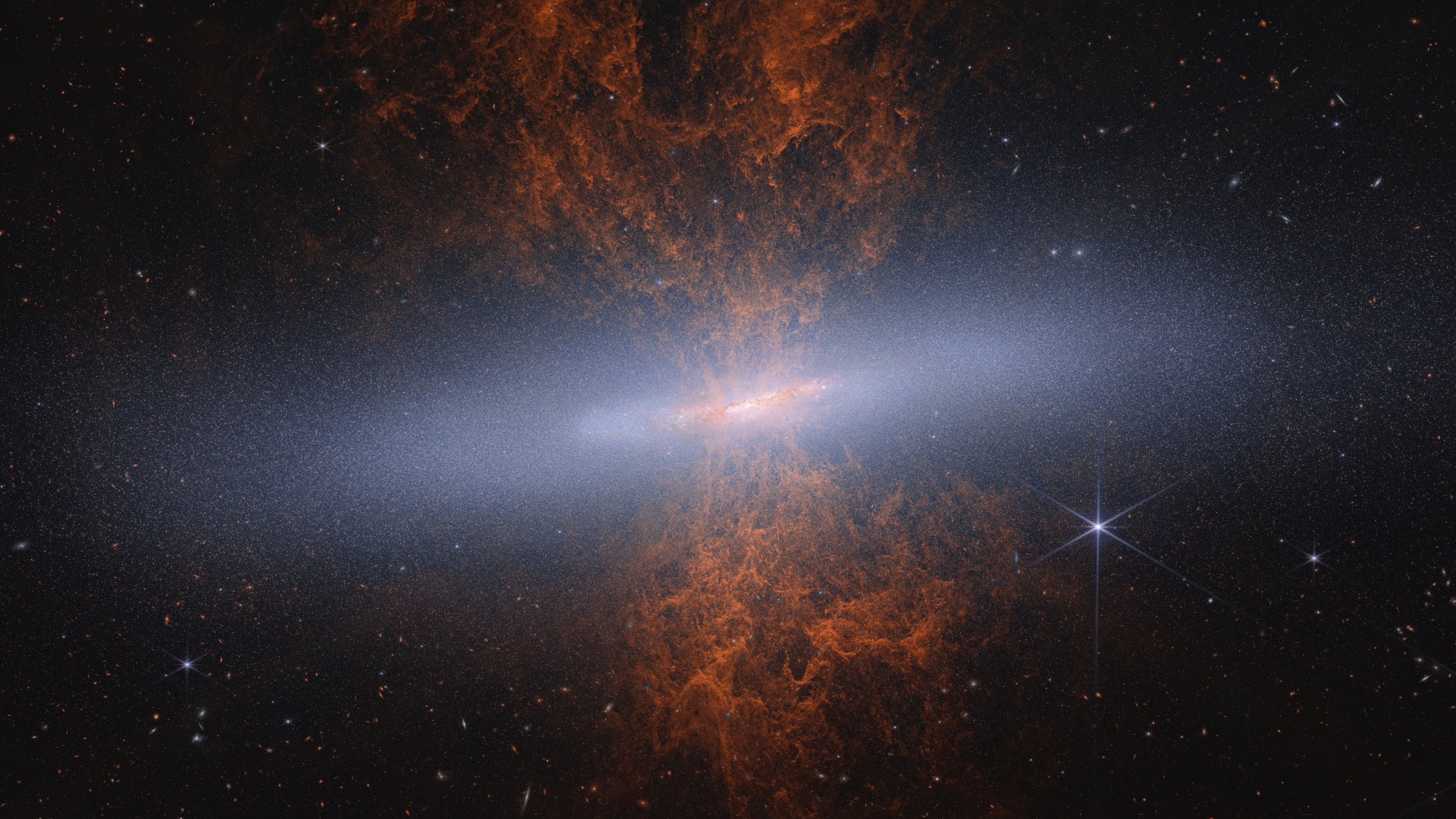
NASA's James Webb Space Telescope recently observed edge-on starburst galaxy Messier 82 (M82), nicknamed the Cigar Galaxy. Webb's near-infrared-light view is a snapshot in time, revealing a scene that has been evolving over a couple hundred million years. In near-infrared light, astronomers can see the galaxy's distended disk structure and millions of individual stars — approximately 16.5 million — for the first time. Webb's imaging survey of the galaxy is helping astronomers investigate the formation history of M82 and will also shed light on the current processes occurring within the starburst galaxy.
40.8k downloads
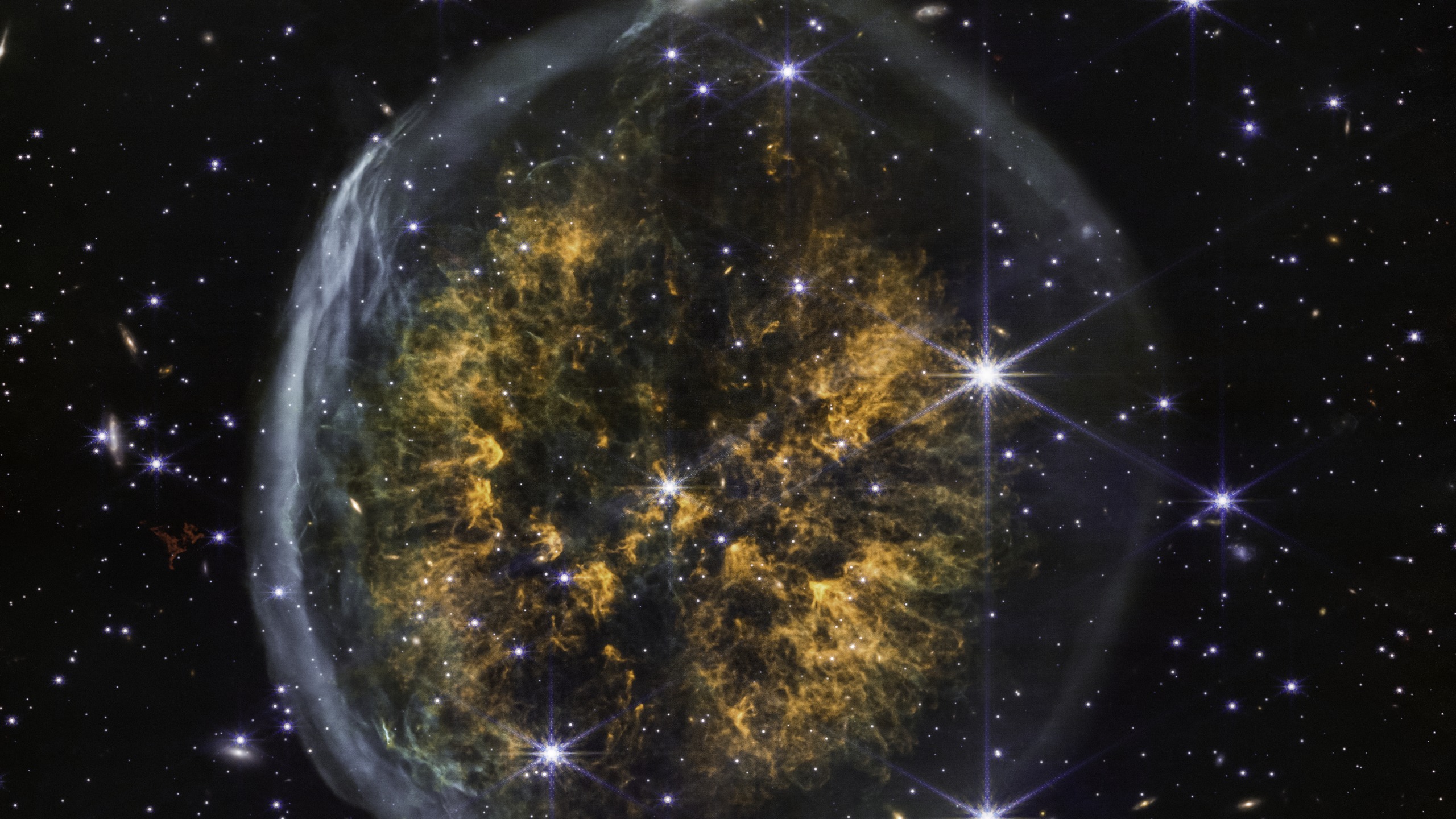
NASA's James Webb Space Telescope captured this near-infrared view of the PMR 1 "Exposed Cranium" nebula using its NIRCam instrument. More stars and background galaxies shine through in this near-infrared light, and the dark center lane that gives the nebula its distinctive brain-like appearance is especially noticeable here.
36k downloads
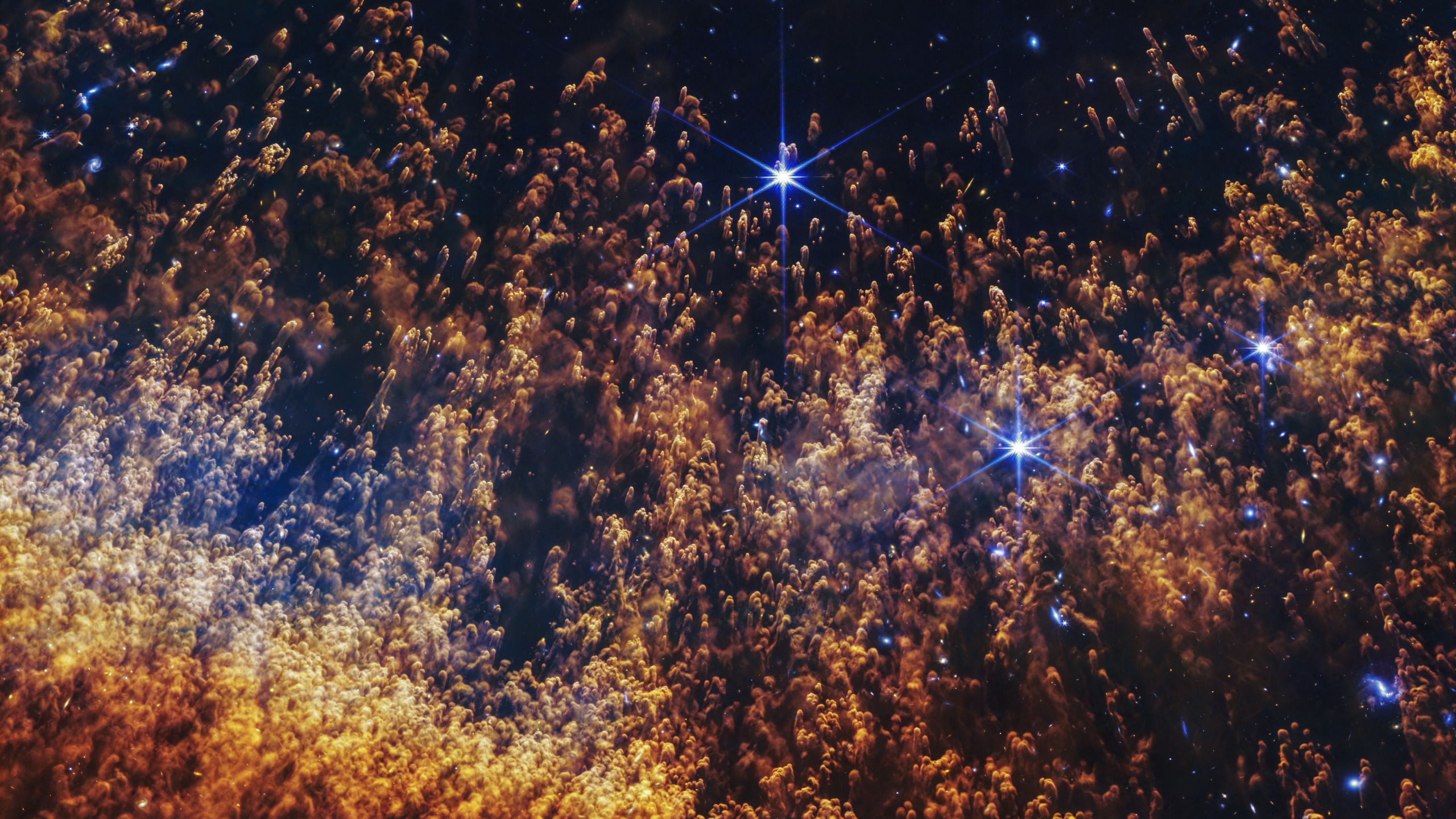
This new image of a portion of the Helix Nebula from NASA’s James Webb Space Telescope highlights comet-like knots shaped by fierce stellar winds and layers of gas and dust shed off by a dying star interacting with its surrounding environment. Webb’s image also shows the stark transition between the hottest gas to the coolest gas as the shell expands out from the central white dwarf.
23.5k downloads
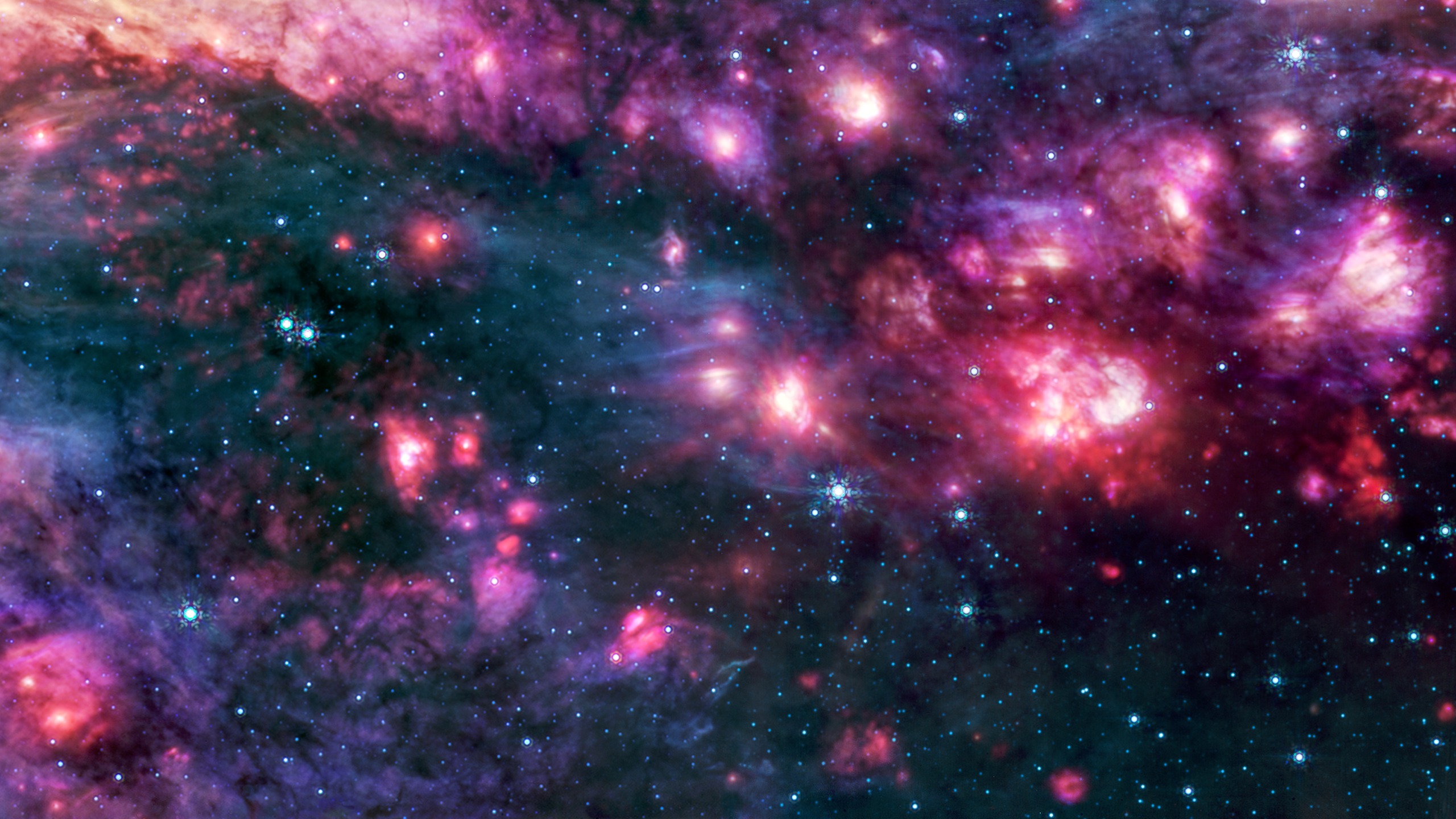
Webb's MIRI (Mid-Infrared Instrument) shows the Sagittarius B2 (Sgr B2) region in mid-infrared light, with warm dust glowing brightly. To the right is one clump of clouds that captured astronomers' attention. It is redder than the rest of the clouds in the image and corresponds to an area that other telescopes have shown to be one of the most molecularly rich regions known.
15k downloads
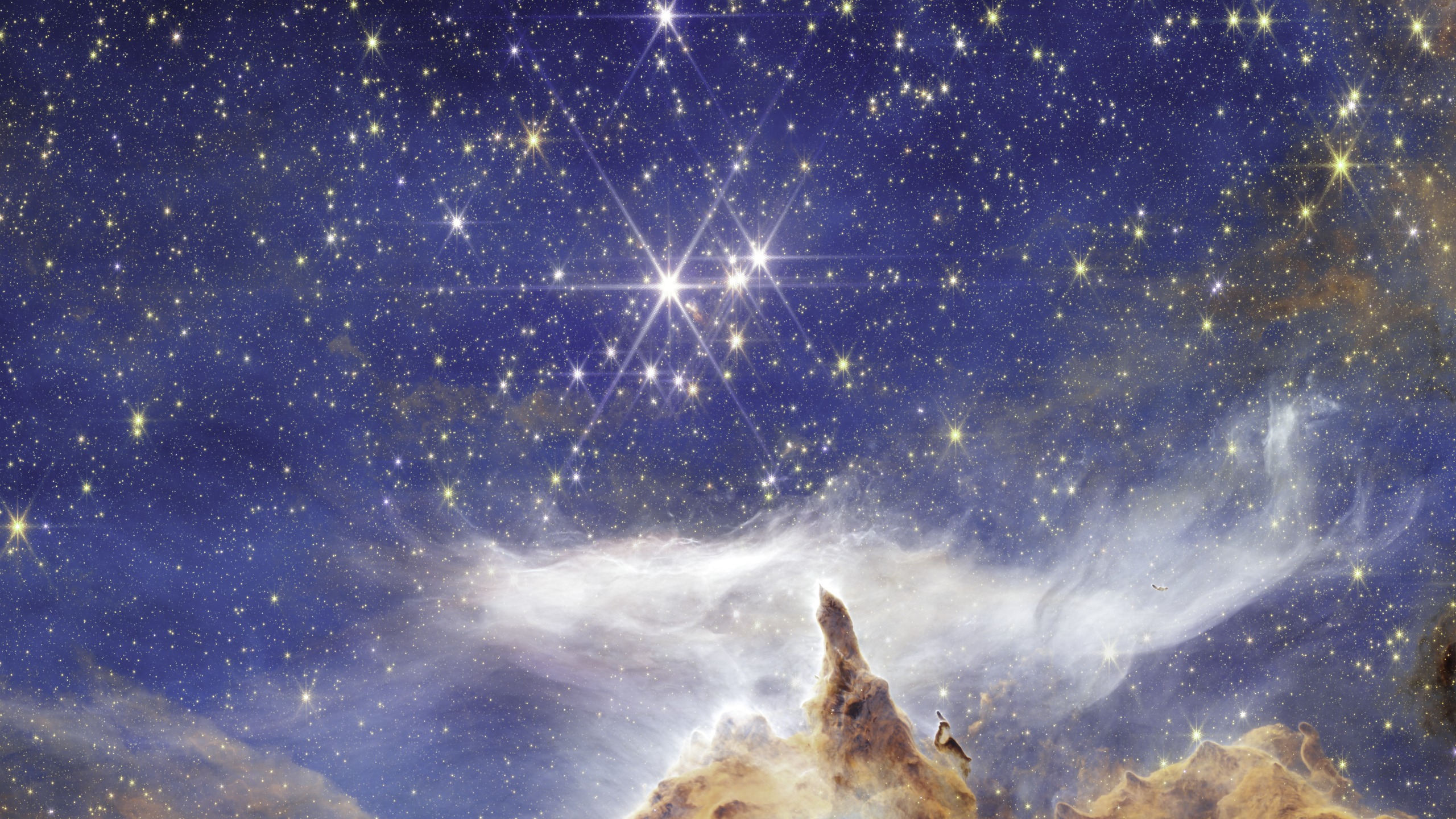
Webb captured this sparkling scene of star birth in Pismis 24, a young star cluster about 5,500 light-years from Earth in the constellation Scorpius. This region is one of the best places to explore the properties of hot young stars and how they evolve. Read the full image description.
16.8k downloads
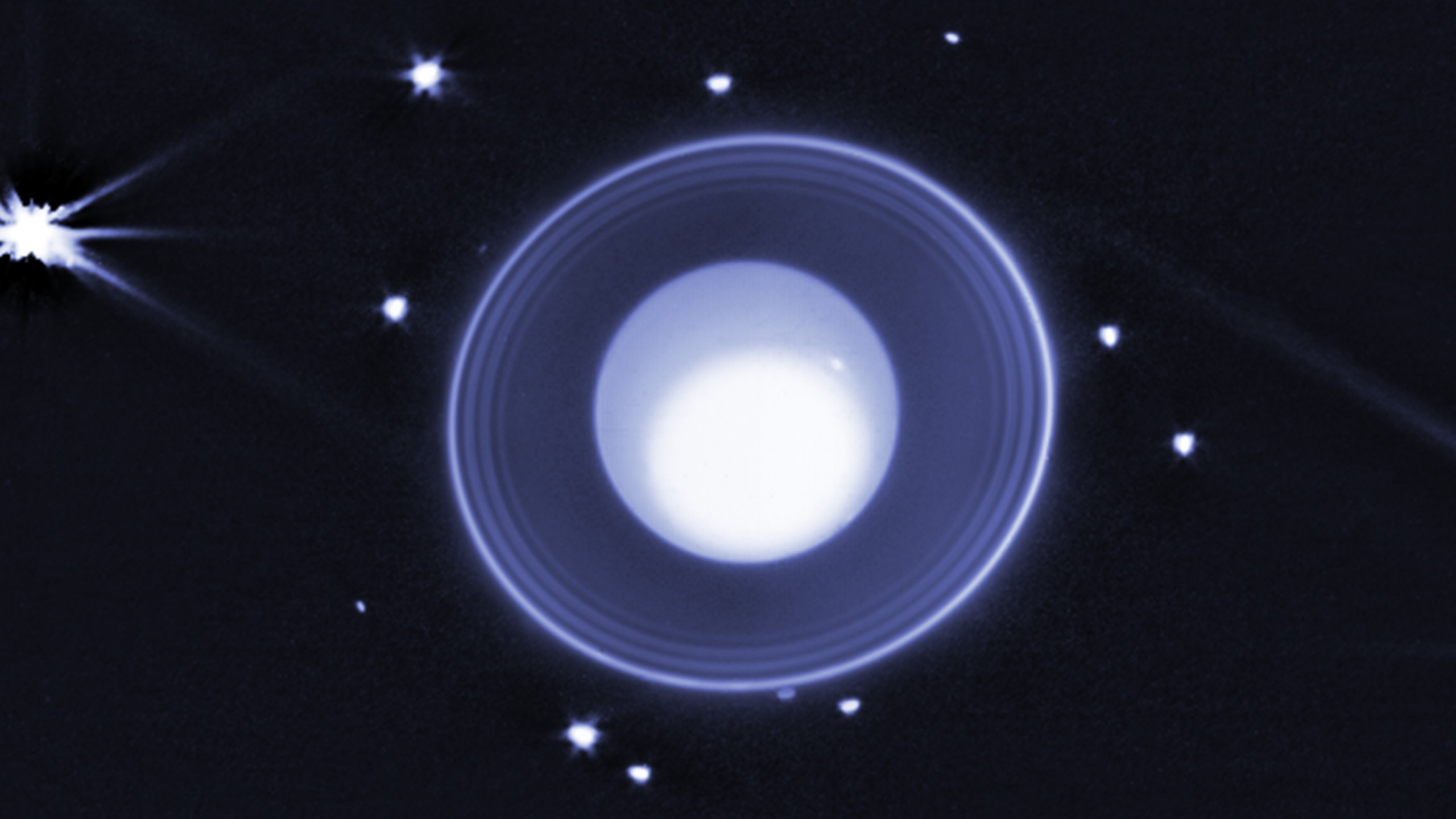
Astronomers using NASA’s James Webb Space Telescope discovered a new moon orbiting Uranus in images taken by Webb’s NIRCam (Near-Infrared Camera). This image shows the moon, designated S/2025 U1, as well as 13 of the 28 other known moons orbiting the planet. (The small moon Cordelia orbits just inside the outermost ring, but is not visible in these views due to glare from the rings.) Due to the drastic differences in brightness levels, the image is a composite of three different treatments of the data, allowing the viewer to see details in the planetary atmosphere, the surrounding rings, and the orbiting moons. The data was taken with NIRCam’s wide band F150W2 filter that transmits infrared wavelengths from about 1.0 to 2.4 microns.
32k downloads
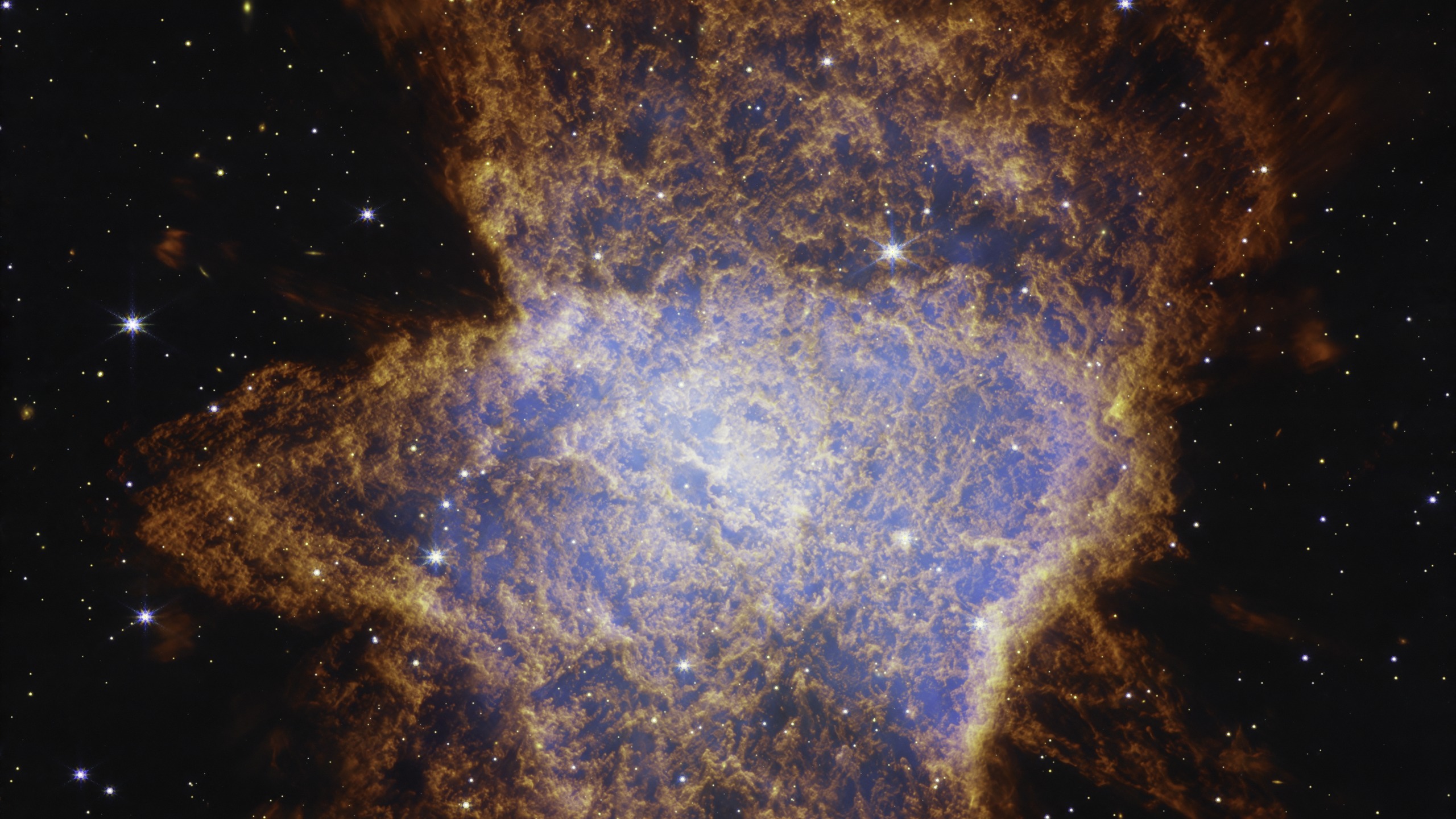
NASA’s James Webb Space Telescope’s view of planetary nebula NGC 6072 in the near-infrared shows a complex scene of multiple outflows expanding out at different angles from a dying star at the center of the scene. There is one stretching from roughly 11 to 5 o’clock, another from 1 to 7 o’clock, and possibly a third from 12 to 6 o’clock. These outflows push gas toward the equatorial plane, forming a disk that appears to span from 9 to 3 o’clock. Astronomers suspect there is at least one other star interacting with the material cast off by the central dying star, creating the abnormal appearance of this planetary nebula. In this image, the red areas represent cool molecular gas, for example, molecular hydrogen. Read the full image description.
27.2k downloads
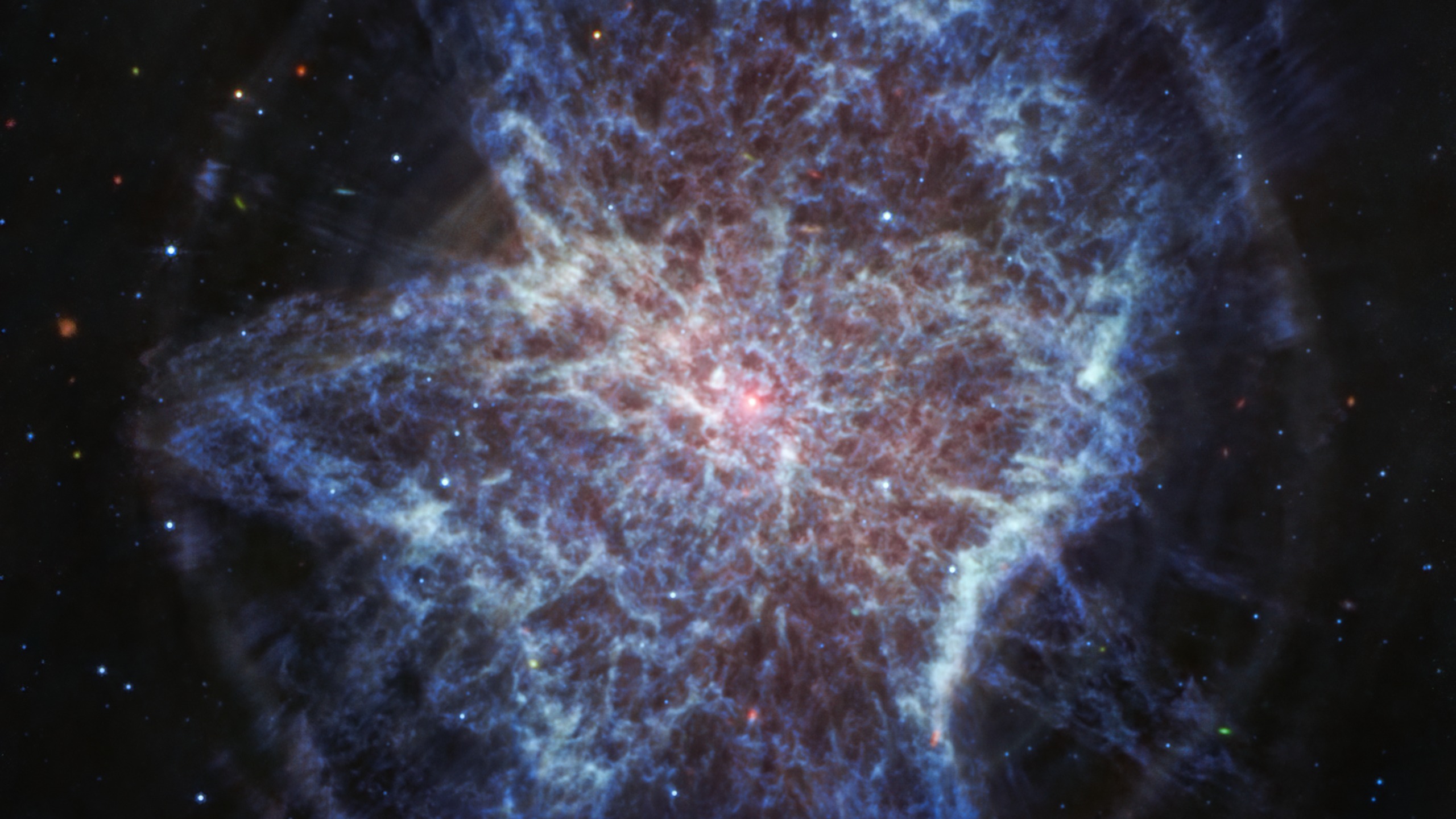
The mid-infrared view of planetary nebula NGC 6072 from NASA's James Webb Space Telescope shows expanding circular shells around the outflows from the dying central star, which astronomers suspect is the pinkish white dot at the center of the image. The longer wavelengths captured by Webb's MIRI (Mid-Infrared Instrument) highlight the dust being cast off by the central dying star. In this image, the blue represents cool molecular gas that is seen in red in the near-infrared image from Webb's NIRCam (Near-Infrared Camera) due to color mapping.
38.7k downloads
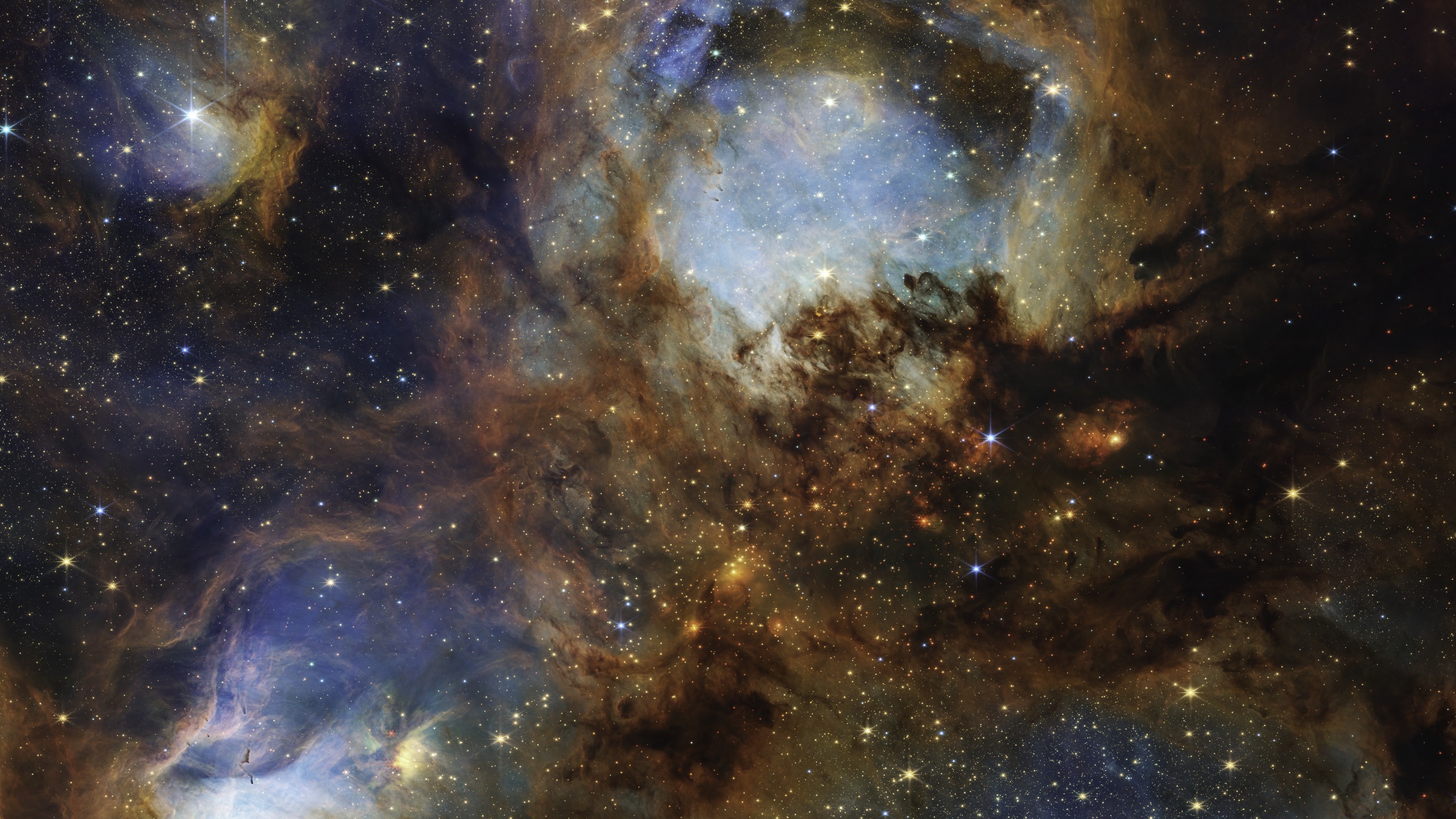
To celebrate NASA’s James Webb Space Telescope’s third year of highly productive science, astronomers used the telescope to scratch beyond the surface of the Cat’s Paw Nebula (NGC 6334), a massive, local star-forming region. This area is of great interest to scientists, having been subject to previous study by NASA’s Hubble and retired Spitzer space telescopes, as they seek to understand the multiple steps required for a turbulent molecular cloud to transition to stars. With its near-infrared capabilities and sharp resolution, the telescope “clawed” back a portion of a singular “toe bean,” revealing a subset of mini toe bean-reminiscent structures composed of gas, dust, and young stars. Webb’s view reveals a chaotic scene still in development: Massive young stars are carving away at nearby gas and dust, while their bright starlight is producing a bright nebulous glow represented in blue. This is only a chapter in the region’s larger story. The disruptive young stars, with their relatively short lifespans and luminosity, will eventually quench the local star formation process. The Cat’s Paw Nebula is located approximately 4,000 light-years away in the constellation Scorpius. To dive deeper into Webb’s image of the Cat’s Paw, embark on a narrated tour, get closer to the image, or read the press release. Additionally, learn more about Webb’s three years of science observations.
38.1k downloads
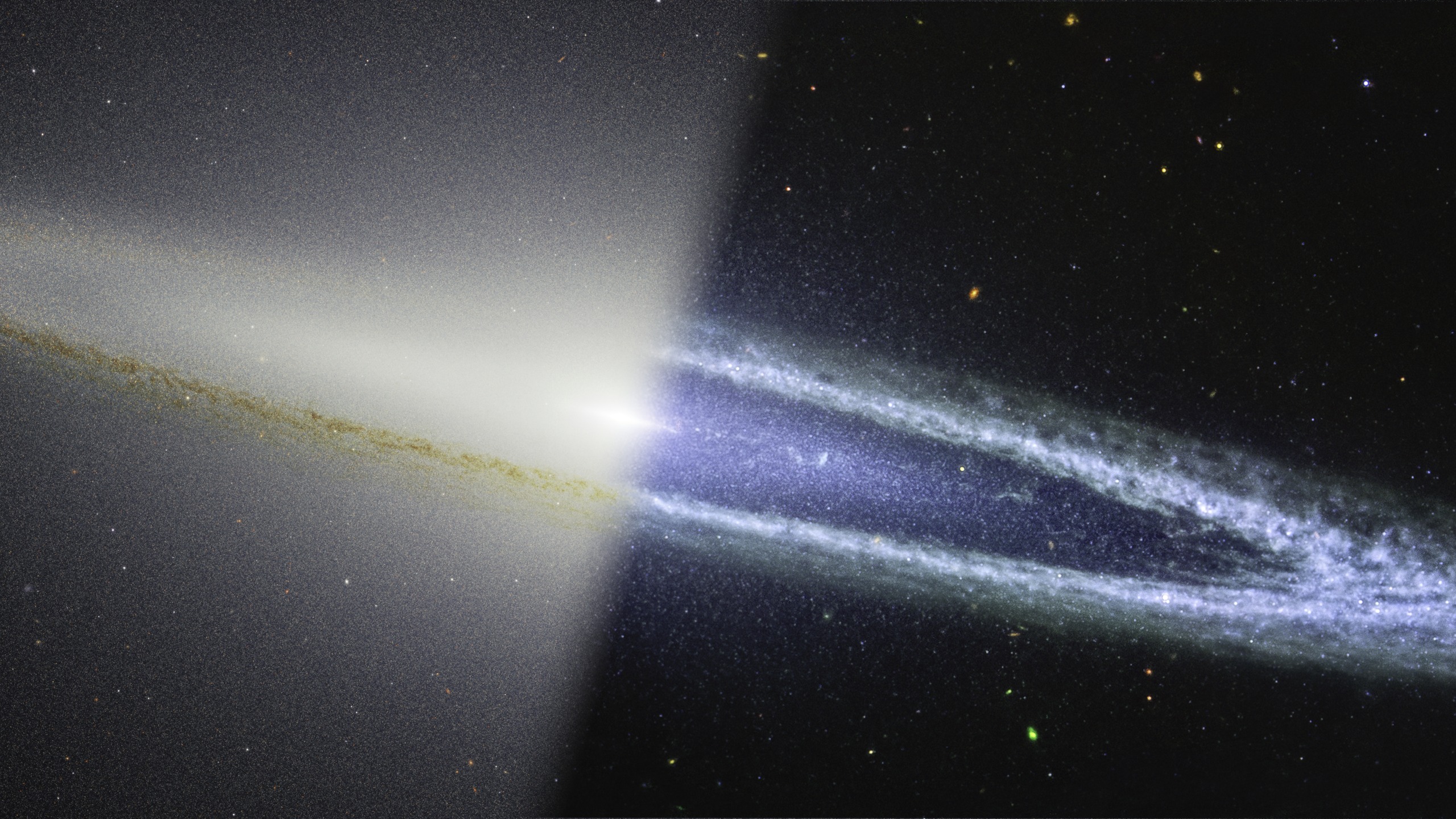
The Sombrero galaxy is split diagonally in this image: near-infrared observations from NASA’s James Webb Space Telescope are at the left, and mid-infrared observations from Webb are at the right. The near-infrared image shows where dust from the outer ring blocks stellar light from the inner portions of the galaxy. Then, in the mid-infrared image actually shows that dust glowing. The powerful resolution of Webb’s NIRCam also allows us to resolve individual stars outside of, but not necessarily at the same distance as, the galaxy, some of which appear red. These are called red giants, which are cooler stars, but their large surface area causes them to glow brightly in this image. These red giants also are detected in the mid-infrared, while the smaller, bluer stars in the near-infrared “disappear” in the longer wavelengths.
41.7k downloads
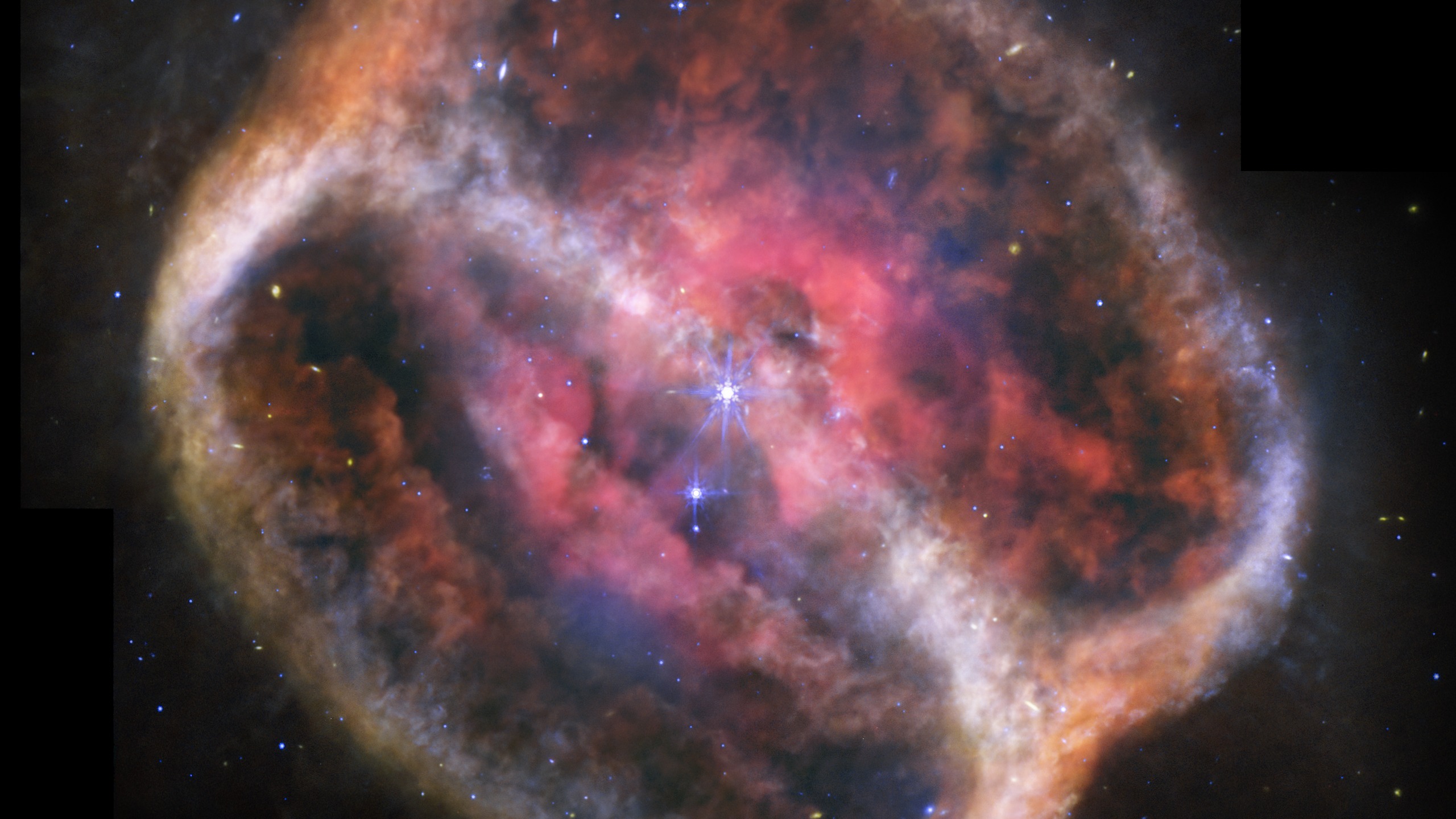
NASA’s James Webb Space Telescope has taken the most detailed image of planetary nebula NGC 1514 to date thanks to its unique mid-infrared observations. Webb shows its rings as intricate clumps of dust. It’s also easier to see holes punched through the bright pink central region.
23.9k downloads
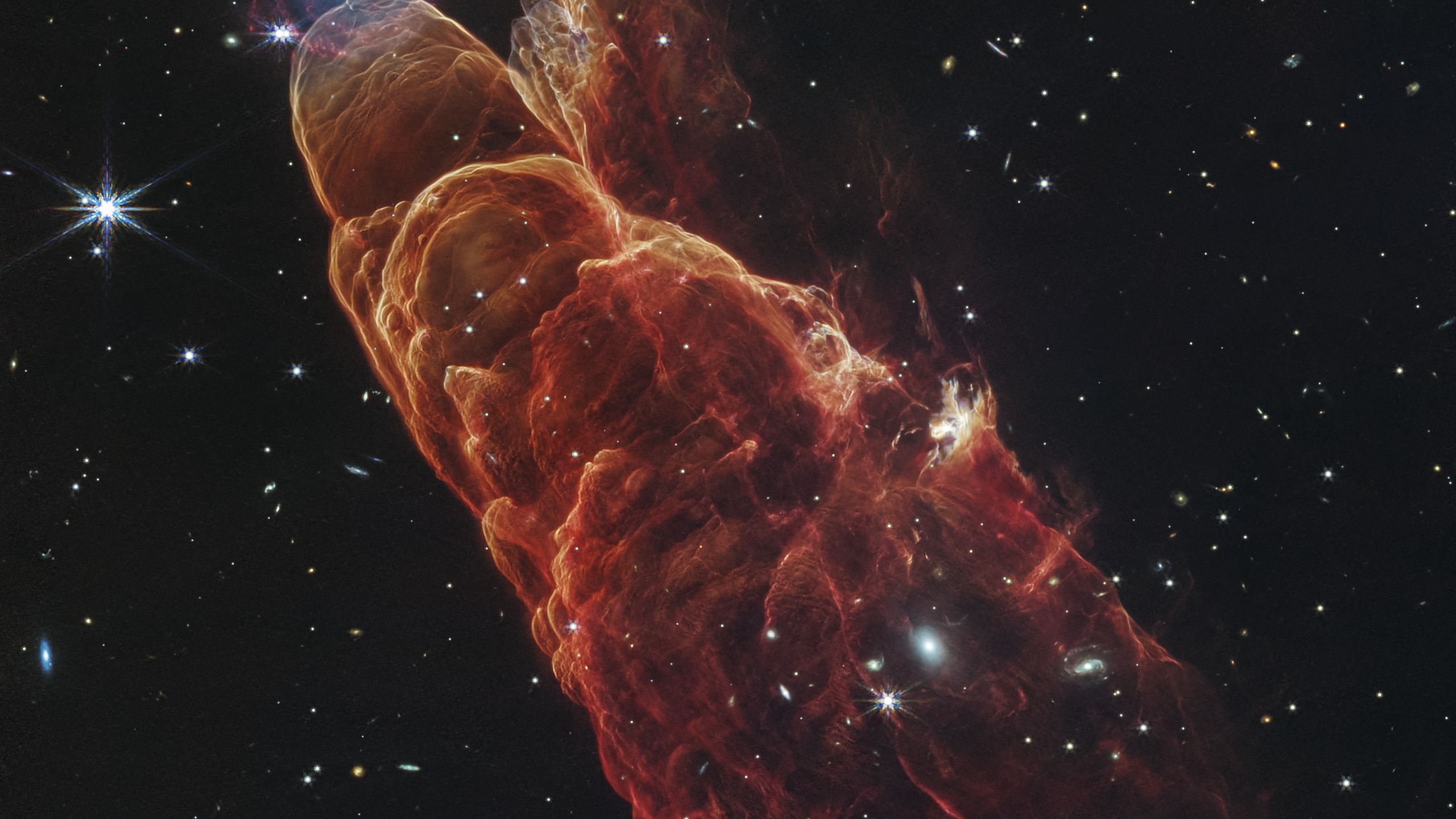
NASA’s James Webb Space Telescope observed Herbig-Haro 49/50, an outflow from a nearby still-forming star, in high-resolution near- and mid-infrared light. The young star is off to the lower right corner of the Webb image.Intricate features of the outflow, represented in reddish-orange color, provide detailed clues about how young stars form and how their jet activity affects the environment around them. A chance alignment in this direction of the sky provides a beautiful juxtaposition of this nearby Herbig-Haro object (located within our Milky Way) with a face-on spiral galaxy in the distant background. Protostars are young stars in the process of formation that generally launch narrow jets of material. These jets move through the surrounding environment, in some cases extending to large distances away from the protostar. Like the water wake generated by a speeding boat, the arcs in this image are created by the fast-moving jet slamming into surrounding dust and gas. This ambient material is compressed and heats up, then cools by emitting light at visible and infrared wavelengths. In particular, the infrared light captured here by Webb highlights molecular hydrogen and carbon monoxide. The galaxy that appears by happenstance at the tip of Herbig-Haro 49/50 is a much more distant spiral galaxy. It has a prominent central bulge represented in blue that shows the location of older stars. It also displays hints of “side lobes,” suggesting that this could be a barred-spiral galaxy. Reddish clumps within the spiral arms show the locations of warm dust and groups of forming stars. There are many more galaxies at further distances in the surrounding background, including ones that shine through the diffuse infrared glow of the nearby Herbig-Haro object.
2.7k downloads
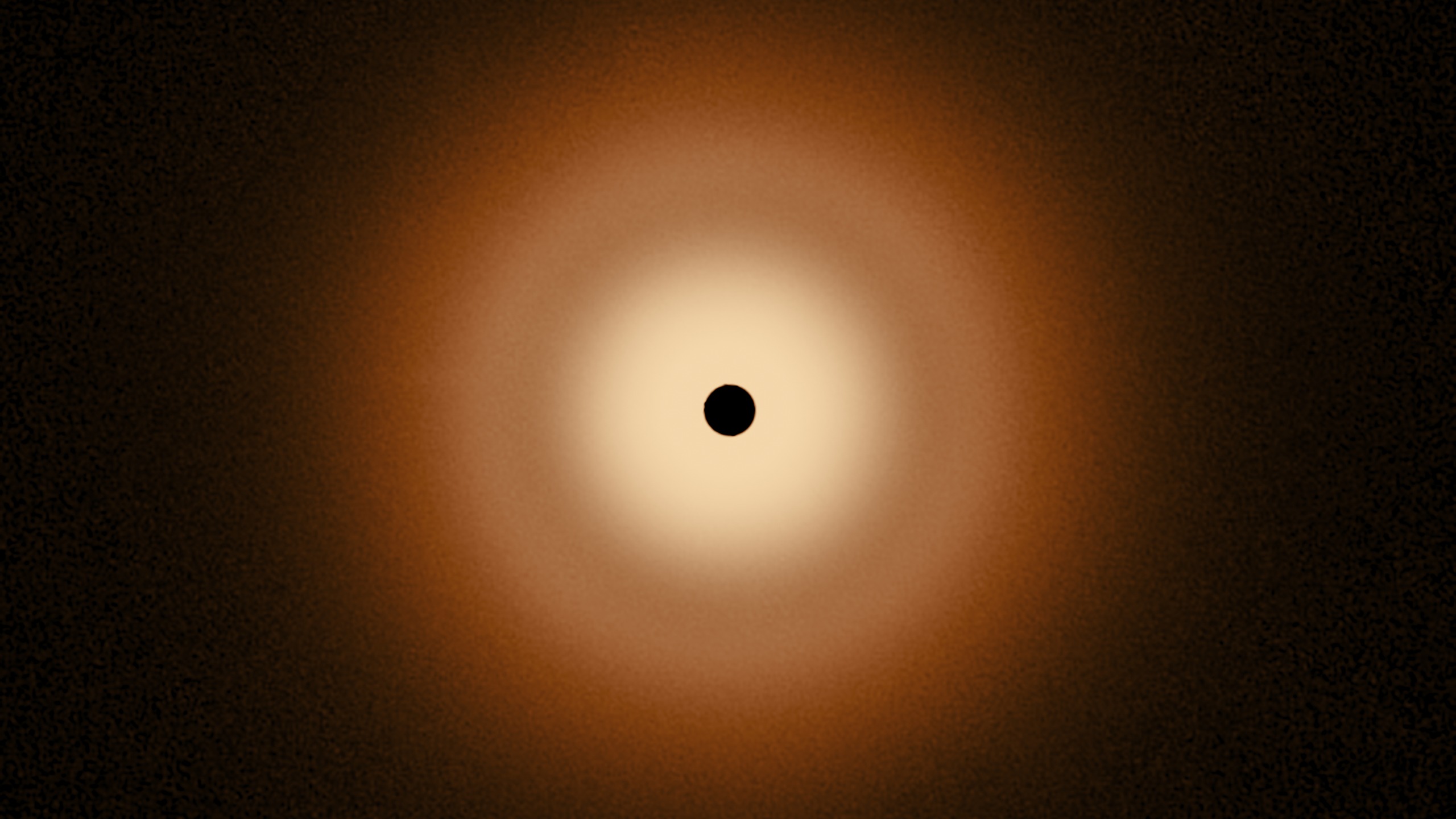
The James Webb Space Telescope resolves the glow of warm dust in a disk halo, at 23 billion miles out. The outer disk (analogous to the solar system's Kuiper Belt) extends from 7 billion miles to 15 billion miles. The inner disk extends from the inner edge of the outer disk down to close proximity to the star. There is a notable dip in surface brightness of the inner disk from approximately 3.7 to 7.2 billion miles. The black spot at the center is due to lack of data from saturation.
4.5k downloads
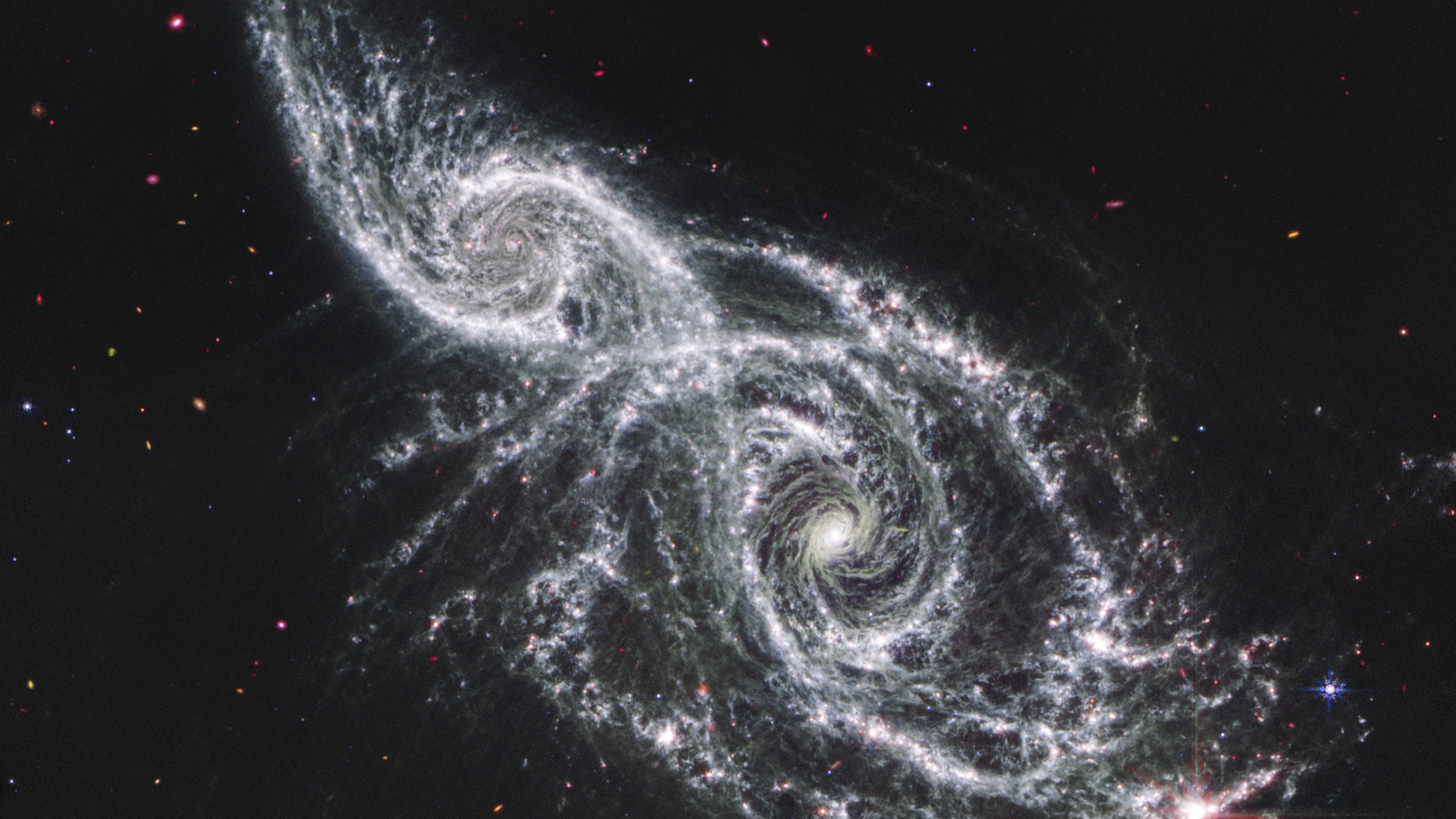
The James Webb Space Telescope’s mid-infrared image of galaxies IC 2163 and NGC 2207 recalls the iciness of long-dead bones mixed with eerie vapors. Two large luminous “eyes” lie at the galaxies’ cores, and gauzy spiral arms reach out into the vast distances of space. Webb’s mid-infrared image excels at showing where the cold dust glows throughout these galaxies — and helps pinpoint where stars and star clusters are buried within the dust. Find these regions by looking for the pink dots along the spiral arms. Many of these areas are home to actively forming stars that are still encased in the gas and dust that feeds their growth. Other pink dots may be objects that lie well behind these galaxies, including extremely distant active supermassive black holes known as quasars. The largest, brightest pink region that glimmers with eight prominent diffraction spikes at the bottom right is a mini starburst — a location where many stars are forming in quick succession. Find the lace-like holes in the spiral arms. These areas are brimming with star formation. Finally, scan the black background of space, where objects shine brightly in a rainbow of colors. Blue circles with tiny diffraction spikes are foreground stars. Objects without spikes are very distant galaxies. Compare the Hubble and Webb images. Extended Description and Image Alt Text
18.4k downloads
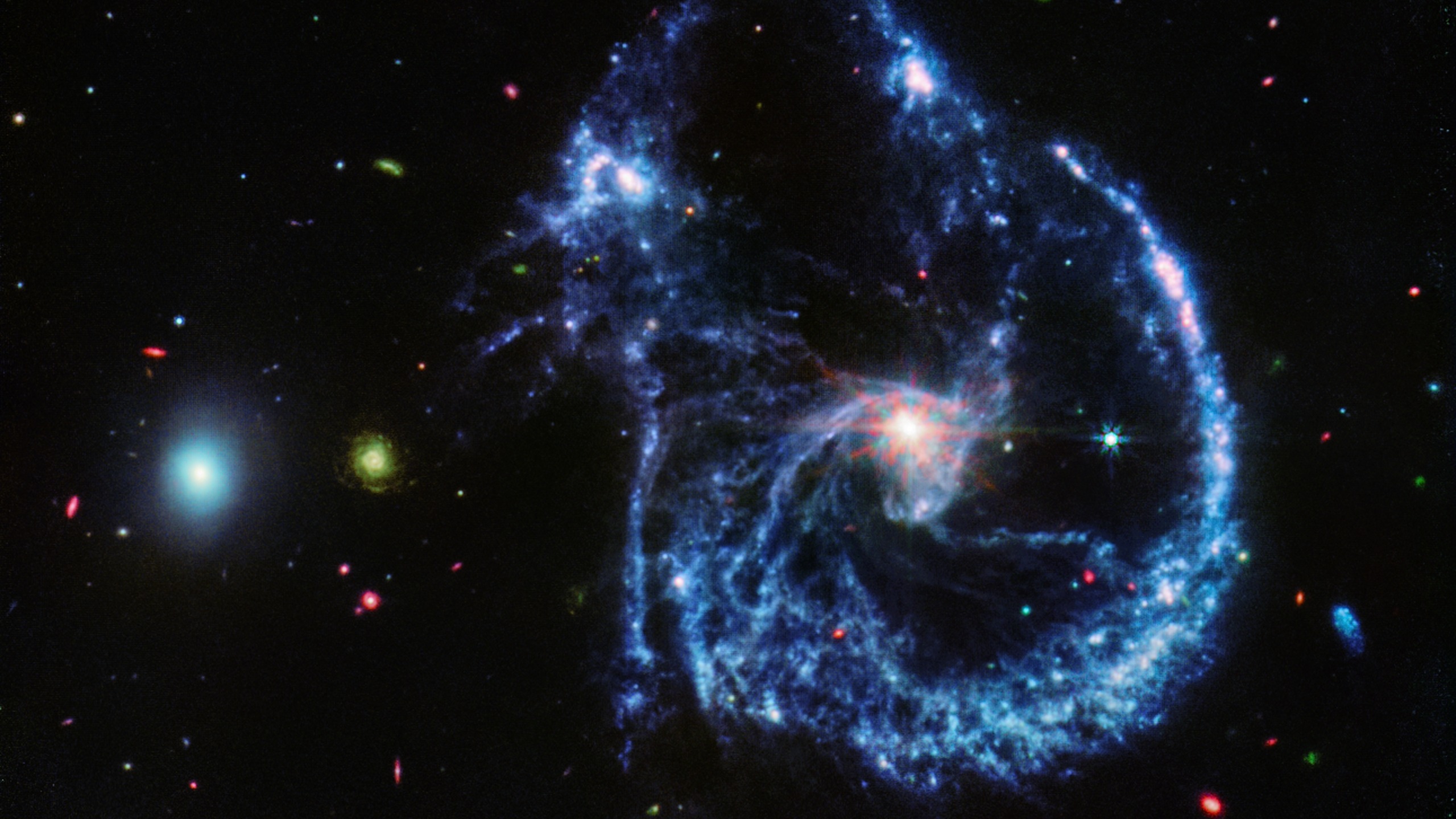
This image of Arp 107, shown by Webb’s MIRI (Mid-Infrared Instrument), reveals the supermassive black hole that lies in the center of the large spiral galaxy to the right. This black hole, which pulls much of the dust into lanes, also display’s Webb’s characteristic diffraction spikes, caused by the light that it emits interacting with the structure of the telescope itself. Perhaps the defining feature of the region, which MIRI reveals, are the millions of young stars that are forming, highlighted in blue. These stars are surrounded by dusty silicates and soot-like molecules known as polycyclic aromatic hydrocarbons. The small elliptical galaxy to the left, which has already gone through much of its star formation, is composed of many of these organic molecules.
36.7k downloads
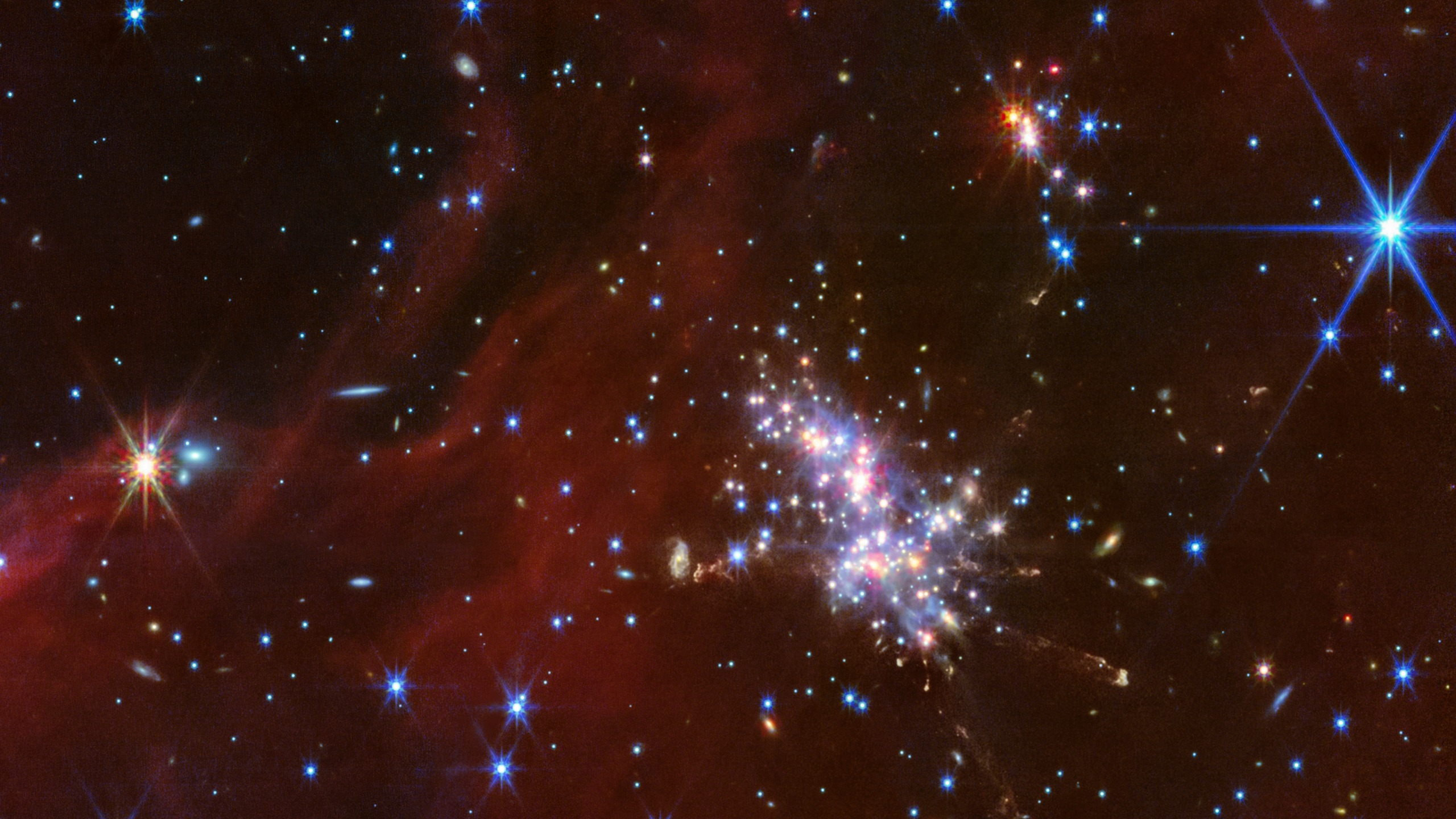
NASA’s James Webb Space Telescope observed the outskirts of our Milky Way galaxy. Known as the Extreme Outer Galaxy, this region is located more than 58,000 light-years from the Galactic Center. To learn more about how a local environment affects the star formation process within it, a team of scientists directed the telescope’s NIRCam (Near-Infrared Camera) and MIRI (Mid-Infrared Instrument) toward a total of four star-forming areas within Digel Clouds 1 and 2: 1A, 1B, 2N, and 2S. In the case of Cloud 2S, shown here, Webb revealed a luminous main cluster that contains newly formed stars. Several of these young stars are emitting extended jets of material from their poles. To the main cluster’s top right is a sub-cluster of stars, a feature that scientists previously suspected to exist but has now been confirmed with Webb. Additionally, the telescope revealed a deep sea of background galaxies and red nebulous structures that are being carved away by winds and radiation from nearby stars.
26.5k downloads
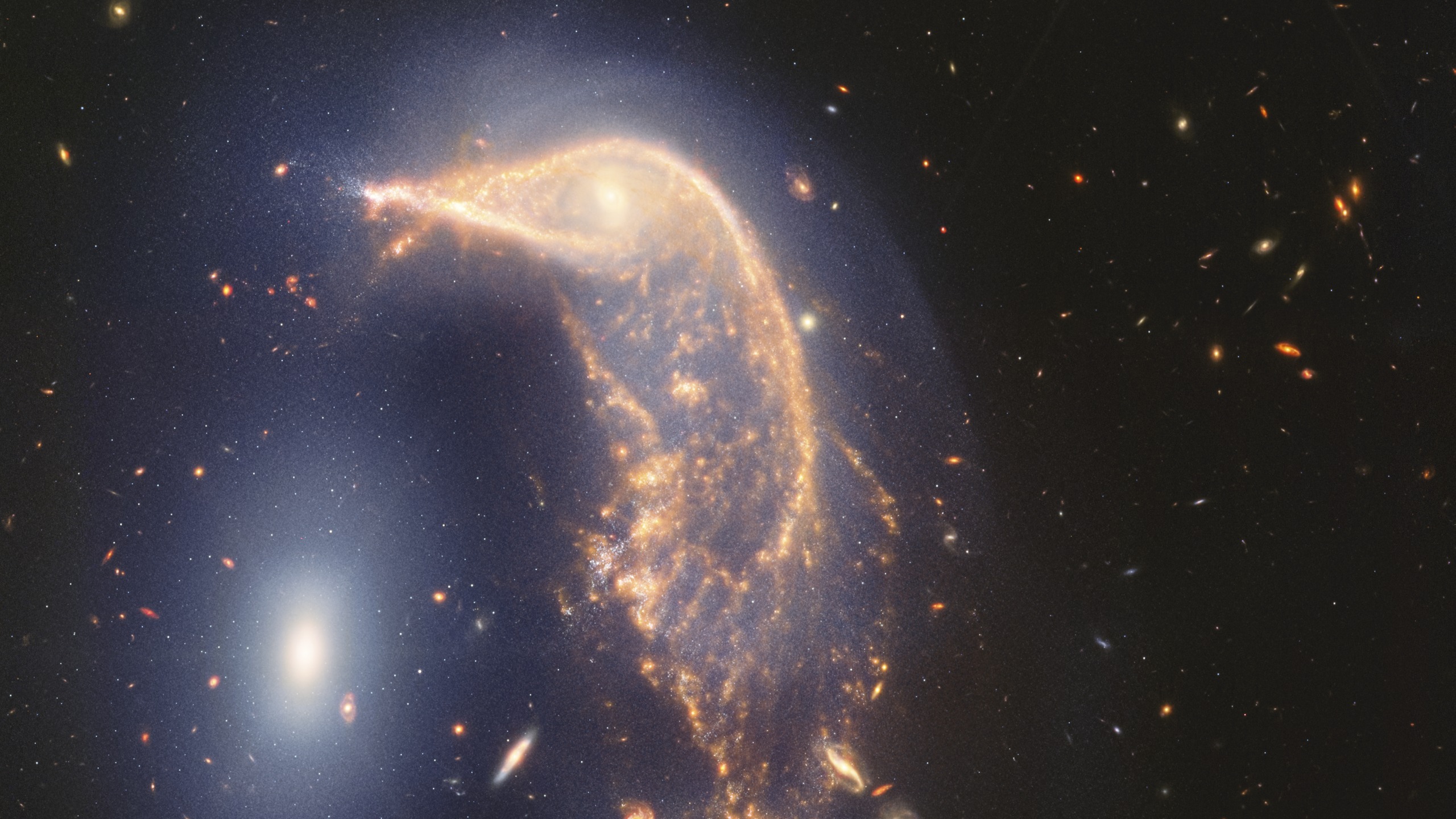
This “penguin party” is loud! The distorted spiral galaxy at center, the Penguin, and the compact elliptical galaxy at left, the Egg, are locked in an active embrace. A new near- and mid-infrared image from the James Webb Space Telescope, taken to mark its second year of science, shows that their interaction is marked by a faint upside-down U-shaped blue glow. The pair, known jointly as Arp 142, made their first pass between 25 and 75 million years ago — causing “fireworks,” or new star formation, in the Penguin. In the most extreme cases, mergers can cause galaxies to form thousands of new stars per year, for a few million years. For the Penguin, research has shown that about 100 to 200 stars have formed per year. By comparison, our Milky Way galaxy (which is not interacting with a galaxy of the same size) forms roughly six to seven new stars per year. This gravitational shimmy also remade the Penguin’s appearance. Its coiled spiral arms unwound, and gas and dust were pulled in an array of directions, like it was releasing confetti. It is rare for individual stars to collide when galaxies interact (space is vast), but galaxies’ mingling disrupts stars’ orbits. Today, the Penguin’s galactic center looks like an eye set within a head, and the galaxy has prominent star trails that take the shape of a beak, backbone, and fanned-out tail. A faint, but prominent dust lane extends from its beak down to its tail. Despite the Penguin appearing far larger than the Egg, these galaxies have approximately the same mass. This is one reason why the smaller-looking Egg hasn’t yet merged with the Penguin. (If one was less massive, it may have merged earlier.) The oval Egg is filled with old stars, and little gas and dust, which is why it isn’t sending out “streamers” or tidal tails of its own and instead has maintained a compact oval shape. If you look closely, the Egg has four prominent diffraction spikes — the galaxy’s stars are so concentrated that it gleams. Now, find the bright, edge-on galaxy at top right. It may look like a party crasher, but it’s not nearby. Cataloged PGC 1237172, it lies 100 million light-years closer to Earth. It is relatively young and isn’t overflowing with dust, which is why it practically disappears in Webb’s mid-infrared view. The background of this image is overflowing with far more distant galaxies. This is a testament to the sensitivity and resolution of Webb’s infrared cameras. Additional images of Arp 142 are available at left, under the Download Options, including a cropped image (like the one above) that features only near-infrared light, and a wider near-infrared field of view, which features an even greater number of distant galaxies. Arp 142 lies 326 million light-years from Earth in the constellation Hydra. Extended Description and Image Alt Text
36.8k downloads
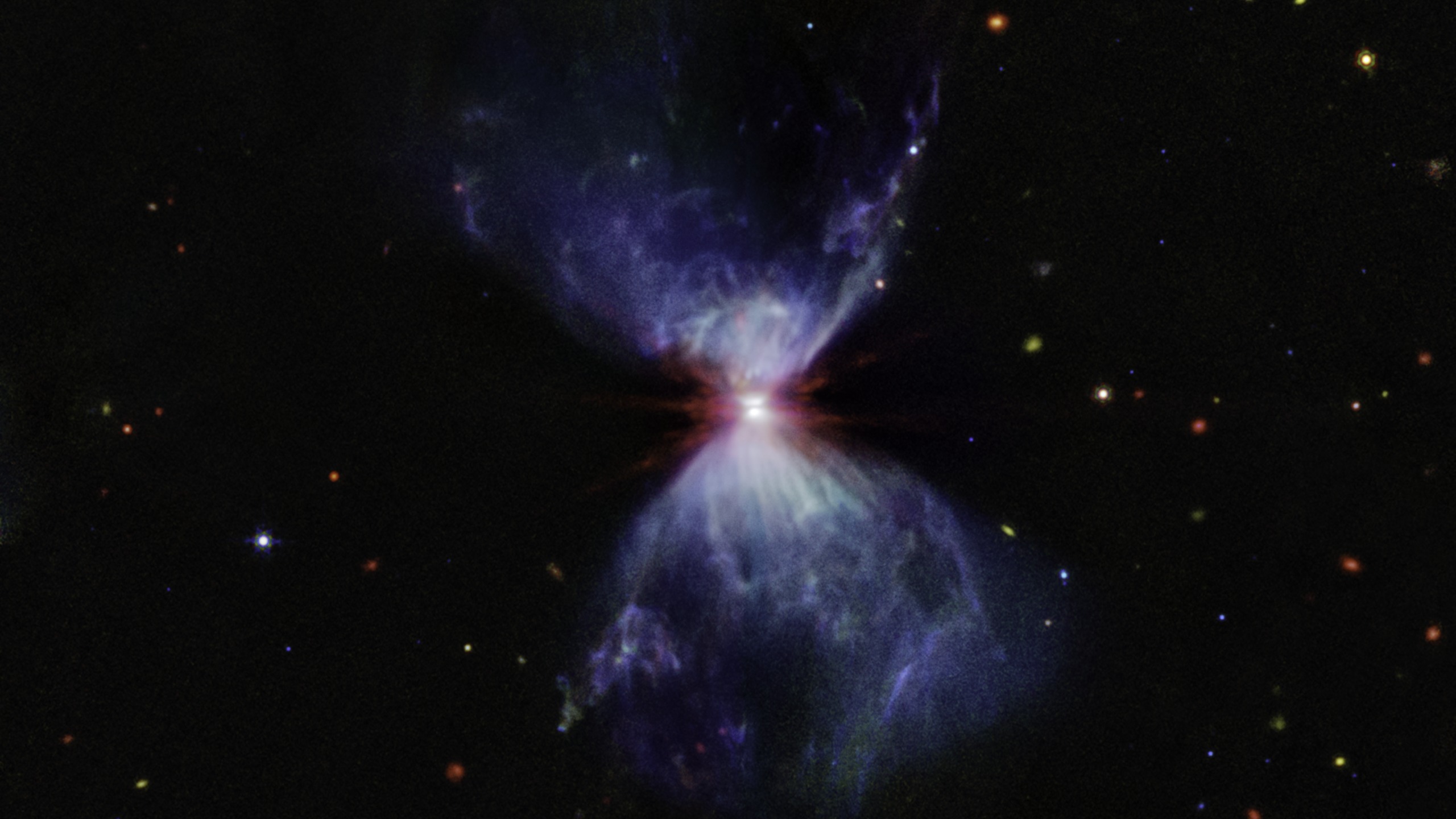
L1527, shown in this image from NASA’s James Webb Space Telescope’s MIRI (Mid-Infrared Instrument), is a molecular cloud that harbors a protostar. It resides about 460 light-years from Earth in the constellation Taurus. The more diffuse blue light and the filamentary structures in the image come from organic compounds known as polycyclic aromatic hydrocarbons (PAHs), while the red at the center of this image is an energized, thick layer of gases and dust that surrounds the protostar. The region in between, which shows up in white, is a mixture of PAHs, ionized gas, and other molecules. This image includes filters representing 7.7 microns light as blue, 12.8 microns light as green, and 18 microns light as red.
831 downloads
![Serpens Nebula, HBC 672, [EC 92] 82](https://pub-cec02c1cd1fa469cb88cc3510c091268.r2.dev/wallpapers/serpens-nebula/serpens-nebula-2560x1440.jpg)
In this image of the Serpens Nebula from the Near-Infrared Camera (NIRCam) on NASA’s James Webb Space Telescope, astronomers found a grouping of aligned protostellar outflows within one small region (the top left corner). In the Webb image, these jets are signified by bright clumpy streaks that appear red, which are shockwaves from the jet hitting surrounding gas and dust. The Serpens Nebula, located 1,300 light-years from Earth, is home to a particularly dense cluster of newly forming stars (~100,000 years old), some of which will eventually grow to the mass of our Sun. This region has been home to other coincidental discoveries, including the flapping “Bat Shadow,” which earned its name when 2020 data from NASA’s Hubble Space Telescope revealed a shadow from a star’s planet-forming disk to flap, or shift. This feature is visible at the center of the Webb image. To the right of the “Bat Shadow” lies another intriguing feature—an eye-shaped crevice, which appears as if a star is bursting through. However, astronomers say looks may be deceiving here. This could just be gases of different densities layered on top of one another, similar to what is seen in the famous Pillars of Creation. And to the right of that, an extremely dark patch could be a similar occurrence. This gas and dust are so dense in comparison to the rest of the region, no near-infrared light is getting through.
30.3k downloads
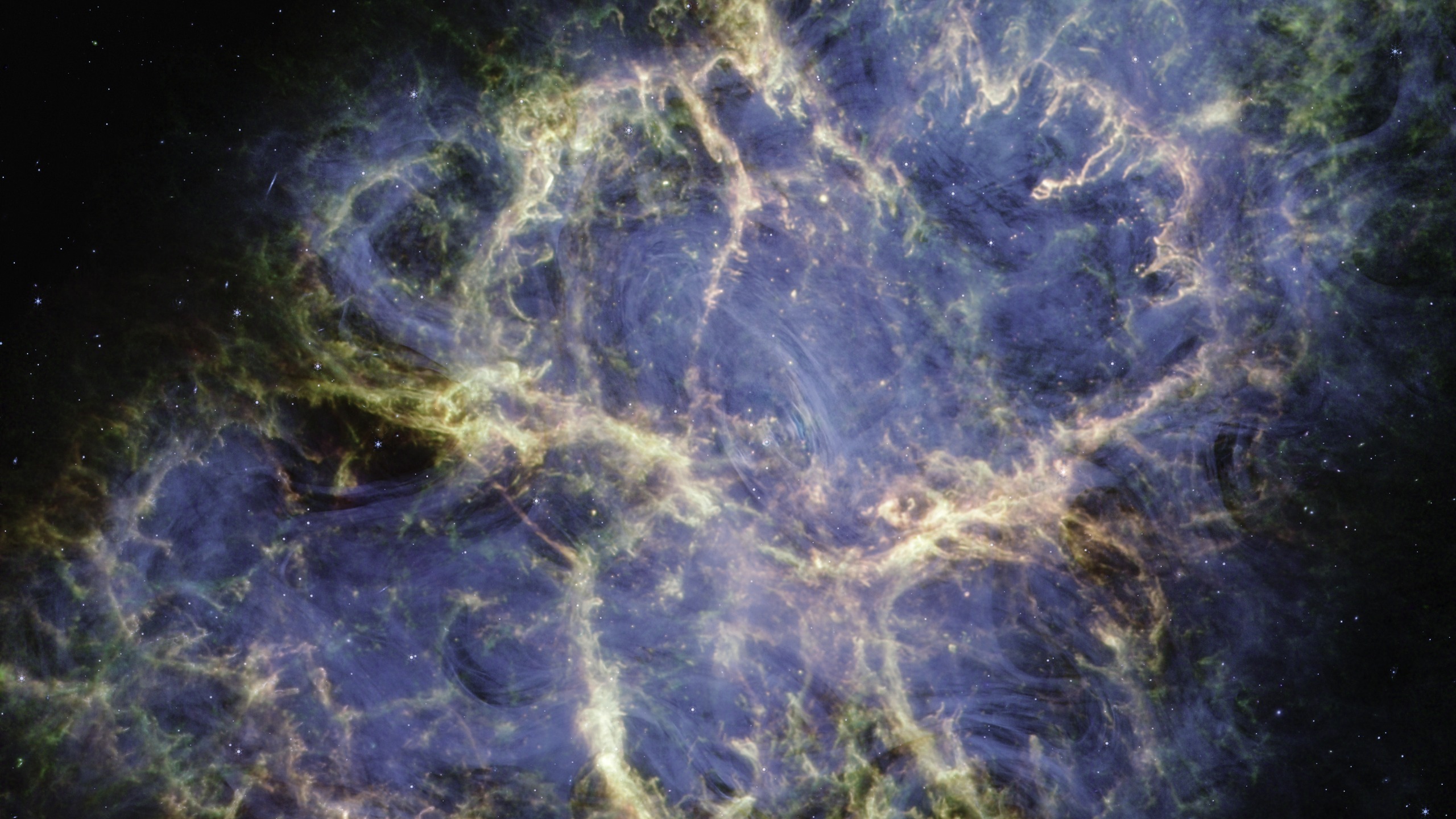
NASA’s James Webb Space Telescope dissected the Crab Nebula’s structure, aiding astronomers as they continue to evaluate leading theories about the supernova remnant’s origins. With the data collected by Webb’s NIRCam (Near-Infrared Camera) and MIRI (Mid-Infrared Instrument), a team of scientists were able to closely inspect some of the Crab Nebula’s major components. For the first time ever, astronomers mapped the warm dust emission throughout this supernova remnant. Represented as fluffy magenta material, the dust grains form a cage-like structure that is most apparent toward the lower left and upper right portions of the remnant. Filaments of dust are also threaded throughout the Crab’s interior and sometimes coincide with regions of doubly ionized sulfur (sulfur III) colored in green. Yellow-white mottled filaments, which form large loop-like structures around the supernova remnant’s center, represent areas where dust and doubly ionized sulfur overlap. The dust’s cage-like structure helps constrain some, but not all of the ghostly synchrotron emission represented in blue. The emission resembles wisps of smoke, most notable toward the Crab’s center. The thin blue ribbons follow the magnetic field lines created by the Crab’s pulsar heart — a rapidly rotating neutron star.
13.1k downloads