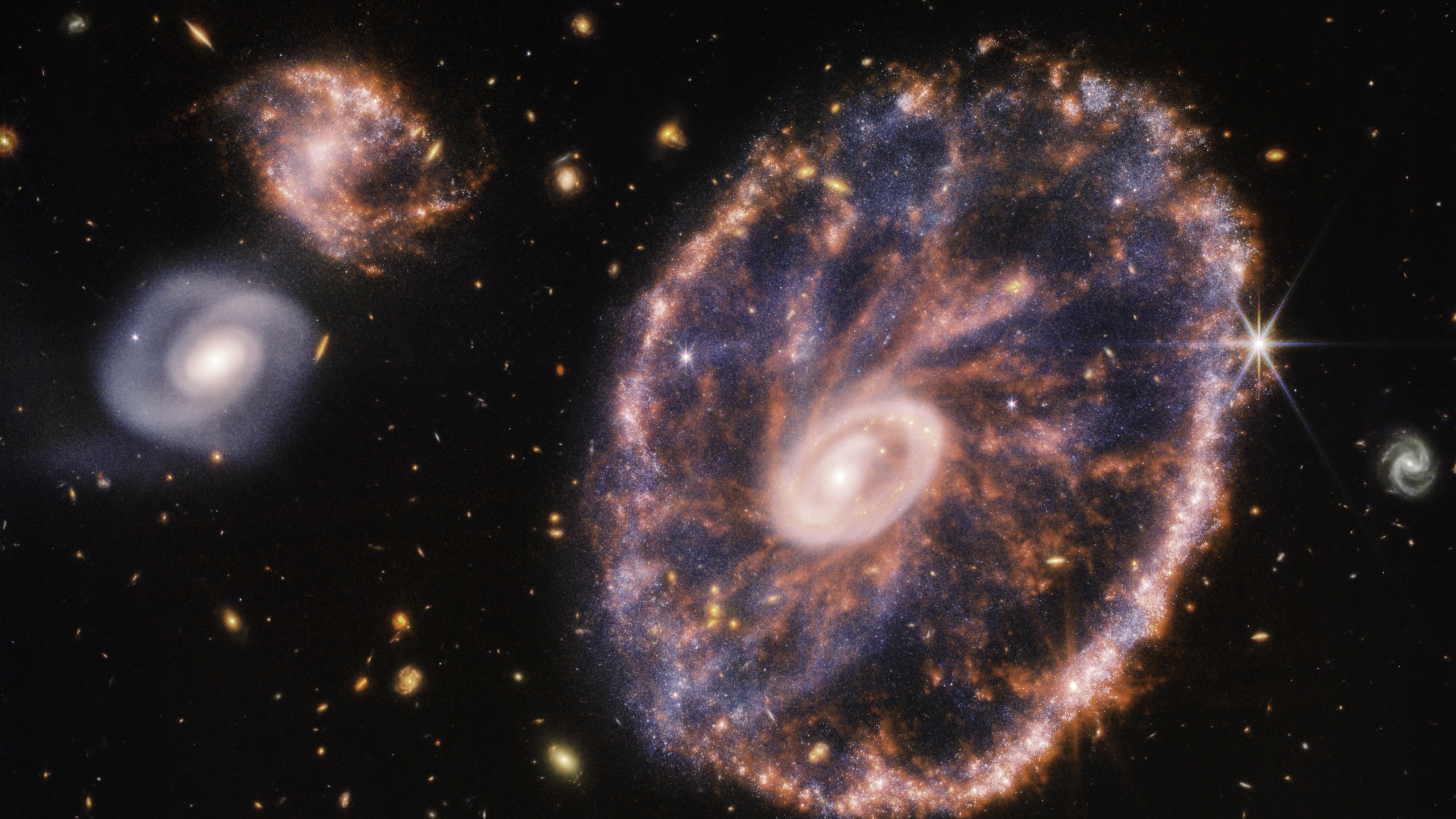
This image of the Cartwheel and its companion galaxies is a composite from Webb’s Near-Infrared Camera (NIRCam) and Mid-Infrared Instrument (MIRI), which reveals details that are difficult to see in the individual images alone. This galaxy formed as the result of a high-speed collision that occurred about 400 million years ago.
The Cartwheel is composed of two rings, a bright inner ring and a colorful outer ring. Both rings expand outward from the center of the collision like shockwaves.
However, despite the impact, much of the character of the large, spiral galaxy that existed before the collision remains, including its rotating arms. This leads to the “spokes” that inspired the name of the Cartwheel Galaxy, which are the bright red streaks seen between the inner and outer rings.
These brilliant red hues, located not only throughout the Cartwheel, but also the companion spiral galaxy at the top left, are caused by glowing, hydrocarbon-rich dust. In this near- and mid-infrared composite image, MIRI data are colored red while NIRCam data are colored blue, orange, and yellow.
Amidst the red swirls of dust, there are many individual blue dots, which represent individual stars or pockets of star formation. NIRCam also defines the difference between the older star populations and dense dust in the core and the younger star populations outside of it.
Webb’s observations capture the Cartwheel in a very transitory stage. The form that the Cartwheel Galaxy will eventually take, given these two competing forces, is still a mystery.
However, this snapshot provides perspective on what happened to the galaxy in the past and what it will do in the future. NIRCam was built by a team at the University of Arizona and Lockheed Martin’s Advanced Technology Center.
MIRI was contributed by ESA and NASA, with the instrument designed and built by a consortium of nationally funded European Institutes (The MIRI European Consortium) in partnership with JPL and the University of Arizona.
Image Credit:NASA, ESA, CSA, STScI, Webb ERO Production Team
About the Object
- R.A. Position
- 00:37:41.09
- Dec. Position
- -33:42:59.0
- Constellation
- Sculptor
- Distance
- 500 million light-years (150 Mpc)
- Dimensions
- Image is 2.34 arcmin across (about 340,000 light-years)
Choose your device
Desktop (5)▾
iPhone (5)▾
Android (5)▾
Special (1)▾
Handheld (1)▾
Motorola (1)▾
More galaxy wallpapers
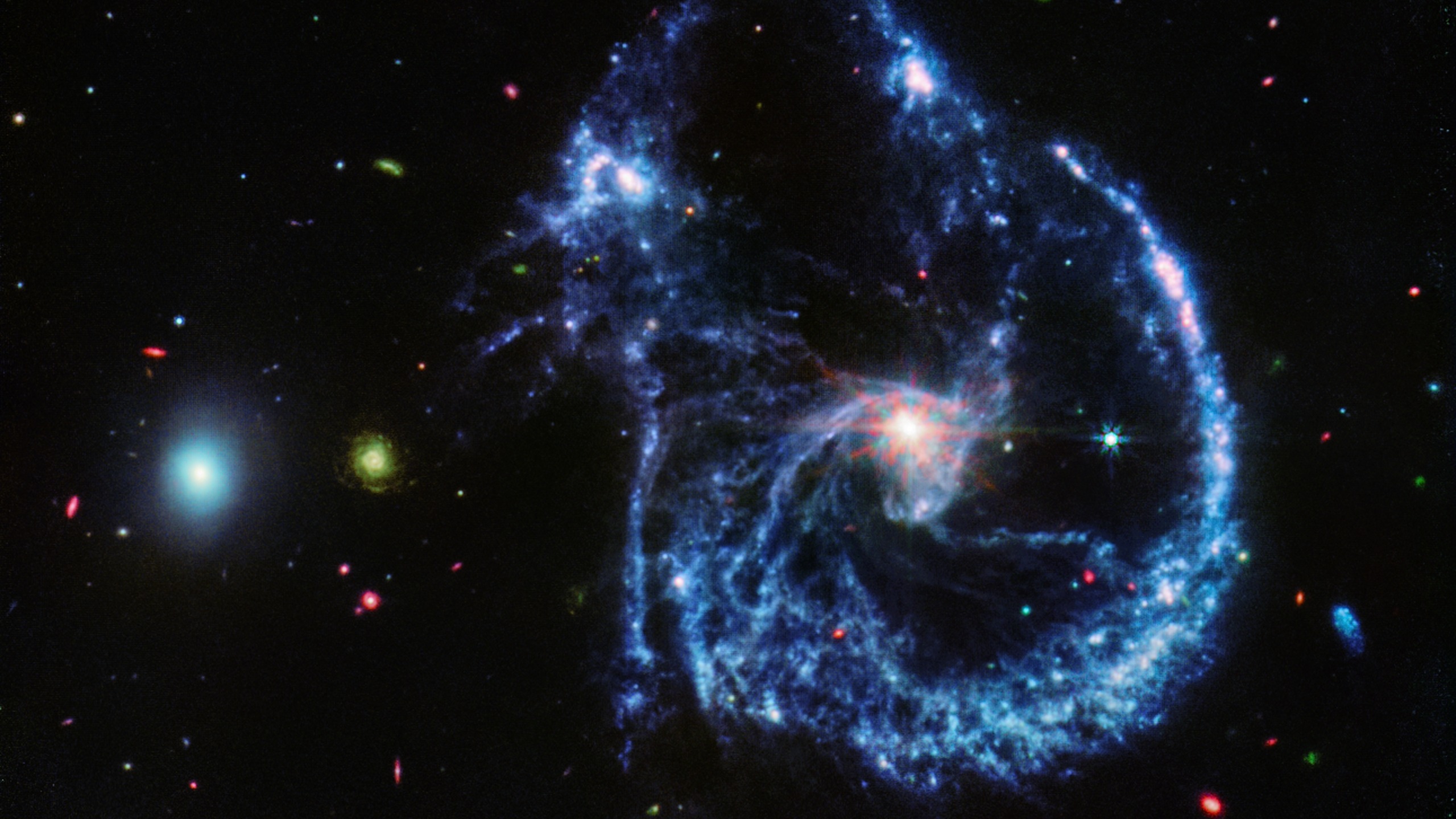
This image of Arp 107, shown by Webb’s MIRI (Mid-Infrared Instrument), reveals the supermassive black hole that lies in the center of the large spiral galaxy to the right. This black hole, which pulls much of the dust into lanes, also display’s Webb’s characteristic diffraction spikes, caused by the light that it emits interacting with the structure of the telescope itself. Perhaps the defining feature of the region, which MIRI reveals, are the millions of young stars that are forming, highlighted in blue. These stars are surrounded by dusty silicates and soot-like molecules known as polycyclic aromatic hydrocarbons. The small elliptical galaxy to the left, which has already gone through much of its star formation, is composed of many of these organic molecules.
36.7k downloads
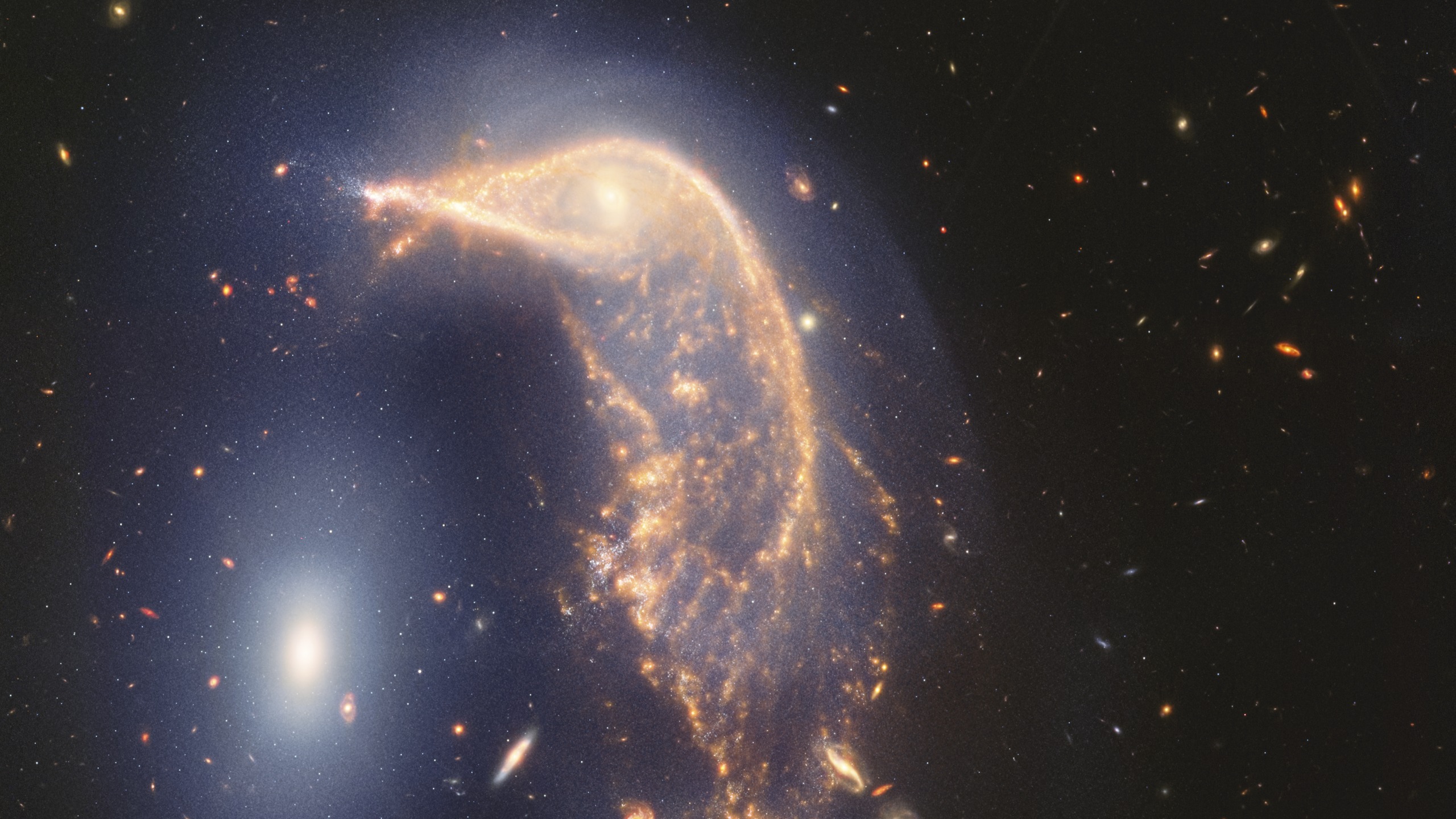
This “penguin party” is loud! The distorted spiral galaxy at center, the Penguin, and the compact elliptical galaxy at left, the Egg, are locked in an active embrace. A new near- and mid-infrared image from the James Webb Space Telescope, taken to mark its second year of science, shows that their interaction is marked by a faint upside-down U-shaped blue glow. The pair, known jointly as Arp 142, made their first pass between 25 and 75 million years ago — causing “fireworks,” or new star formation, in the Penguin. In the most extreme cases, mergers can cause galaxies to form thousands of new stars per year, for a few million years. For the Penguin, research has shown that about 100 to 200 stars have formed per year. By comparison, our Milky Way galaxy (which is not interacting with a galaxy of the same size) forms roughly six to seven new stars per year. This gravitational shimmy also remade the Penguin’s appearance. Its coiled spiral arms unwound, and gas and dust were pulled in an array of directions, like it was releasing confetti. It is rare for individual stars to collide when galaxies interact (space is vast), but galaxies’ mingling disrupts stars’ orbits. Today, the Penguin’s galactic center looks like an eye set within a head, and the galaxy has prominent star trails that take the shape of a beak, backbone, and fanned-out tail. A faint, but prominent dust lane extends from its beak down to its tail. Despite the Penguin appearing far larger than the Egg, these galaxies have approximately the same mass. This is one reason why the smaller-looking Egg hasn’t yet merged with the Penguin. (If one was less massive, it may have merged earlier.) The oval Egg is filled with old stars, and little gas and dust, which is why it isn’t sending out “streamers” or tidal tails of its own and instead has maintained a compact oval shape. If you look closely, the Egg has four prominent diffraction spikes — the galaxy’s stars are so concentrated that it gleams. Now, find the bright, edge-on galaxy at top right. It may look like a party crasher, but it’s not nearby. Cataloged PGC 1237172, it lies 100 million light-years closer to Earth. It is relatively young and isn’t overflowing with dust, which is why it practically disappears in Webb’s mid-infrared view. The background of this image is overflowing with far more distant galaxies. This is a testament to the sensitivity and resolution of Webb’s infrared cameras. Additional images of Arp 142 are available at left, under the Download Options, including a cropped image (like the one above) that features only near-infrared light, and a wider near-infrared field of view, which features an even greater number of distant galaxies. Arp 142 lies 326 million light-years from Earth in the constellation Hydra. Extended Description and Image Alt Text
36.8k downloads
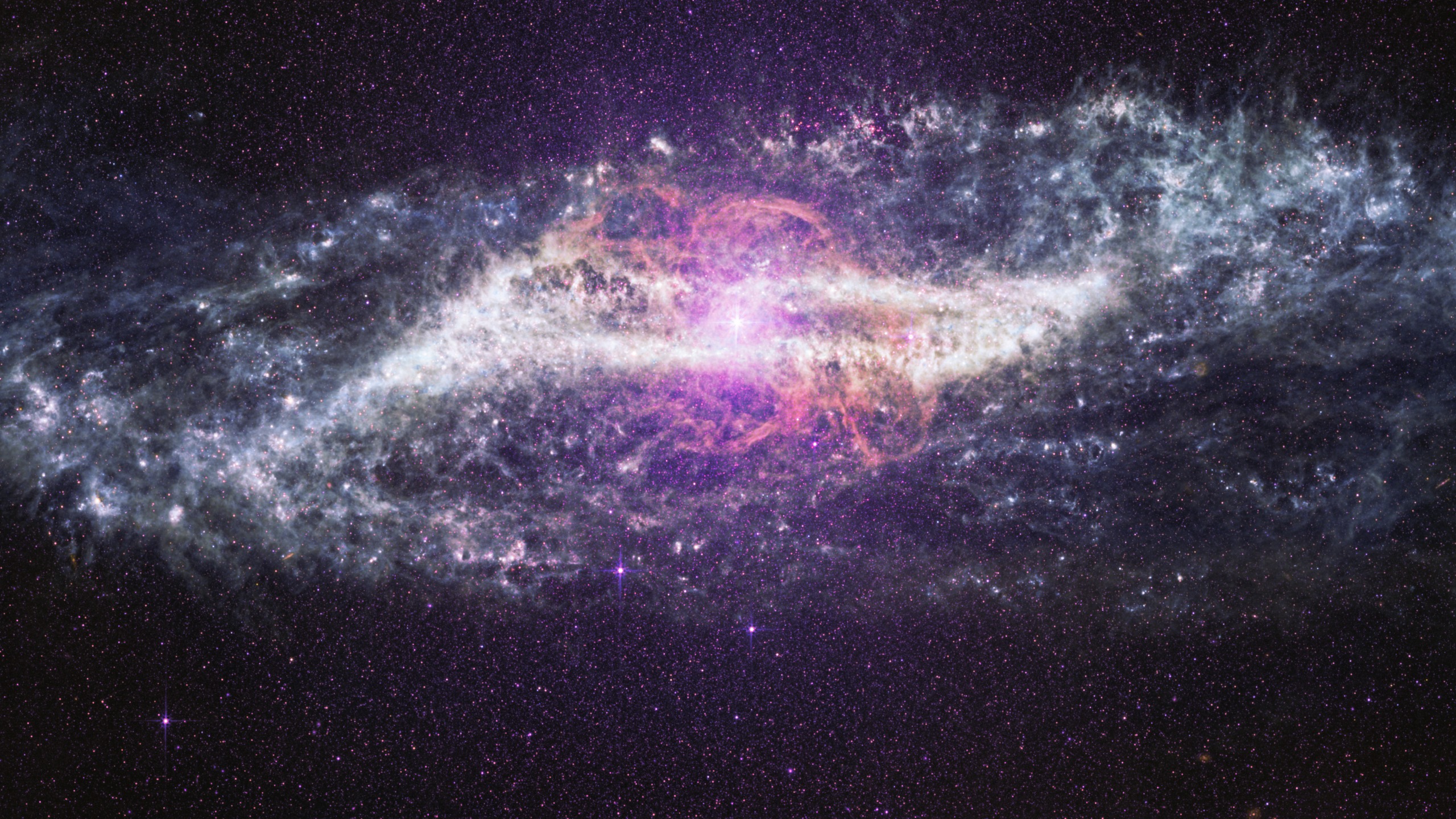
NASA’s James Webb Space Telescope’s Mid-Infrared Instrument (MIRI) reveals the nearby galaxy Centaurus A, exposing the dusty structures and hidden activity that shape this unusual system. Webb’s infrared vision unveils intricate filaments, loops, and glowing clouds of warm dust stretching across its center. At the heart of the galaxy, an actively feeding supermassive black hole shines brightly, surrounded by complex structures sculpted by a past galactic collision and ongoing activity. Deeper Dive Explore tours and points of interest in the interactive map below.
27.3k downloads