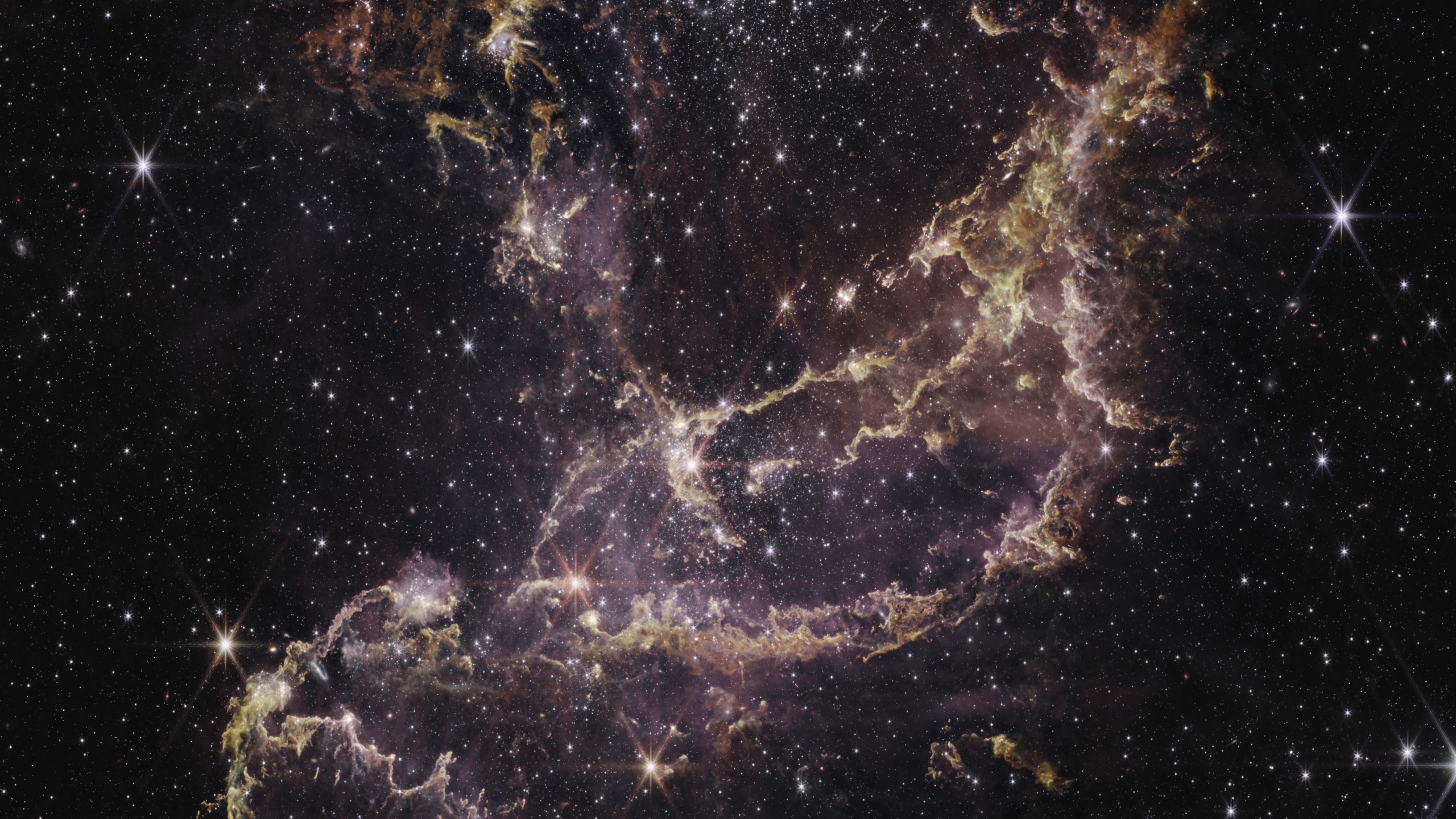
NGC 346, shown here in this image from NASA’s James Webb Space Telescope Near-Infrared Camera (NIRCam), is a dynamic star cluster that lies within a nebula 200,000 light years away. Webb reveals the presence of many more building blocks than previously expected, not only for stars, but also planets, in the form of clouds packed with dust and hydrogen.
The plumes and arcs of gas in this image contains two types of hydrogen. The pink gas represents energized hydrogen, which is typically as hot as around 10,000 °C (approximately 18,000 °F) or more, while the more orange gas represents dense, molecular hydrogen, which is much colder at around -200 °C (approximately -300 °F) or less, and associated dust.
The colder gas provides an excellent environment for stars to form, and, as they do, they change the environment around them. The effect of this is seen in the various ridges throughout, which are created as the light of these young stars breaks down the dense clouds.
The many pillars of glowing gas show the effects of this stellar erosion throughout the region.
Image Credit:NASA, ESA, CSA, Olivia Jones (UK ATC), Guido De Marchi (ESTEC), Margaret Meixner (USRA)
About the Object
- R.A. Position
- 00:59:04.95
- Dec. Position
- -72:10:09.15
- Constellation
- Tucana
- Distance
- 200,000 light-years away (61,300 parsecs)
- Dimensions
- This image is about 3.9 arcminutes across (240 light-years).
Choose your device
Desktop (5)▾
iPhone (5)▾
Android (5)▾
Special (1)▾
Handheld (1)▾
Motorola (1)▾
More star cluster wallpapers
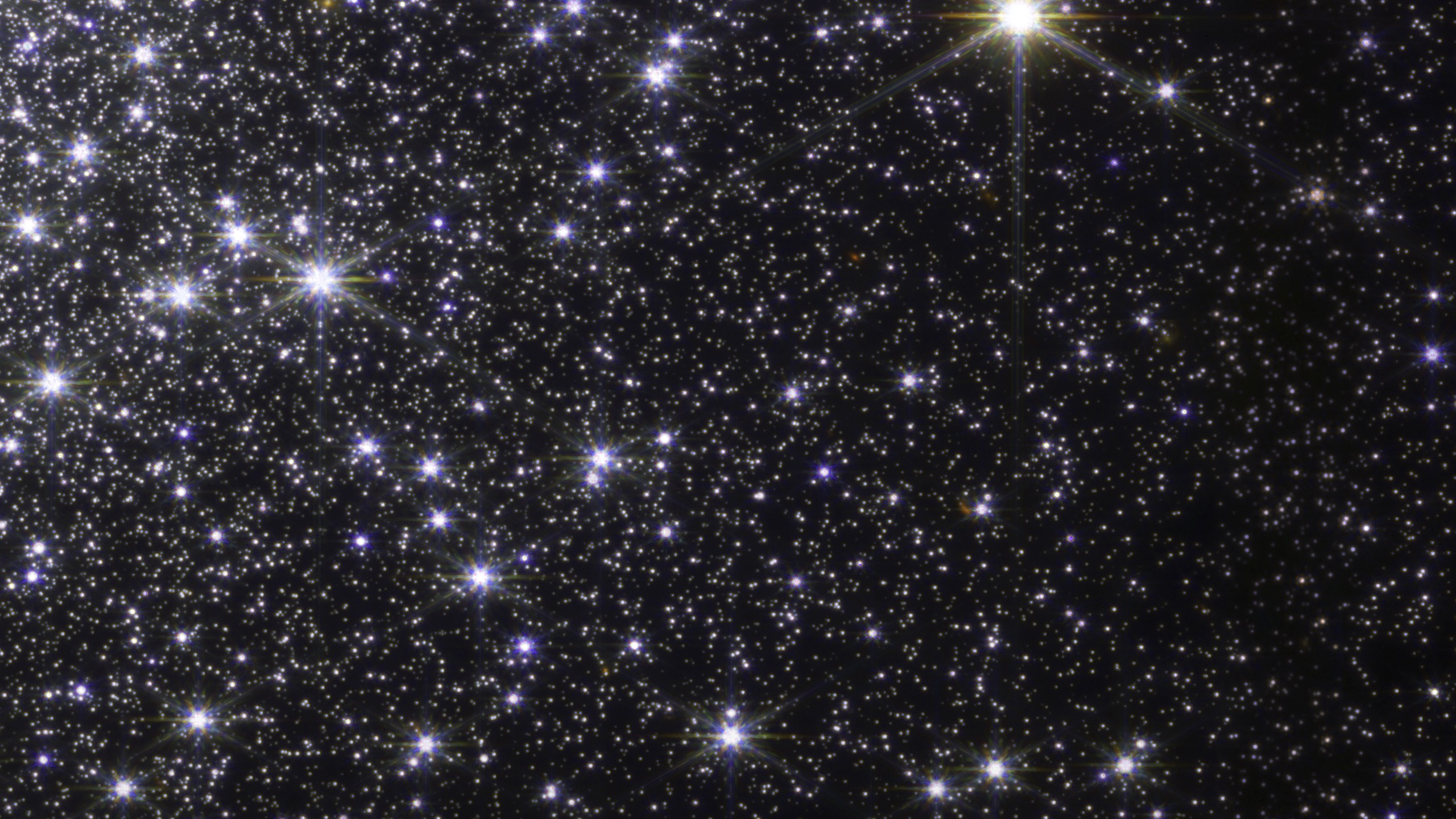
Detail of the globular cluster Messier 92 (M92) captured by Webb’s NIRCam instrument. This field of view covers the lower left quarter of the right half of the full image. Globular clusters are dense masses of tightly packed stars that all formed around the same time. In M92, there are about 300,000 stars packed into a ball about 100 light-years across. The night sky of a planet in the middle of M92 would shine with thousands of stars that appear thousands of times brighter than those in our own sky. The image shows stars at different distances from the center, which helps astronomers understand the motion of stars in the cluster, and the physics of that motion.
3.7k downloads