#Serpens
2 wallpapers tagged "Serpens"
![Serpens Nebula, HBC 672, [EC 92] 82](https://pub-cec02c1cd1fa469cb88cc3510c091268.r2.dev/wallpapers/serpens-nebula/serpens-nebula-2560x1440.jpg)
In this image of the Serpens Nebula from the Near-Infrared Camera (NIRCam) on NASA’s James Webb Space Telescope, astronomers found a grouping of aligned protostellar outflows within one small region (the top left corner). In the Webb image, these jets are signified by bright clumpy streaks that appear red, which are shockwaves from the jet hitting surrounding gas and dust. The Serpens Nebula, located 1,300 light-years from Earth, is home to a particularly dense cluster of newly forming stars (~100,000 years old), some of which will eventually grow to the mass of our Sun. This region has been home to other coincidental discoveries, including the flapping “Bat Shadow,” which earned its name when 2020 data from NASA’s Hubble Space Telescope revealed a shadow from a star’s planet-forming disk to flap, or shift. This feature is visible at the center of the Webb image. To the right of the “Bat Shadow” lies another intriguing feature—an eye-shaped crevice, which appears as if a star is bursting through. However, astronomers say looks may be deceiving here. This could just be gases of different densities layered on top of one another, similar to what is seen in the famous Pillars of Creation. And to the right of that, an extremely dark patch could be a similar occurrence. This gas and dust are so dense in comparison to the rest of the region, no near-infrared light is getting through.
30.3k downloads
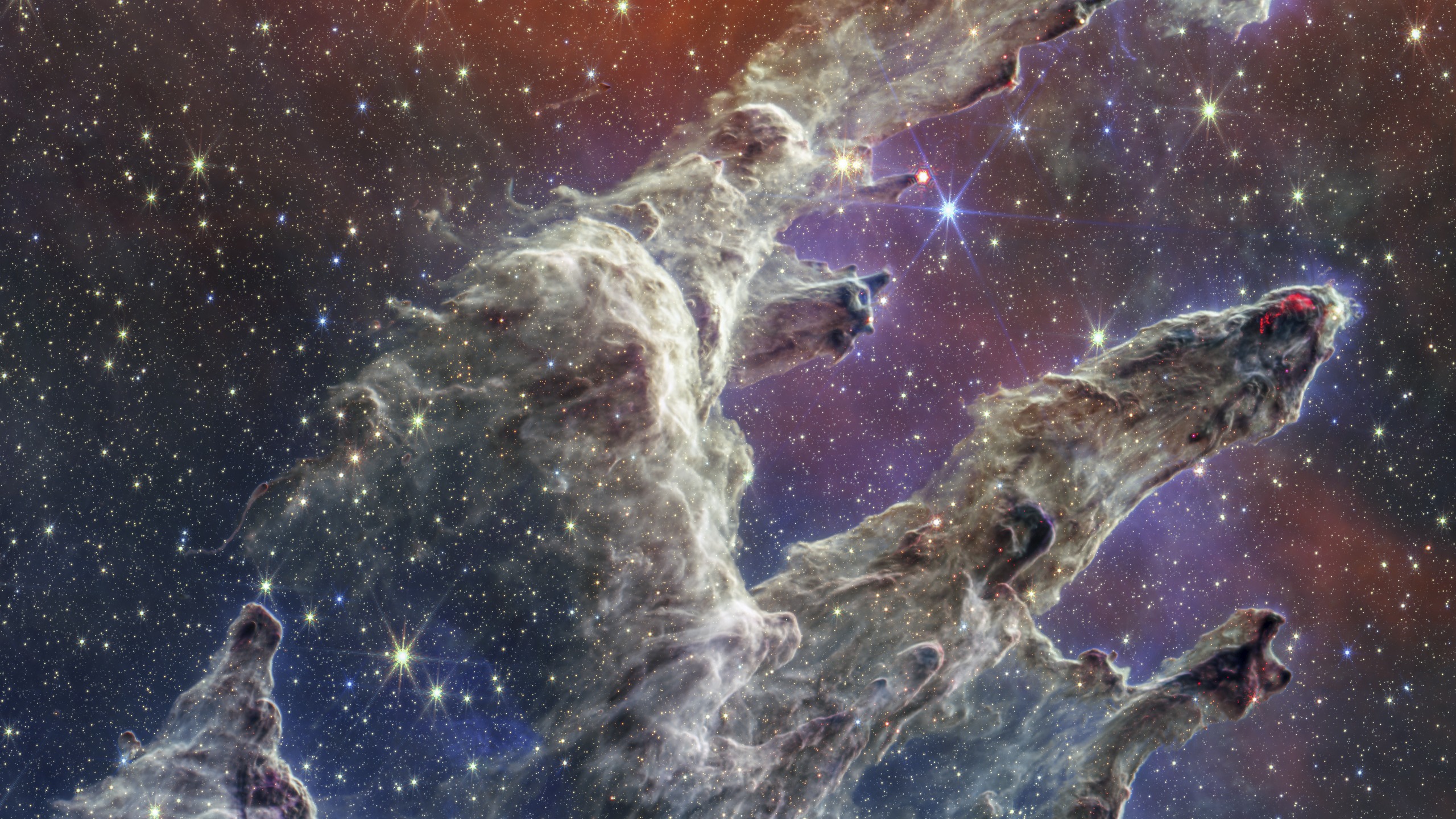
By combining images of the iconic Pillars of Creation from two cameras aboard NASA’s James Webb Space Telescope, the universe has been framed in its infrared glory. Webb’s near-infrared image was fused with its mid-infrared image, setting this star-forming region ablaze with new details. Myriad stars are spread throughout the scene. The stars primarily show up in near-infrared light, marking a contribution of Webb’s Near-Infrared Camera (NIRCam). Near-infrared light also reveals thousands of newly formed stars – look for bright orange spheres that lie just outside the dusty pillars. In mid-infrared light, the dust is on full display. The contributions from Webb’s Mid-Infrared Instrument (MIRI) are most apparent in the layers of diffuse, orange dust that drape the top of the image, relaxing into a V. The densest regions of dust are cast in deep indigo hues, obscuring our view of the activities inside the dense pillars. Dust also makes up the spire-like pillars that extend from the bottom left to the top right. This is one of the reasons why the region is overflowing with stars – dust is a major ingredient of star formation. When knots of gas and dust with sufficient mass form in the pillars, they begin to collapse under their own gravitational attraction, slowly heat up, and eventually form new stars. Newly formed stars are especially apparent at the edges of the top two pillars – they are practically bursting onto the scene. At the top edge of the second pillar, undulating detail in red hints at even more embedded stars. These are even younger, and are quite active as they form. The lava-like regions capture their periodic ejections. As stars form, they periodically send out supersonic jets that can interact within clouds of material, like these thick pillars of gas and dust. These young stars are estimated to be only a few hundred thousand years old, and will continue to form for millions of years. Almost everything you see in this scene is local. The distant universe is largely blocked from our view both by the interstellar medium, which is made up of sparse gas and dust located between the stars, and a thick dust lane in our Milky Way galaxy. As a result, the stars take center stage in Webb’s view of the Pillars of Creation. The Pillars of Creation is a small region within the vast Eagle Nebula, which lies 6,500 light-years away. Revisit Webb’s near-infrared image and its mid-infrared image. The Pillars of Creation was made famous by the Hubble Space Telescope’s 1995 image. NIRCam was built by a team at the University of Arizona and Lockheed Martin’s Advanced Technology Center. MIRI was contributed by ESA and NASA, with the instrument designed and built by a consortium of nationally funded European Institutes (The MIRI European Consortium) in partnership with JPL and the University of Arizona.
20.4k downloads