CosmicRift
← Back to blog

How Do Infrared Telescopes Work?

July 11, 2026

How Do Infrared Telescopes Work?

Look up at the night sky and you’ll see stars as tiny points of light. That’s what your eyes can pick up. But there’s a whole other picture hiding right in front of you, invisible to human eyes. Infrared telescopes are how we see it.

The Basics

What is infrared light?

Light comes in more types than the kind we can see. Visible light (the reds, blues, and every color in between) is just one small slice of something bigger called the electromagnetic spectrum. Infrared light is a slice right next to it. It’s invisible to us, but it’s real, and it’s everywhere.

Here’s the easiest way to think about it: infrared light is basically heat. Anything warm gives it off: your body, a cup of coffee, a car engine, a star. The warmer something is, the more infrared light it gives off. Night-vision goggles work by picking up this heat and turning it into a picture you can see. An infrared telescope does the same thing, just pointed at space instead of a backyard.

How It Works

How do infrared telescopes work?

A regular telescope, like the kind you’d look through in your backyard, collects visible light (the same light your eyes already see) and makes it brighter and bigger. An infrared telescope collects infrared light instead, using special detectors that react to heat rather than color.

A lot of the universe’s most interesting stuff is hard to see in visible light. Thick clouds of cosmic dust block visible light almost completely, much like fog blocking your headlights. Infrared light slips through that same dust far more easily, though. So an infrared telescope can see straight into places a regular telescope struggles with, like the middle of a dust cloud where new stars are being born.
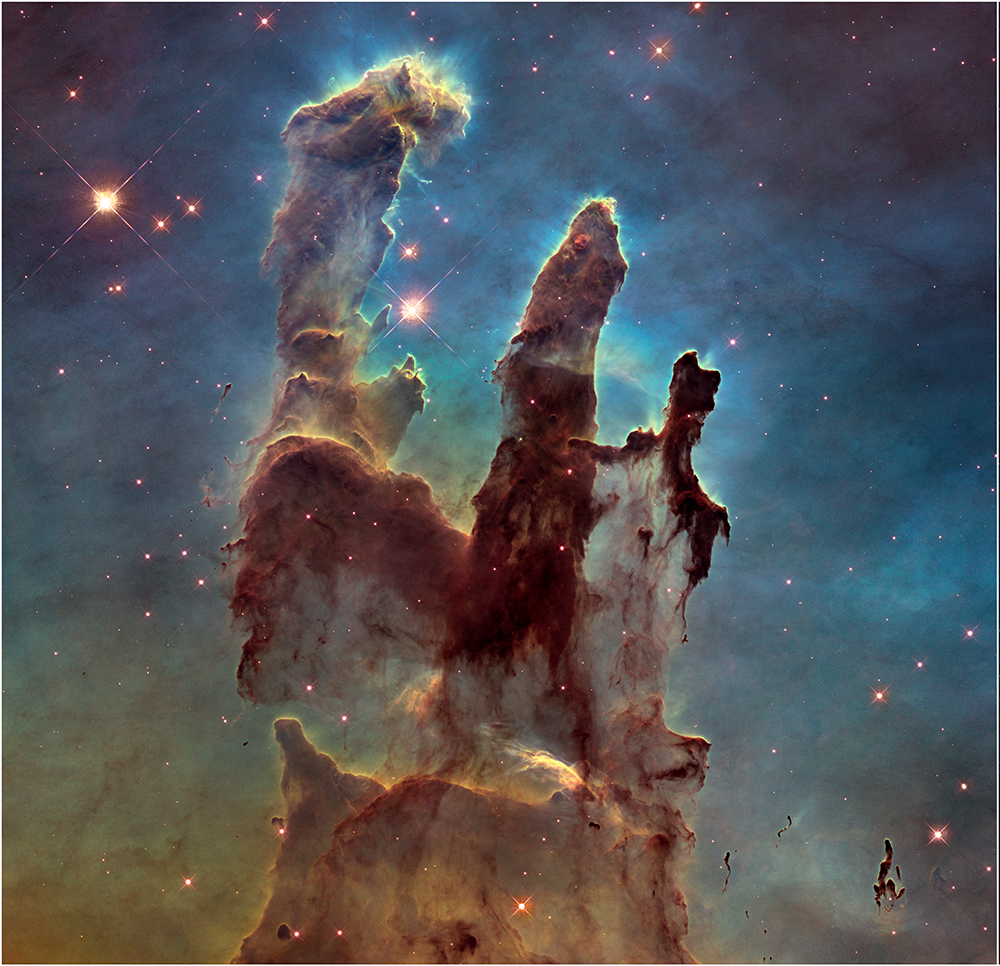
Visible Light The Pillars of Creation in visible light. The dust looks thick and mostly solid, hiding most of the stars inside it.
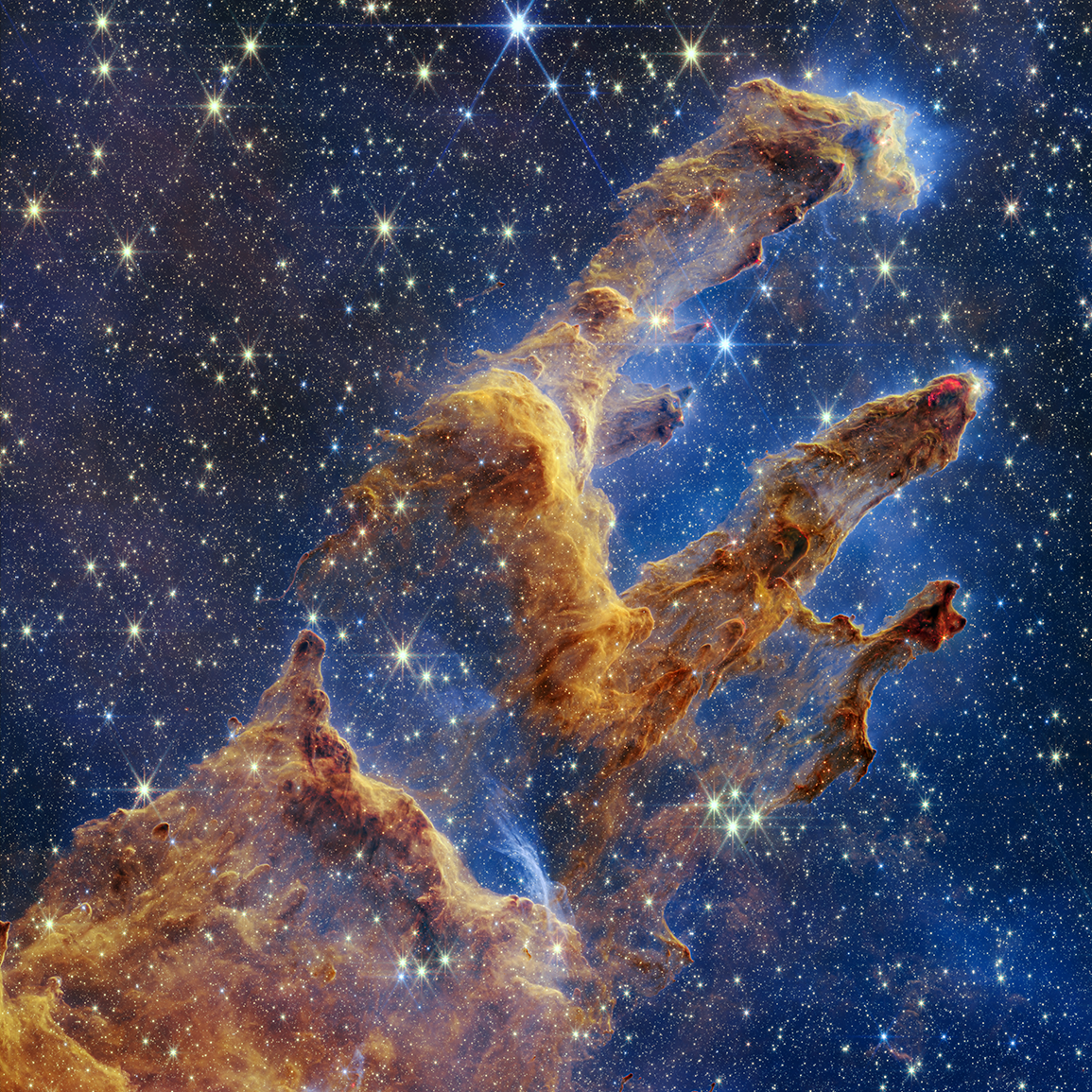
Infrared Light The Pillars of Creation in infrared light. The dust looks thinner and glows gold, and many more stars are visible shining through it.

There’s a catch, though. The telescope itself gives off heat, and so does everything around it, including Earth. An infrared telescope has to be kept extremely cold, or its own heat would completely drown out the faint infrared signals it’s trying to detect from space, the same way a bright flashlight makes it hard to see faint stars nearby. That’s why infrared telescopes are kept unbelievably cold, often colder than -370°F (-223°C).

Where They Live

Where are infrared telescopes located?

Some infrared telescopes sit on the ground, usually on top of tall, dry mountains where the air holds very little water vapor. Water vapor absorbs infrared light before it ever reaches the telescope. Mauna Kea in Hawaii is one popular spot for exactly this reason.

But the best place for an infrared telescope is space. It’s a vacuum, bone dry, and far from the heat radiating off any planet’s surface. The James Webb Space Telescope (JWST), the most powerful infrared telescope ever built, orbits about a million miles from Earth, far enough away to stay cold and clear.

Common Uses

What are infrared telescopes used for?

Infrared telescopes let astronomers do things visible light struggles with:

  • See through dust to watch new stars and planets forming inside clouds of gas.
  • Spot extremely distant galaxies. Light from the earliest galaxies has been stretched out by the universe’s expansion until it shifts into infrared. So if you want to see the oldest galaxies in the universe, infrared is the only way to do it.
  • Detect cooler objects, like planets, brown dwarfs, and cold dust, that are too dim to show up well in visible light but glow steadily in infrared.

Real-World Example

A real example: the James Webb Space Telescope

JWST is the clearest real-world example of everything above. Its giant golden mirror collects infrared light, its instruments are kept extremely cold, and it sits far from Earth in a stable orbit around a point called L2. The result is a telescope that can look straight through clouds of dust to show newborn stars, or look so far back in time that it’s seeing galaxies from close to the beginning of the universe.

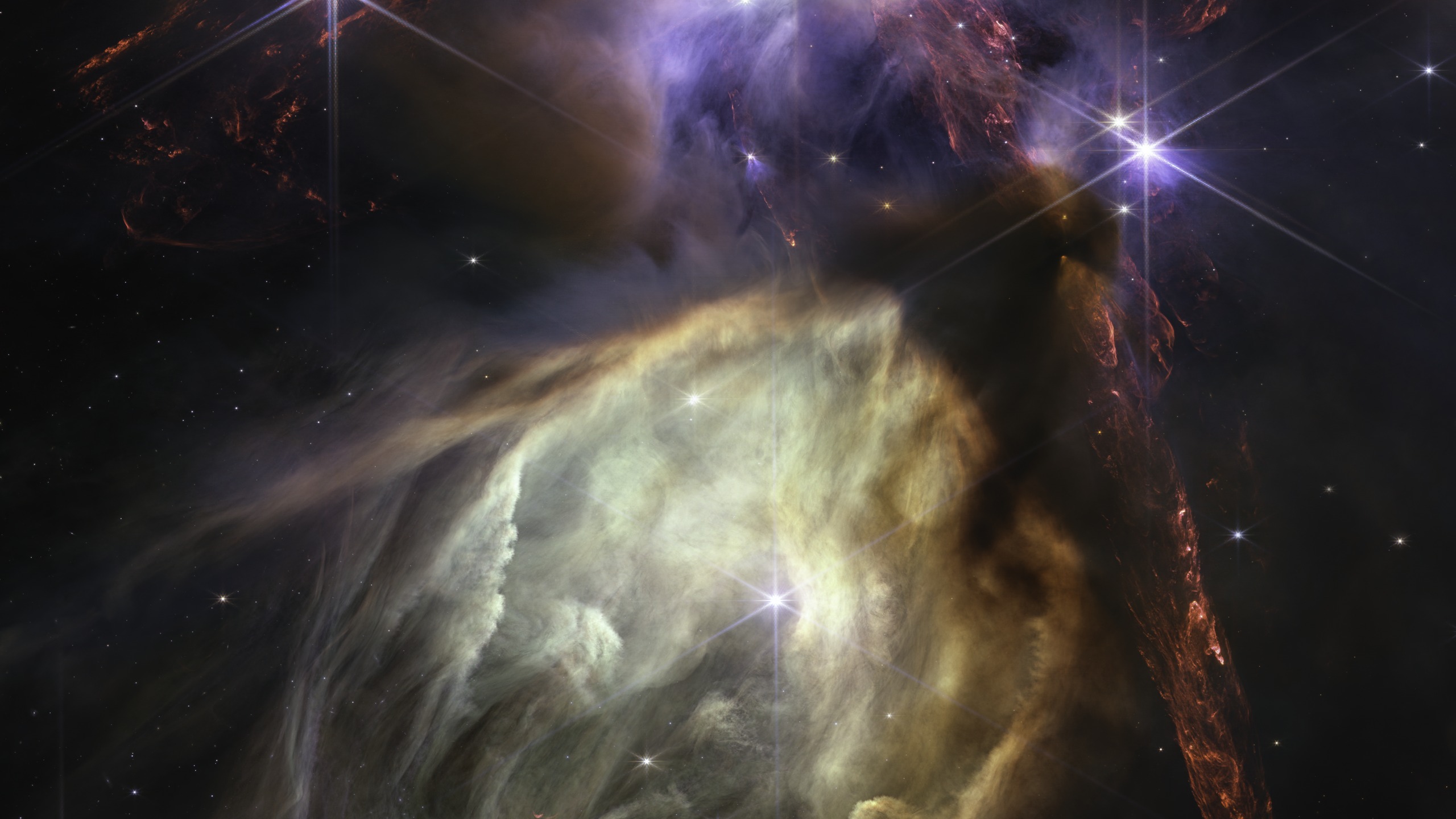
Below are a few real JWST images that show exactly what infrared light reveals. Each one is a place regular visible-light telescopes couldn’t see nearly as clearly.

Curious why these infrared images come out looking so colorful, since infrared light itself is invisible? That part of the story is explained in Why Are JWST Images So Colorful?

If any of these catch your eye, every image on CosmicRift is free to download, already sized for your phone, tablet, or desktop. Browse the full gallery to find more.
Wallpapers from this post

Pillars of Creation, M16, Eagle Nebula
More info

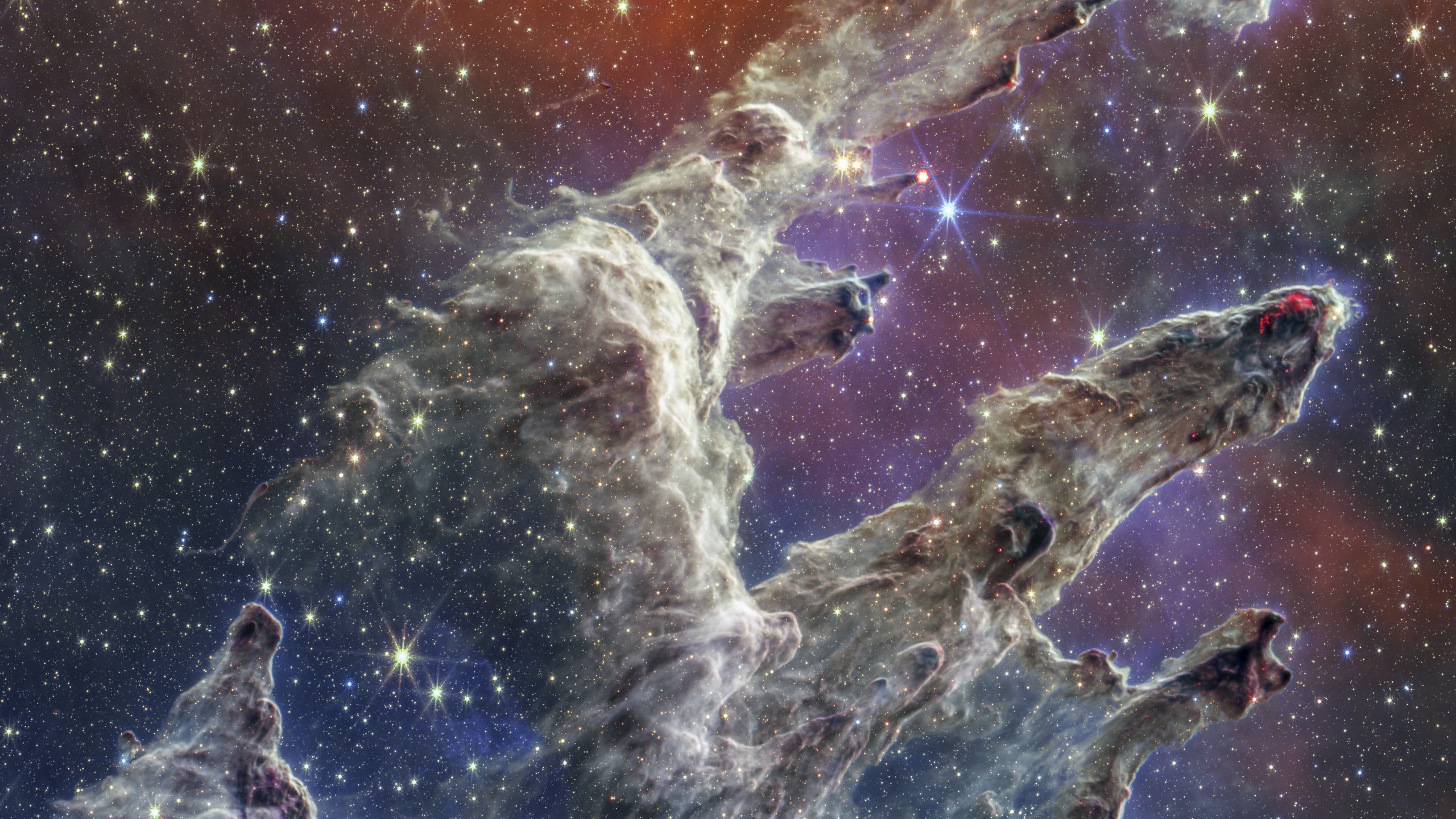
By combining images of the iconic Pillars of Creation from two cameras aboard NASA’s James Webb Space Telescope, the universe has been framed in its infrared glory. Webb’s near-infrared image was fused with its mid-infrared image, setting this star-forming region ablaze with new details. Myriad stars are spread throughout the scene. The stars primarily show up in near-infrared light, marking a contribution of Webb’s Near-Infrared Camera (NIRCam). Near-infrared light also reveals thousands of newly formed stars – look for bright orange spheres that lie just outside the dusty pillars. In mid-infrared light, the dust is on full display. The contributions from Webb’s Mid-Infrared Instrument (MIRI) are most apparent in the layers of diffuse, orange dust that drape the top of the image, relaxing into a V. The densest regions of dust are cast in deep indigo hues, obscuring our view of the activities inside the dense pillars. Dust also makes up the spire-like pillars that extend from the bottom left to the top right. This is one of the reasons why the region is overflowing with stars – dust is a major ingredient of star formation. When knots of gas and dust with sufficient mass form in the pillars, they begin to collapse under their own gravitational attraction, slowly heat up, and eventually form new stars. Newly formed stars are especially apparent at the edges of the top two pillars – they are practically bursting onto the scene. At the top edge of the second pillar, undulating detail in red hints at even more embedded stars. These are even younger, and are quite active as they form. The lava-like regions capture their periodic ejections. As stars form, they periodically send out supersonic jets that can interact within clouds of material, like these thick pillars of gas and dust. These young stars are estimated to be only a few hundred thousand years old, and will continue to form for millions of years. Almost everything you see in this scene is local. The distant universe is largely blocked from our view both by the interstellar medium, which is made up of sparse gas and dust located between the stars, and a thick dust lane in our Milky Way galaxy. As a result, the stars take center stage in Webb’s view of the Pillars of Creation. The Pillars of Creation is a small region within the vast Eagle Nebula, which lies 6,500 light-years away. Revisit Webb’s near-infrared image and its mid-infrared image. The Pillars of Creation was made famous by the Hubble Space Telescope’s 1995 image. NIRCam was built by a team at the University of Arizona and Lockheed Martin’s Advanced Technology Center. MIRI was contributed by ESA and NASA, with the instrument designed and built by a consortium of nationally funded European Institutes (The MIRI European Consortium) in partnership with JPL and the University of Arizona.

Image Credit: NASA, ESA, CSA, STScI

nebula·20.4k downloads
DesktopUltrawideMacBookiPadiPhoneAndroidSpecialHandheldMotorola
Rho Ophiuchi
Rho Ophiuchi
More info

The first anniversary image from NASA’s James Webb Space Telescope displays star birth like it’s never been seen before, full of detailed, impressionistic texture. The subject is the Rho Ophiuchi cloud complex, the closest star-forming region to Earth. It is a relatively small, quiet stellar nursery, but you’d never know it from Webb’s chaotic close-up. Jets bursting from young stars crisscross the image, impacting the surrounding interstellar gas and lighting up molecular hydrogen, shown in red. Some stars display the telltale shadow of a circumstellar disk, the makings of future planetary systems. The young stars at the center of many of these disks are similar in mass to the Sun, or smaller. The heftiest in this image is the star S1, which appears amid a glowing cave it is carving out with its stellar winds in the lower half of the image. The lighter-colored gas surrounding S1 consists of polycyclic aromatic hydrocarbons, a family of carbon-based molecules that are among the most common compounds found in space. For more detail on what is happening where in Webb’s image of Rho Ophiuchi, watch the video tour and read the press release.

Image Credit: NASA, ESA, CSA, STScI, Klaus Pontoppidan (STScI)

nebula·7.2k downloads
DesktopUltrawideMacBookiPadiPhoneAndroidSpecialHandheldMotorola
Orion Bar
Orion Bar
More info

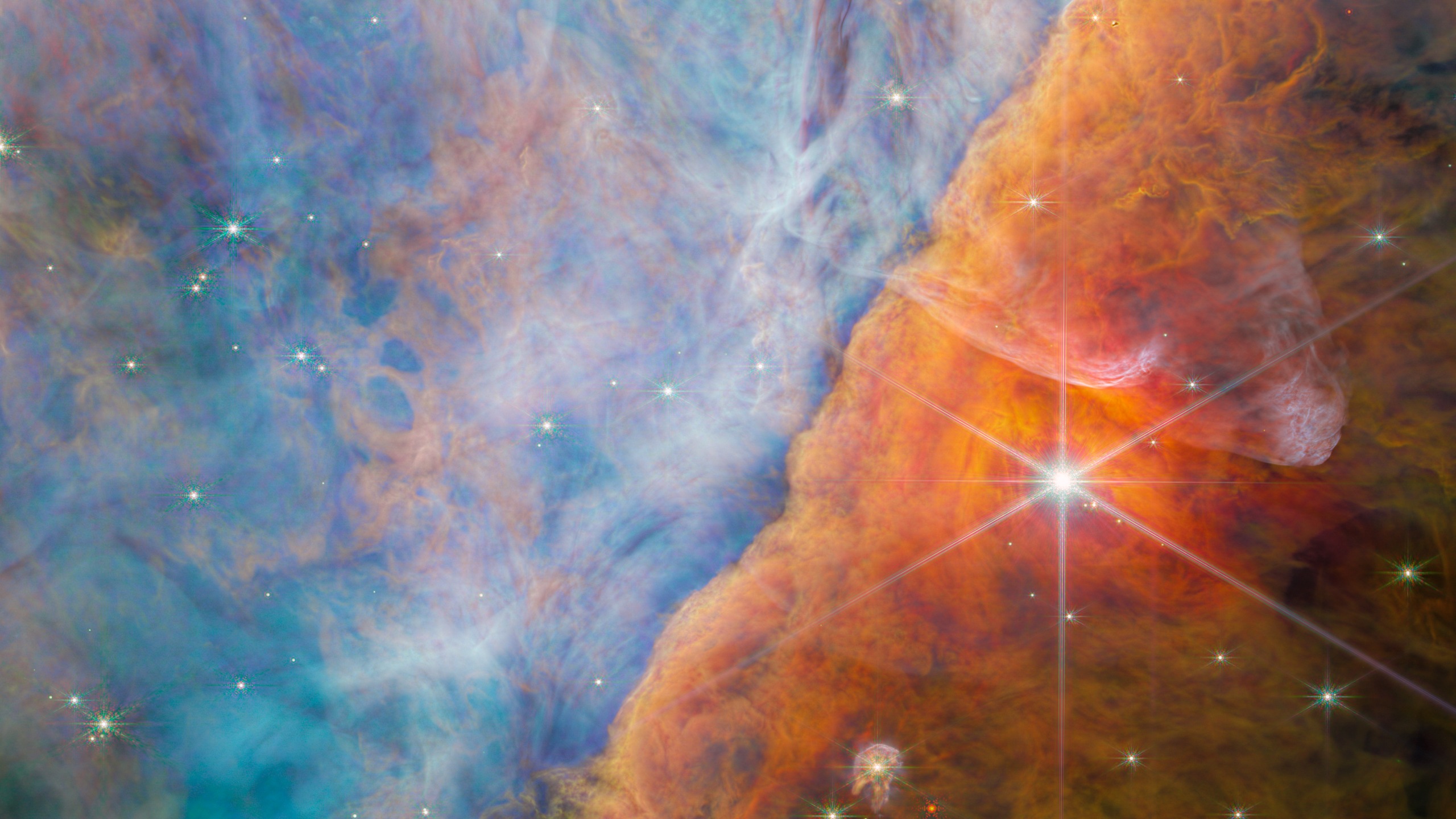
This image taken by Webb’s NIRCam (Near-Infrared Camera) shows a part of the Orion Nebula known as the Orion Bar. It is a region where energetic ultraviolet light from the Trapezium Cluster — located off the upper-left corner — interacts with dense molecular clouds. The energy of the stellar radiation is slowly eroding the Orion Bar, and this has a profound effect on the molecules and chemistry in the protoplanetary disks that have formed around newborn stars here. Within this image lies a young star system known as d203-506, which has a protoplanetary disk. Astronomers used Webb to detect a carbon molecule known as methyl cation in that disk for the first time. That molecule is important because it aids the formation of more complex carbon-based molecules.

Image Credit: ESA/Webb, NASA, CSA, PDRs4ALL ERS Team, Mahdi Zamani (ESA/Webb)

nebula·18.6k downloads
DesktopUltrawideMacBookiPadiPhoneAndroidSpecialHandheldMotorola