#Vela
5 wallpapers tagged "Vela"
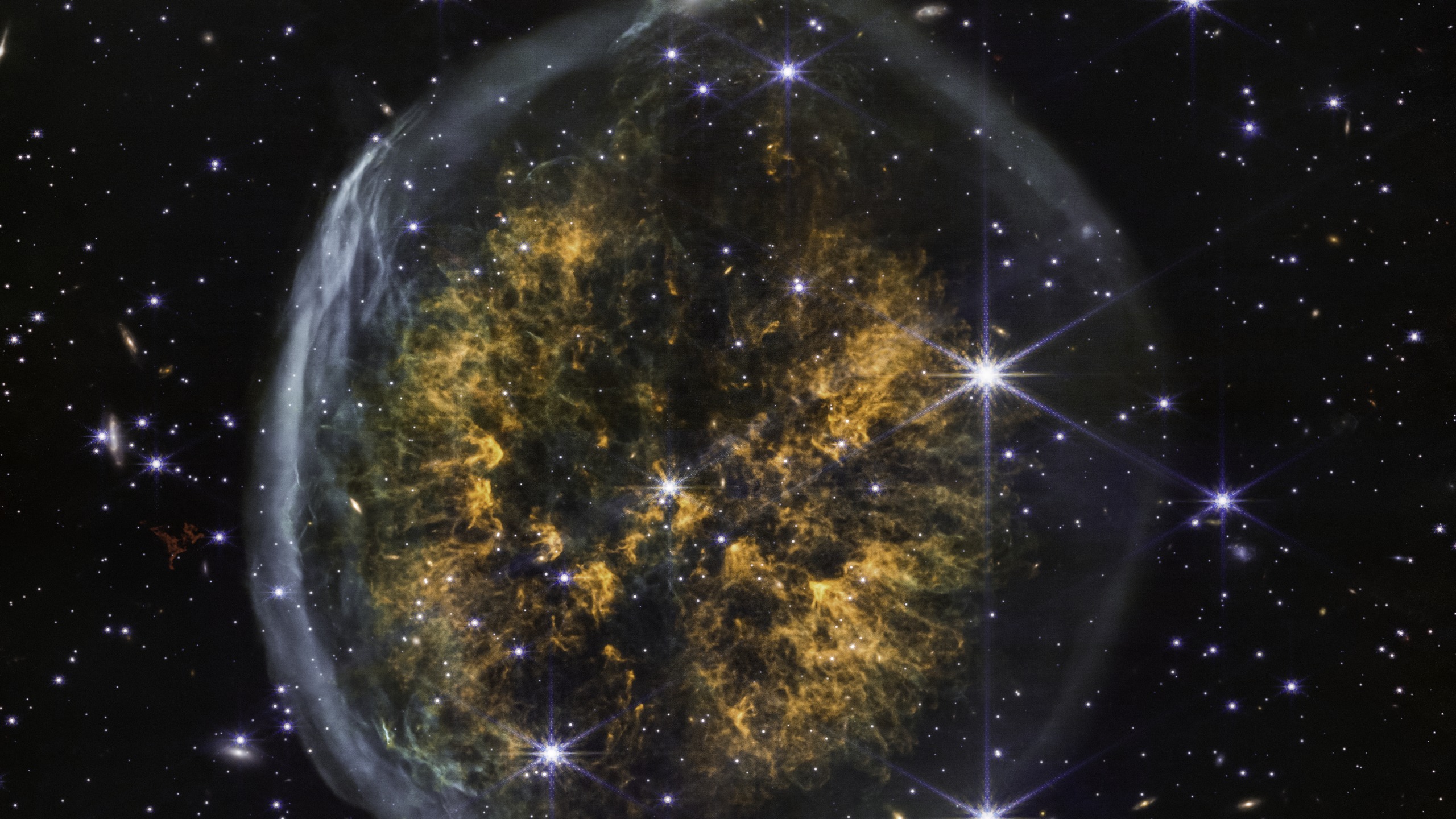
NASA's James Webb Space Telescope captured this near-infrared view of the PMR 1 "Exposed Cranium" nebula using its NIRCam instrument. More stars and background galaxies shine through in this near-infrared light, and the dark center lane that gives the nebula its distinctive brain-like appearance is especially noticeable here.
36k downloads
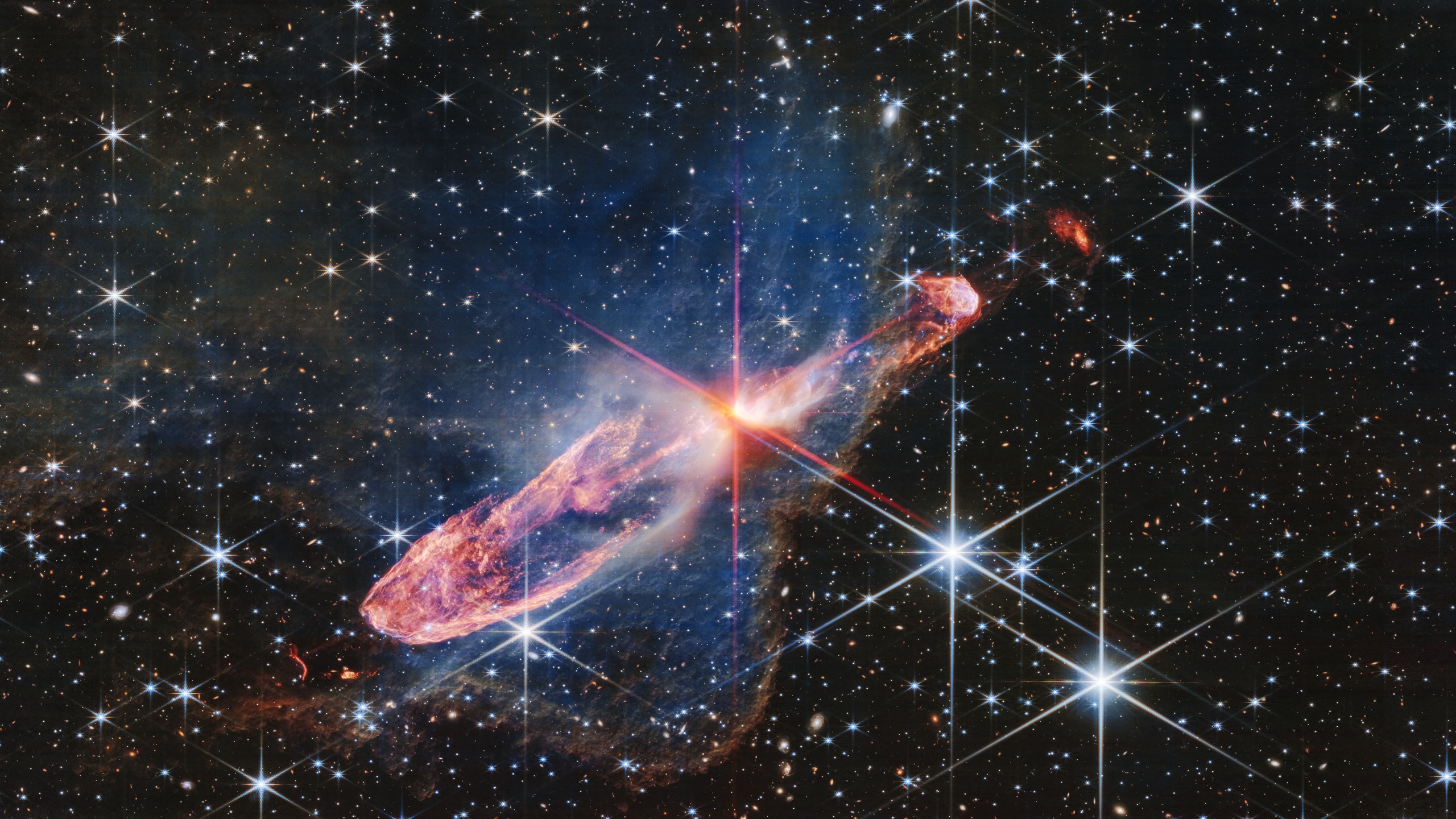
These stars have a lot of energy to let loose! NASA’s James Webb Space Telescope has captured a tightly bound pair of actively forming stars, known as Herbig-Haro 46/47, in high-resolution near-infrared light. Look for them at the center of the red diffraction spikes. The stars are buried deeply, appearing as an orange-white splotch. They are surrounded by a disk of gas and dust that continues to add to their mass. Herbig-Haro 46/47 is an important object to study because it is relatively young – only a few thousand years old. Stars take millions of years to fully form. Targets like this also give researchers insight into how stars gather mass over time, potentially allowing them to model how our own Sun, a low-mass star, formed. The two-sided orange lobes were created by earlier ejections from these stars. The stars’ more recent ejections appear in a thread-like blue, running along the angled diffraction spike that covers the orange lobes. Actively forming stars ingest the gas and dust that immediately surrounds them in a disk (imagine an edge-on circle encasing them). When the stars “eat” too much material in too short a time, they respond by sending out two-sided jets along the opposite axis, settling down the star’s spin, and removing mass from the area. Over millennia, these ejections regulate how much mass the stars retain. Don’t miss the delicate, semi-transparent blue cloud. This is a region of dense dust and gas, known as a nebula. Webb’s crisp near-infrared image lets us see through its gauzy layers, showing off a lot more of Herbig-Haro 46/47, while also revealing a deep range of stars and galaxies that lie far beyond it. The nebula’s edges transform into a soft orange outline, like a backward L along the right and bottom. The blue nebula influences the shapes of the orange jets shot out by the central stars. As ejected material rams into the nebula on the lower left, it takes on wider shapes, because there is more opportunity for the jets to interact with molecules within the nebula. Its material also causes the stars’ ejections to light up. Over millions of years, the stars in Herbig-Haro 46/47 will fully form – clearing the scene. Take a moment to linger on the background. A profusion of extremely distant galaxies dot Webb’s view. Its composite NIRCam (Near-Infrared Camera) image is made up of several exposures, highlighting distant galaxies and stars. Blue objects with diffraction spikes are stars, and the closer they are, the larger they appear. White-and-pink spiral galaxies sometimes appear larger than these stars, but are significantly father away. The tiniest red dots, Webb’s infrared specialty, are often the oldest, most distant galaxies.
12k downloads
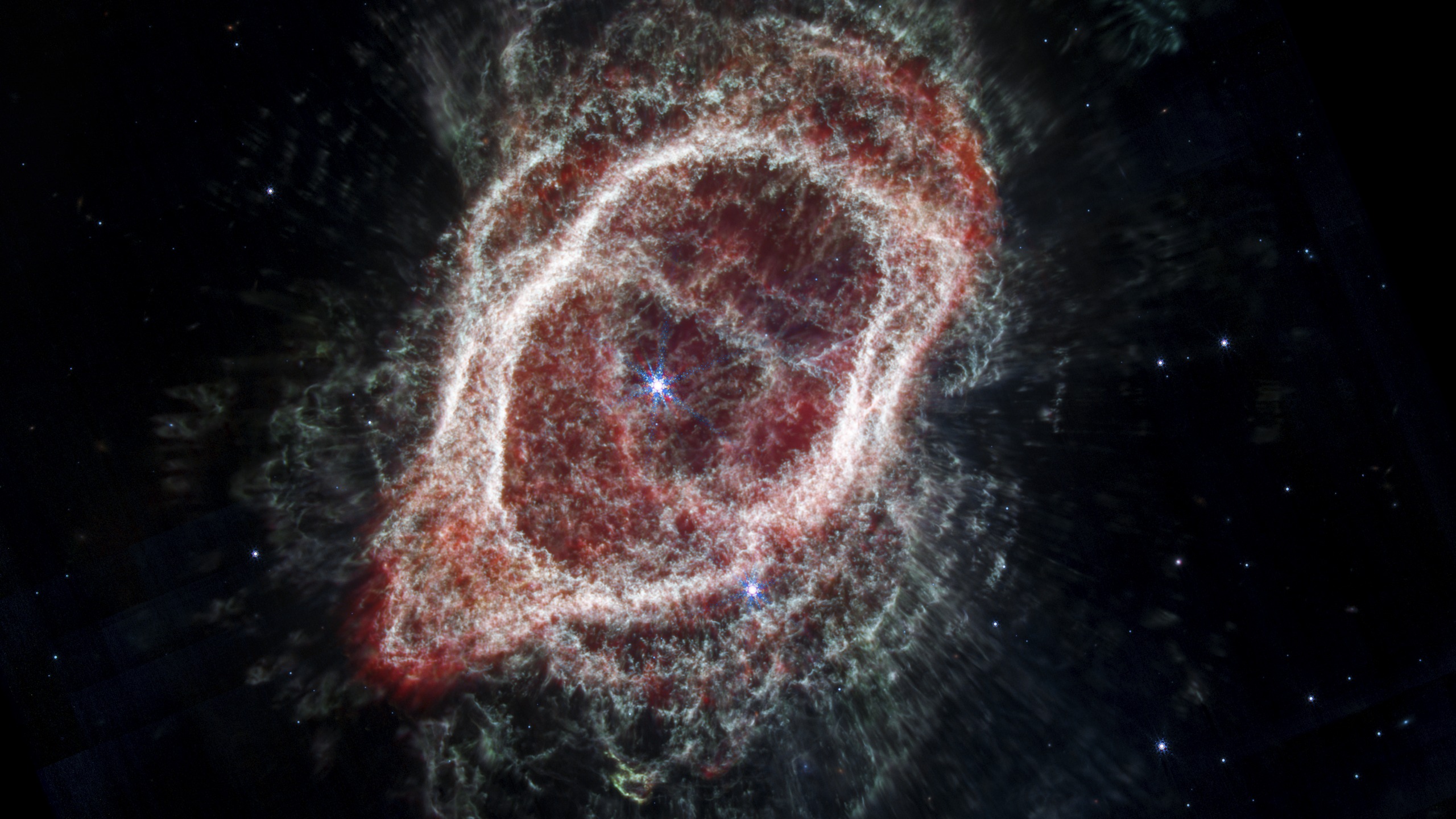
Webb's image traces the star's scattered outflows that have reached farther into the cosmos. Most of the molecular gas that lies outside the band of cooler gas is also cold. It is also far clumpier, consisting of dense knots of molecular gas that form a halo around the central stars. By accounting for the temperatures and gas contents in both areas, inside and outside the band, and by combining Webb's data with precise measurements from other observatories, researchers were able to create far more accurate models to demonstrate when gas was ejected by the central star. What about the third star that is visible at the lower-right edge of the band within the nebula? From Webb's vantage point, it appears within the scene, but isn't part of the nebula itself.
11.4k downloads
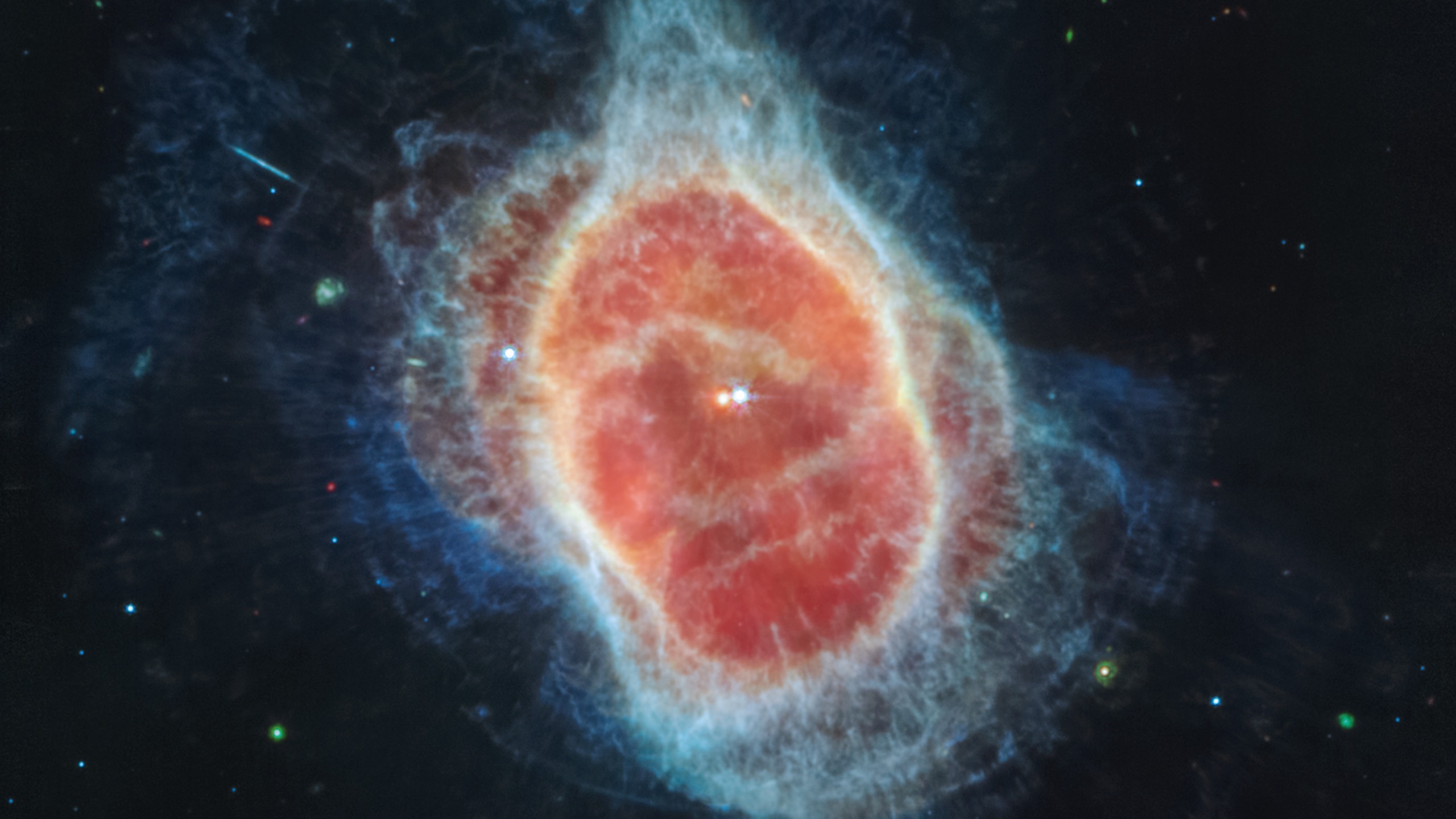
NASA's Webb Telescope has revealed the cloak of dust around the second star, shown at left in red, at the center of the Southern Ring Nebula for the first time. It is a hot, dense white dwarf star. As it transformed into a white dwarf, the star periodically ejected mass, the shells of material you see here. The bluer star at right in this image has also shaped the scene, helping stir up the ejected material. The disk around the stars is also wobbling, shooting out spirals of gas and dust over long periods of time. Webb captured this scene in mid-infrared light, most of which can only be observed from space. Mid-infrared light helps researchers detect objects enshrouded in dust, like the red star. This Mid-Infrared Instrument (MIRI) image also offers an incredible amount of detail, including a cache of distant galaxies in the background.
1k downloads
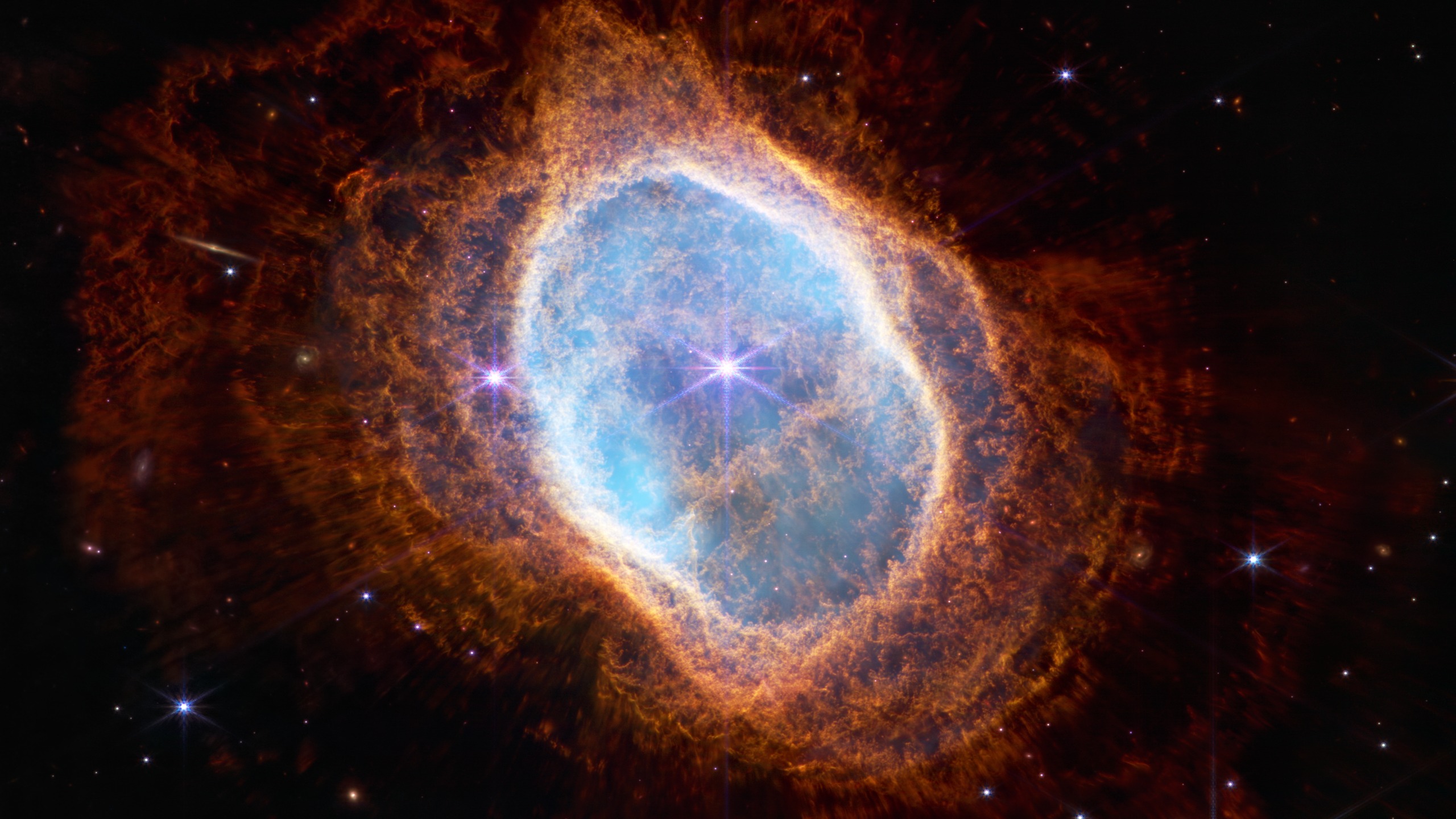
The bright star at the center of NGC 3132, the Southern Ring Nebula, plays a supporting role in sculpting the nebula's rings — a dimmer companion star hidden along one of its diffraction spikes is the true source, having ejected at least eight layers of gas and dust over thousands of years. Webb's near-infrared view also reveals countless background galaxies through the nebula's transparent regions.
2.1k downloads