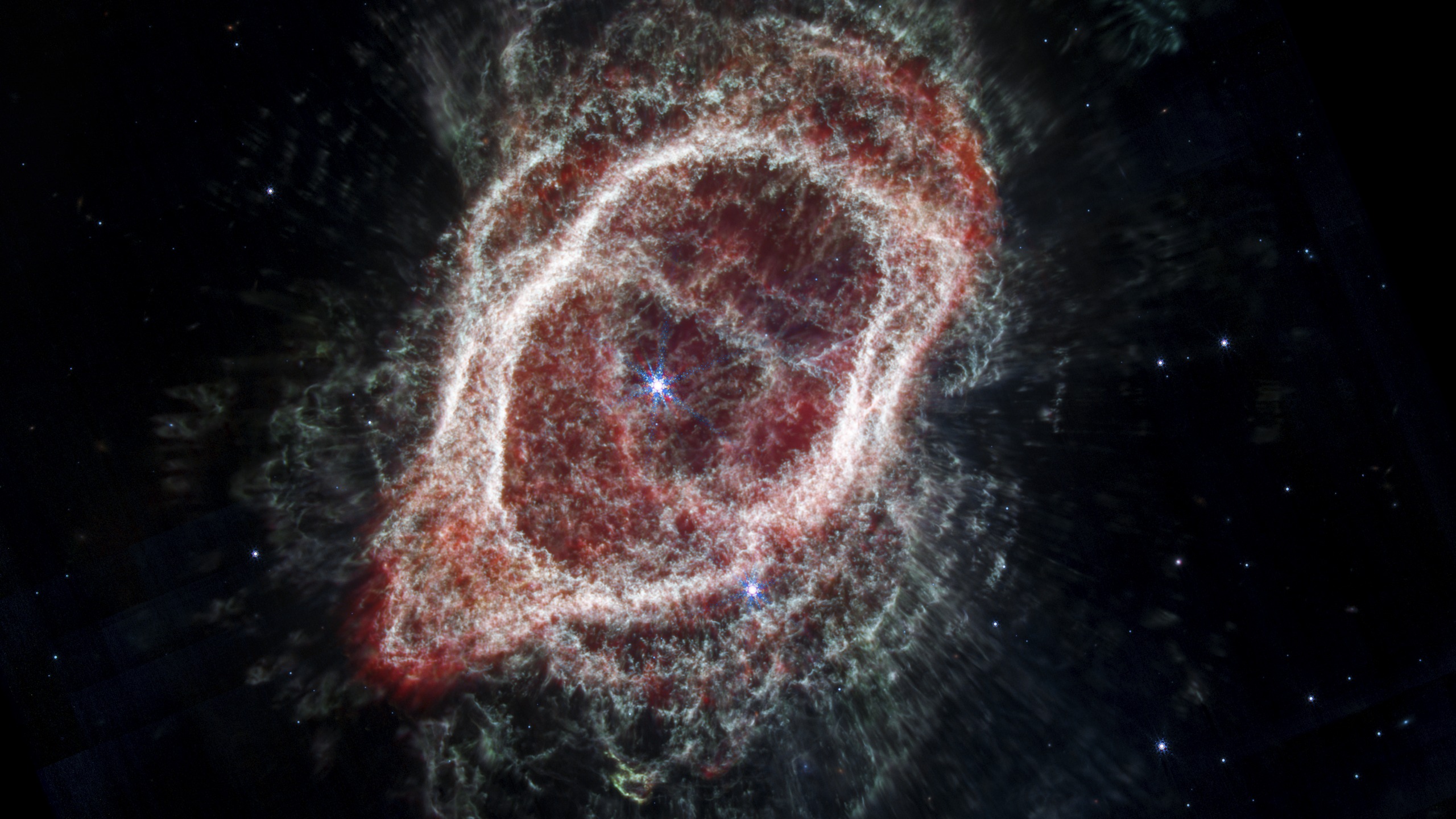
Webb's image traces the star's scattered outflows that have reached farther into the cosmos. Most of the molecular gas that lies outside the band of cooler gas is also cold.
It is also far clumpier, consisting of dense knots of molecular gas that form a halo around the central stars. By accounting for the temperatures and gas contents in both areas, inside and outside the band, and by combining Webb's data with precise measurements from other observatories, researchers were able to create far more accurate models to demonstrate when gas was ejected by the central star.
What about the third star that is visible at the lower-right edge of the band within the nebula? From Webb's vantage point, it appears within the scene, but isn't part of the nebula itself.
Image Credit:NASA, ESA, CSA, STScI, Orsola De Marco (Macquarie University)
About the Object
- R.A. Position
- 10:06:58.54
- Dec. Position
- -40:26:00
- Constellation
- Vela
- Distance
- 2,000 light-years (590 parsecs)
- Dimensions
- Image is about 2.4 arcmin across (1.4 light-years)
Choose your device
Desktop (5)▾
iPhone (5)▾
Android (5)▾
Special (1)▾
Handheld (1)▾
Motorola (1)▾
More nebula wallpapers
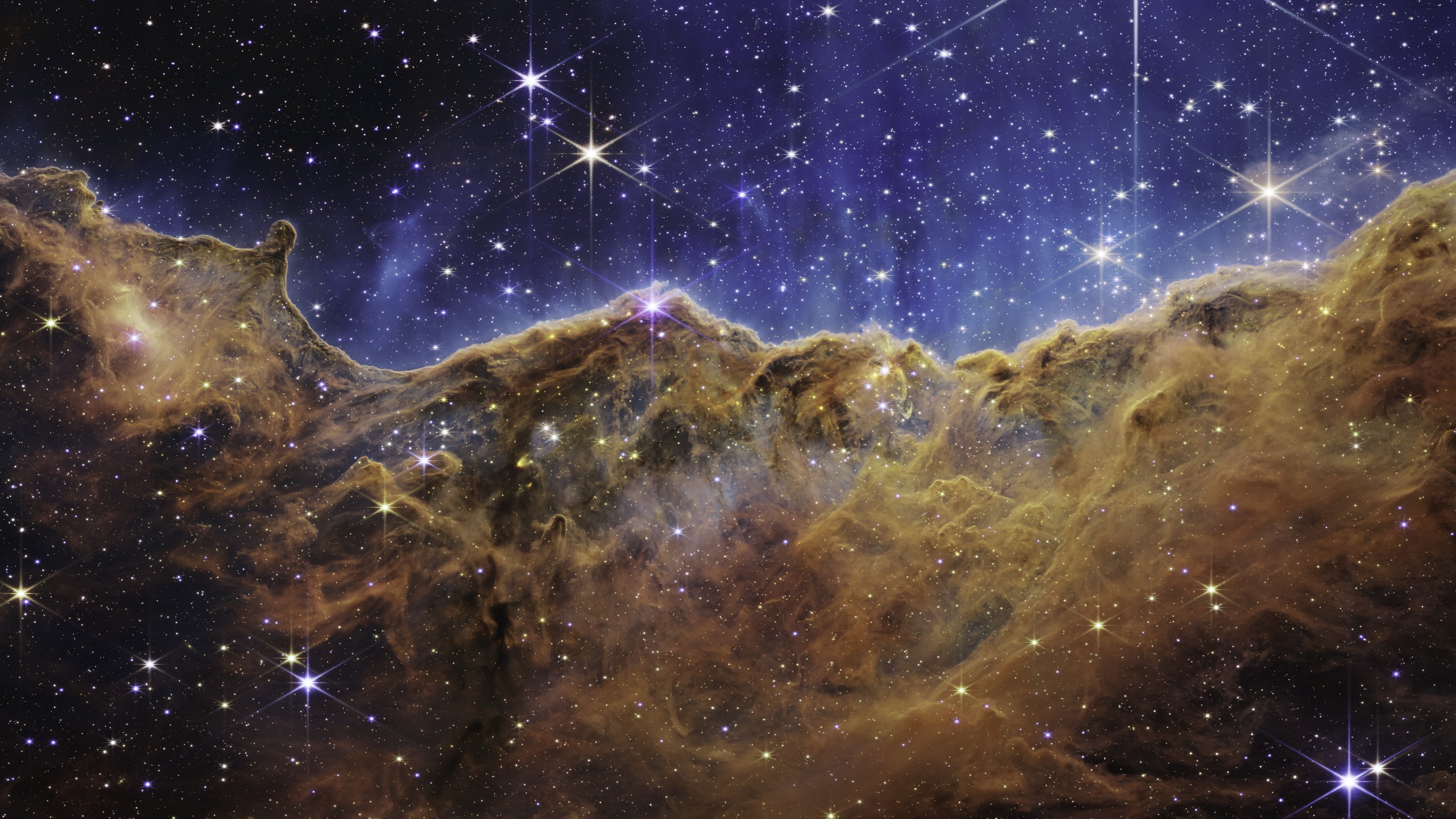
What looks like craggy mountains in moonlight is actually the edge of NGC 3324, a young star-forming region in the Carina Nebula, captured in infrared by Webb's NIRCam. Nicknamed the "Cosmic Cliffs," the region is the edge of a gigantic cavity carved by intense ultraviolet radiation and stellar winds from hot, massive young stars, revealing hundreds of previously hidden stars and background galaxies for the first time.
5.2k downloads
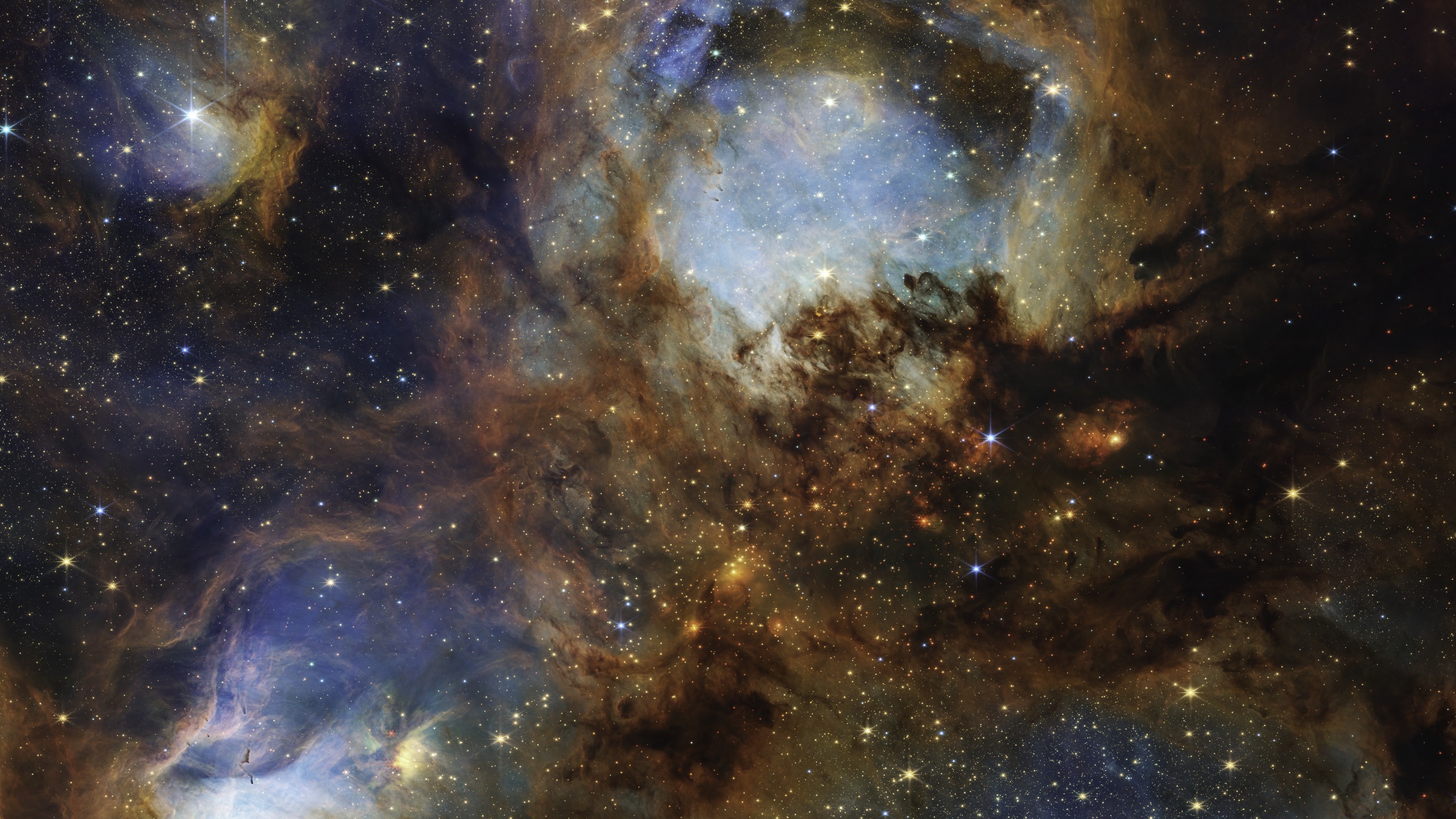
To celebrate NASA’s James Webb Space Telescope’s third year of highly productive science, astronomers used the telescope to scratch beyond the surface of the Cat’s Paw Nebula (NGC 6334), a massive, local star-forming region. This area is of great interest to scientists, having been subject to previous study by NASA’s Hubble and retired Spitzer space telescopes, as they seek to understand the multiple steps required for a turbulent molecular cloud to transition to stars. With its near-infrared capabilities and sharp resolution, the telescope “clawed” back a portion of a singular “toe bean,” revealing a subset of mini toe bean-reminiscent structures composed of gas, dust, and young stars. Webb’s view reveals a chaotic scene still in development: Massive young stars are carving away at nearby gas and dust, while their bright starlight is producing a bright nebulous glow represented in blue. This is only a chapter in the region’s larger story. The disruptive young stars, with their relatively short lifespans and luminosity, will eventually quench the local star formation process. The Cat’s Paw Nebula is located approximately 4,000 light-years away in the constellation Scorpius. To dive deeper into Webb’s image of the Cat’s Paw, embark on a narrated tour, get closer to the image, or read the press release. Additionally, learn more about Webb’s three years of science observations.
38.1k downloads