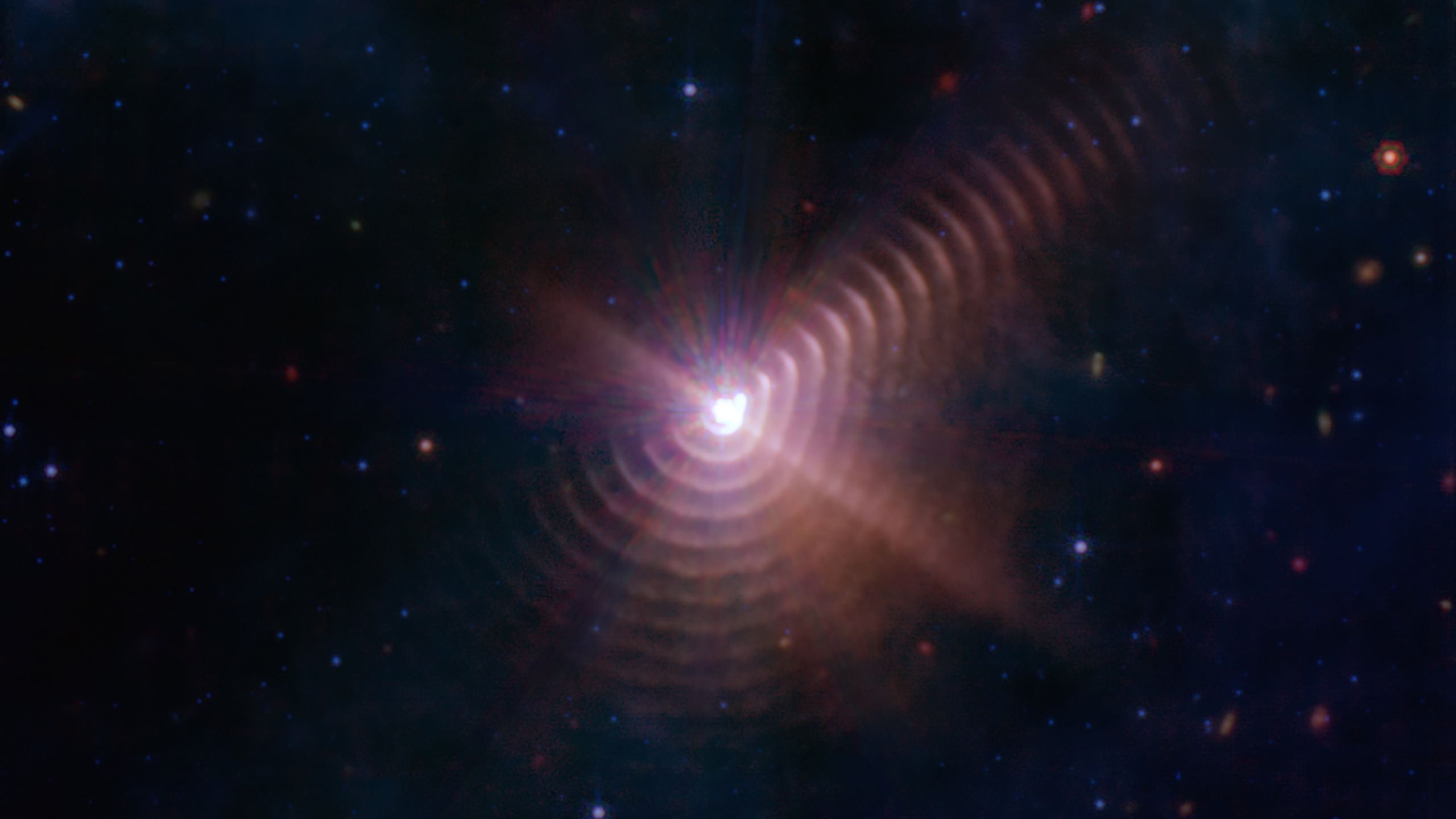
This image from NASA's James Webb Space Telescope reveals at least 17 concentric dust rings emanating from a pair of stars orbiting one another. Located just over 5,000 light-years from Earth, the system is known as Wolf-Rayet 140 because one of the stars is a Wolf-Rayet star.
The other is an O-type star, one of the most massive star types known. Each ring was created when the two stars came close together and their stellar winds (streams of gas they blow into space) collided, compressing the gas and forming dust.
A ring is produced once per orbit, every 7.93 years. A Wolf-Rayet star is an O-type star born with at least 25 times more mass than our Sun that is nearing the end of its life, when it will likely collapse directly to black hole, or explode as a supernova.
These delays between periods of dust production create the unique ring pattern. Some Wolf-Rayet binaries in which the stars are close enough together and have circular orbits produce dust continuously, often forming a pinwheel pattern.
WR 140's rings are also referred to as shells because they are not perfectly circular and are thicker and wider than they appear in the image. The rings appear brighter in some areas but are almost invisible in others, rather than forming a perfect "bullseye" pattern.
That's because production of dust is variable as the stars get close to one another, and because Webb views the system at an angle and is not looking directly at the orbital plane of the stars. One of the densest regions of dust production creates the bright feature appearing at 2 o'clock.
The image was taken by the Mid-Infrared Instrument (MIRI), now managed by the agency's Goddard Space Flight Center. MIRI was developed through a 50-50 partnership between NASA and ESA (European Space Agency).
Image Credit:NASA, ESA, CSA, STScI, JPL-Caltech
About the Object
- Distance
- Just over 5,000 light-years from Earth
Choose your device
Ultrawide (2)▾
iPhone (5)▾
Special (1)▾
Handheld (1)▾
Motorola (1)▾
More nebula wallpapers
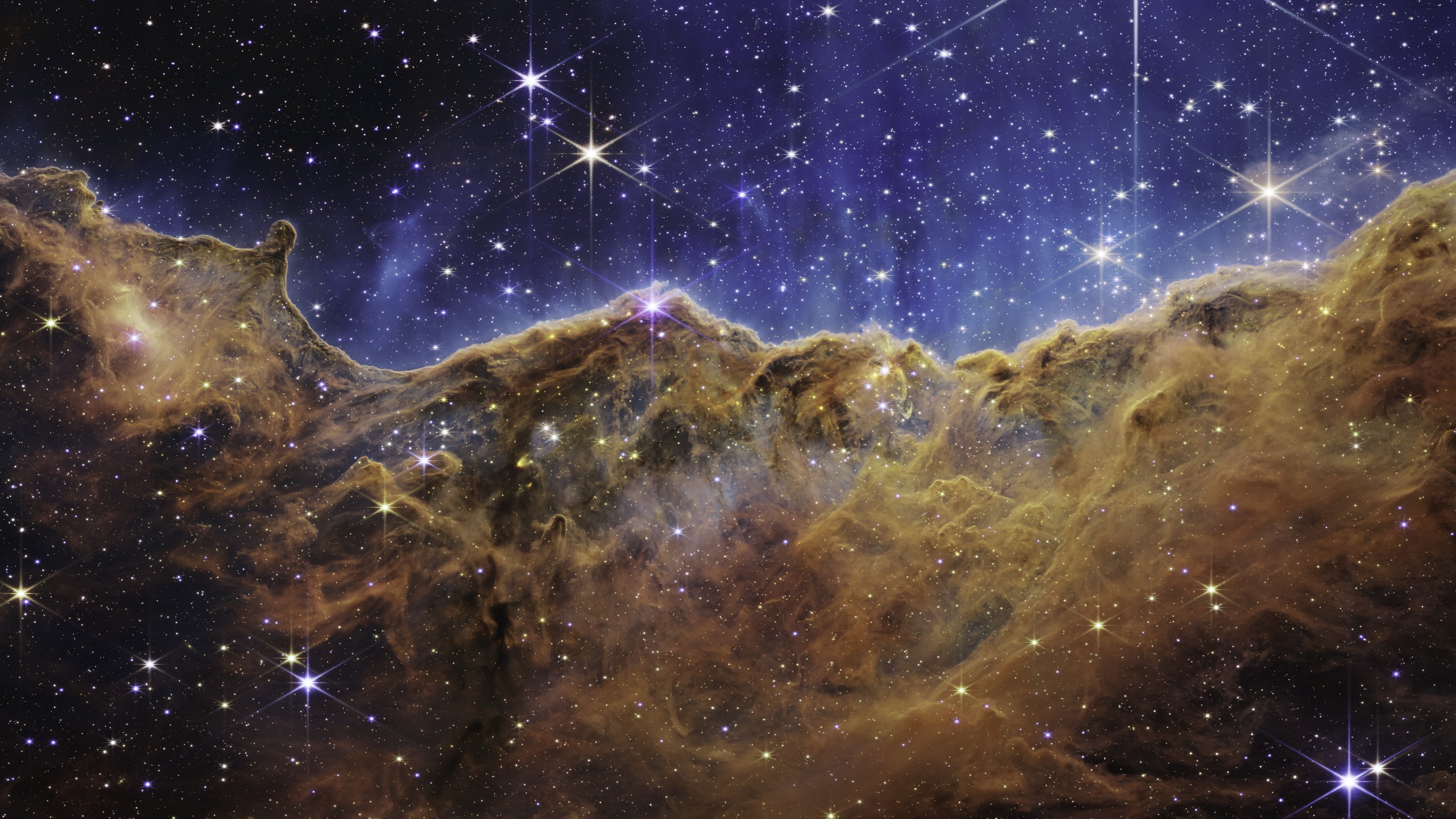
What looks like craggy mountains in moonlight is actually the edge of NGC 3324, a young star-forming region in the Carina Nebula, captured in infrared by Webb's NIRCam. Nicknamed the "Cosmic Cliffs," the region is the edge of a gigantic cavity carved by intense ultraviolet radiation and stellar winds from hot, massive young stars, revealing hundreds of previously hidden stars and background galaxies for the first time.
5.2k downloads
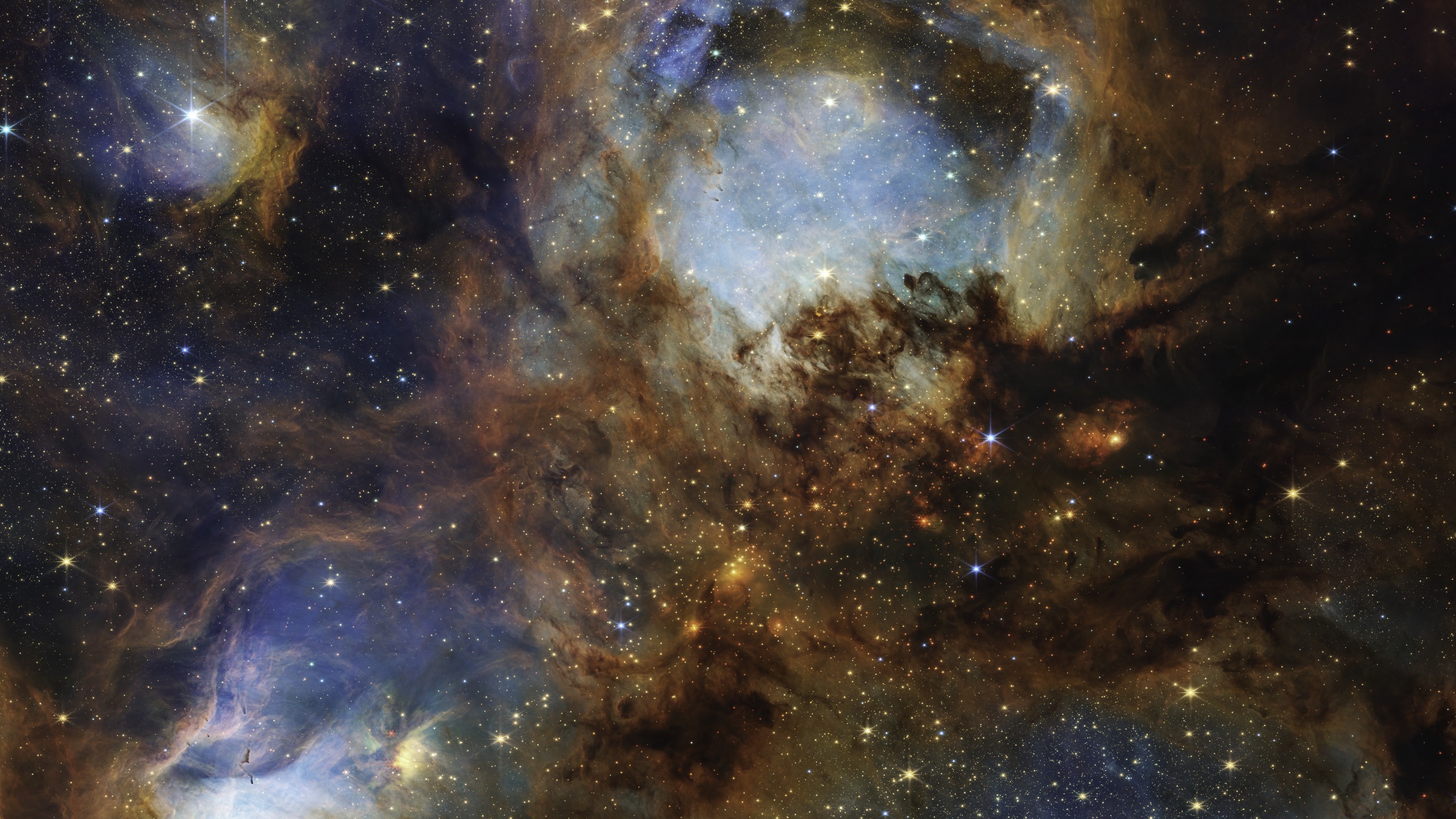
To celebrate NASA’s James Webb Space Telescope’s third year of highly productive science, astronomers used the telescope to scratch beyond the surface of the Cat’s Paw Nebula (NGC 6334), a massive, local star-forming region. This area is of great interest to scientists, having been subject to previous study by NASA’s Hubble and retired Spitzer space telescopes, as they seek to understand the multiple steps required for a turbulent molecular cloud to transition to stars. With its near-infrared capabilities and sharp resolution, the telescope “clawed” back a portion of a singular “toe bean,” revealing a subset of mini toe bean-reminiscent structures composed of gas, dust, and young stars. Webb’s view reveals a chaotic scene still in development: Massive young stars are carving away at nearby gas and dust, while their bright starlight is producing a bright nebulous glow represented in blue. This is only a chapter in the region’s larger story. The disruptive young stars, with their relatively short lifespans and luminosity, will eventually quench the local star formation process. The Cat’s Paw Nebula is located approximately 4,000 light-years away in the constellation Scorpius. To dive deeper into Webb’s image of the Cat’s Paw, embark on a narrated tour, get closer to the image, or read the press release. Additionally, learn more about Webb’s three years of science observations.
38.1k downloads