Pink Wallpapers
A blend of hydrogen emission and scattered starlight, often seen where young, hot stars illuminate the gas around them.
6 wallpapers
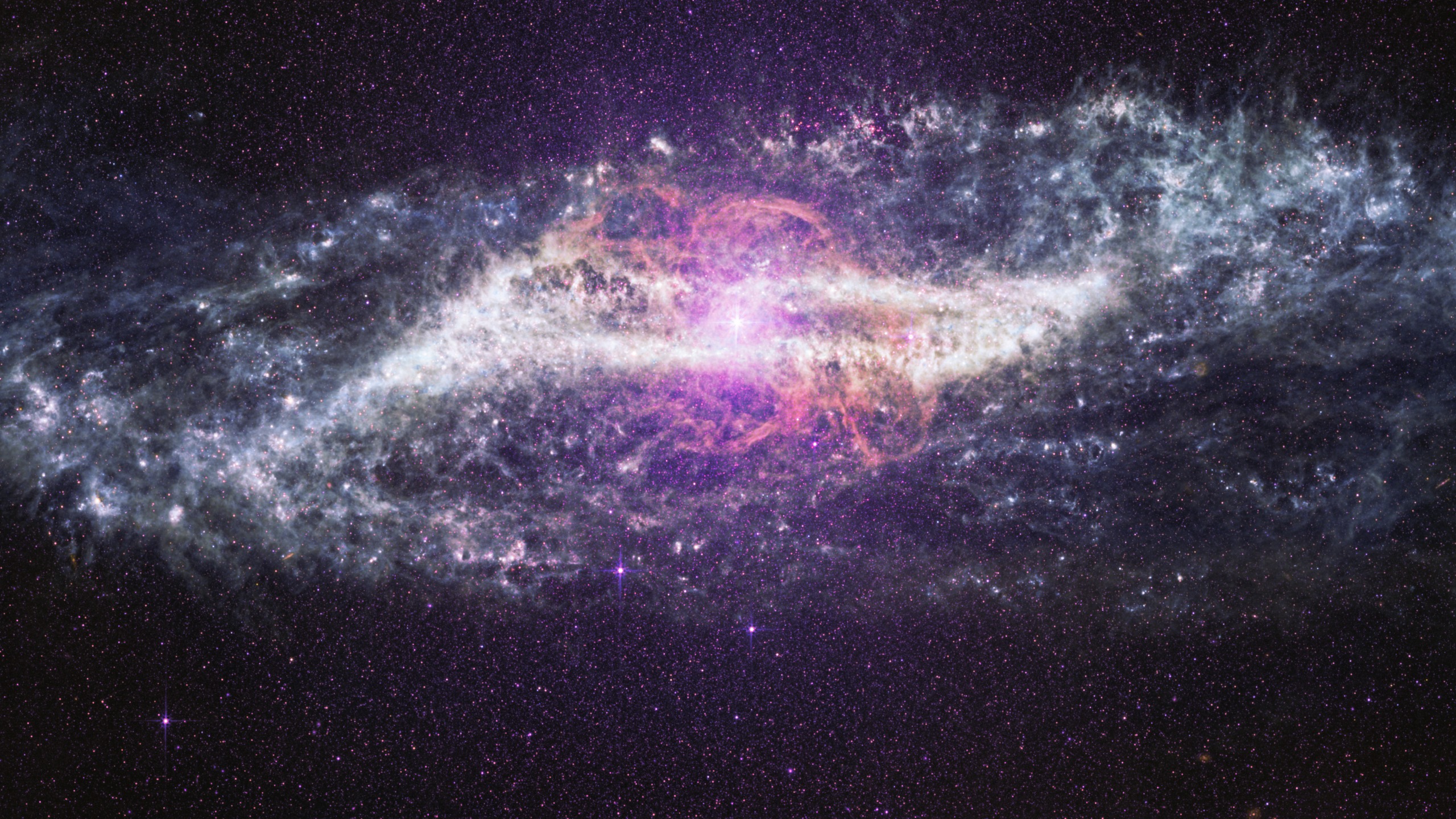
NASA’s James Webb Space Telescope’s Mid-Infrared Instrument (MIRI) reveals the nearby galaxy Centaurus A, exposing the dusty structures and hidden activity that shape this unusual system. Webb’s infrared vision unveils intricate filaments, loops, and glowing clouds of warm dust stretching across its center. At the heart of the galaxy, an actively feeding supermassive black hole shines brightly, surrounded by complex structures sculpted by a past galactic collision and ongoing activity. Deeper Dive Explore tours and points of interest in the interactive map below.
27.3k downloads
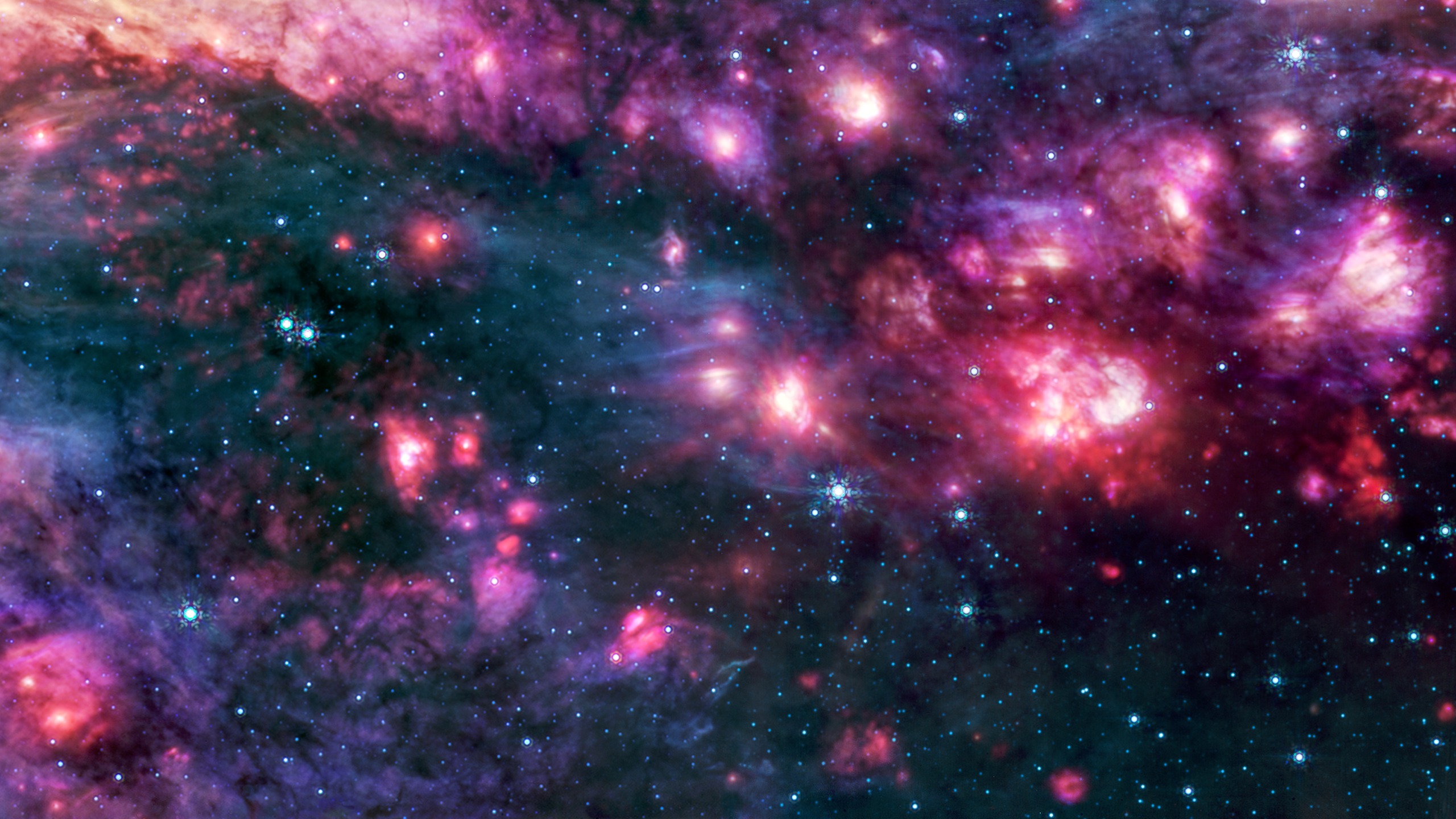
Webb's MIRI (Mid-Infrared Instrument) shows the Sagittarius B2 (Sgr B2) region in mid-infrared light, with warm dust glowing brightly. To the right is one clump of clouds that captured astronomers' attention. It is redder than the rest of the clouds in the image and corresponds to an area that other telescopes have shown to be one of the most molecularly rich regions known.
15k downloads
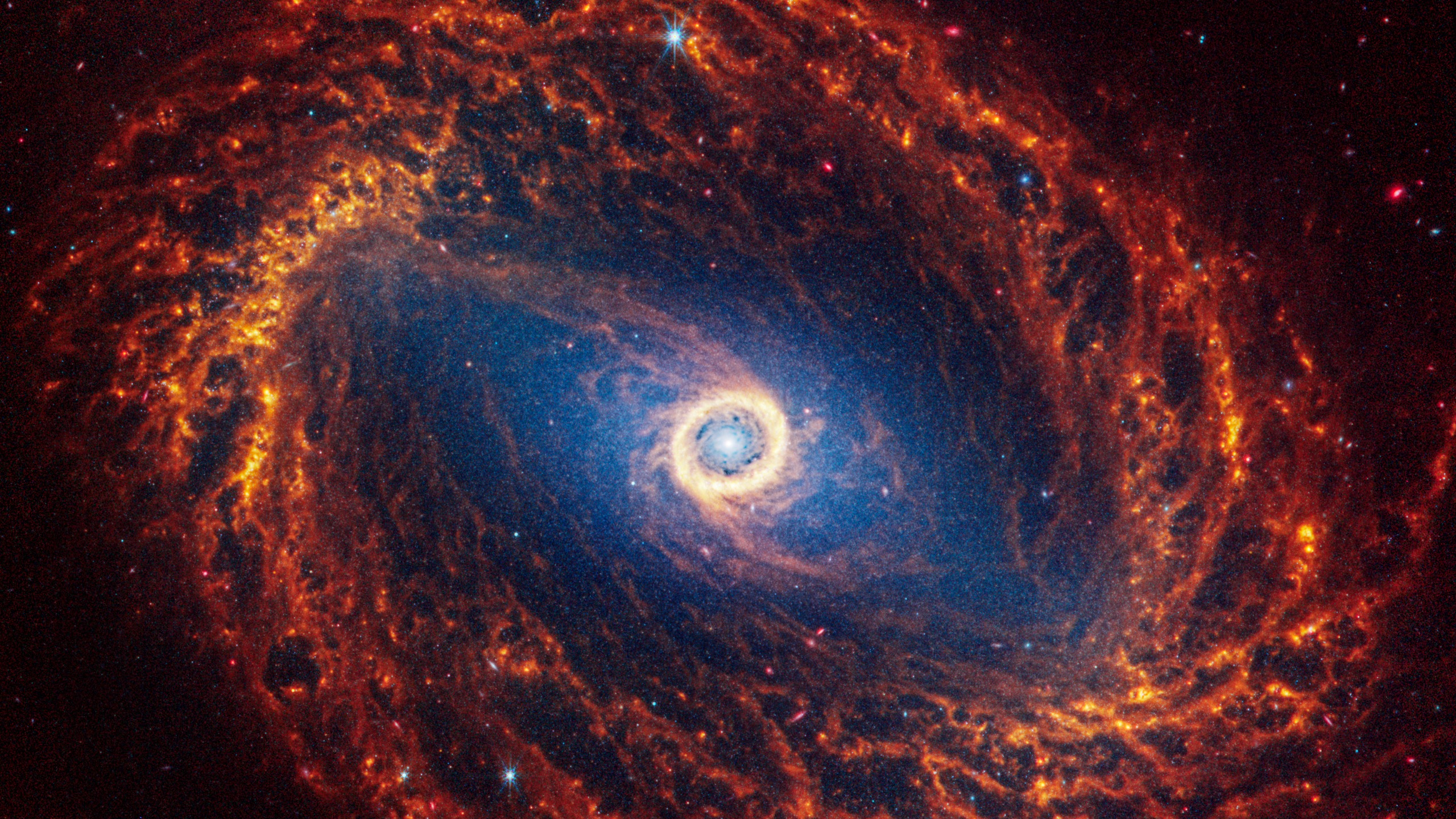
Face-on barred spiral galaxy, NGC 1512, is split diagonally in this image: The James Webb Space Telescope’s observations appear at top left, and the Hubble Space Telescope’s on bottom right. Webb and Hubble’s images show a striking contrast, an inverse of darkness and light. Why? Webb’s observations combine near- and mid-infrared light and Hubble’s showcase visible and ultraviolet light. Dust absorbs ultraviolet and visible light, and then re-emits it in the infrared. In Webb's images, we see dust glowing in infrared light. In Hubble’s images, dark regions are where starlight is absorbed by dust. The individual Webb and Hubble images are available for download using the links on the left side of this page. Background galaxies Webb’s image includes distant galaxies that are located well behind the tightly cropped foreground galaxy. Look for bright blue and pink disks, some seen edge-on, like a plate with a central sphere. Redder galaxies are more distant. In Hubble’s view, distant galaxies are often light orange if they are slightly closer. Like in Webb's image, those that are deeper red are also more distant. Galaxy NGC 1512 was observed as part of the Physics at High Angular resolution in Nearby GalaxieS (PHANGS) program, a large project that includes observations from several space- and ground-based telescopes of many galaxies to help researchers study all phases of the star formation cycle, from the formation of stars within dusty gas clouds to the energy released in the process that creates the intricate structures revealed by Webb’s new images. NGC 1512 is 30 million light-years away in the constellation Horologium. Extended Description and Image Alt Text
23.9k downloads
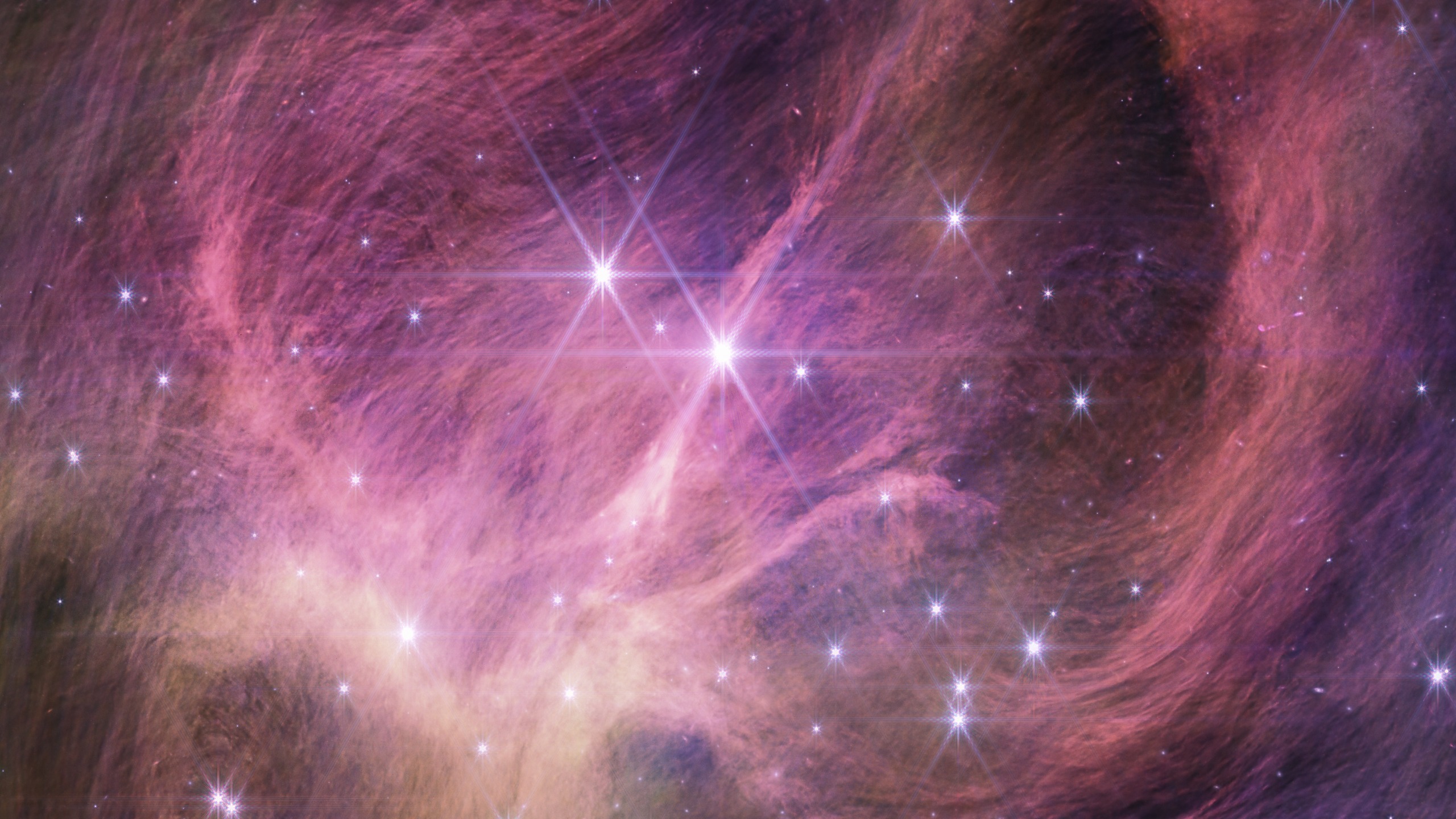
This image from the NIRCam (Near-Infrared Camera) instrument on NASA’s James Webb Space Telescope shows the central portion of the star cluster IC 348. Astronomers combed the cluster in search of tiny, free-floating brown dwarfs: objects too small to be stars but larger than most planets. They found three brown dwarfs that are less than eight times the mass of Jupiter. The smallest weighs just three to four times Jupiter, challenging theories for star formation. The wispy curtains filling the image are interstellar material reflecting the light from the cluster’s stars – what is known as a reflection nebula. The material also includes carbon-containing molecules known as polycyclic aromatic hydrocarbons, or PAHs. The bright star closest to the center of the frame is actually a pair of type B stars in a binary system, which are the most massive stars in the cluster. Winds from these stars may help sculpt the large loop seen on the right side of the field of view.
37.5k downloads
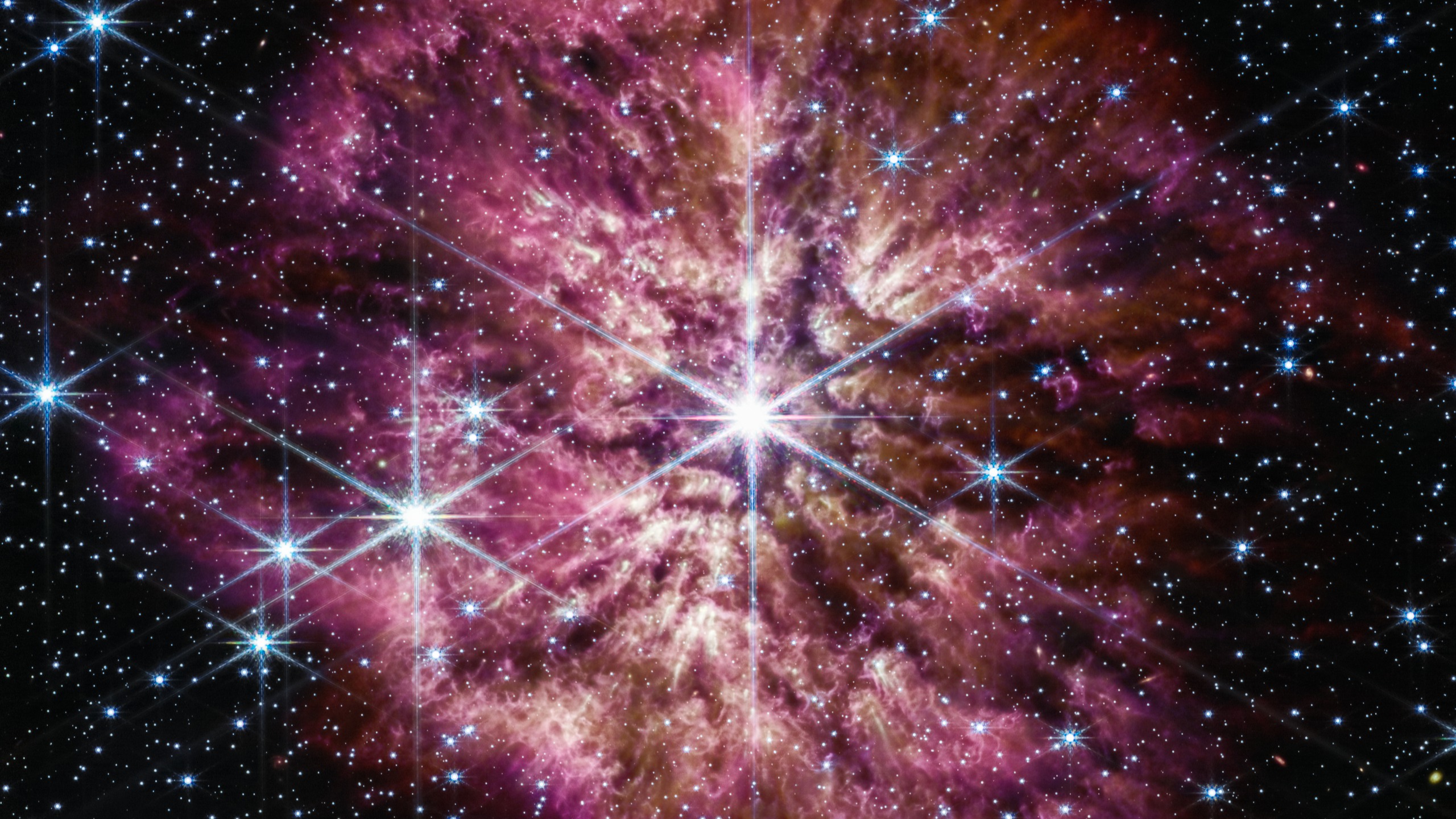
The luminous, hot star Wolf-Rayet 124 (WR 124) is prominent at the center of the James Webb Space Telescope’s composite image combining near-infrared and mid-infrared wavelengths of light. The star displays the characteristic diffraction spikes of Webb’s Near-Infrared Camera (NIRCam), caused by the physical structure of the telescope itself. NIRCam effectively balances the brightness of the star with the fainter gas and dust surrounding it, while Webb’s Mid-Infrared Instrument (MIRI) reveals the nebula’s structure. Background stars and background galaxies populate the field of view and peek through the nebula of gas and dust that has been ejected from the aging massive star to span 10 light-years across space. A history of the star’s past episodes of mass can be read in the nebula’s structure. Rather than smooth shells, the nebula is formed from random, asymmetric ejections. Bright clumps of gas and dust appear like tadpoles swimming toward the star, with tails streaming out behind them, blown back by the stellar wind. This image combines various filters from both Webb imaging instruments, with the color red assigned to wavelengths of 4.44, 4.7, 12.8, and 18 microns (F444W, F470N, F1280W, F1800W), green to 2.1, 3.35, and 11.3 microns (F210M, F335M, F1130W), and blue to 0.9, 1.5, and 7.7 microns (F090W, F150W, F770W).
30.4k downloads
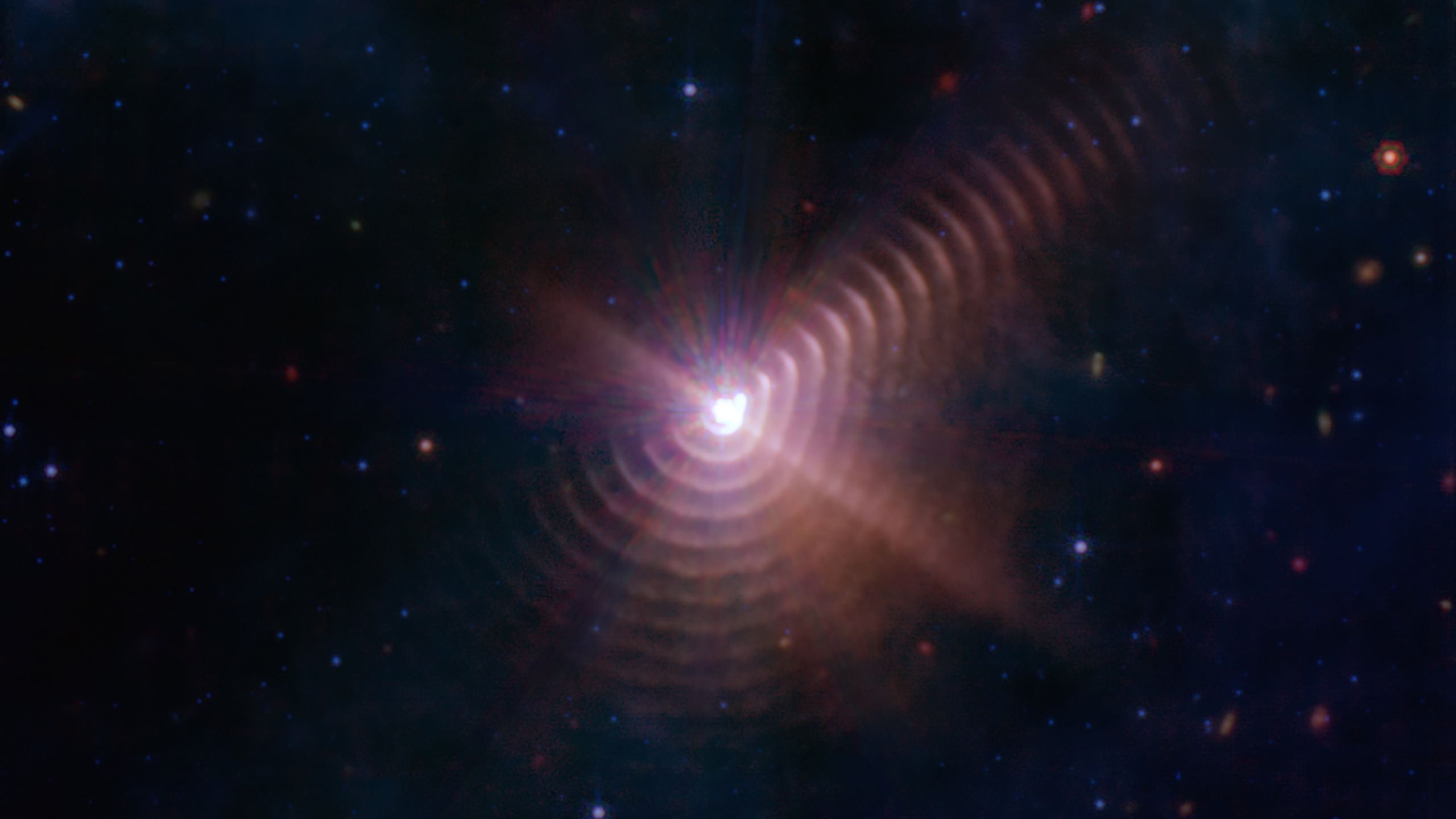
This image from NASA's James Webb Space Telescope reveals at least 17 concentric dust rings emanating from a pair of stars orbiting one another. Located just over 5,000 light-years from Earth, the system is known as Wolf-Rayet 140 because one of the stars is a Wolf-Rayet star. The other is an O-type star, one of the most massive star types known. Each ring was created when the two stars came close together and their stellar winds (streams of gas they blow into space) collided, compressing the gas and forming dust. A ring is produced once per orbit, every 7.93 years. A Wolf-Rayet star is an O-type star born with at least 25 times more mass than our Sun that is nearing the end of its life, when it will likely collapse directly to black hole, or explode as a supernova. These delays between periods of dust production create the unique ring pattern. Some Wolf-Rayet binaries in which the stars are close enough together and have circular orbits produce dust continuously, often forming a pinwheel pattern. WR 140's rings are also referred to as shells because they are not perfectly circular and are thicker and wider than they appear in the image. The rings appear brighter in some areas but are almost invisible in others, rather than forming a perfect "bullseye" pattern. That's because production of dust is variable as the stars get close to one another, and because Webb views the system at an angle and is not looking directly at the orbital plane of the stars. One of the densest regions of dust production creates the bright feature appearing at 2 o'clock. The image was taken by the Mid-Infrared Instrument (MIRI), now managed by the agency's Goddard Space Flight Center. MIRI was developed through a 50-50 partnership between NASA and ESA (European Space Agency).
30.5k downloads