Galaxy Wallpapers
Spiral arms, colliding galaxy groups, and distant island universes resolved by JWST at a level of detail no telescope has reached before.
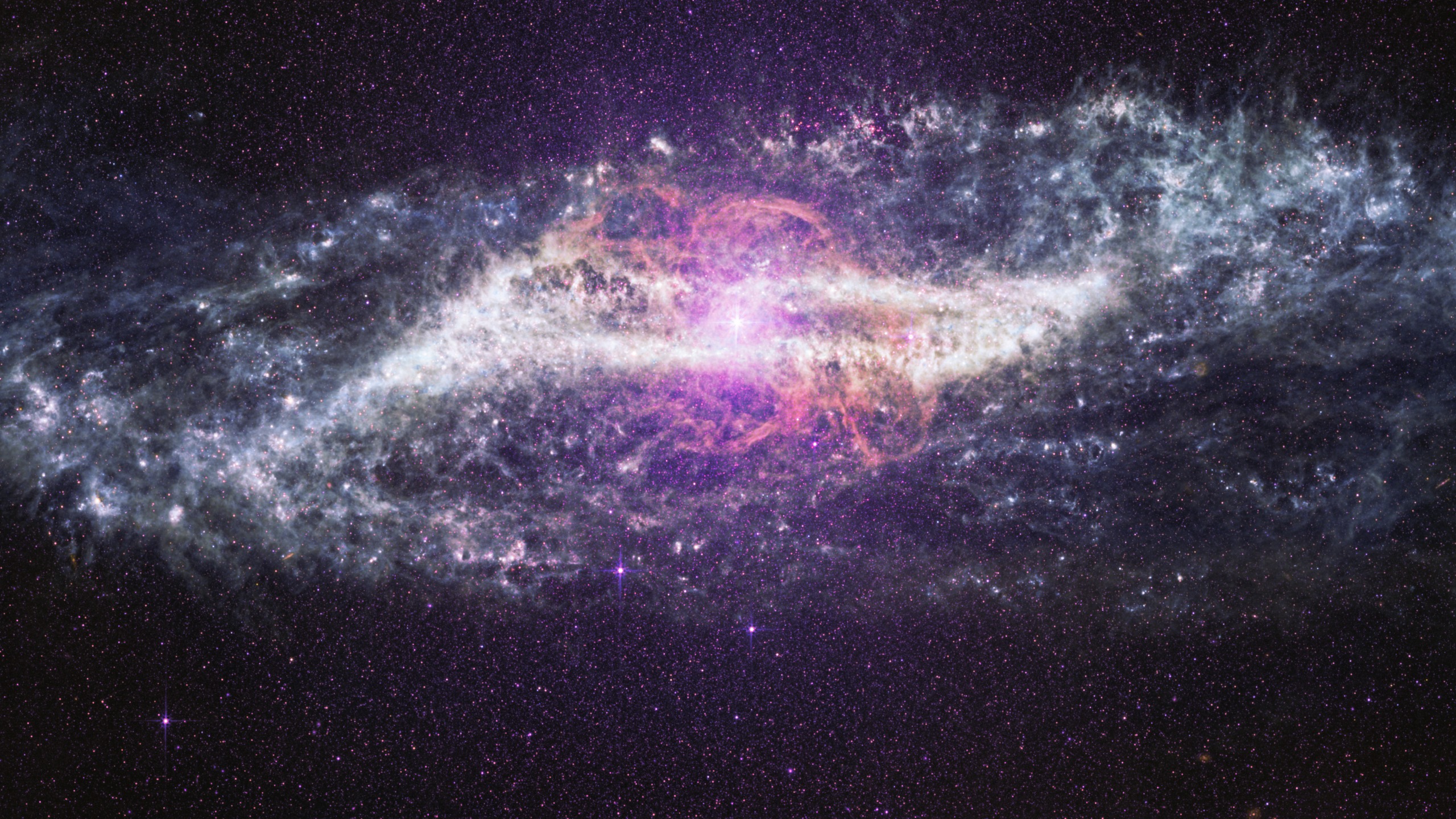
NASA’s James Webb Space Telescope’s Mid-Infrared Instrument (MIRI) reveals the nearby galaxy Centaurus A, exposing the dusty structures and hidden activity that shape this unusual system. Webb’s infrared vision unveils intricate filaments, loops, and glowing clouds of warm dust stretching across its center. At the heart of the galaxy, an actively feeding supermassive black hole shines brightly, surrounded by complex structures sculpted by a past galactic collision and ongoing activity. Deeper Dive Explore tours and points of interest in the interactive map below.
27.3k downloads
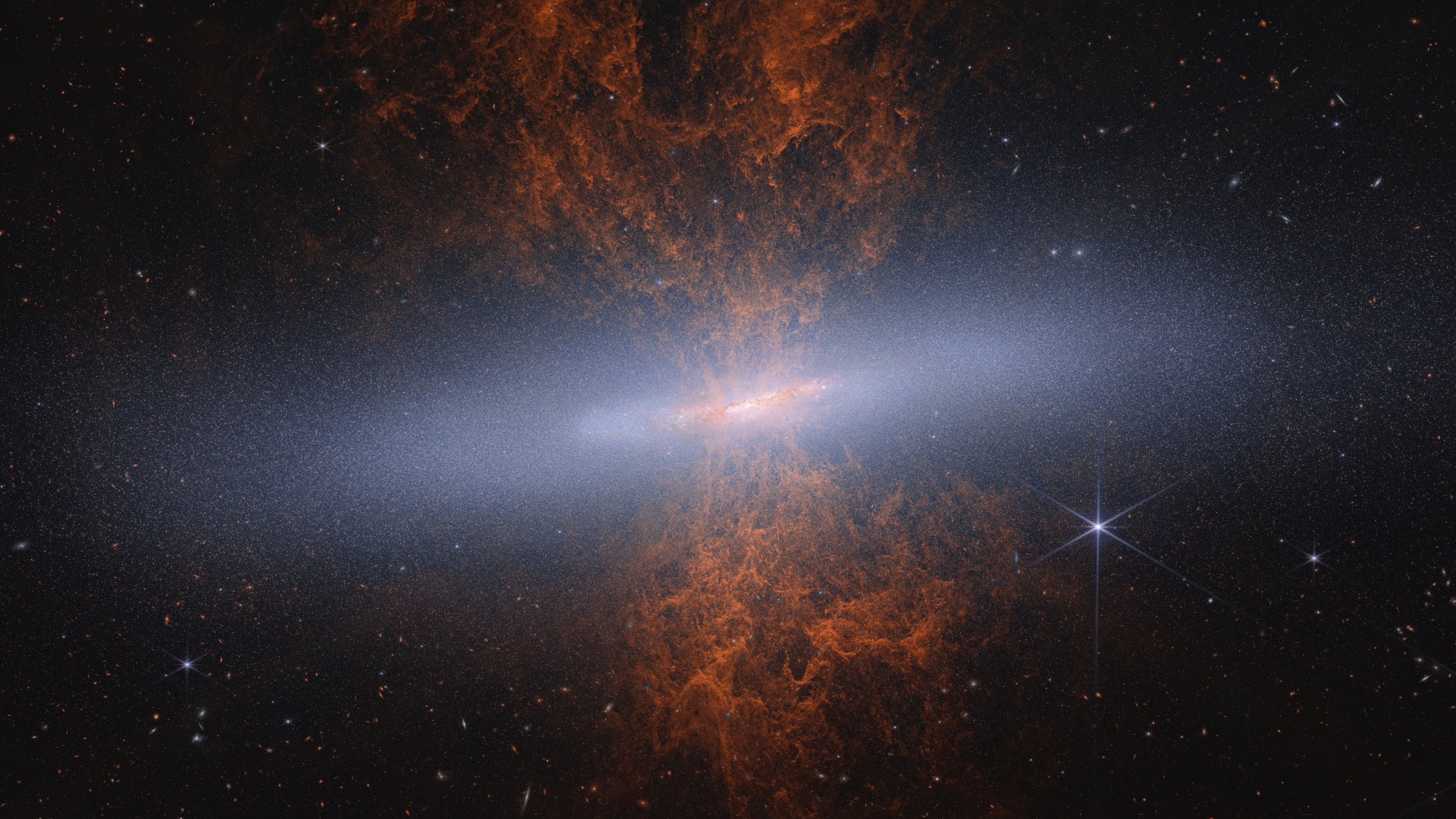
NASA's James Webb Space Telescope recently observed edge-on starburst galaxy Messier 82 (M82), nicknamed the Cigar Galaxy. Webb's near-infrared-light view is a snapshot in time, revealing a scene that has been evolving over a couple hundred million years. In near-infrared light, astronomers can see the galaxy's distended disk structure and millions of individual stars — approximately 16.5 million — for the first time. Webb's imaging survey of the galaxy is helping astronomers investigate the formation history of M82 and will also shed light on the current processes occurring within the starburst galaxy.
40.8k downloads
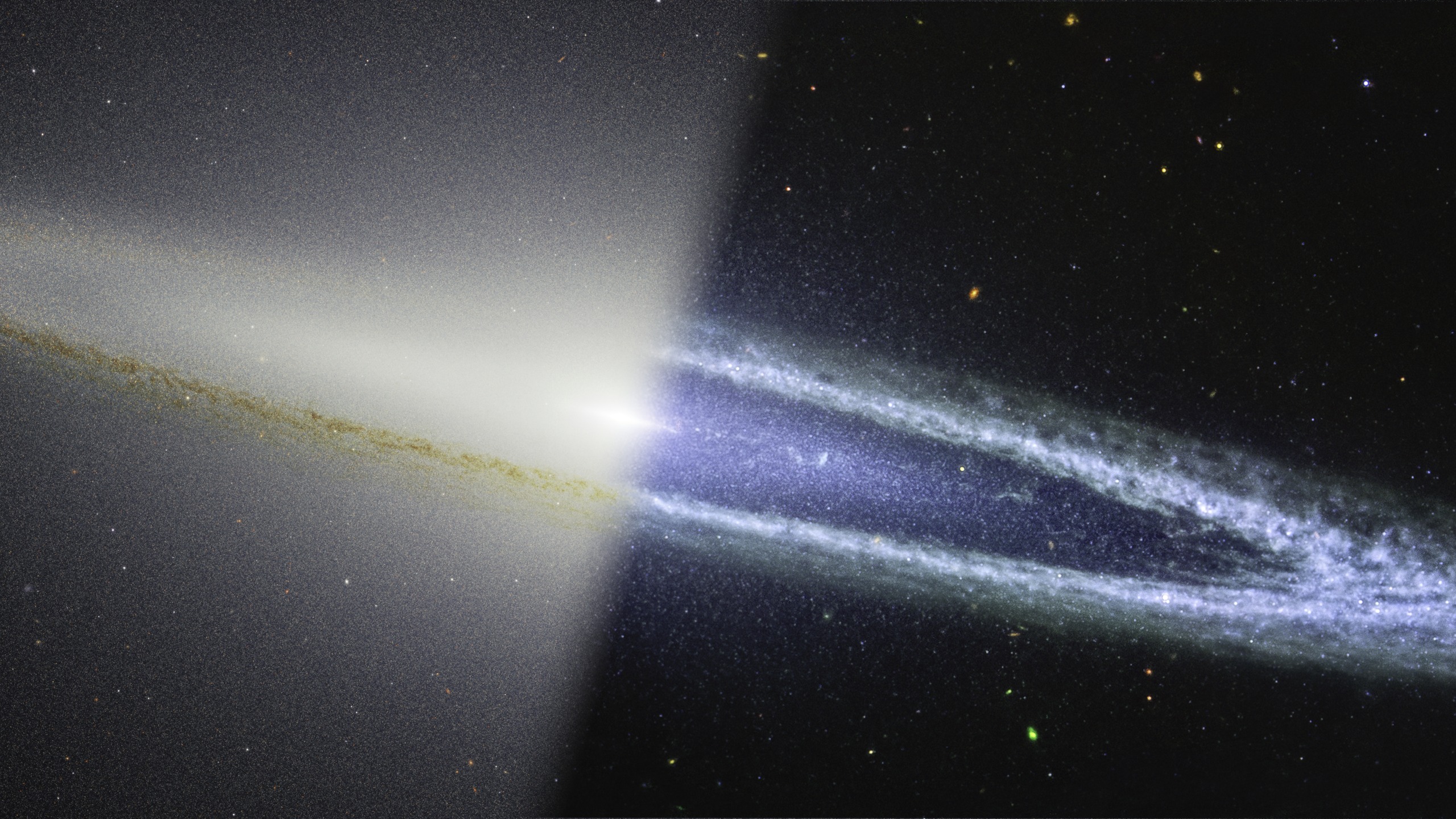
The Sombrero galaxy is split diagonally in this image: near-infrared observations from NASA’s James Webb Space Telescope are at the left, and mid-infrared observations from Webb are at the right. The near-infrared image shows where dust from the outer ring blocks stellar light from the inner portions of the galaxy. Then, in the mid-infrared image actually shows that dust glowing. The powerful resolution of Webb’s NIRCam also allows us to resolve individual stars outside of, but not necessarily at the same distance as, the galaxy, some of which appear red. These are called red giants, which are cooler stars, but their large surface area causes them to glow brightly in this image. These red giants also are detected in the mid-infrared, while the smaller, bluer stars in the near-infrared “disappear” in the longer wavelengths.
41.7k downloads
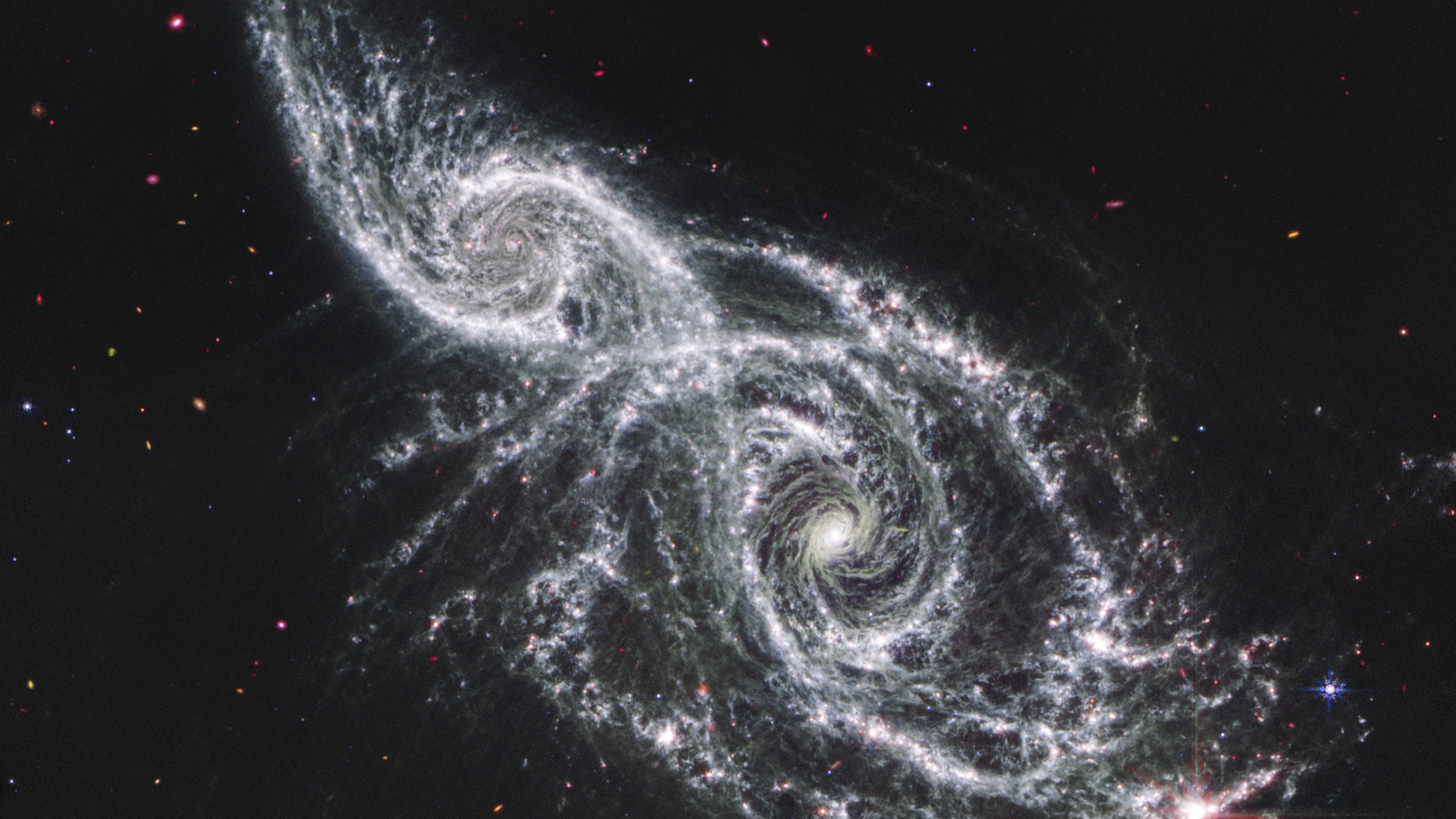
The James Webb Space Telescope’s mid-infrared image of galaxies IC 2163 and NGC 2207 recalls the iciness of long-dead bones mixed with eerie vapors. Two large luminous “eyes” lie at the galaxies’ cores, and gauzy spiral arms reach out into the vast distances of space. Webb’s mid-infrared image excels at showing where the cold dust glows throughout these galaxies — and helps pinpoint where stars and star clusters are buried within the dust. Find these regions by looking for the pink dots along the spiral arms. Many of these areas are home to actively forming stars that are still encased in the gas and dust that feeds their growth. Other pink dots may be objects that lie well behind these galaxies, including extremely distant active supermassive black holes known as quasars. The largest, brightest pink region that glimmers with eight prominent diffraction spikes at the bottom right is a mini starburst — a location where many stars are forming in quick succession. Find the lace-like holes in the spiral arms. These areas are brimming with star formation. Finally, scan the black background of space, where objects shine brightly in a rainbow of colors. Blue circles with tiny diffraction spikes are foreground stars. Objects without spikes are very distant galaxies. Compare the Hubble and Webb images. Extended Description and Image Alt Text
18.4k downloads
This image of Arp 107, shown by Webb’s MIRI (Mid-Infrared Instrument), reveals the supermassive black hole that lies in the center of the large spiral galaxy to the right. This black hole, which pulls much of the dust into lanes, also display’s Webb’s characteristic diffraction spikes, caused by the light that it emits interacting with the structure of the telescope itself. Perhaps the defining feature of the region, which MIRI reveals, are the millions of young stars that are forming, highlighted in blue. These stars are surrounded by dusty silicates and soot-like molecules known as polycyclic aromatic hydrocarbons. The small elliptical galaxy to the left, which has already gone through much of its star formation, is composed of many of these organic molecules.
36.7k downloads
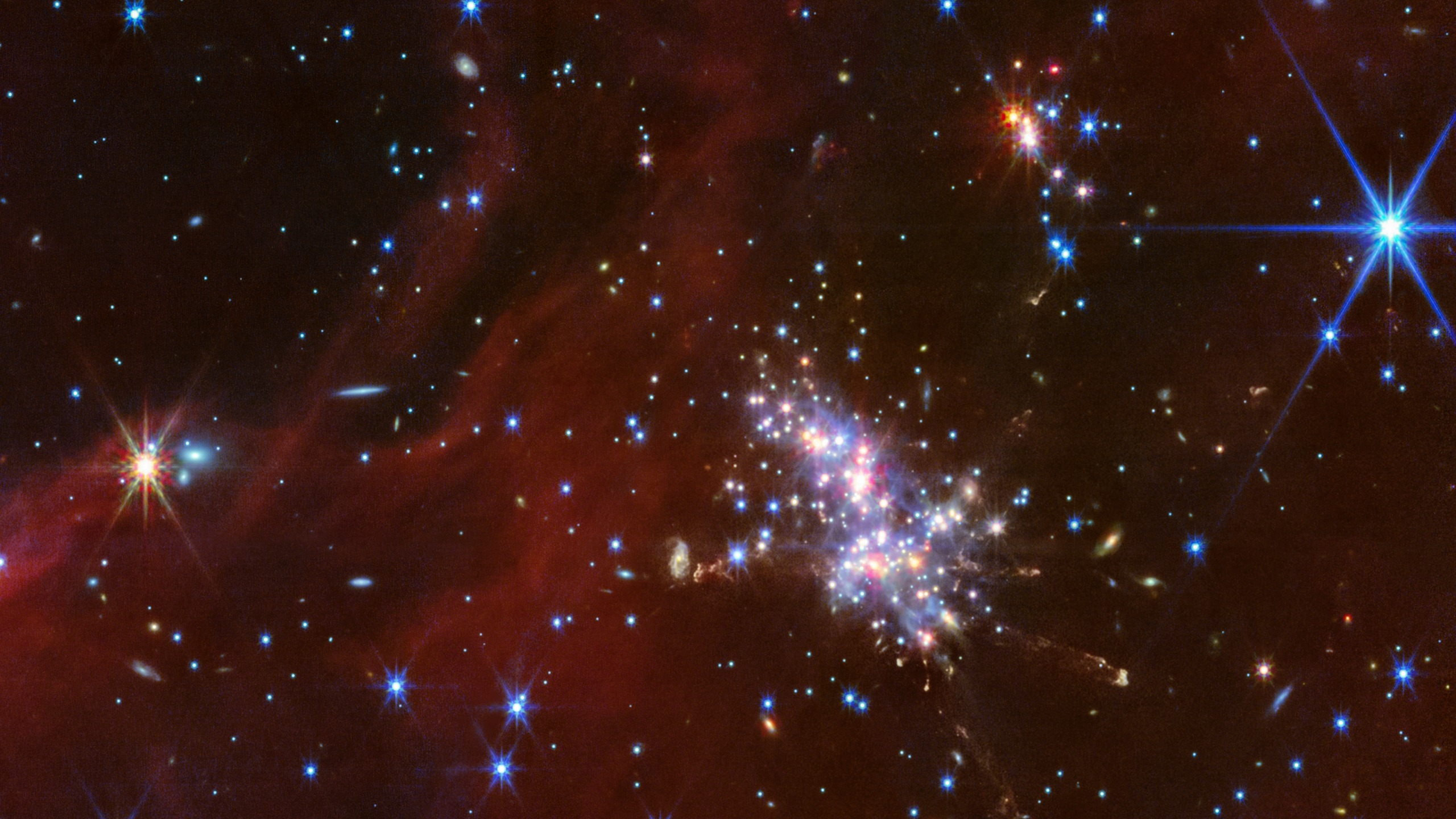
NASA’s James Webb Space Telescope observed the outskirts of our Milky Way galaxy. Known as the Extreme Outer Galaxy, this region is located more than 58,000 light-years from the Galactic Center. To learn more about how a local environment affects the star formation process within it, a team of scientists directed the telescope’s NIRCam (Near-Infrared Camera) and MIRI (Mid-Infrared Instrument) toward a total of four star-forming areas within Digel Clouds 1 and 2: 1A, 1B, 2N, and 2S. In the case of Cloud 2S, shown here, Webb revealed a luminous main cluster that contains newly formed stars. Several of these young stars are emitting extended jets of material from their poles. To the main cluster’s top right is a sub-cluster of stars, a feature that scientists previously suspected to exist but has now been confirmed with Webb. Additionally, the telescope revealed a deep sea of background galaxies and red nebulous structures that are being carved away by winds and radiation from nearby stars.
26.5k downloads
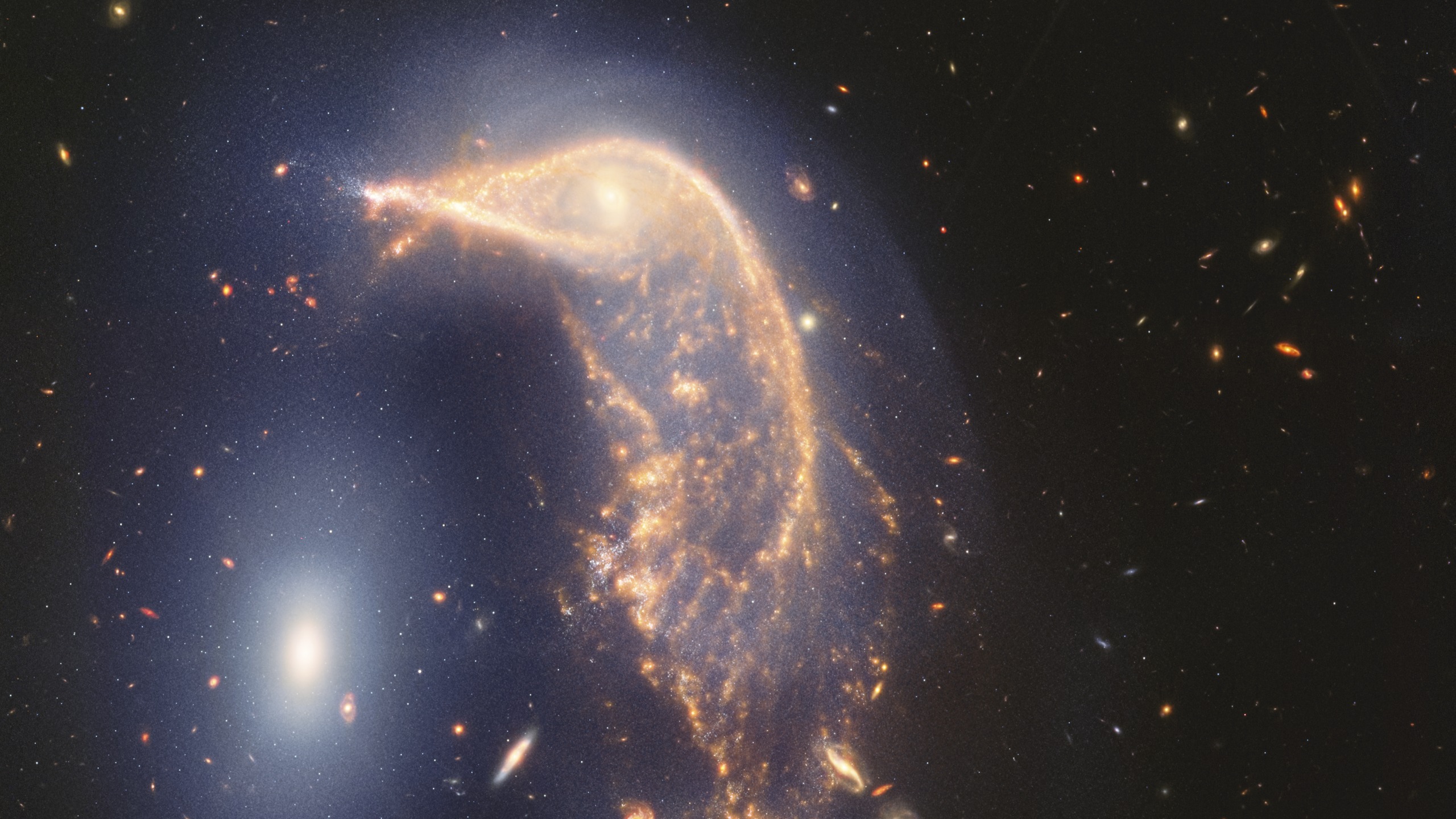
This “penguin party” is loud! The distorted spiral galaxy at center, the Penguin, and the compact elliptical galaxy at left, the Egg, are locked in an active embrace. A new near- and mid-infrared image from the James Webb Space Telescope, taken to mark its second year of science, shows that their interaction is marked by a faint upside-down U-shaped blue glow. The pair, known jointly as Arp 142, made their first pass between 25 and 75 million years ago — causing “fireworks,” or new star formation, in the Penguin. In the most extreme cases, mergers can cause galaxies to form thousands of new stars per year, for a few million years. For the Penguin, research has shown that about 100 to 200 stars have formed per year. By comparison, our Milky Way galaxy (which is not interacting with a galaxy of the same size) forms roughly six to seven new stars per year. This gravitational shimmy also remade the Penguin’s appearance. Its coiled spiral arms unwound, and gas and dust were pulled in an array of directions, like it was releasing confetti. It is rare for individual stars to collide when galaxies interact (space is vast), but galaxies’ mingling disrupts stars’ orbits. Today, the Penguin’s galactic center looks like an eye set within a head, and the galaxy has prominent star trails that take the shape of a beak, backbone, and fanned-out tail. A faint, but prominent dust lane extends from its beak down to its tail. Despite the Penguin appearing far larger than the Egg, these galaxies have approximately the same mass. This is one reason why the smaller-looking Egg hasn’t yet merged with the Penguin. (If one was less massive, it may have merged earlier.) The oval Egg is filled with old stars, and little gas and dust, which is why it isn’t sending out “streamers” or tidal tails of its own and instead has maintained a compact oval shape. If you look closely, the Egg has four prominent diffraction spikes — the galaxy’s stars are so concentrated that it gleams. Now, find the bright, edge-on galaxy at top right. It may look like a party crasher, but it’s not nearby. Cataloged PGC 1237172, it lies 100 million light-years closer to Earth. It is relatively young and isn’t overflowing with dust, which is why it practically disappears in Webb’s mid-infrared view. The background of this image is overflowing with far more distant galaxies. This is a testament to the sensitivity and resolution of Webb’s infrared cameras. Additional images of Arp 142 are available at left, under the Download Options, including a cropped image (like the one above) that features only near-infrared light, and a wider near-infrared field of view, which features an even greater number of distant galaxies. Arp 142 lies 326 million light-years from Earth in the constellation Hydra. Extended Description and Image Alt Text
36.8k downloads
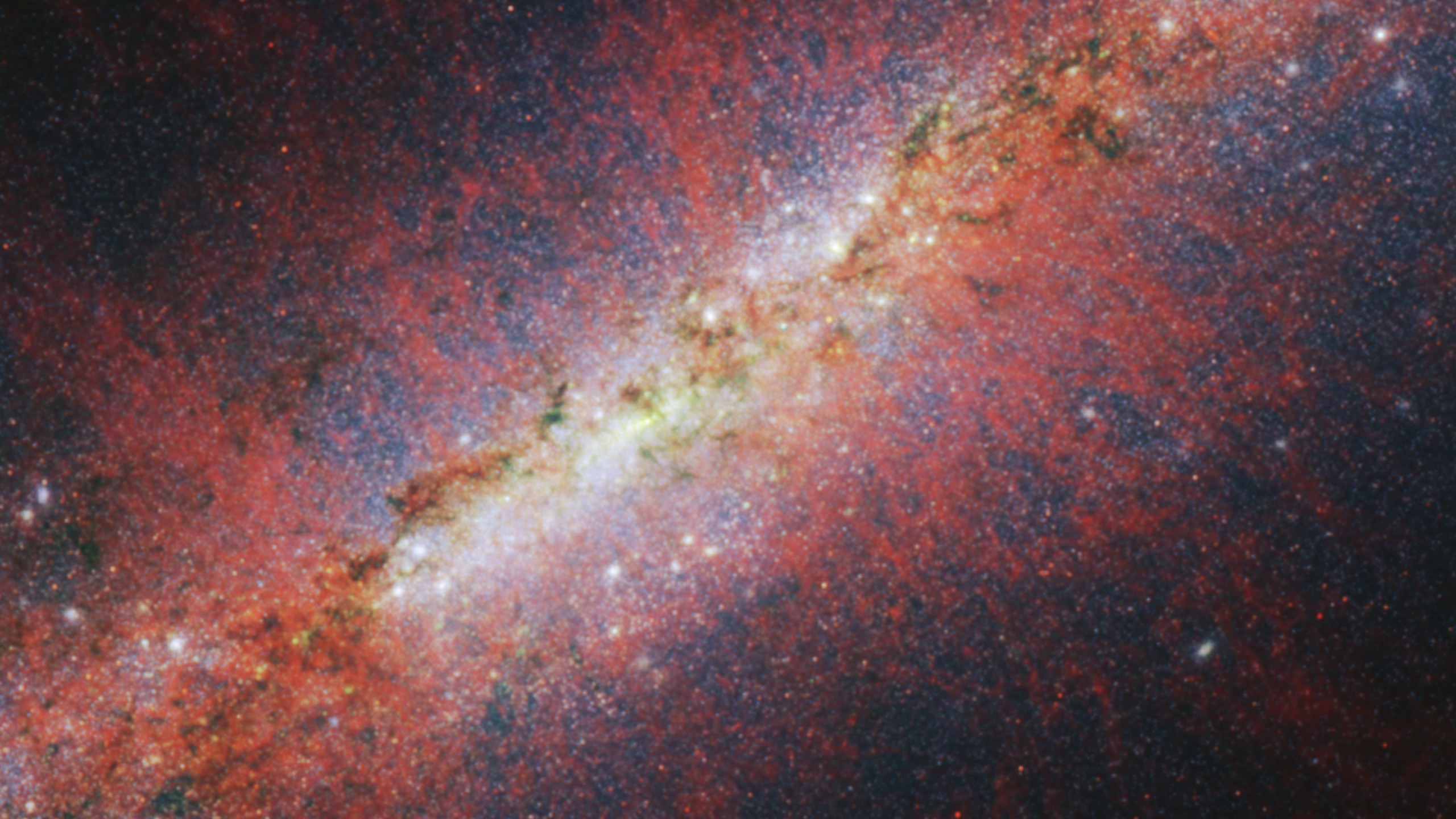
Astronomers used the James Webb Space Telescope to look toward M82’s center, where a galactic wind is being launched as a result of rapid star formation and subsequent supernovas. Studying the galactic wind can offer insight into how the loss of gas shapes the future growth of the galaxy. This image from Webb’s NIRCam (Near-Infrared Camera) instrument shows M82’s galactic wind via emission from sooty chemical molecules known as polycyclic aromatic hydrocarbons (PAHs). PAHs are very small dust grains that survive in cooler temperatures but are destroyed in hot conditions. The structure of the emission resembles that of hot, ionized gas, suggesting PAHs may be replenished by continued ionization of molecular gas. In this image, light at 3.35 microns is colored red, 2.50 microns is green, and 1.64 microns is blue (filters F335M, F250M, and F164N, respectively).
23.3k downloads
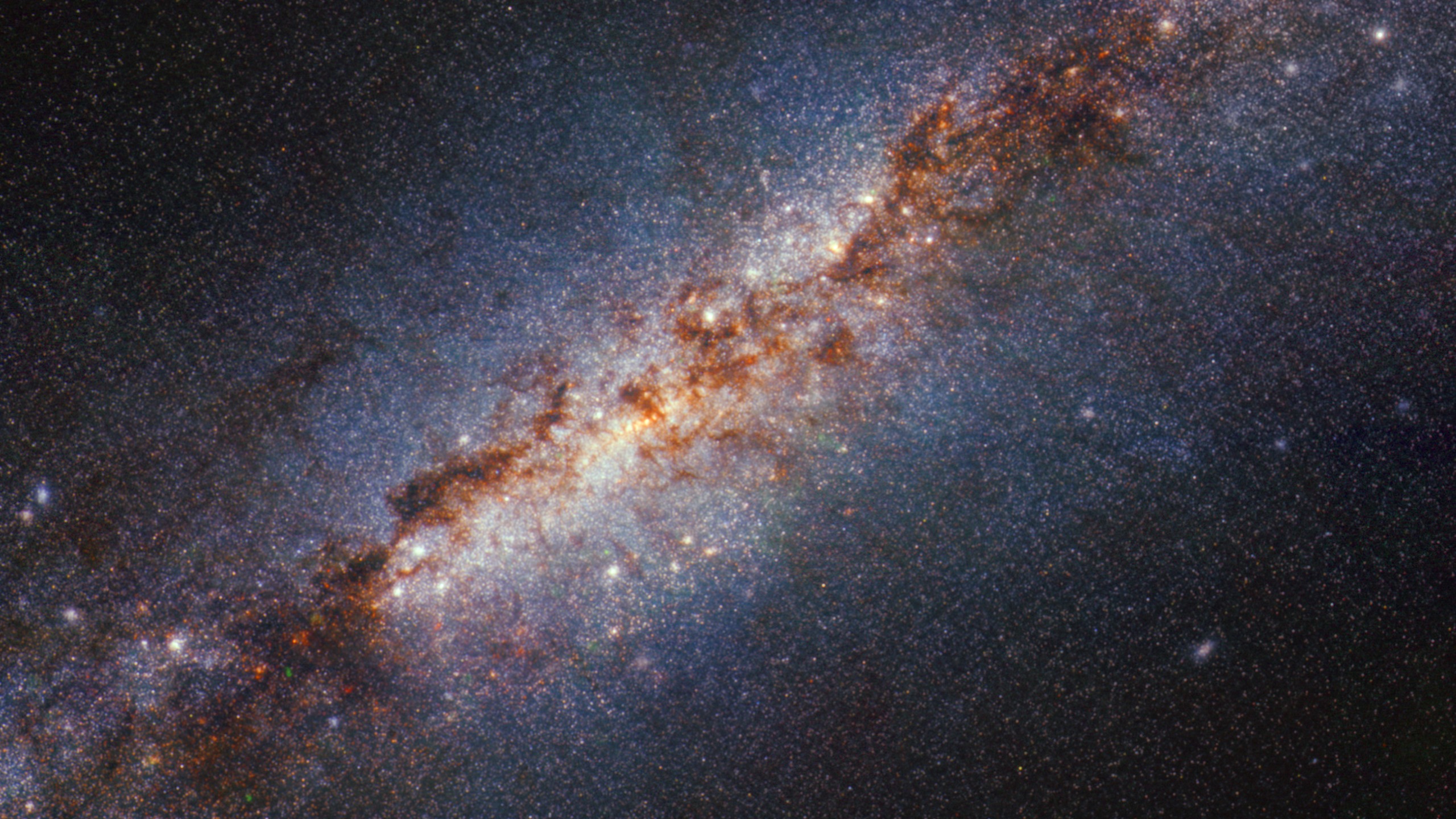
A team of astronomers used NASA’s James Webb Space Telescope to survey the starburst galaxy Messier 82 (M82), which is located 12 million light-years away in the constellation Ursa Major. M82 hosts a frenzy of star formation, sprouting new stars 10 times faster than the Milky Way galaxy. Webb’s infrared capabilities enabled scientists to peer through curtains of dust and gas that have historically obscured the star formation process. This image from Webb’s NIRCam (Near-Infrared Camera) instrument shows M82’s center in an unprecedented level of detail. With Webb’s resolution, astronomers can distinguish small, bright compact sources that are either individual stars or star clusters. Obtaining an accurate count of the stars and clusters that compose M82’s center can help astronomers understand the different phases of star formation and the timelines for each stage. In this image, light at 2.12 microns is colored red, 1.64 microns is green, and 1.40 microns is blue (filters F212N, 164N, and F140M, respectively).
34.5k downloads
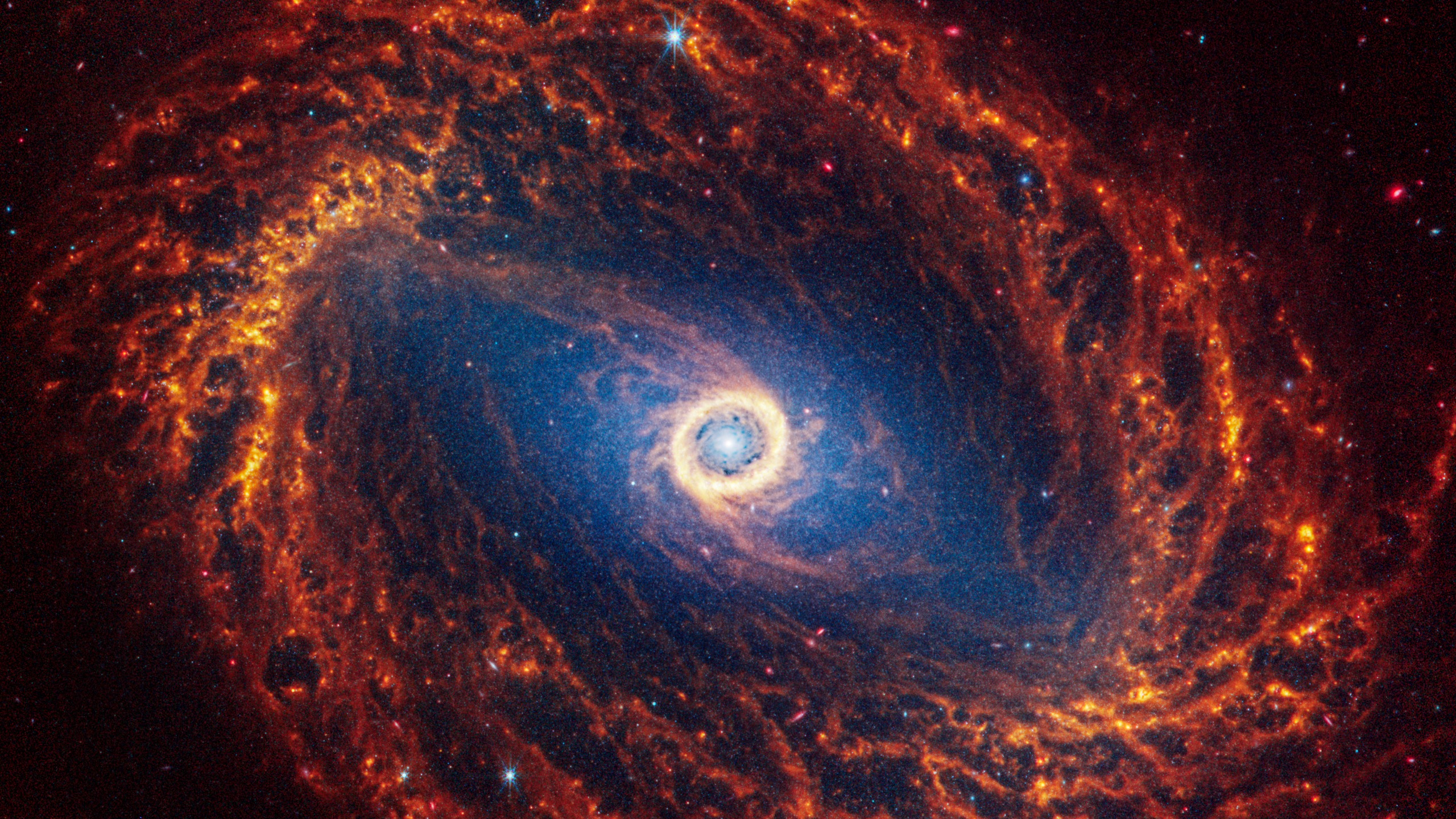
Face-on barred spiral galaxy, NGC 1512, is split diagonally in this image: The James Webb Space Telescope’s observations appear at top left, and the Hubble Space Telescope’s on bottom right. Webb and Hubble’s images show a striking contrast, an inverse of darkness and light. Why? Webb’s observations combine near- and mid-infrared light and Hubble’s showcase visible and ultraviolet light. Dust absorbs ultraviolet and visible light, and then re-emits it in the infrared. In Webb's images, we see dust glowing in infrared light. In Hubble’s images, dark regions are where starlight is absorbed by dust. The individual Webb and Hubble images are available for download using the links on the left side of this page. Background galaxies Webb’s image includes distant galaxies that are located well behind the tightly cropped foreground galaxy. Look for bright blue and pink disks, some seen edge-on, like a plate with a central sphere. Redder galaxies are more distant. In Hubble’s view, distant galaxies are often light orange if they are slightly closer. Like in Webb's image, those that are deeper red are also more distant. Galaxy NGC 1512 was observed as part of the Physics at High Angular resolution in Nearby GalaxieS (PHANGS) program, a large project that includes observations from several space- and ground-based telescopes of many galaxies to help researchers study all phases of the star formation cycle, from the formation of stars within dusty gas clouds to the energy released in the process that creates the intricate structures revealed by Webb’s new images. NGC 1512 is 30 million light-years away in the constellation Horologium. Extended Description and Image Alt Text
23.9k downloads
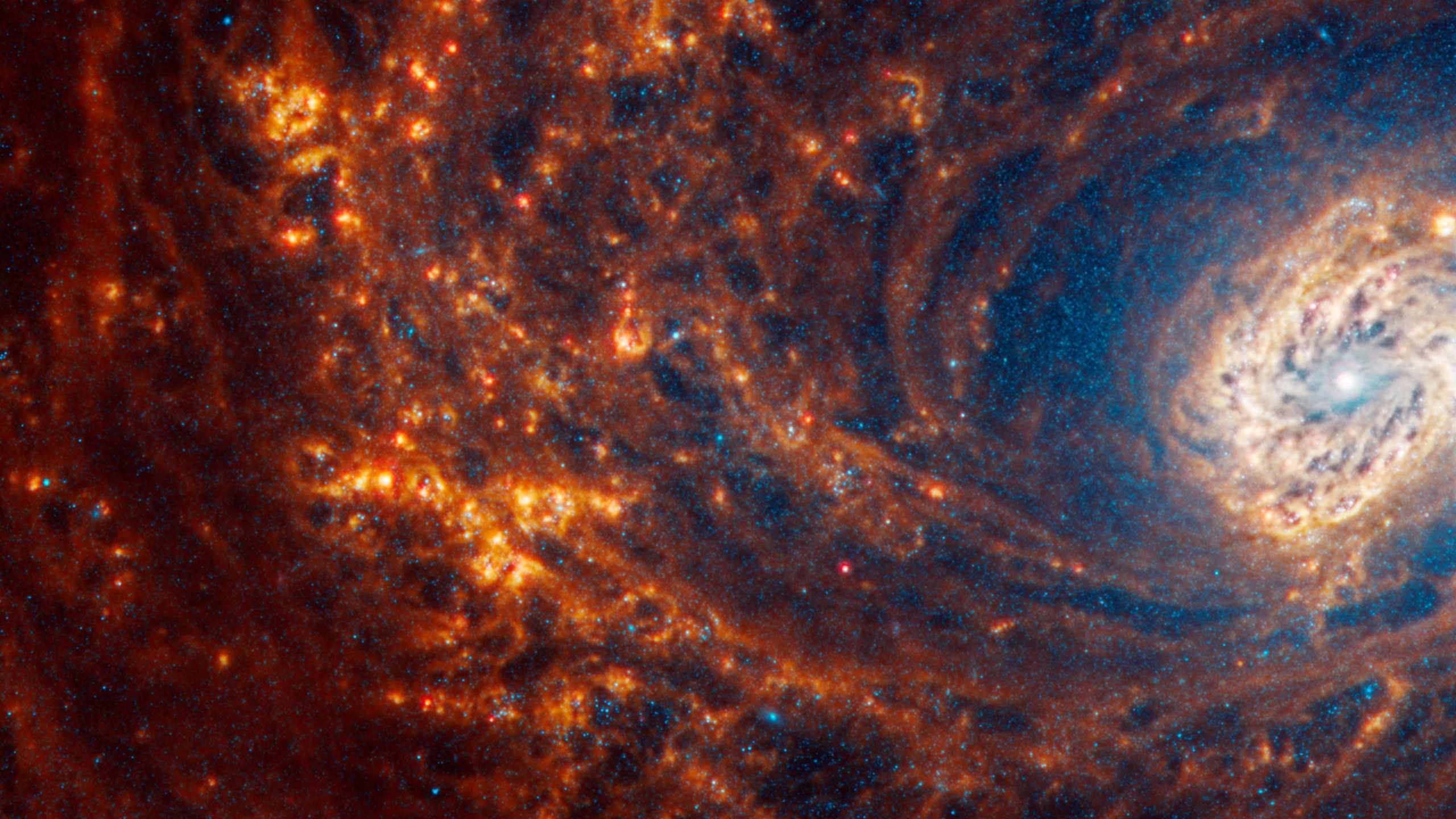
Face-on spiral galaxy, NGC 4321, is split diagonally in this image: The James Webb Space Telescope’s observations appear at bottom left, and the Hubble Space Telescope’s on top right. Webb and Hubble’s images show a striking contrast, an inverse of darkness and light. Why? Webb’s observations combine near- and mid-infrared light and Hubble’s showcase visible light. Dust absorbs ultraviolet and visible light, and then re-emits it in the infrared. In Webb's images, we see dust glowing in infrared light. In Hubble’s images, dark regions are where starlight is absorbed by dust. Background Galaxies Webb’s image includes distant galaxies that are located well behind the tightly cropped foreground galaxy. Look for bright blue and pink disks, some seen edge-on, like a plate with a central sphere. Redder galaxies are more distant. In Hubble’s view, distant galaxies are often light orange if they are slightly closer. Like in Webb's image, those that are deeper red are also more distant. Galaxy NGC 4321 was observed as part of the Physics at High Angular resolution in Nearby GalaxieS (PHANGS) program, a large project that includes observations from several space- and ground-based telescopes of many galaxies to help researchers study all phases of the star formation cycle, from the formation of stars within dusty gas clouds to the energy released in the process that creates the intricate structures revealed by Webb’s new images. NGC 4321 is 55 million light-years away in the constellation Coma Berenices. Extended Description and Image Alt Text
27.4k downloads
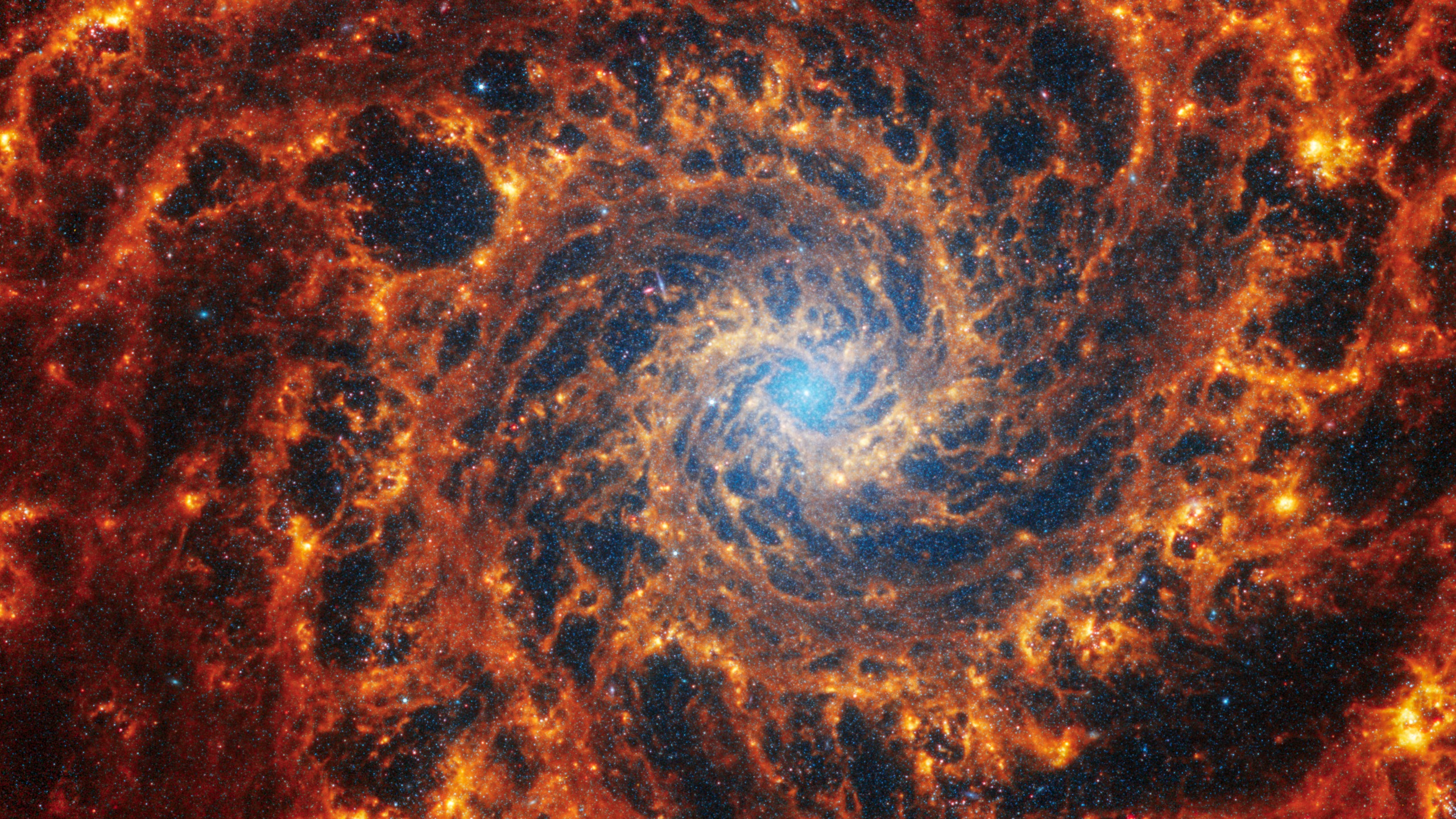
Face-on spiral galaxy, NGC 628, is split diagonally in this image: The James Webb Space Telescope’s observations appear at top left, and the Hubble Space Telescope’s on bottom right. Webb and Hubble’s images show a striking contrast, an inverse of darkness and light. Why? Webb’s observations combine near- and mid-infrared light and Hubble’s showcase visible light. Dust absorbs ultraviolet and visible light, and then re-emits it in the infrared. In Webb's images, we see dust glowing in infrared light. In Hubble’s images, dark regions are where starlight is absorbed by dust. Webb’s image includes distant galaxies that are located well behind the tightly cropped foreground galaxy. Look for bright blue and pink disks, some seen edge-on, like a plate with a central sphere. Redder galaxies are more distant. In Hubble’s view, distant galaxies are often light orange if they are slightly closer. Like in Webb's image, those that are deeper red are also more distant. Galaxy NGC 628 was observed as part of the Physics at High Angular resolution in Nearby GalaxieS (PHANGS) program, a large project that includes observations from several space- and ground-based telescopes of many galaxies to help researchers study all phases of the star formation cycle, from the formation of stars within dusty gas clouds to the energy released in the process that creates the intricate structures revealed by Webb’s new images. NGC 628 is 32 million light-years away in the constellation Pisces. Extended Description and Image Alt Text
21.8k downloads
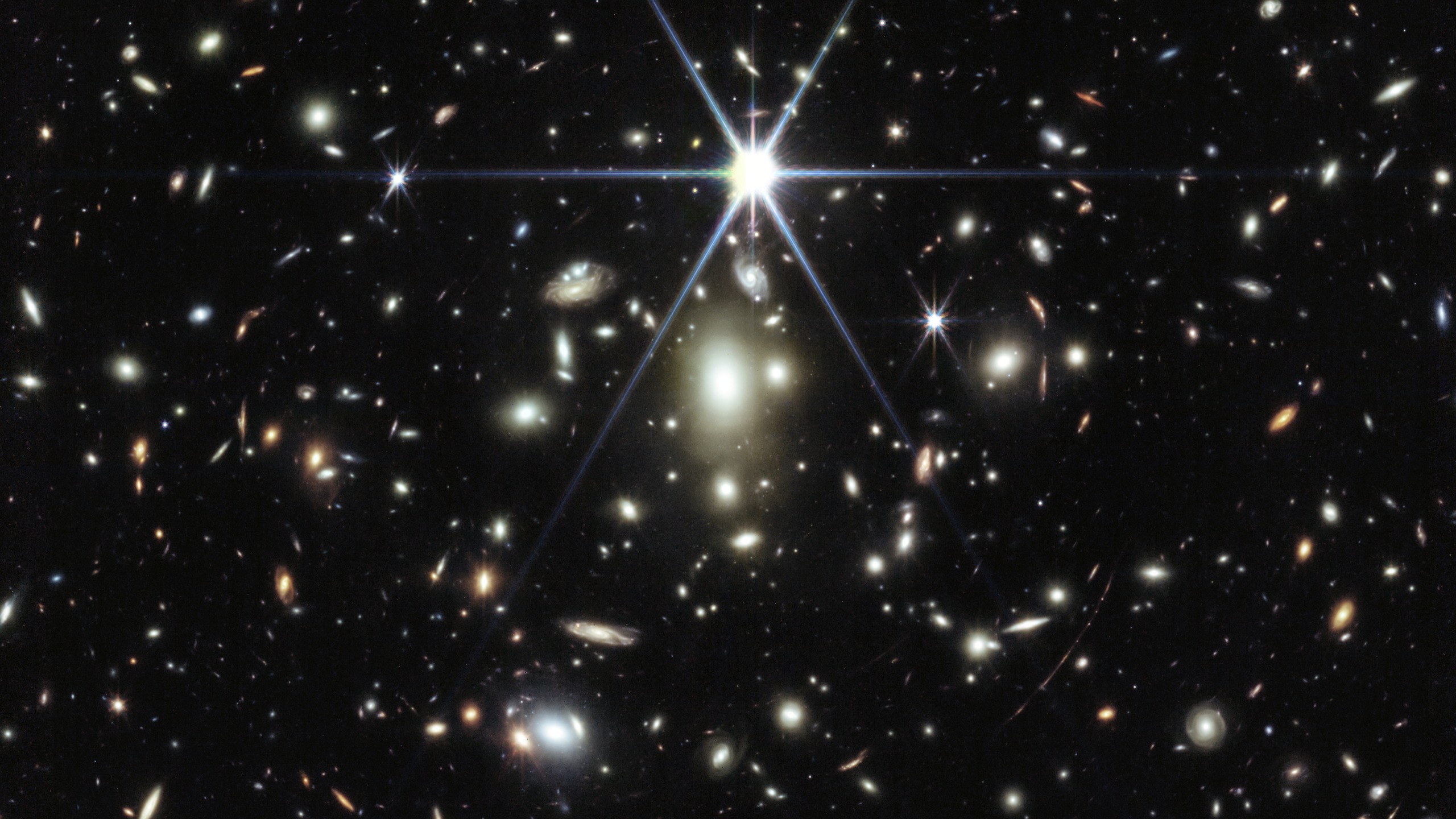
This image from NASA’s James Webb Space Telescope of a massive galaxy cluster called WHL0137-08 contains the most strongly magnified galaxy known in the universe’s first billion years: the Sunrise Arc, and within that galaxy, the most distant star ever detected. The star, nicknamed Earendel, was first discovered by the Hubble Space Telescope. Follow-up observations using Webb’s NIRCam (Near-Infrared Camera) reveals the star to be a massive B-type star more than twice as hot as our Sun, and about a million times more luminous. Earendel is positioned along a wrinkle in spacetime that gives it extreme magnification, allowing it to emerge into view from its host galaxy, which appears as a red smear across the sky. The star is detectable only due to the combined power of human technology and nature via an effect called gravitational lensing. In this image, the Sunrise Arc appears just below the diffraction spike at the 5 o’clock position. The fuzzier, white galaxies at the center of the image are part of the galaxy cluster bound together by gravity. The various redder, curved galaxies are background galaxies picked up by Webb’s sensitive mirror.
5.1k downloads
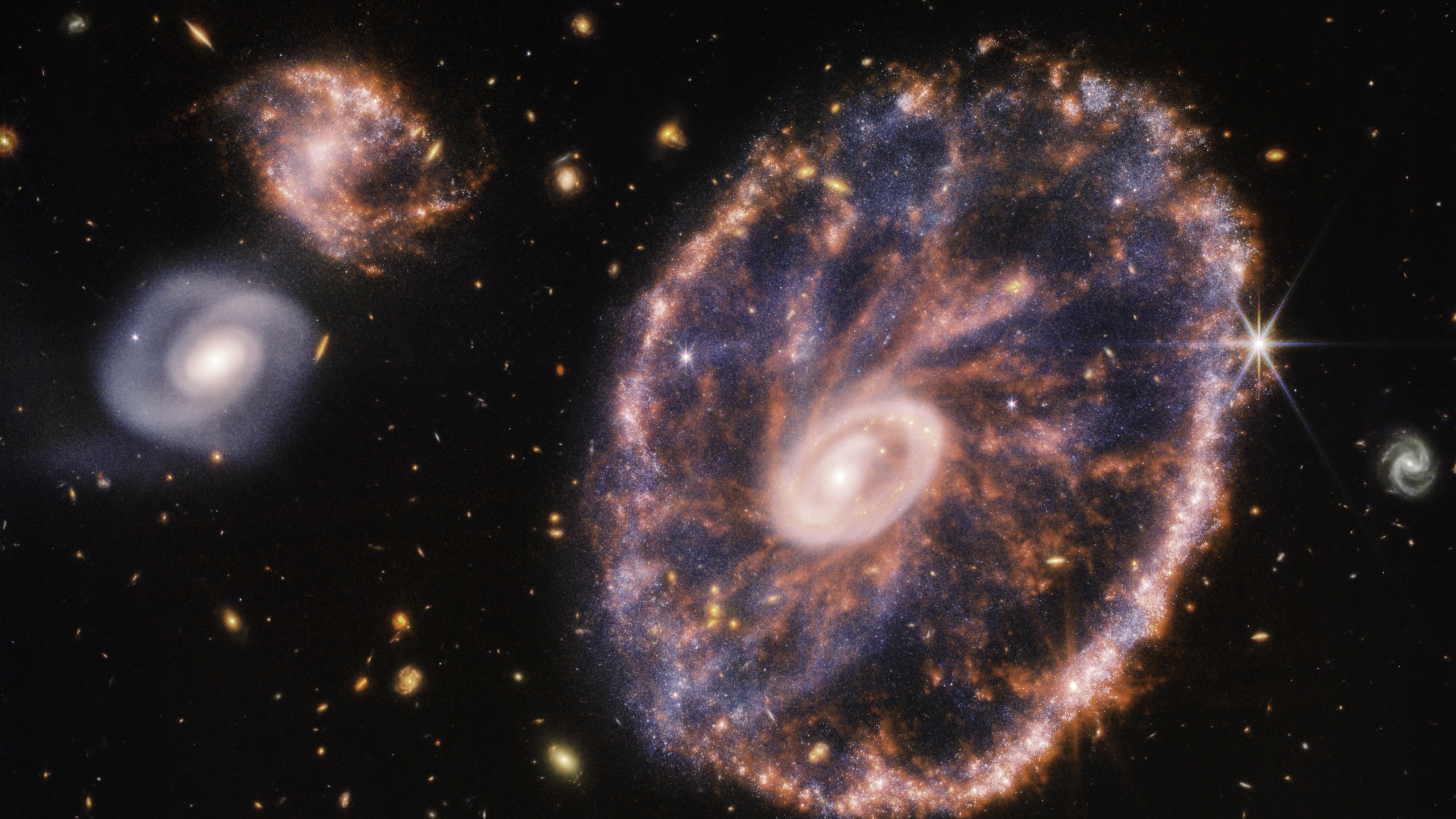
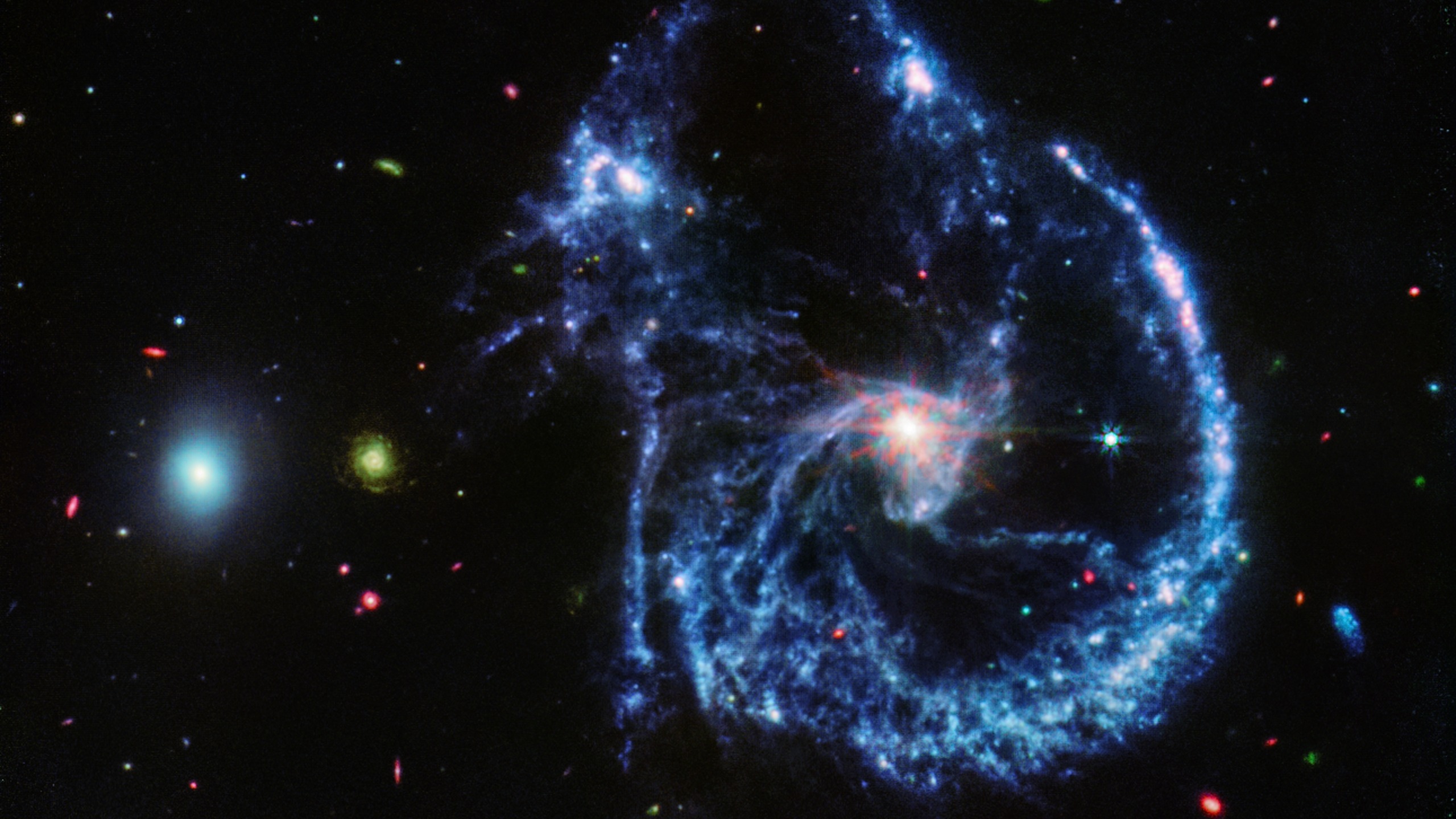
This image of the Cartwheel and its companion galaxies is a composite from Webb’s Near-Infrared Camera (NIRCam) and Mid-Infrared Instrument (MIRI), which reveals details that are difficult to see in the individual images alone. This galaxy formed as the result of a high-speed collision that occurred about 400 million years ago. The Cartwheel is composed of two rings, a bright inner ring and a colorful outer ring. Both rings expand outward from the center of the collision like shockwaves. However, despite the impact, much of the character of the large, spiral galaxy that existed before the collision remains, including its rotating arms. This leads to the “spokes” that inspired the name of the Cartwheel Galaxy, which are the bright red streaks seen between the inner and outer rings. These brilliant red hues, located not only throughout the Cartwheel, but also the companion spiral galaxy at the top left, are caused by glowing, hydrocarbon-rich dust. In this near- and mid-infrared composite image, MIRI data are colored red while NIRCam data are colored blue, orange, and yellow. Amidst the red swirls of dust, there are many individual blue dots, which represent individual stars or pockets of star formation. NIRCam also defines the difference between the older star populations and dense dust in the core and the younger star populations outside of it. Webb’s observations capture the Cartwheel in a very transitory stage. The form that the Cartwheel Galaxy will eventually take, given these two competing forces, is still a mystery. However, this snapshot provides perspective on what happened to the galaxy in the past and what it will do in the future. NIRCam was built by a team at the University of Arizona and Lockheed Martin’s Advanced Technology Center. MIRI was contributed by ESA and NASA, with the instrument designed and built by a consortium of nationally funded European Institutes (The MIRI European Consortium) in partnership with JPL and the University of Arizona.
19.3k downloads
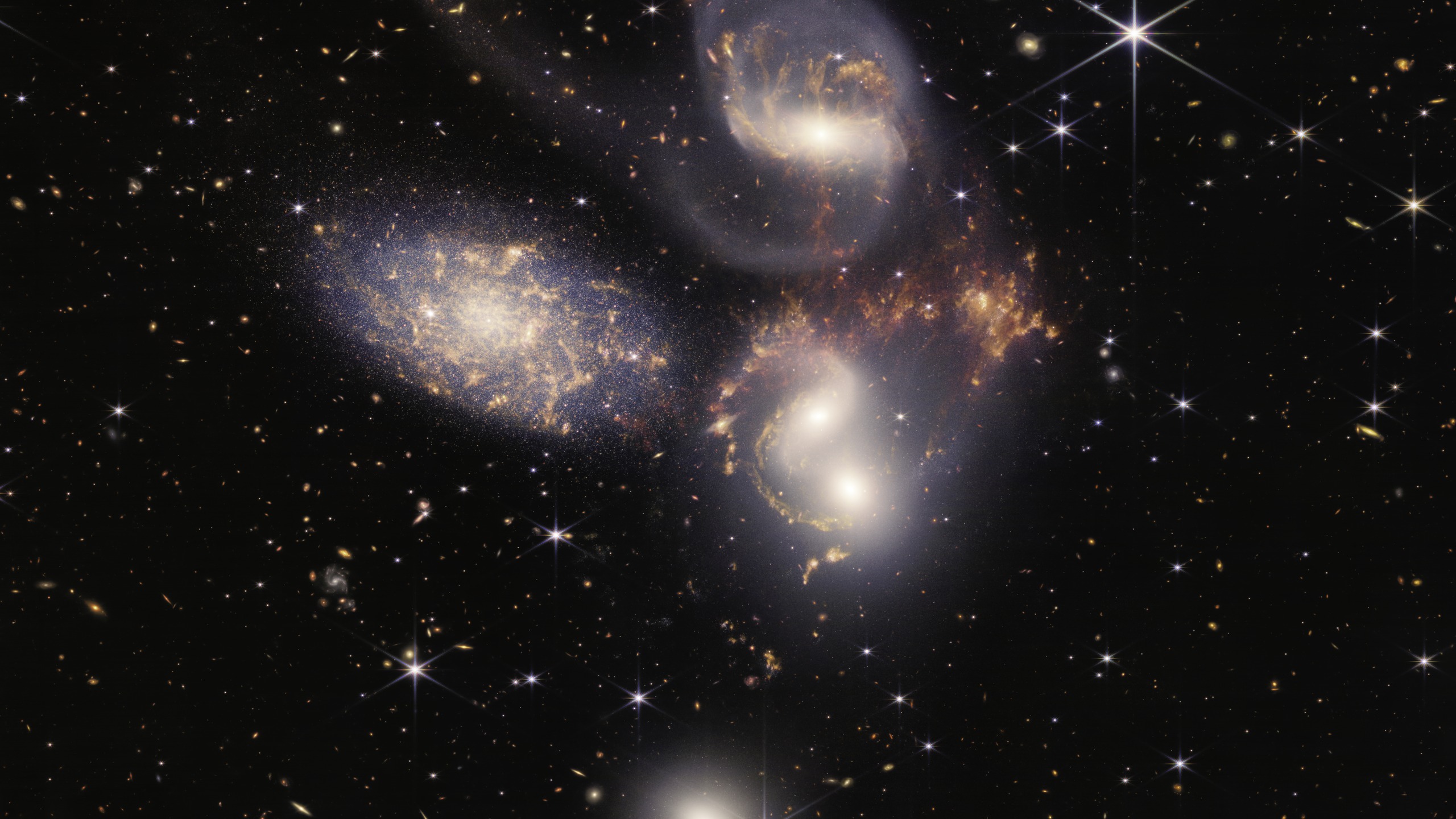
An enormous mosaic of Stephan's Quintet is the largest image to date from NASA's James Webb Space Telescope, covering about one-fifth of the Moon's diameter. It contains over 150 million pixels and is constructed from almost 1,000 separate image files. The visual grouping of five galaxies was captured by Webb's Near-Infrared Camera (NIRCam) and Mid-Infrared Instrument (MIRI). With its powerful, infrared vision and extremely high spatial resolution, Webb shows never-before-seen details in this galaxy group. Sparkling clusters of millions of young stars and starburst regions of fresh star birth grace the image. Sweeping tails of gas, dust and stars are being pulled from several of the galaxies due to gravitational interactions. Most dramatically, Webb's MIRI instrument captures huge shock waves as one of the galaxies, NGC 7318B, smashes through the cluster.
21.3k downloads
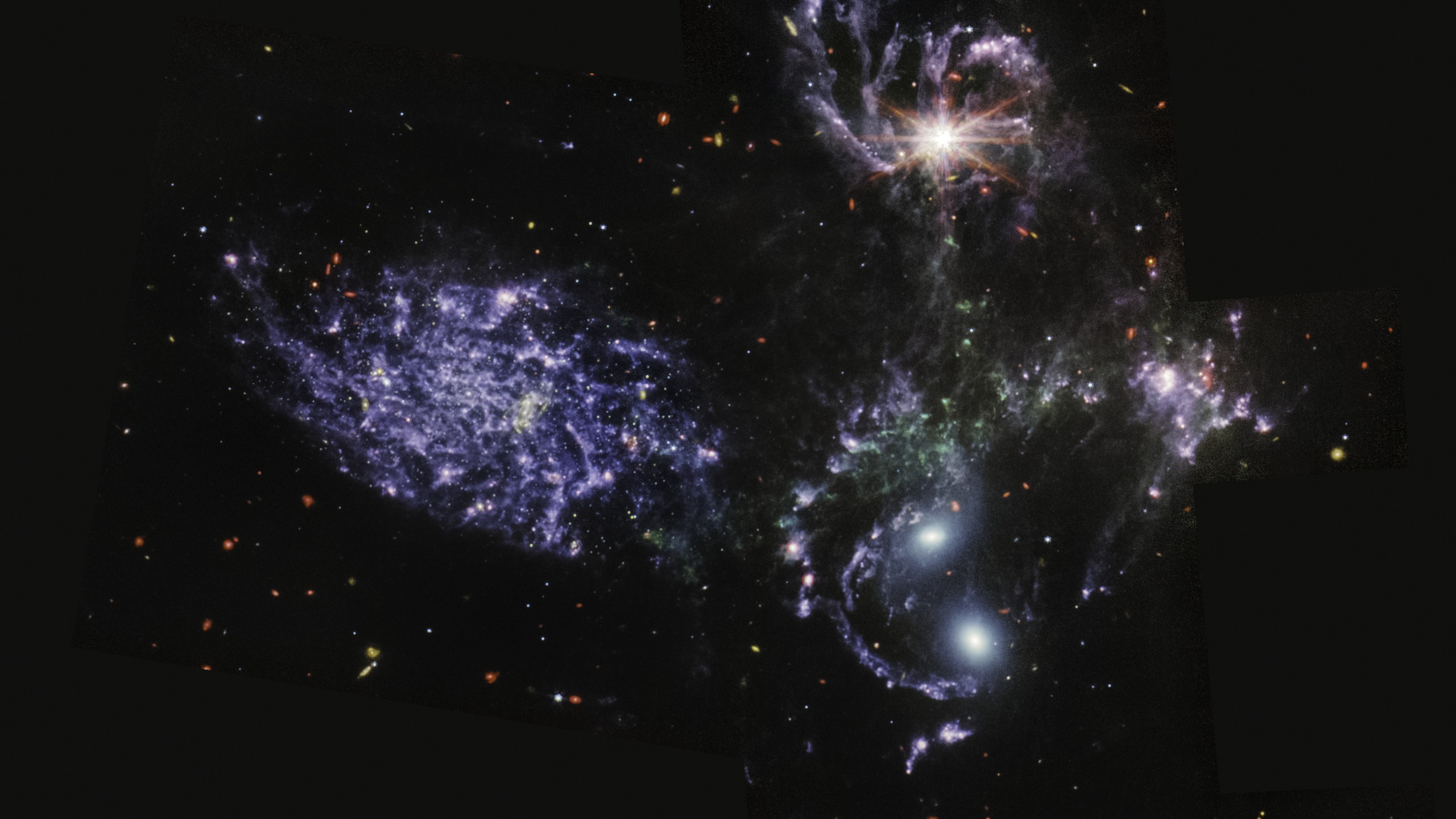
With its powerful, mid-infrared vision, the Mid-Infrared Instrument (MIRI) shows never-before-seen details of Stephan’s Quintet, a visual grouping of five galaxies. MIRI pierced through dust-enshrouded regions to reveal huge shock waves and tidal tails, gas and stars stripped from the outer regions of the galaxies by interactions. It also unveiled hidden areas of star formation. The new information from MIRI provides invaluable insights into how galactic interactions may have driven galaxy evolution in the early universe. This image contains one more MIRI filter than was used in the NIRCam-MIRI composite picture. The image processing specialists at the Space Telescope Science Institute in Baltimore opted to use all three MIRI filters and the colors red, green and blue to most clearly differentiate the galaxy features from each other and the shock waves between the galaxies. In this image, red denotes dusty, star-forming regions, as well as extremely distant, early galaxies and galaxies enshrouded in thick dust. Blue point sources show stars or star clusters without dust. Diffuse areas of blue indicate dust that has a significant amount of large hydrocarbon molecules. For small background galaxies scattered throughout the image, the green and yellow colors represent more distant, earlier galaxies that are rich in these hydrocarbons as well. Stephan’s Quintet’s topmost galaxy – NGC 7319 – harbors a supermassive black hole 24 million times the mass of the Sun. It is actively accreting material and puts out light energy equivalent to 40 billion Suns. MIRI sees through the dust surrounding this black hole to unveil the strikingly bright active galactic nucleus. As a bonus, the deep mid-infrared sensitivity of MIRI revealed a sea of previously unresolved background galaxies reminiscent of Hubble’s Deep Fields. Together, the five galaxies of Stephan’s Quintet are also known as the Hickson Compact Group 92 (HCG 92). Although called a “quintet,” only four of the galaxies are truly close together and caught up in a cosmic dance. The fifth and leftmost galaxy, called NGC 7320, is well in the foreground compared with the other four. NGC 7320 resides 40 million light-years from Earth, while the other four galaxies (NGC 7317, NGC 7318A, NGC 7318B, and NGC 7319) are about 290 million light-years away. This is still fairly close in cosmic terms, compared with more distant galaxies billions of light-years away. Studying these relatively nearby galaxies helps scientists better understand structures seen in a much more distant universe. This proximity provides astronomers a ringside seat for witnessing the merging of and interactions between galaxies that are so crucial to all of galaxy evolution. Rarely do scientists see in so much exquisite detail how interacting galaxies trigger star formation in each other, and how the gas in these galaxies is being disturbed. Stephan’s Quintet is a fantastic “laboratory” for studying these processes fundamental to all galaxies. Tight groups like this may have been more common in the early universe when their superheated, infalling material may have fueled very energetic black holes called quasars. Even today, the topmost galaxy in the group – NGC 7319 – harbors an active galactic nucleus, a supermassive black hole that is actively pulling in material. MIRI was contributed by ESA and NASA, with the instrument designed and built by a consortium of nationally funded European Institutes (The MIRI European Consortium) in partnership with JPL and the University of Arizona. For a full array of Webb’s first images and spectra, including downloadable files, please visit: https://webbtelescope.org/news/first-images
22.6k downloads