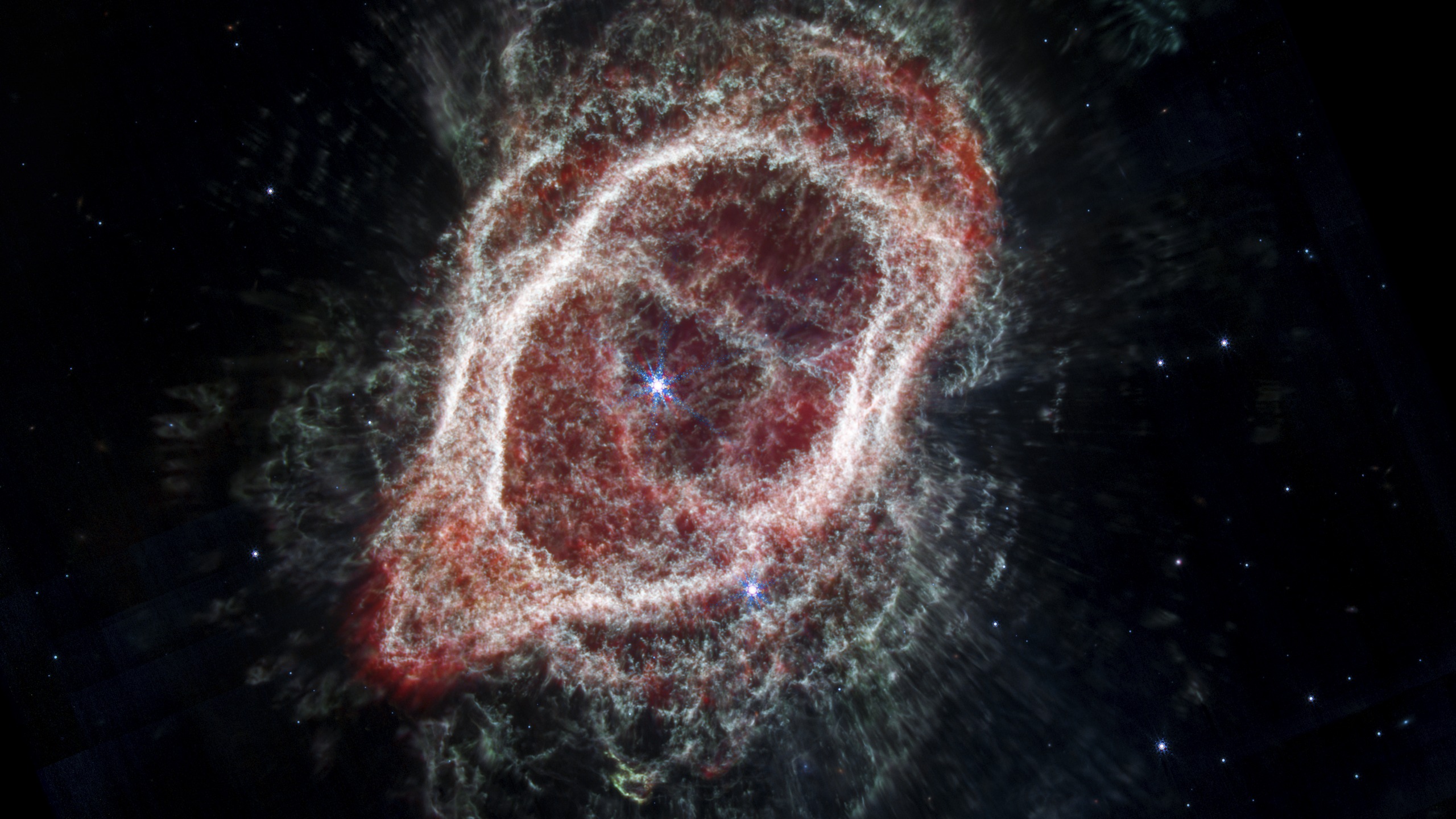
Some of the most beautiful JWST photos aren’t stars being born at all. They’re stars dying. Those glowing rings you see are literally the star’s last few breaths, spread out in front of a camera powerful enough to catch every layer.
The Basics
How does a star actually die?
Most stars, including our own Sun someday, don’t die in a sudden explosion. They die slowly. Near the end of its life, a star runs low on fuel, swells up, and starts shedding its outer layers into space. What’s left behind is a small, hot leftover core, called a white dwarf, surrounded by the gas and dust the star just shed. That gas and dust is often cold, which is exactly the kind of thing infrared telescopes are built to see through. Astronomers call this glowing shape a planetary nebula, even though it has nothing to do with planets. Early astronomers just thought the round, glowing shape looked a bit like one through their small telescopes, and the name stuck.
Bigger, heavier stars die differently, in a sudden violent explosion called a supernova. But the rings in this post, and the ones you’ve probably seen in JWST photos, come from the slower, gentler kind of death.
How It Works
Why does the star leave rings instead of just fading away?
A dying star doesn’t shed its outer layers in one smooth, continuous puff. It happens in separate episodes, one pulse of gas at a time, with real gaps of hundreds or thousands of years between each pulse. Since every pulse happens at a different moment and expands outward at its own pace, each one keeps its own separate shape instead of blurring into the last one. That’s why the final picture looks like a set of rings, or layers of an onion, instead of one plain cloud.
And yes, every ring really is its own separate physical shell of gas and dust. It’s not a lighting effect or a pattern in the color processing. Each ring is genuine material the star threw off at a specific point in time, still expanding outward today.
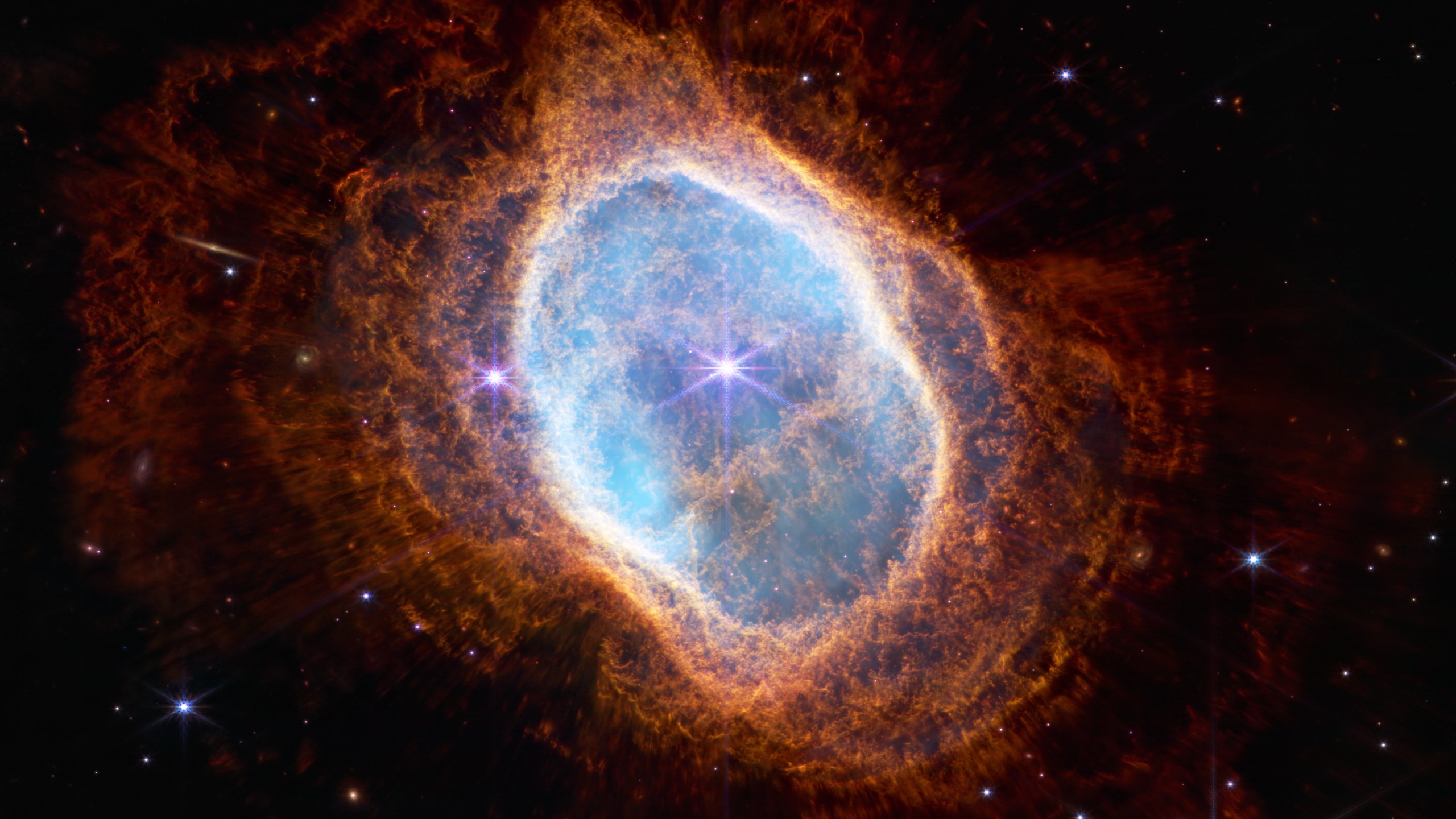
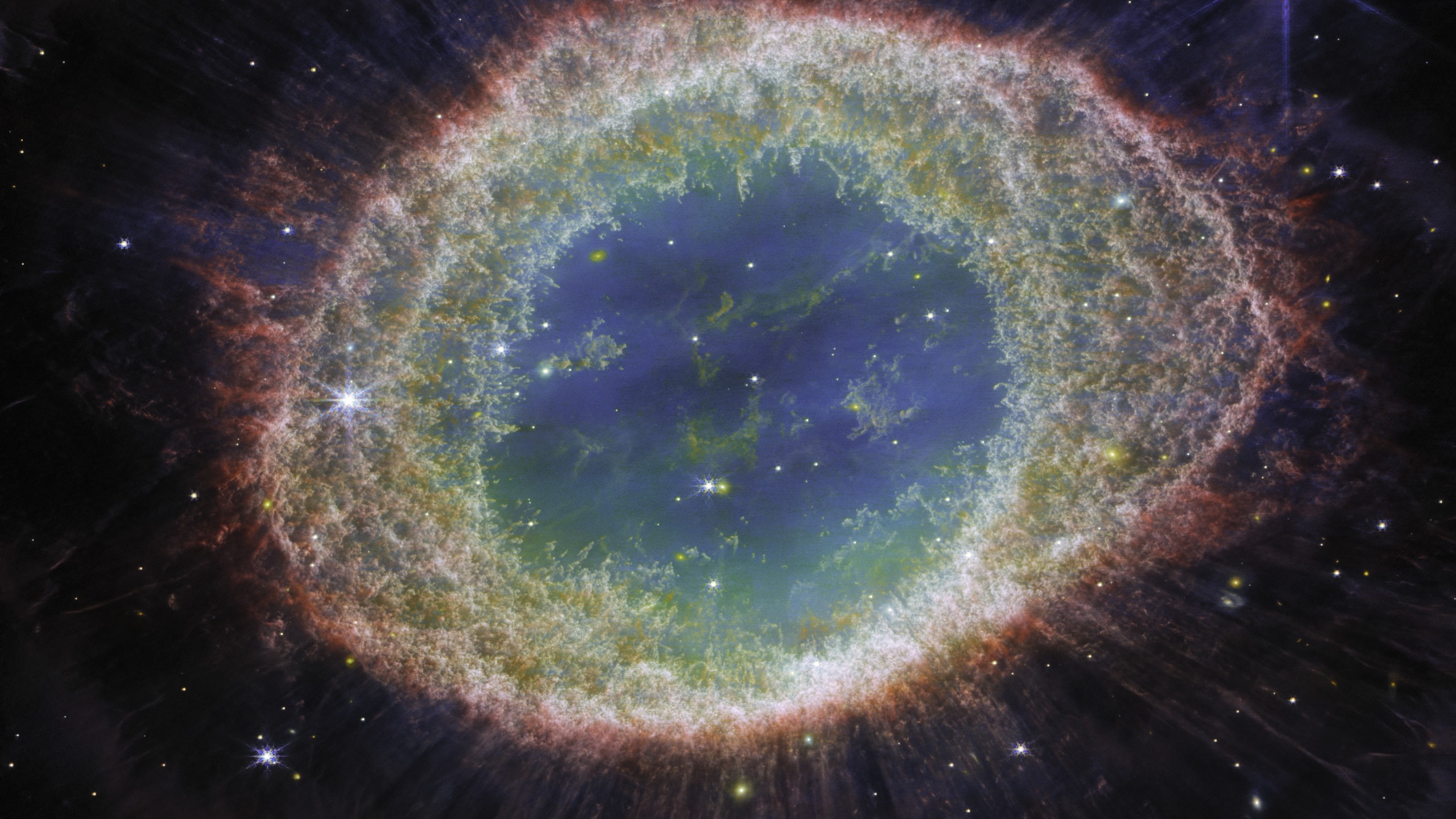
Notice the two images above use completely different colors, even though both are showing dying stars caught in infrared. That’s not a mistake. Why Are JWST Images So Colorful? explains exactly how scientists make that choice.
The Scale Of It
How far apart are these rings, really?
It’s tempting to picture the rings sitting close together, like the lines on a target. In reality, the gap between one shell and the next is usually hundreds of billions of miles, sometimes more. Here’s why: the gas is moving fast, tens of thousands of miles per hour, but the star waits hundreds or thousands of years between pulses. Even at that speed, gas covers an enormous distance in that much time.
To put that in perspective, Pluto orbits about 3.7 billion miles from our Sun. In the Ring Nebula, astronomers believe a hidden second star orbits the dying one at a distance in that same rough range, and the rippling arcs that companion star stirs up reach far beyond the main ring itself. The whole scene is built on a scale where “nearby” still means billions of miles.
What The Rings Tell Us
What do scientists actually learn from studying the rings?
The rings aren’t just beautiful. Each one is a record scientists can read:
- How old each pulse is. Since the gas expands at a steady, measurable speed, scientists can calculate almost exactly how long ago the star threw off any given shell.
- Whether a hidden companion star is involved. Uneven, spiral, or off-center patterns in the shells often reveal a second, smaller star quietly orbiting the dying one, tugging the gas into unexpected shapes.
- What the star was made of. The exact mix of colors and chemistry inside each shell reveals which elements the star built up over its lifetime, material that will eventually become part of new stars and planets someday.
Real-World Example
A real example: the Ring Nebula
The Ring Nebula, also called M57, is one of the clearest examples of this whole process. Webb’s image reveals around 20,000 dense clumps of gas packed into the main ring, with hot, glowing gas filling the hollow center. Just beyond the outer edge, astronomers count roughly ten faint concentric arcs, extra rings layered on top of the main one, which they believe are stirred up by a second, smaller star orbiting the dying one at a distance similar to Pluto’s orbit around our Sun. Every ripple in this image is a real trace of that hidden second star’s influence over thousands of years.
If any of these catch your eye, every image on CosmicRift is free to download, already sized for your phone, tablet, or desktop. Browse the full gallery to find more.