Solar System Wallpapers
Webb turned toward our own neighborhood too — Jupiter's auroras and rings, Europa's icy surface, and other solar system targets in infrared.
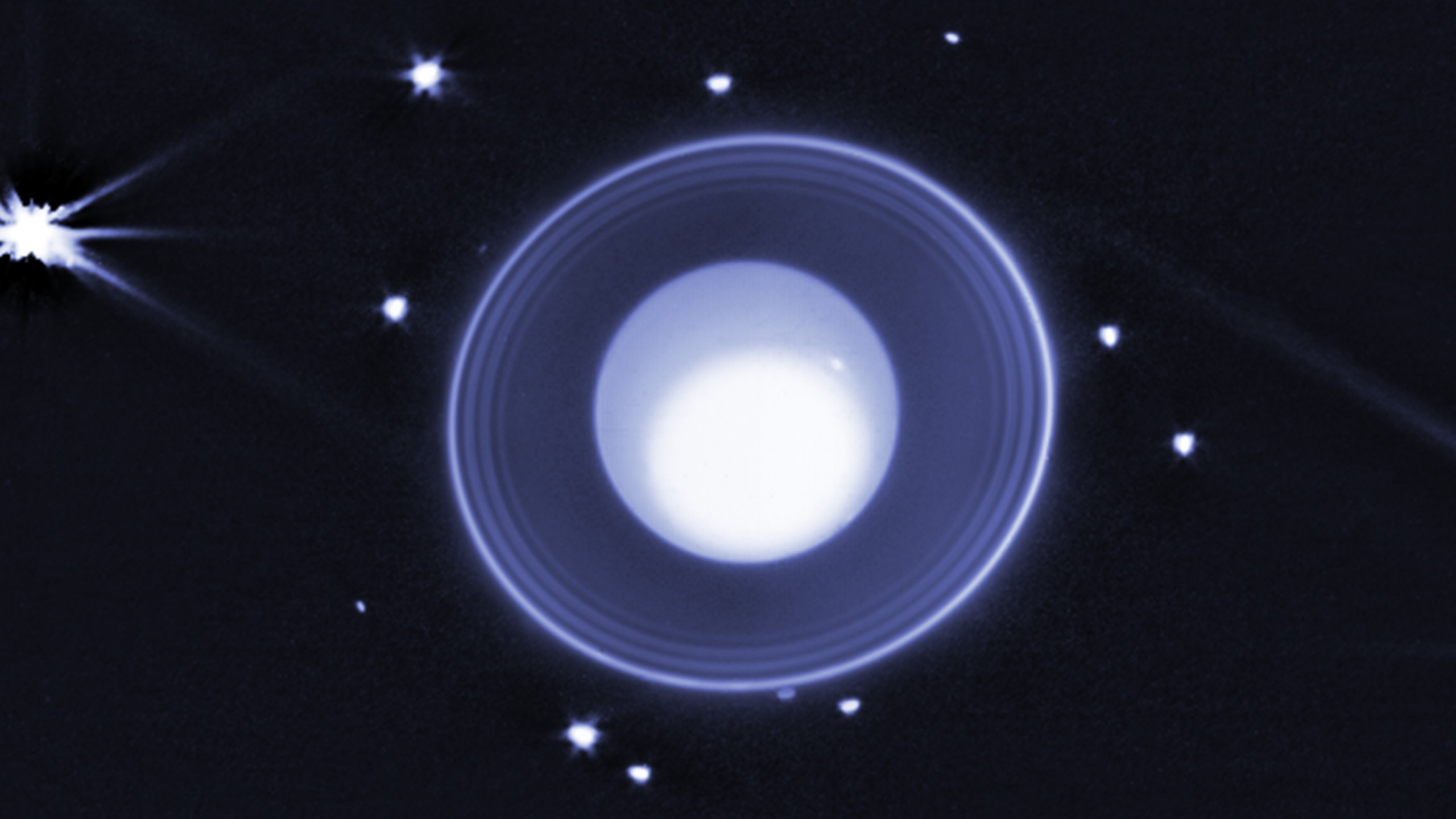
Astronomers using NASA’s James Webb Space Telescope discovered a new moon orbiting Uranus in images taken by Webb’s NIRCam (Near-Infrared Camera). This image shows the moon, designated S/2025 U1, as well as 13 of the 28 other known moons orbiting the planet. (The small moon Cordelia orbits just inside the outermost ring, but is not visible in these views due to glare from the rings.) Due to the drastic differences in brightness levels, the image is a composite of three different treatments of the data, allowing the viewer to see details in the planetary atmosphere, the surrounding rings, and the orbiting moons. The data was taken with NIRCam’s wide band F150W2 filter that transmits infrared wavelengths from about 1.0 to 2.4 microns.
32k downloads
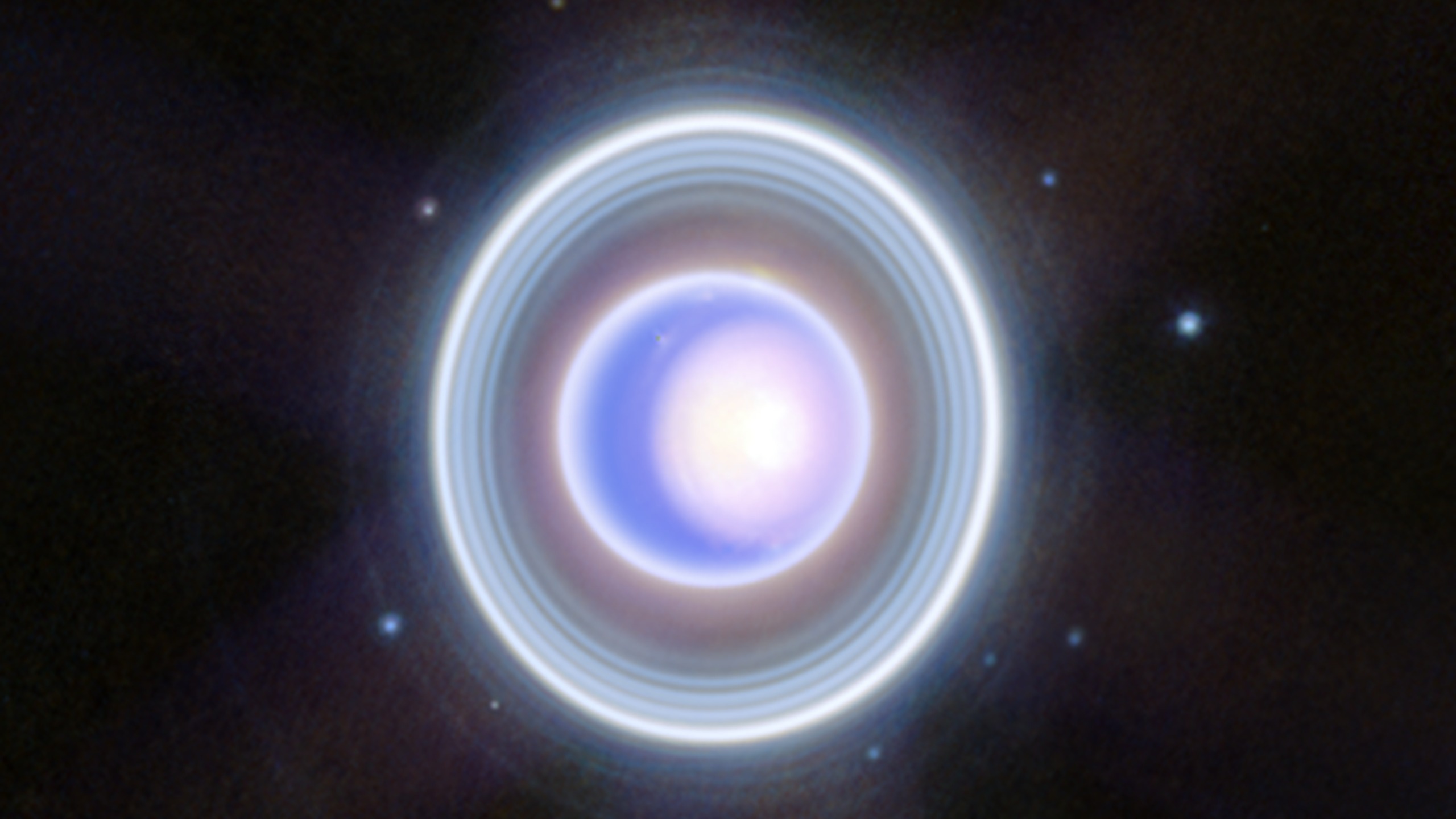
This image of Uranus from NIRCam (Near-Infrared Camera) on NASA's James Webb Space Telescope shows the planet and its rings in new clarity. The Webb image exquisitely captures Uranus's seasonal north polar cap, including the bright, white, inner cap and the dark lane in the bottom of the polar cap. Uranus' dim inner and outer rings are also visible in this image, including the elusive Zeta ring, the extremely faint and diffuse ring closest to the planet. Nine of the planet's 27 known moons are also visible around the rings: Rosalind, Puck, Belinda, Desdemona, Cressida, Bianca, Portia, Juliet, and Perdita.
8.8k downloads
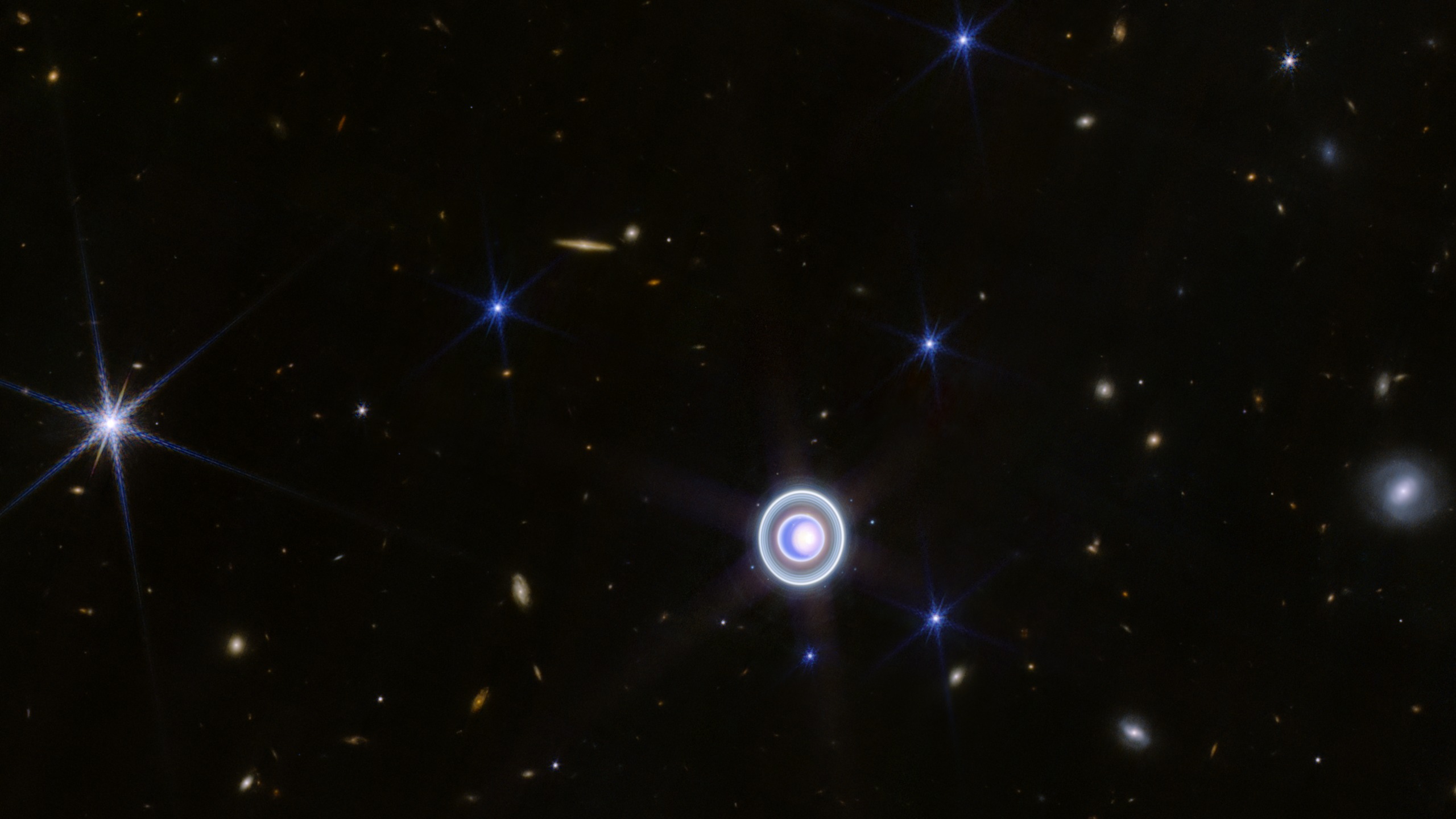
This image of Uranus from NIRCam (Near-Infrared Camera) on NASA's James Webb Space Telescope shows the planet and its rings in new clarity. The planet's seasonal north polar cap gleams in a bright white, and Webb's exquisite sensitivity resolves Uranus' dim inner and outer rings, including the Zeta ring—the extremely faint and diffuse ring closest to the planet. This Webb image also shows 14 of the planet's 27 moons: Oberon, Titania, Umbriel, Juliet, Perdita, Rosalind, Puck, Belinda, Desdemona, Cressida, Ariel, Miranda, Bianca, and Portia. One day on Uranus is about 17 hours, so the planet's rotation is relatively quick. This makes it supremely difficult for observatories with a sharp eye like Webb to capture one simple image of the entire planet – storms and other atmospheric features, and the planet's moons, move visibly within minutes. This image combines several longer and shorter exposures of this dynamic system to correct for those slight changes throughout the observing time. Webb's extreme sensitivity also picks up a smattering of background galaxies—most appear as orange smudges, and there are two larger, fuzzy white galaxies to the right of the planet in this field of view.
17k downloads
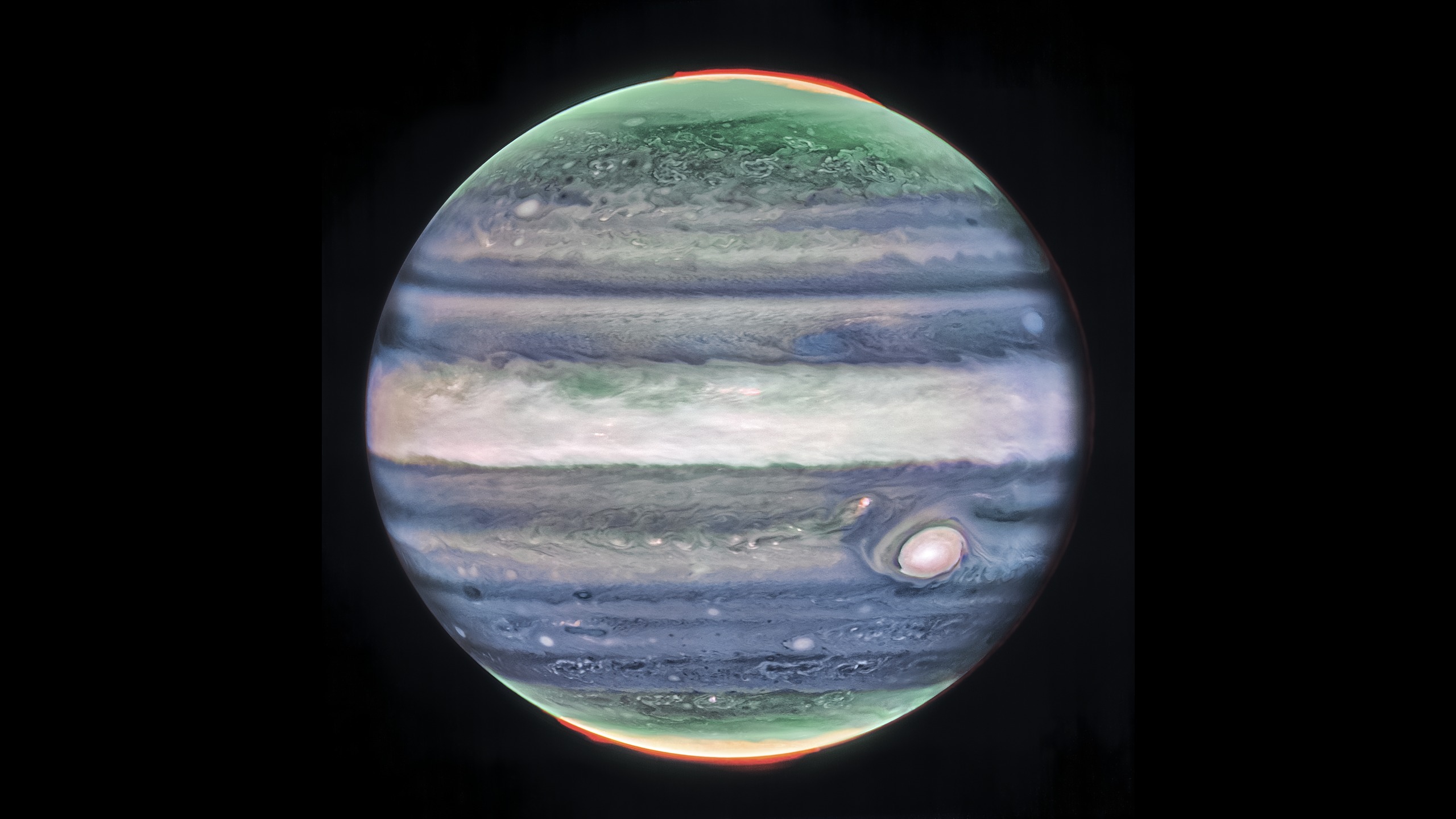
This image of Jupiter from NASA's James Webb Space Telescope's NIRCam (Near-Infrared Camera) shows stunning details of the majestic planet in infrared light. In this image, brightness indicates high altitude. The numerous bright white "spots" and "streaks" are likely very high-altitude cloud tops of condensed convective storms. Auroras, appearing in red in this image, extend to higher altitudes above both the northern and southern poles of the planet. By contrast, dark ribbons north of the equatorial region have little cloud cover. In Webb's images of Jupiter from July 2022, researchers recently discovered a narrow jet stream traveling 320 miles per hour (515 kilometers per hour) sitting over Jupiter's equator above the main cloud decks.
2.3k downloads
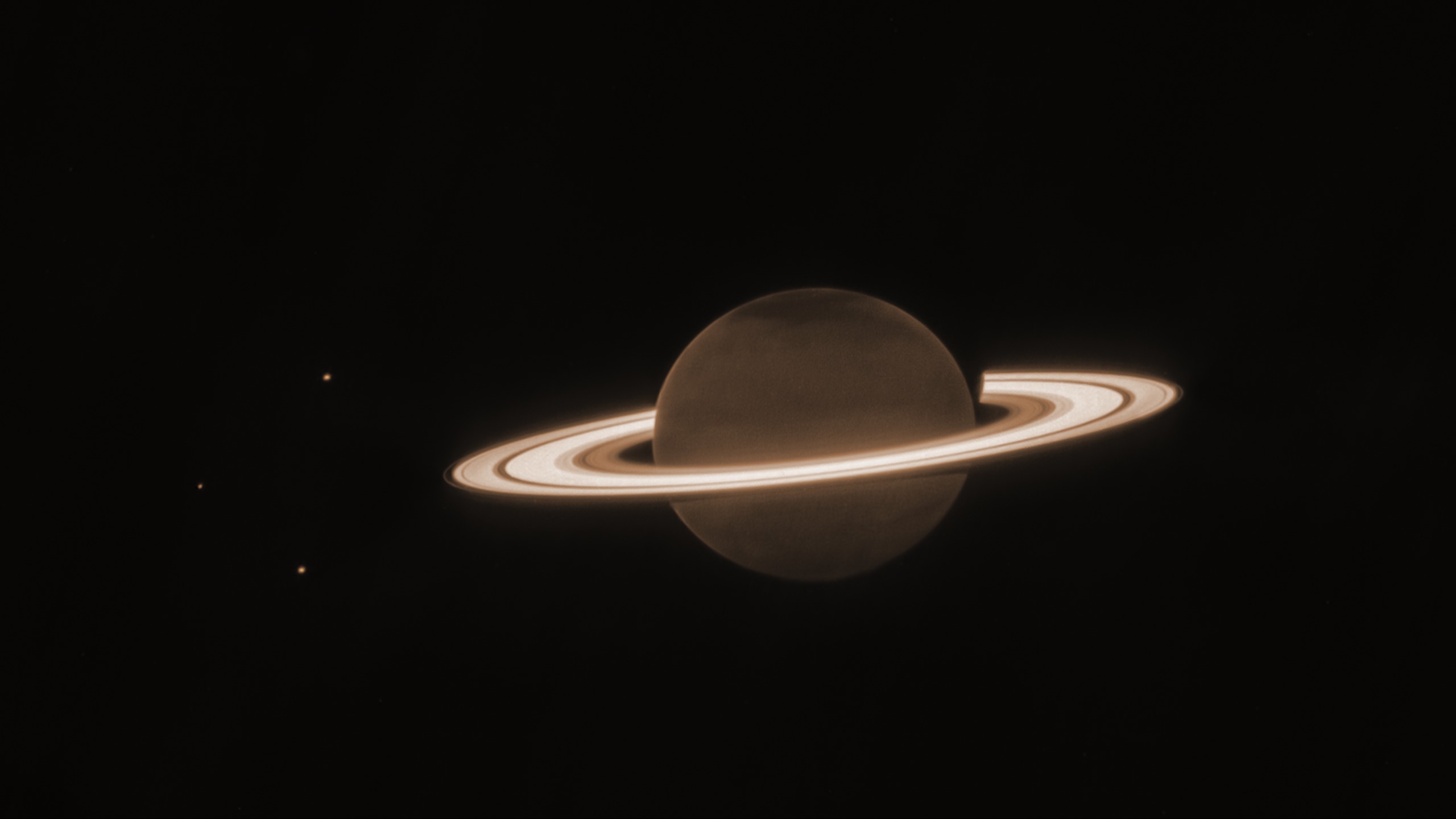
On June 25, 2023, NASA's James Webb Space Telescope turned to famed ringed world Saturn for its first near-infrared observations of the planet. The initial imagery from Webb's NIRCam (Near-Infrared Camera) is already fascinating researchers. Saturn itself appears extremely dark at this infrared wavelength observed by the telescope, as methane gas absorbs almost all of the sunlight falling on the atmosphere. However, the icy rings stay relatively bright, leading to the unusual appearance of Saturn in the Webb image. This image was taken as part of Webb Guaranteed Time Observation program 1247. The program included several very deep exposures of Saturn, which were designed to test the telescope's capacity to detect faint moons around the planet and its bright rings. Any newly discovered moons could garner important clues about the flow of material in the current Saturn system, as well as its past history.
12.5k downloads
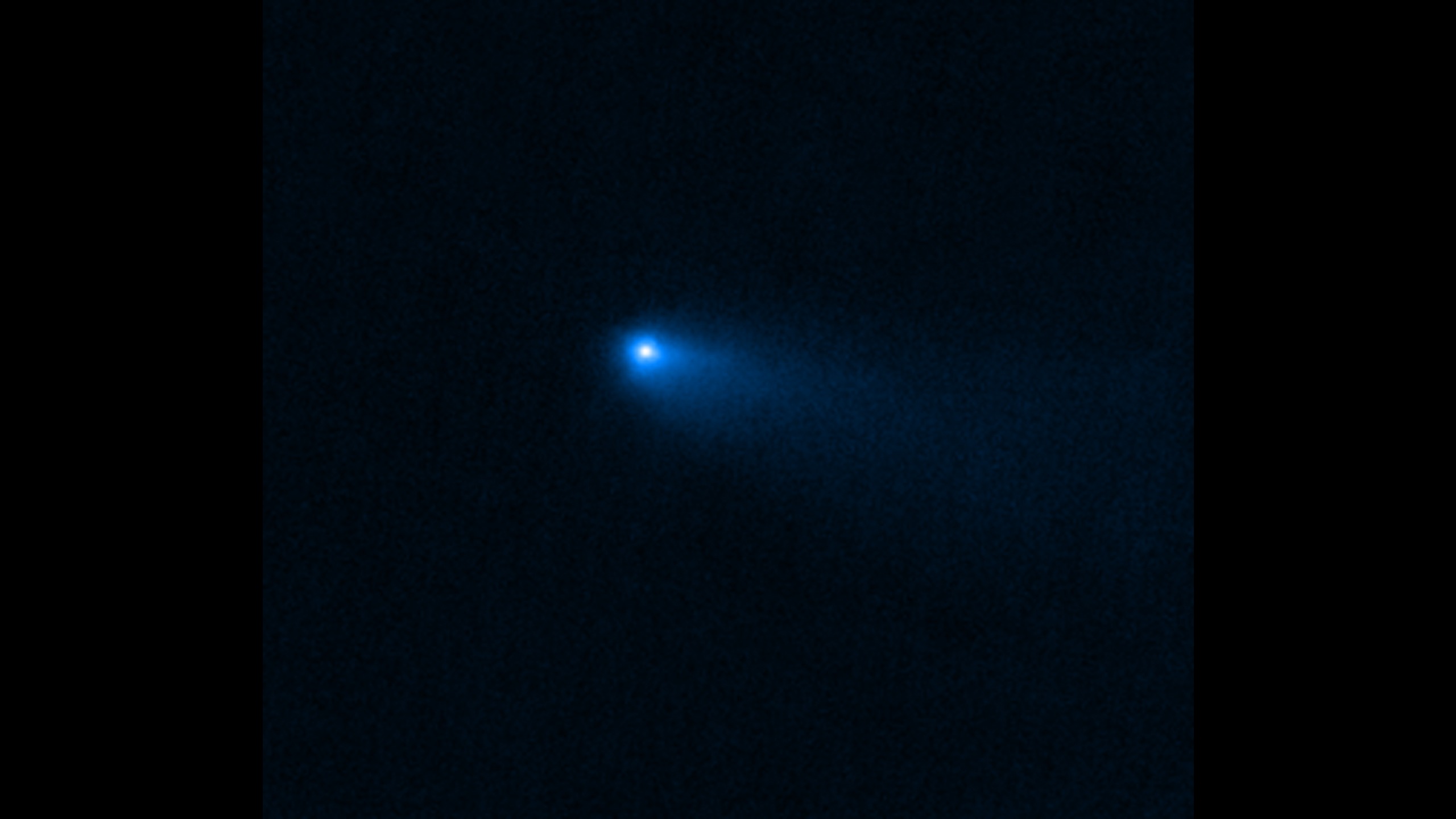
This image of Comet 238P/Read was captured by the NIRCam (Near-Infrared Camera) instrument on NASA’s James Webb Space Telescope on September 8, 2022. It displays the hazy halo, called the coma, and tail that are characteristic of comets, as opposed to asteroids. The dusty coma and tail result from the vaporization of ices as the Sun warms the main body of the comet. Comet Read was among three objects used to define the category of main belt comets in 2006. Before that, comets were understood to reside in the Kuiper Belt and Oort Cloud, beyond the orbit of Neptune, where their ices were preserved farther from the Sun. Since that time scientists have sought to confirm the presence of sublimating material in main belt comets, proving that their coma and tail were due to the same processes that other comets exhibit. With the detection of water vapor on Comet Read, Webb’s sensitive NIRSpec (Near-Infrared Spectrograph) instrument has achieved this goal.
5.9k downloads
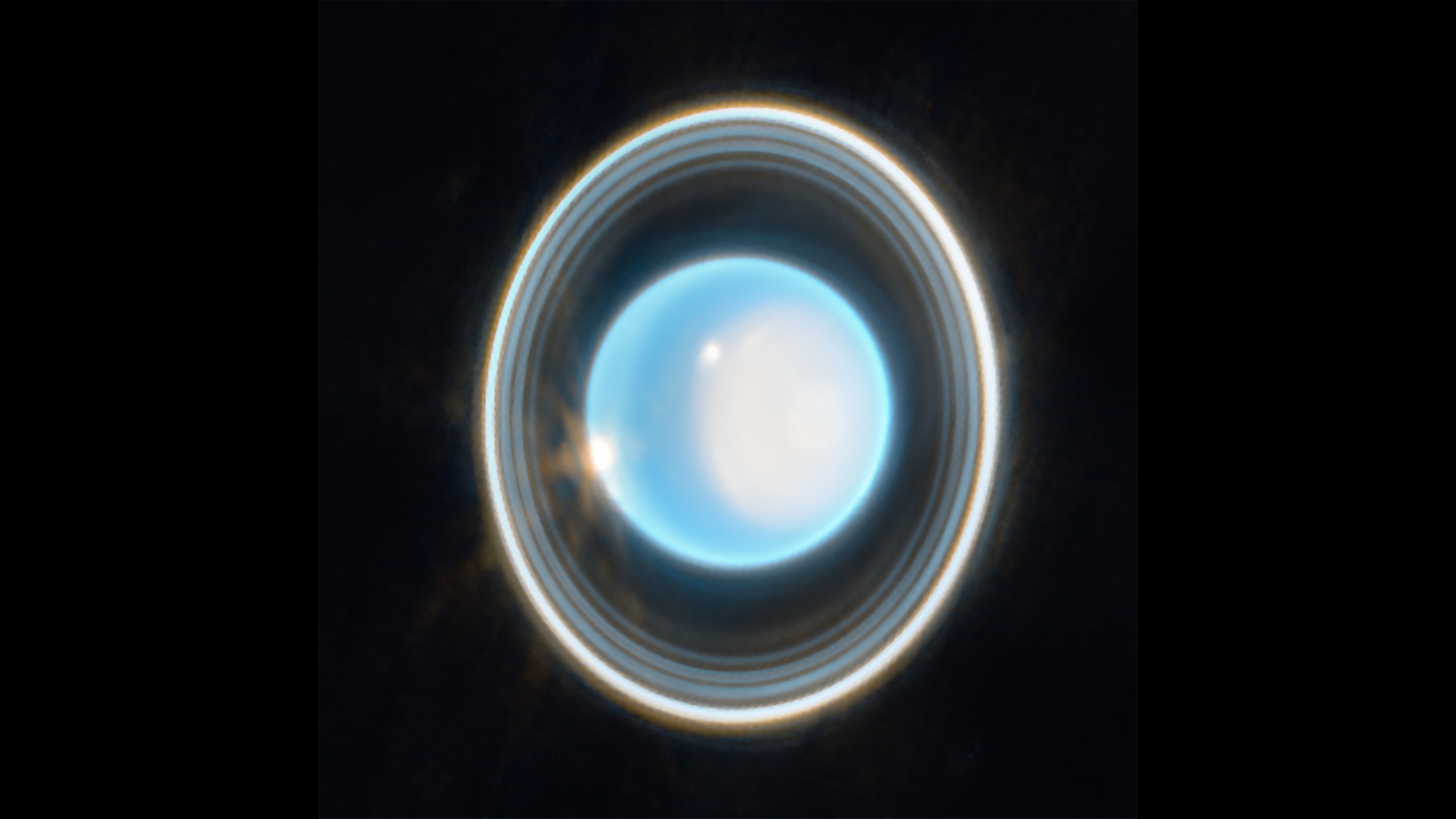
This zoomed-in image of Uranus, captured by Webb’s Near-Infrared Camera (NIRCam) Feb. 6, 2023, reveals stunning views of the planet’s rings. The planet displays a blue hue in this representative-color image, made by combining data from two filters (F140M, F300M) at 1.4 and 3.0 microns, which are shown here as blue and orange, respectively. On the right side of the planet there’s an area of brightening at the pole facing the Sun, known as a polar cap. This polar cap is unique to Uranus because it is the only planet in the solar system tilted on its side, which causes its extreme seasons. A new aspect of the polar cap revealed by Webb is a subtle brightening near the Uranian north pole. At the edge of the polar cap lies a bright cloud as well as a few fainter extended features just northward of the cap’s edge, and a second very bright cloud is seen at the planet’s left limb. Such clouds are typical for Uranus in infrared wavelengths, and likely are connected to storm activity.
36.4k downloads
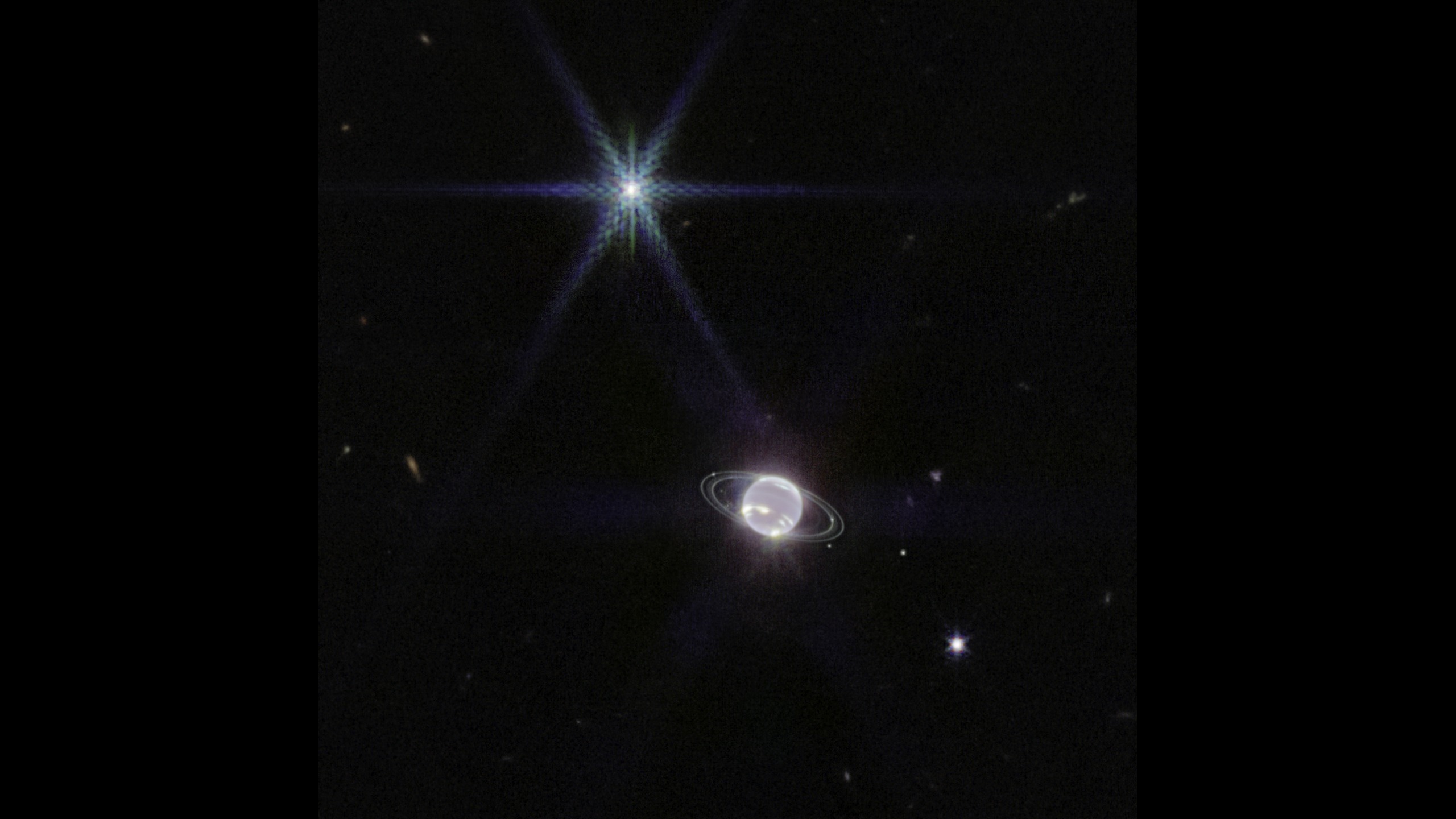
This image of the Neptune system, captured by Webb’s Near-Infrared Camera (NIRCam), reveals stunning views of the planet’s rings, which have not been seen with this clarity in more than three decades. Webb’s new image of Neptune also captures details of the planet’s turbulent, windy atmosphere. Neptune, an ice giant, has an interior that is much richer in elements heavier than hydrogen and helium, like methane, than the gas giants Jupiter and Saturn. Methane appears blue in visible wavelengths but, as evident in Webb’s image, that’s not the case in the near-infrared. Methane so strongly absorbs red and infrared light that the planet is quite dark at near-infrared wavelengths, except where high-altitude clouds are present. These methane-ice clouds are prominent in Webb’s image as bright streaks and spots, which reflect sunlight before it is absorbed by methane gas. To the upper left of the planet in this image, one of Neptune’s moons, Triton, also sports Webb’s distinctive eight diffraction spikes, an artifact of the telescope’s structure. Webb also captured 6 more of Neptune’s 14 known moons, along with a smattering of distant galaxies that appear as dim splotches and a nearby star. NIRCam was built by a team at the University of Arizona and Lockheed Martin’s Advanced Technology Center.
24.2k downloads
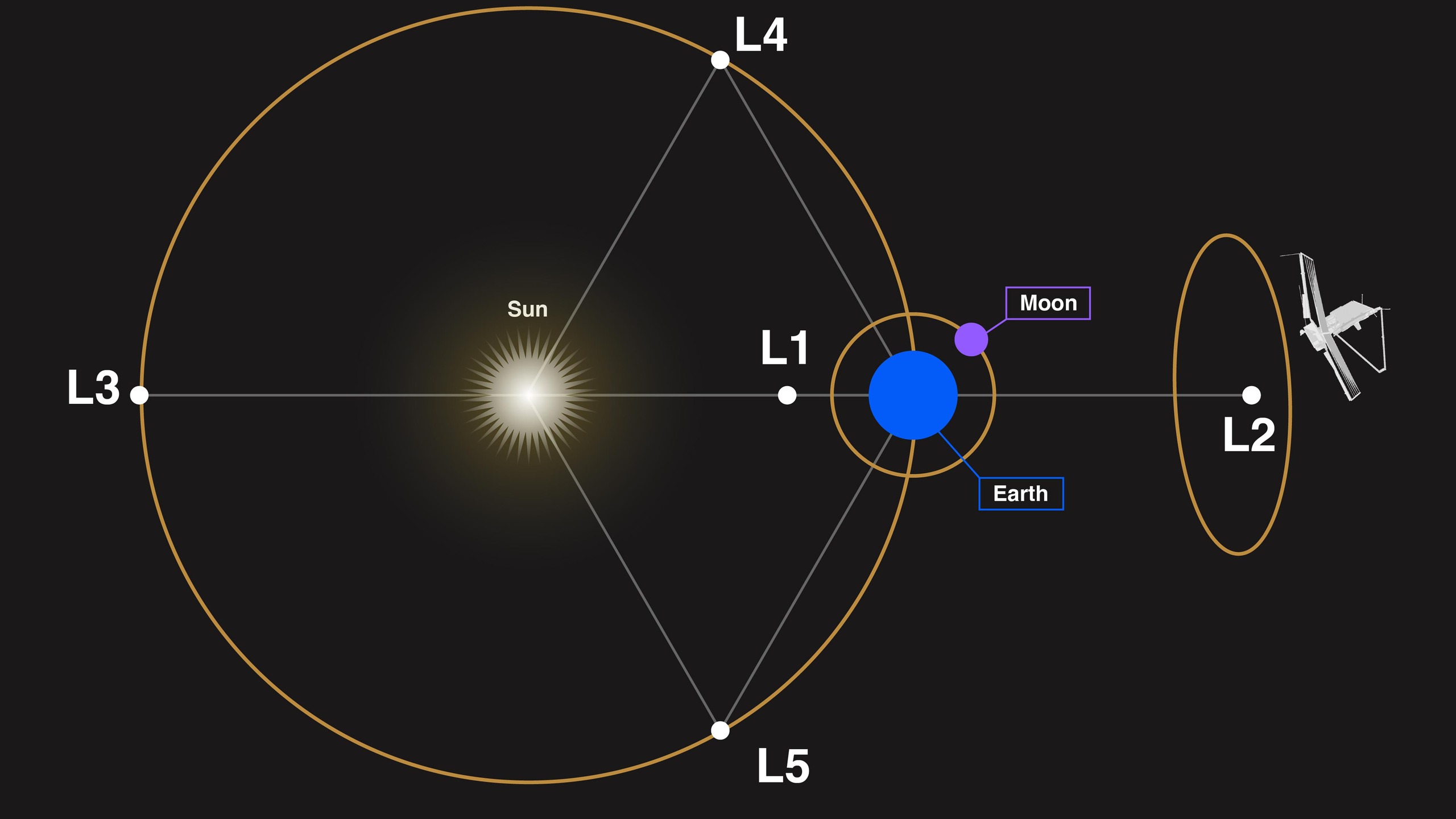
The James Webb Space Telescope orbits the Sun near Sun-Earth Lagrange point 2 (L2), approximately 1.5 million kilometers (1 million miles) from Earth. L2 is one of five Sun-Earth Lagrange points, positions in space where the gravitational pull of the Sun and Earth combine such that small objects in that region have the same orbital period (length of year) as Earth. This makes it possible for Webb to remain in constant communication with Earth. Webb is not located at L2, but instead orbits L2, completing one circuit every 168 days. This "halo orbit" around L2 is highly elliptical and is roughly perpendicular to its orbital path around the Sun. The distance between Webb and L2 varies between about 250,000 and 830,000 kilometers (150,000 - 500,000 miles). Because of this complex orbit , Webb's precise distance from Earth varies over time. Sizes and distances in this illustration are not to scale. The actual distance between the Sun and Earth is about 100 times the distance between Earth and L2. The distance between Earth and L1 is almost the same as between Earth and L2. L2 is about four times farther from Earth than the Moon. The long diameter (major axis) of the halo orbit around L2 is around the same as the distance between Earth and L2.
13.1k downloads