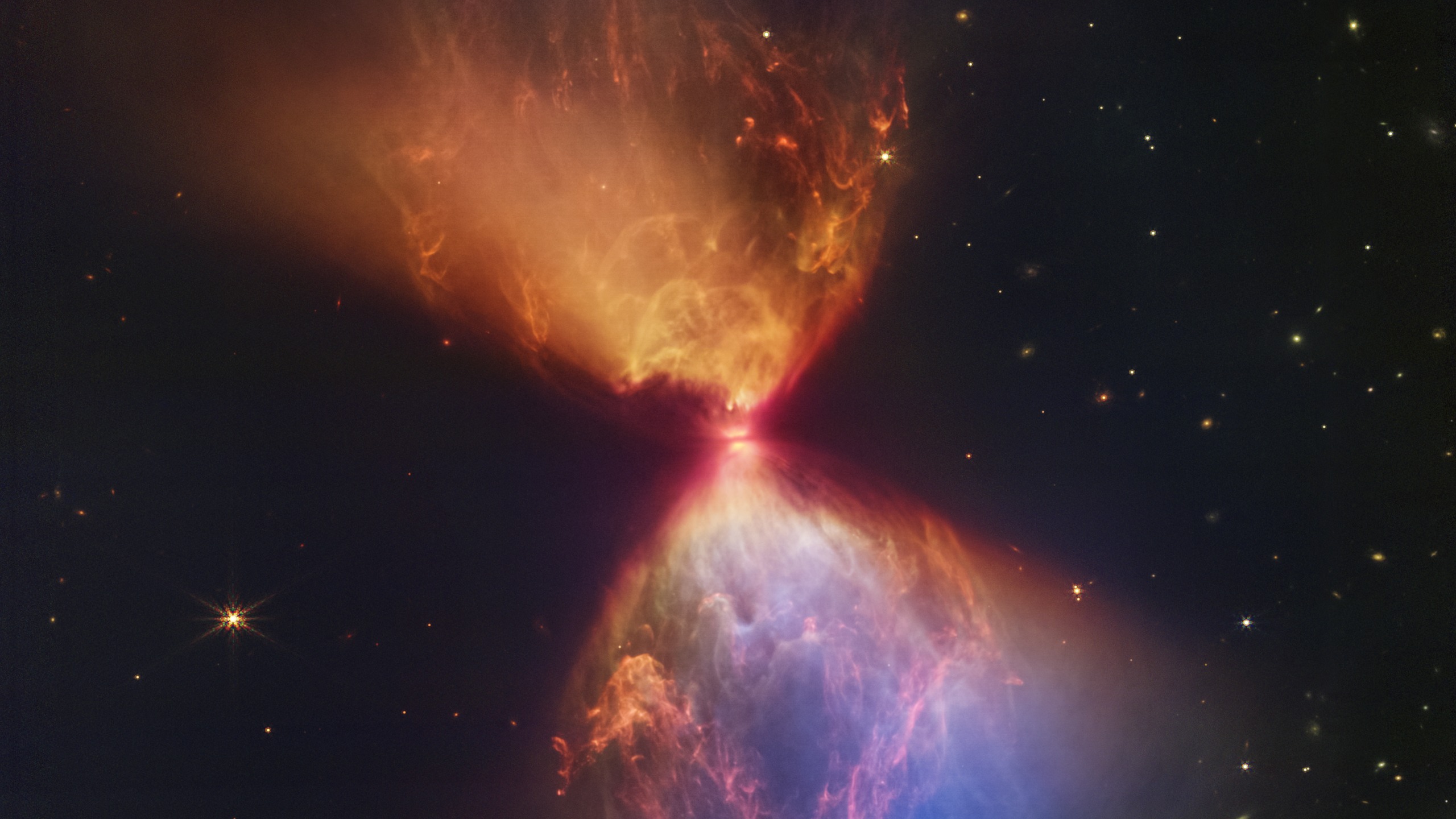
The protostar within the dark cloud L1527, shown in this image from NASA’s James Webb Space Telescope Near-Infrared Camera (NIRCam), is embedded within a cloud of material feeding its growth. Ejections from the star have cleared out cavities above and below it, whose boundaries glow orange and blue in this infrared view.
The upper central region displays bubble-like shapes due to stellar “burps,” or sporadic ejections. Webb also detects filaments made of molecular hydrogen that has been shocked by past stellar ejections.
The edges of the cavities at upper left and lower right appear straight, while the boundaries at upper right and lower left are curved. The region at lower right appears blue, as there’s less dust between it and Webb than the orange regions above it.
Image Credit:NASA, ESA, CSA, STScI
About the Object
- R.A. Position
- 04:39:53.59
- Dec. Position
- +26:03:05.50
- Constellation
- Taurus
- Distance
- About 460 light-years
- Dimensions
- Image is 2.2 arcmin across (about 0.3 light-years)
Choose your device
Desktop (5)▾
iPhone (5)▾
Android (5)▾
Special (1)▾
Handheld (1)▾
Motorola (1)▾
More protoplanetary disk wallpapers
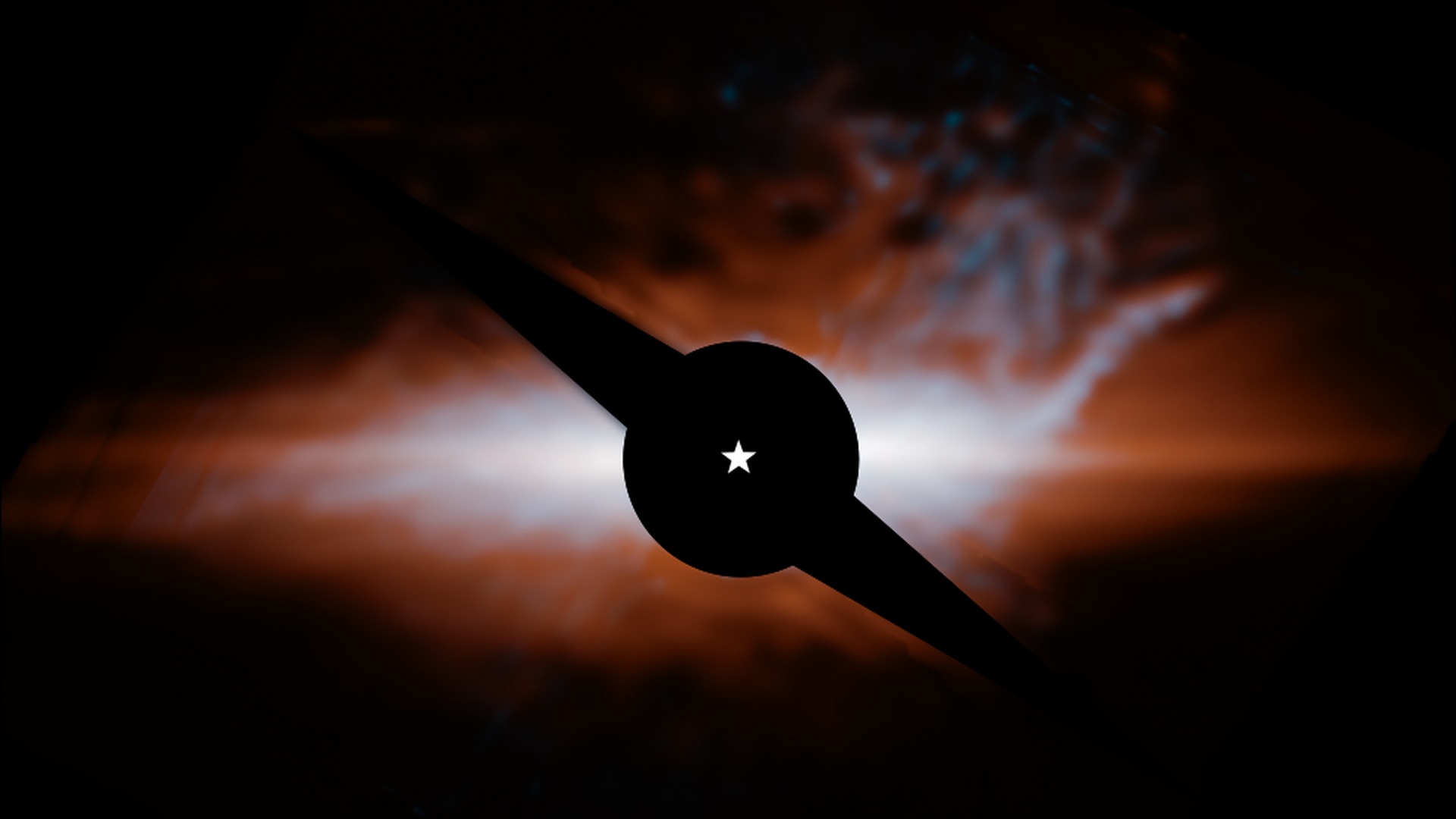
The dark circle and two smaller disks at the center of this image are a coronagraph, deliberately blocking the light of Beta Pictoris' central star (its actual position is marked with a small white star shape) so the much fainter dust disks surrounding it become visible. NASA's James Webb Space Telescope used this technique to image star system Beta Pictoris in detail. Webb's MIRI (Mid-Infrared Instrument) enabled a team of astronomers to investigate the composition of Beta Pic's main and secondary debris disks, the latter a feature previously detected by the Hubble Space Telescope. Unexpectedly, Webb's infrared capabilities detected a new feature of the Beta Pic system: a curvy branch of dust that resembles the shape of a cat's tail. This tail, only noticeable in the MIRI data, extends from the southwest portion of the secondary debris disk and is estimated to span 10 billion miles. The dust that forms the tail may be similar to the matter found on the surfaces of comets and asteroids in our solar system. The team believes a dust production event, such as a collision between asteroids, comets, or planetesimals, is responsible. In this image, light at 15.5 microns is colored cyan and 23 microns is orange (filters F1550C and F2300C).
10.8k downloads
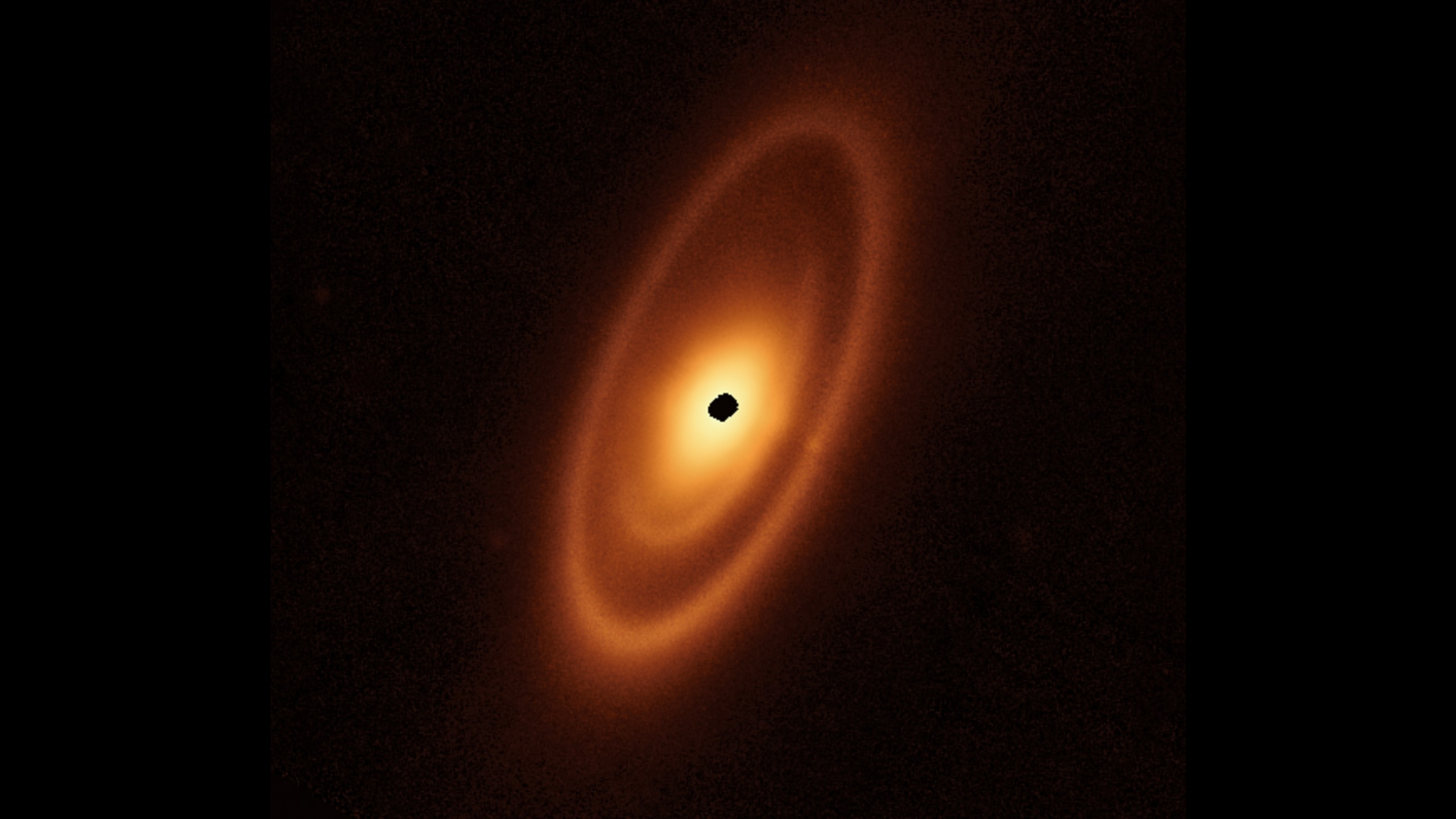
This image of the dusty debris disk surrounding the young star Fomalhaut is from Webb’s Mid-Infrared Instrument (MIRI). It reveals three nested belts extending out to 14 billion miles (23 billion kilometers) from the star. The inner belts – which had never been seen before – were revealed by Webb for the first time. The ragged black spot in the middle indicates a lack of data due to detector saturation. The Hubble Space Telescope and Herschel Space Observatory, as well as the Atacama Large Millimeter/submillimeter Array (ALMA), have previously taken sharp images of the outermost belt. However, none of them found any structure interior to it. These belts most likely are carved by the gravitational forces produced by unseen planets.
10.7k downloads
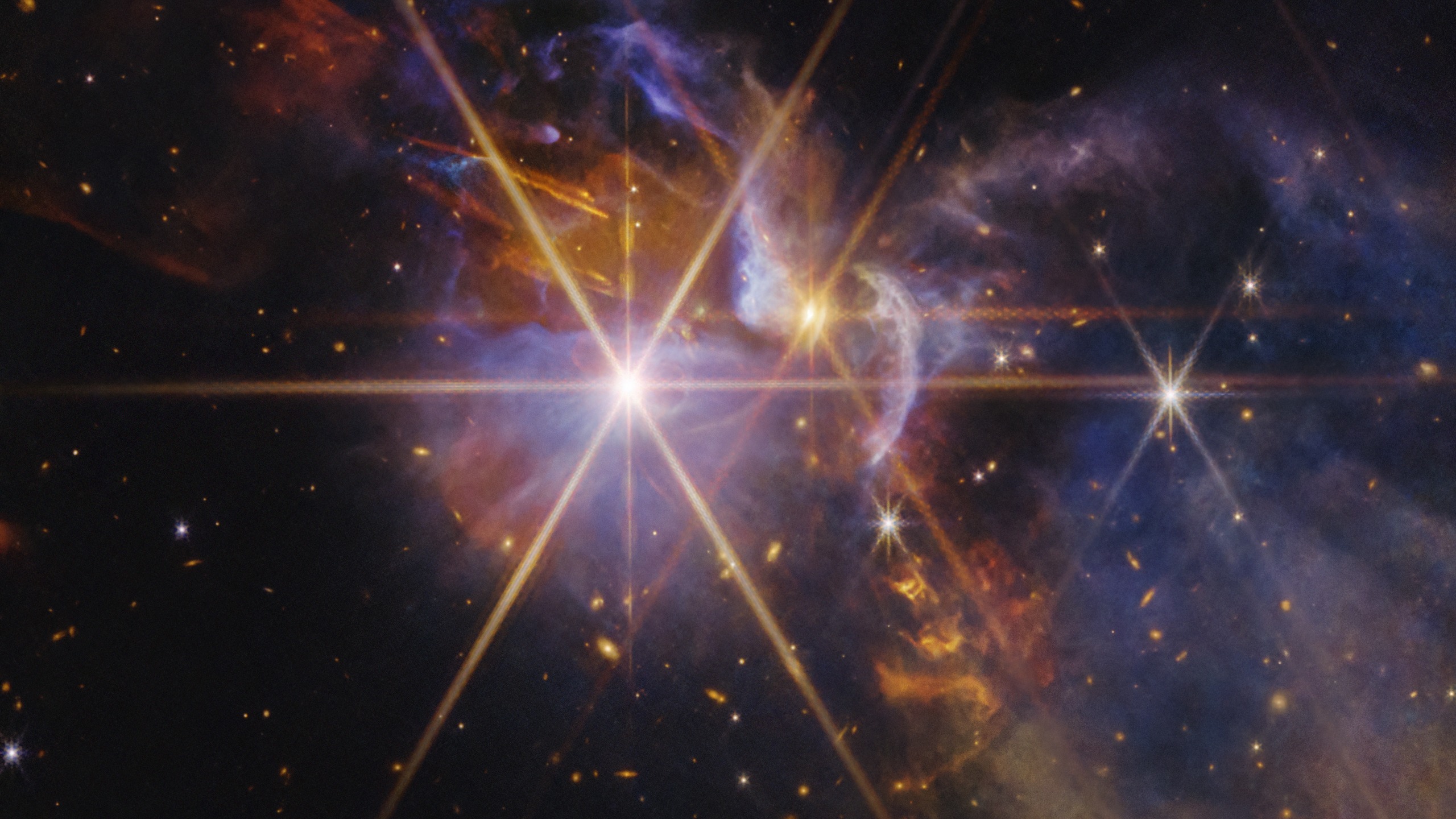
NASA's James Webb Space Telescope captures the infrared light from bright protostars in young star system FS Tau. FS Tau A, a pair of protostars that creates the largest diffraction pattern slightly to the left of center, is about half the mass of our Sun. FS Tau B, the orange protostar slightly right of center, is thought to be responsible for the red (molecular hydrogen) and orange (soot-like molecules known as polycyclic aromatic hydrocarbons) outflows that we see amid the dusty region. The blue ridges are areas where light has been scattered by dust.
12.3k downloads