All Wallpapers
65 JWST wallpapers, pre-sized for every device.
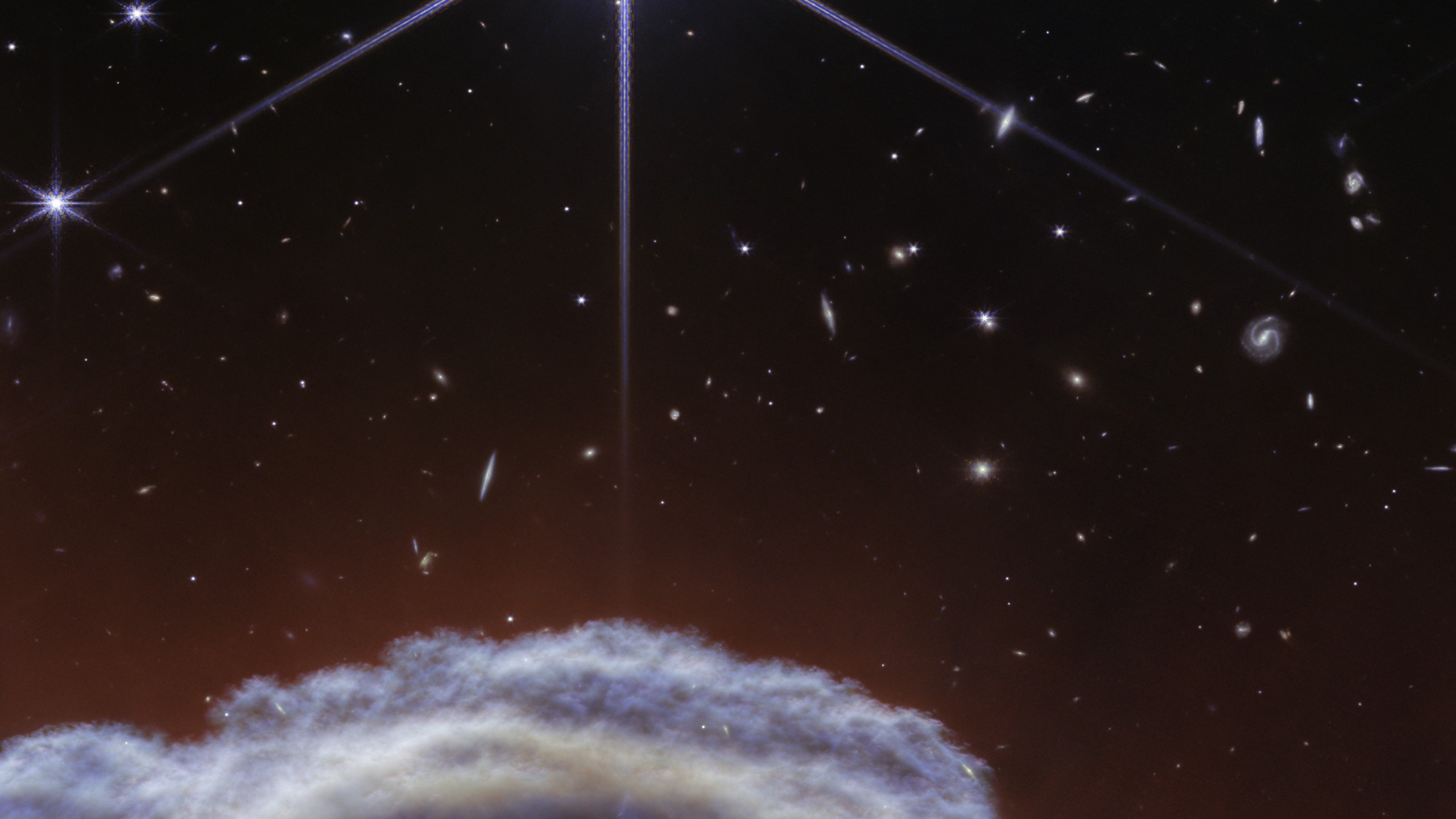
This image of the Horsehead Nebula from NASA’s James Webb Space Telescope focuses on a portion of the horse’s “mane” that is about 0.8 light-years in width. It was taken with Webb’s NIRCam (Near-infrared Camera). The ethereal clouds that appear blue at the bottom of the image are filled with a variety of materials including hydrogen, methane, and water ice. Red-colored wisps extending above the main nebula represent both atomic and molecular hydrogen. In this area, known as a photodissociation region, ultraviolet light from nearby young, massive stars creates a mostly neutral, warm area of gas and dust between the fully ionized gas above and the nebula below. As with many Webb images, distant galaxies are sprinkled in the background. This image is composed of light at wavelengths of 1.4 and 2.5 microns (represented in blue), 3.0 and 3.23 microns (cyan), 3.35 microns (green), 4.3 microns (yellow), and 4.7 and 4.05 microns (red).
24.2k downloads
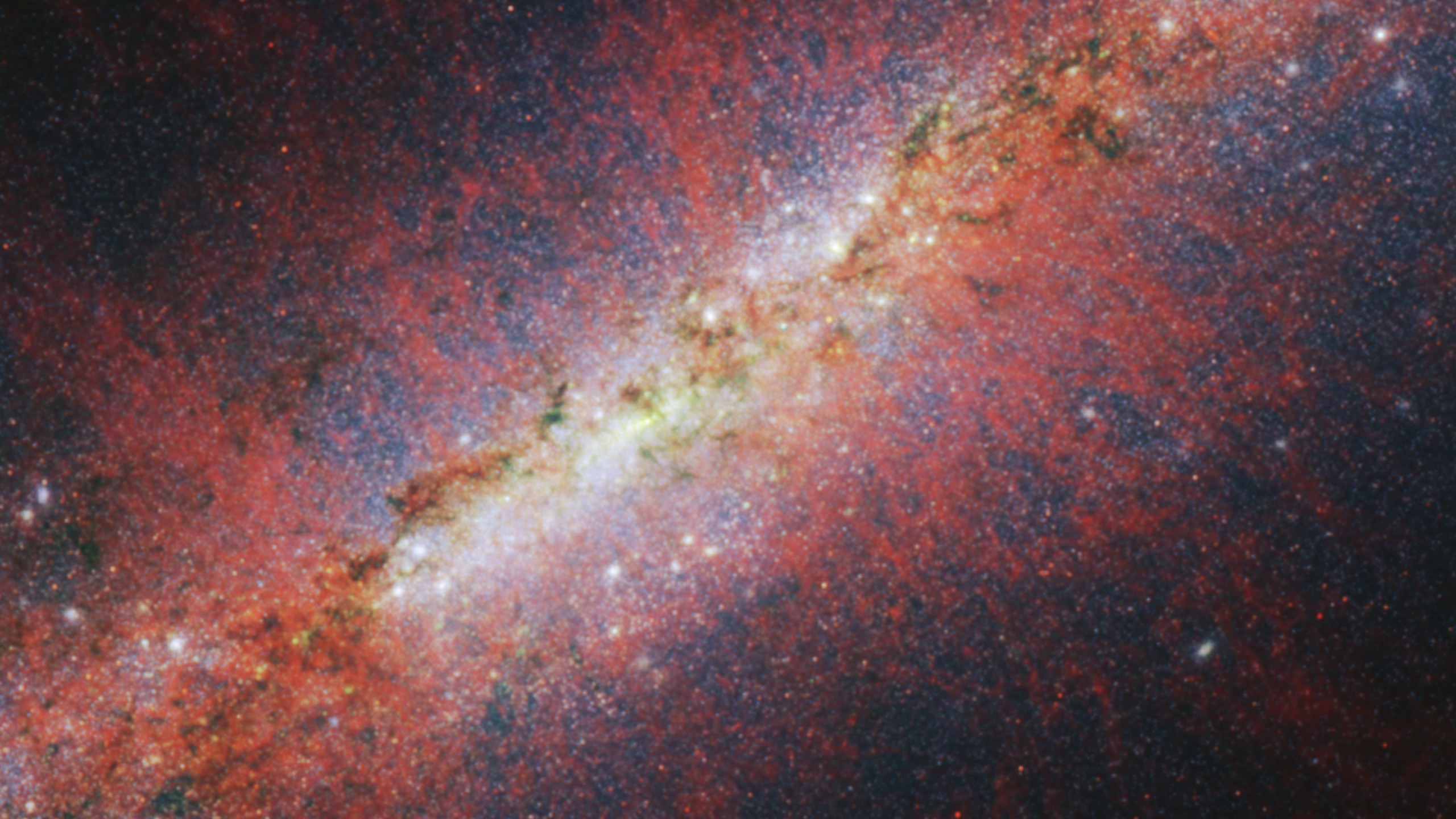
Astronomers used the James Webb Space Telescope to look toward M82’s center, where a galactic wind is being launched as a result of rapid star formation and subsequent supernovas. Studying the galactic wind can offer insight into how the loss of gas shapes the future growth of the galaxy. This image from Webb’s NIRCam (Near-Infrared Camera) instrument shows M82’s galactic wind via emission from sooty chemical molecules known as polycyclic aromatic hydrocarbons (PAHs). PAHs are very small dust grains that survive in cooler temperatures but are destroyed in hot conditions. The structure of the emission resembles that of hot, ionized gas, suggesting PAHs may be replenished by continued ionization of molecular gas. In this image, light at 3.35 microns is colored red, 2.50 microns is green, and 1.64 microns is blue (filters F335M, F250M, and F164N, respectively).
23.3k downloads
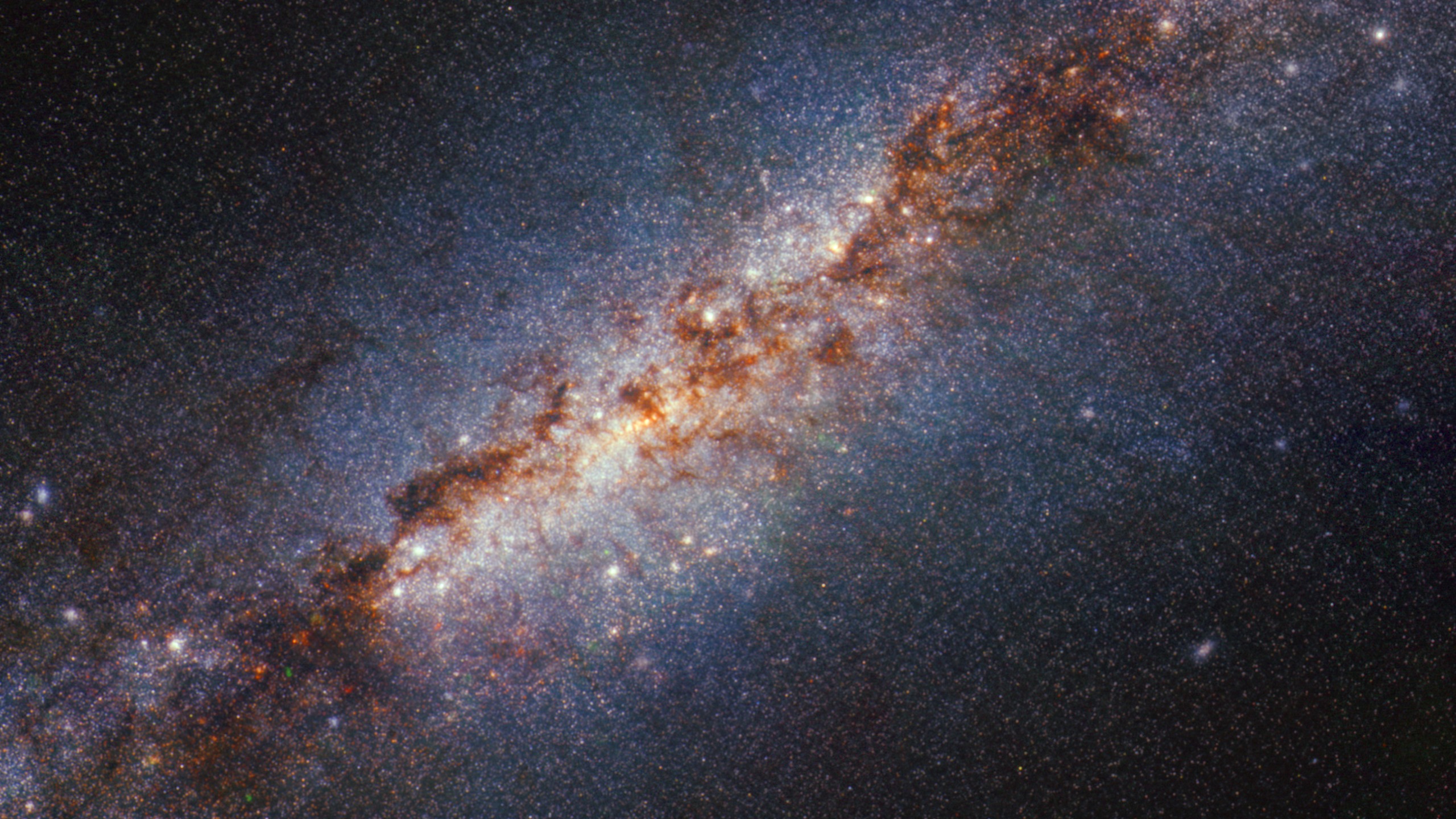
A team of astronomers used NASA’s James Webb Space Telescope to survey the starburst galaxy Messier 82 (M82), which is located 12 million light-years away in the constellation Ursa Major. M82 hosts a frenzy of star formation, sprouting new stars 10 times faster than the Milky Way galaxy. Webb’s infrared capabilities enabled scientists to peer through curtains of dust and gas that have historically obscured the star formation process. This image from Webb’s NIRCam (Near-Infrared Camera) instrument shows M82’s center in an unprecedented level of detail. With Webb’s resolution, astronomers can distinguish small, bright compact sources that are either individual stars or star clusters. Obtaining an accurate count of the stars and clusters that compose M82’s center can help astronomers understand the different phases of star formation and the timelines for each stage. In this image, light at 2.12 microns is colored red, 1.64 microns is green, and 1.40 microns is blue (filters F212N, 164N, and F140M, respectively).
34.5k downloads
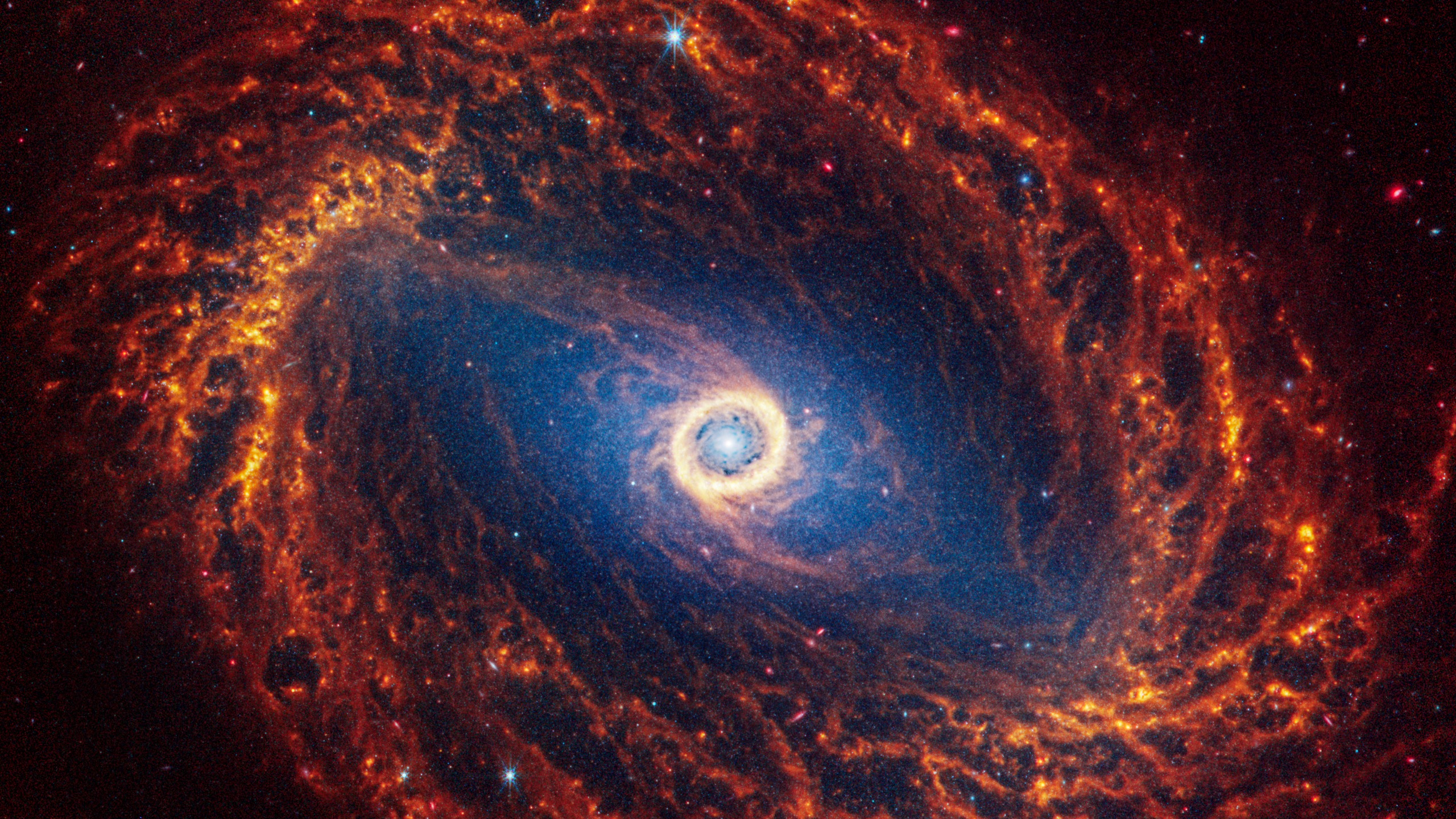
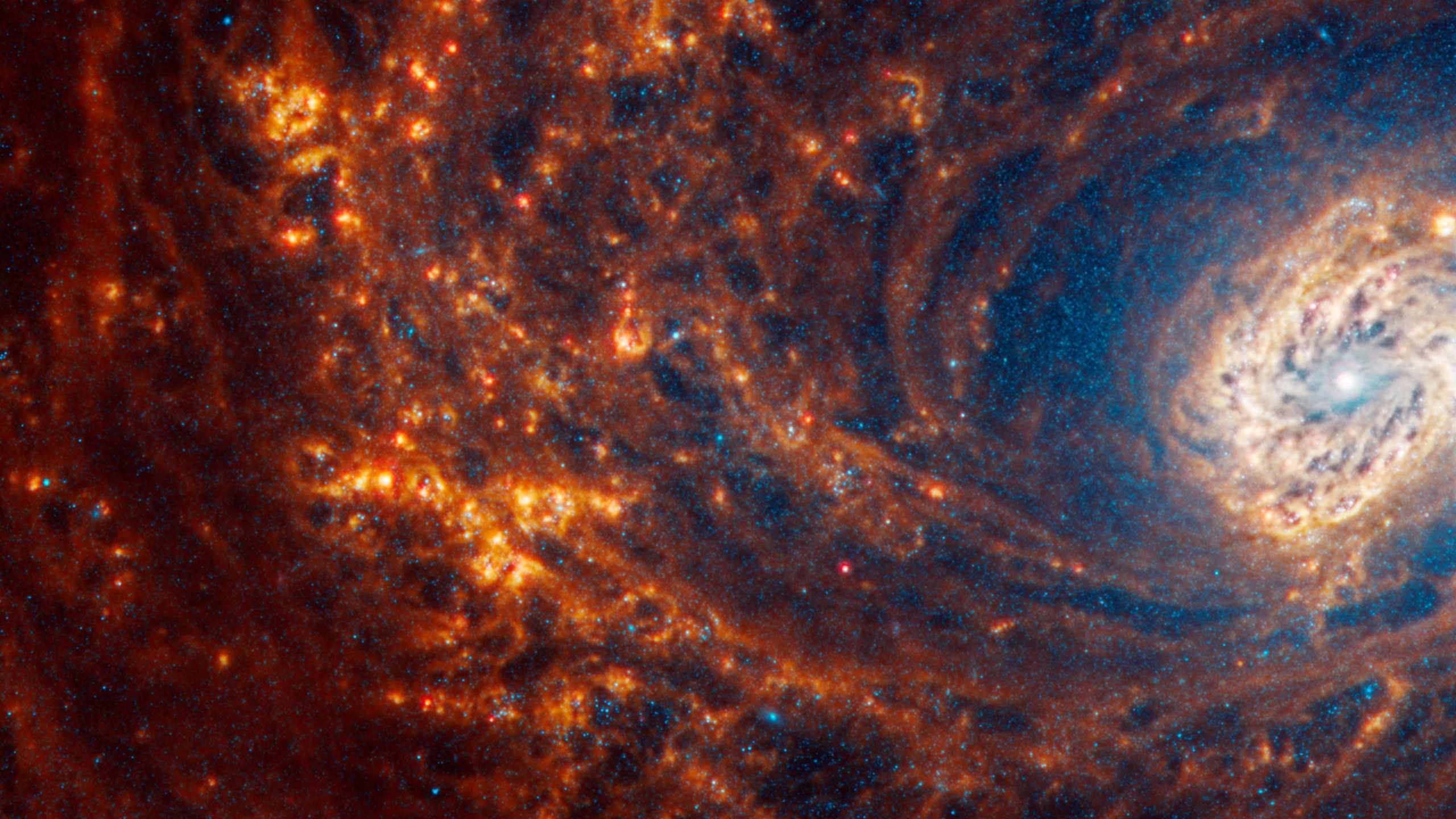
Face-on barred spiral galaxy, NGC 1512, is split diagonally in this image: The James Webb Space Telescope’s observations appear at top left, and the Hubble Space Telescope’s on bottom right. Webb and Hubble’s images show a striking contrast, an inverse of darkness and light. Why? Webb’s observations combine near- and mid-infrared light and Hubble’s showcase visible and ultraviolet light. Dust absorbs ultraviolet and visible light, and then re-emits it in the infrared. In Webb's images, we see dust glowing in infrared light. In Hubble’s images, dark regions are where starlight is absorbed by dust. The individual Webb and Hubble images are available for download using the links on the left side of this page. Background galaxies Webb’s image includes distant galaxies that are located well behind the tightly cropped foreground galaxy. Look for bright blue and pink disks, some seen edge-on, like a plate with a central sphere. Redder galaxies are more distant. In Hubble’s view, distant galaxies are often light orange if they are slightly closer. Like in Webb's image, those that are deeper red are also more distant. Galaxy NGC 1512 was observed as part of the Physics at High Angular resolution in Nearby GalaxieS (PHANGS) program, a large project that includes observations from several space- and ground-based telescopes of many galaxies to help researchers study all phases of the star formation cycle, from the formation of stars within dusty gas clouds to the energy released in the process that creates the intricate structures revealed by Webb’s new images. NGC 1512 is 30 million light-years away in the constellation Horologium. Extended Description and Image Alt Text
23.9k downloads
Face-on spiral galaxy, NGC 4321, is split diagonally in this image: The James Webb Space Telescope’s observations appear at bottom left, and the Hubble Space Telescope’s on top right. Webb and Hubble’s images show a striking contrast, an inverse of darkness and light. Why? Webb’s observations combine near- and mid-infrared light and Hubble’s showcase visible light. Dust absorbs ultraviolet and visible light, and then re-emits it in the infrared. In Webb's images, we see dust glowing in infrared light. In Hubble’s images, dark regions are where starlight is absorbed by dust. Background Galaxies Webb’s image includes distant galaxies that are located well behind the tightly cropped foreground galaxy. Look for bright blue and pink disks, some seen edge-on, like a plate with a central sphere. Redder galaxies are more distant. In Hubble’s view, distant galaxies are often light orange if they are slightly closer. Like in Webb's image, those that are deeper red are also more distant. Galaxy NGC 4321 was observed as part of the Physics at High Angular resolution in Nearby GalaxieS (PHANGS) program, a large project that includes observations from several space- and ground-based telescopes of many galaxies to help researchers study all phases of the star formation cycle, from the formation of stars within dusty gas clouds to the energy released in the process that creates the intricate structures revealed by Webb’s new images. NGC 4321 is 55 million light-years away in the constellation Coma Berenices. Extended Description and Image Alt Text
27.4k downloads
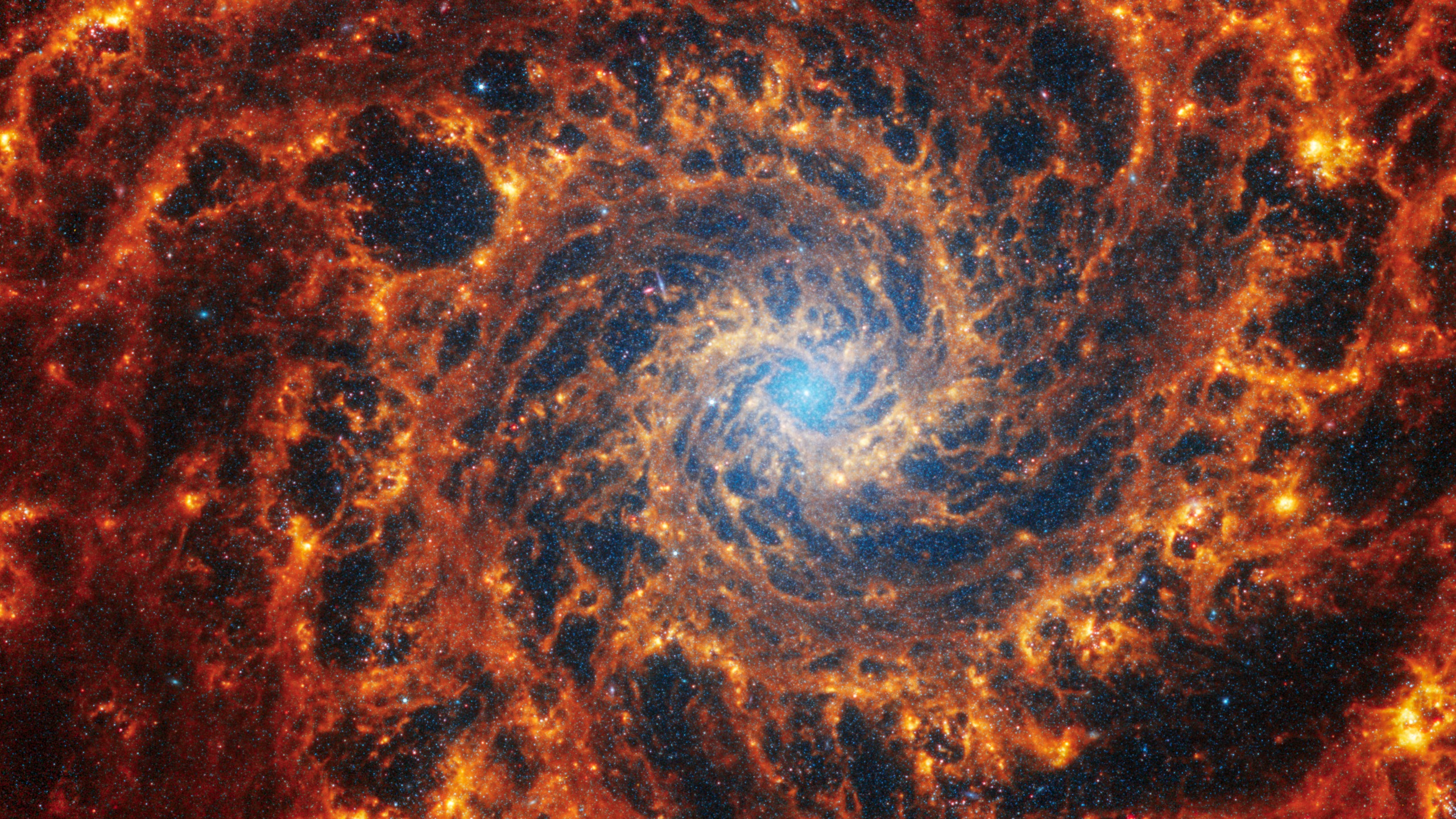
Face-on spiral galaxy, NGC 628, is split diagonally in this image: The James Webb Space Telescope’s observations appear at top left, and the Hubble Space Telescope’s on bottom right. Webb and Hubble’s images show a striking contrast, an inverse of darkness and light. Why? Webb’s observations combine near- and mid-infrared light and Hubble’s showcase visible light. Dust absorbs ultraviolet and visible light, and then re-emits it in the infrared. In Webb's images, we see dust glowing in infrared light. In Hubble’s images, dark regions are where starlight is absorbed by dust. Webb’s image includes distant galaxies that are located well behind the tightly cropped foreground galaxy. Look for bright blue and pink disks, some seen edge-on, like a plate with a central sphere. Redder galaxies are more distant. In Hubble’s view, distant galaxies are often light orange if they are slightly closer. Like in Webb's image, those that are deeper red are also more distant. Galaxy NGC 628 was observed as part of the Physics at High Angular resolution in Nearby GalaxieS (PHANGS) program, a large project that includes observations from several space- and ground-based telescopes of many galaxies to help researchers study all phases of the star formation cycle, from the formation of stars within dusty gas clouds to the energy released in the process that creates the intricate structures revealed by Webb’s new images. NGC 628 is 32 million light-years away in the constellation Pisces. Extended Description and Image Alt Text
21.8k downloads
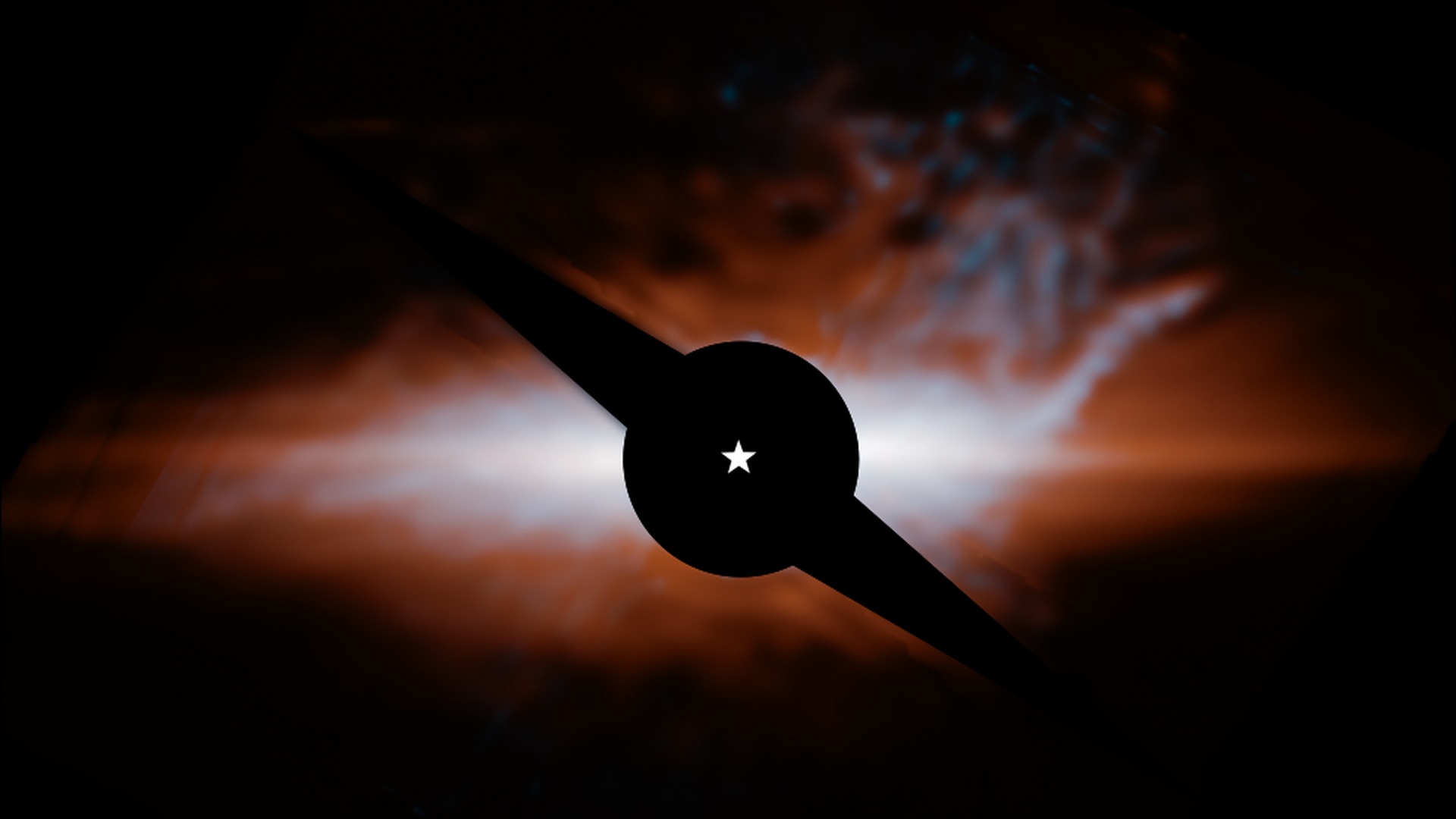
The dark circle and two smaller disks at the center of this image are a coronagraph, deliberately blocking the light of Beta Pictoris' central star (its actual position is marked with a small white star shape) so the much fainter dust disks surrounding it become visible. NASA's James Webb Space Telescope used this technique to image star system Beta Pictoris in detail. Webb's MIRI (Mid-Infrared Instrument) enabled a team of astronomers to investigate the composition of Beta Pic's main and secondary debris disks, the latter a feature previously detected by the Hubble Space Telescope. Unexpectedly, Webb's infrared capabilities detected a new feature of the Beta Pic system: a curvy branch of dust that resembles the shape of a cat's tail. This tail, only noticeable in the MIRI data, extends from the southwest portion of the secondary debris disk and is estimated to span 10 billion miles. The dust that forms the tail may be similar to the matter found on the surfaces of comets and asteroids in our solar system. The team believes a dust production event, such as a collision between asteroids, comets, or planetesimals, is responsible. In this image, light at 15.5 microns is colored cyan and 23 microns is orange (filters F1550C and F2300C).
10.8k downloads
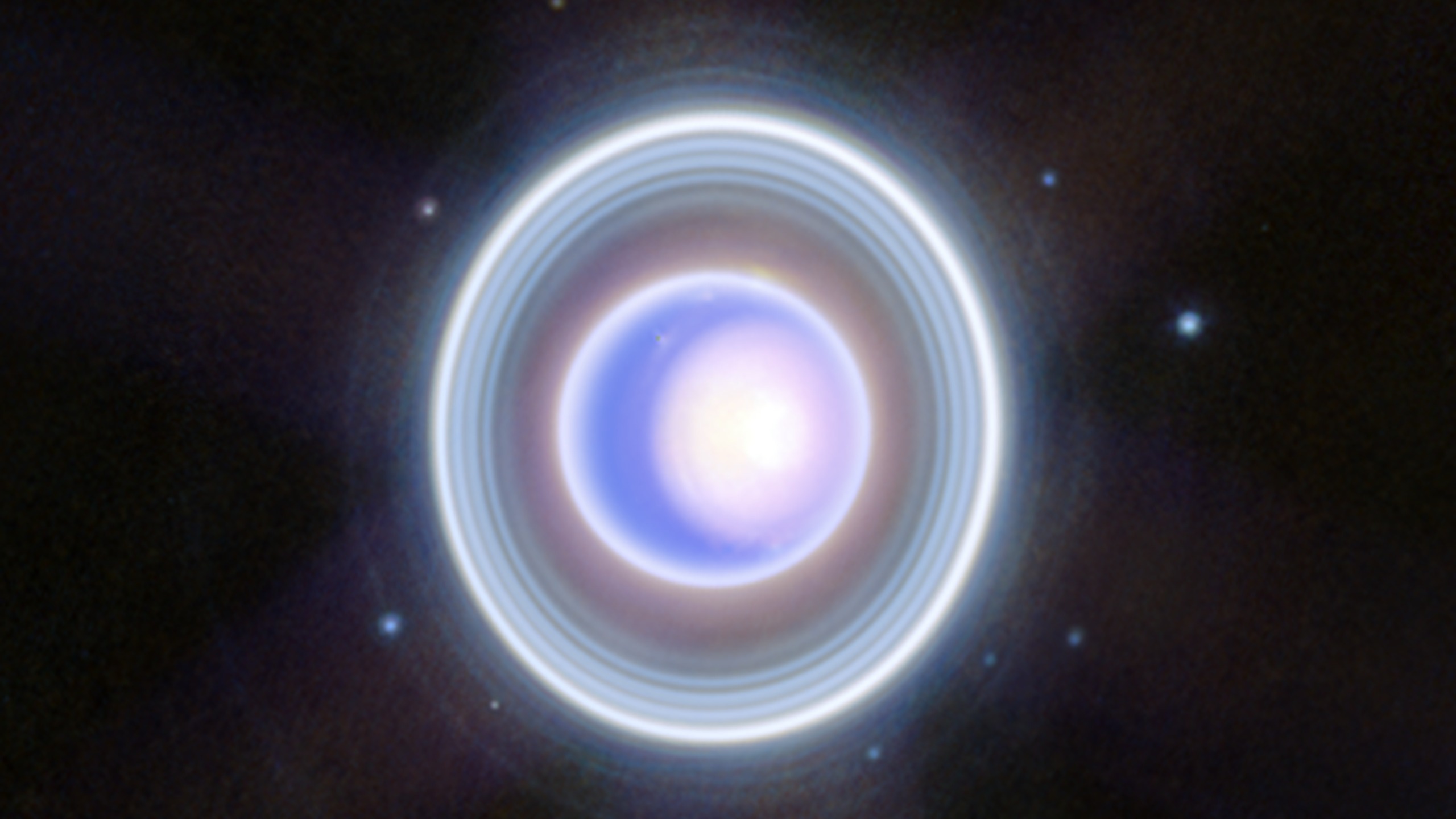
This image of Uranus from NIRCam (Near-Infrared Camera) on NASA's James Webb Space Telescope shows the planet and its rings in new clarity. The Webb image exquisitely captures Uranus's seasonal north polar cap, including the bright, white, inner cap and the dark lane in the bottom of the polar cap. Uranus' dim inner and outer rings are also visible in this image, including the elusive Zeta ring, the extremely faint and diffuse ring closest to the planet. Nine of the planet's 27 known moons are also visible around the rings: Rosalind, Puck, Belinda, Desdemona, Cressida, Bianca, Portia, Juliet, and Perdita.
8.8k downloads
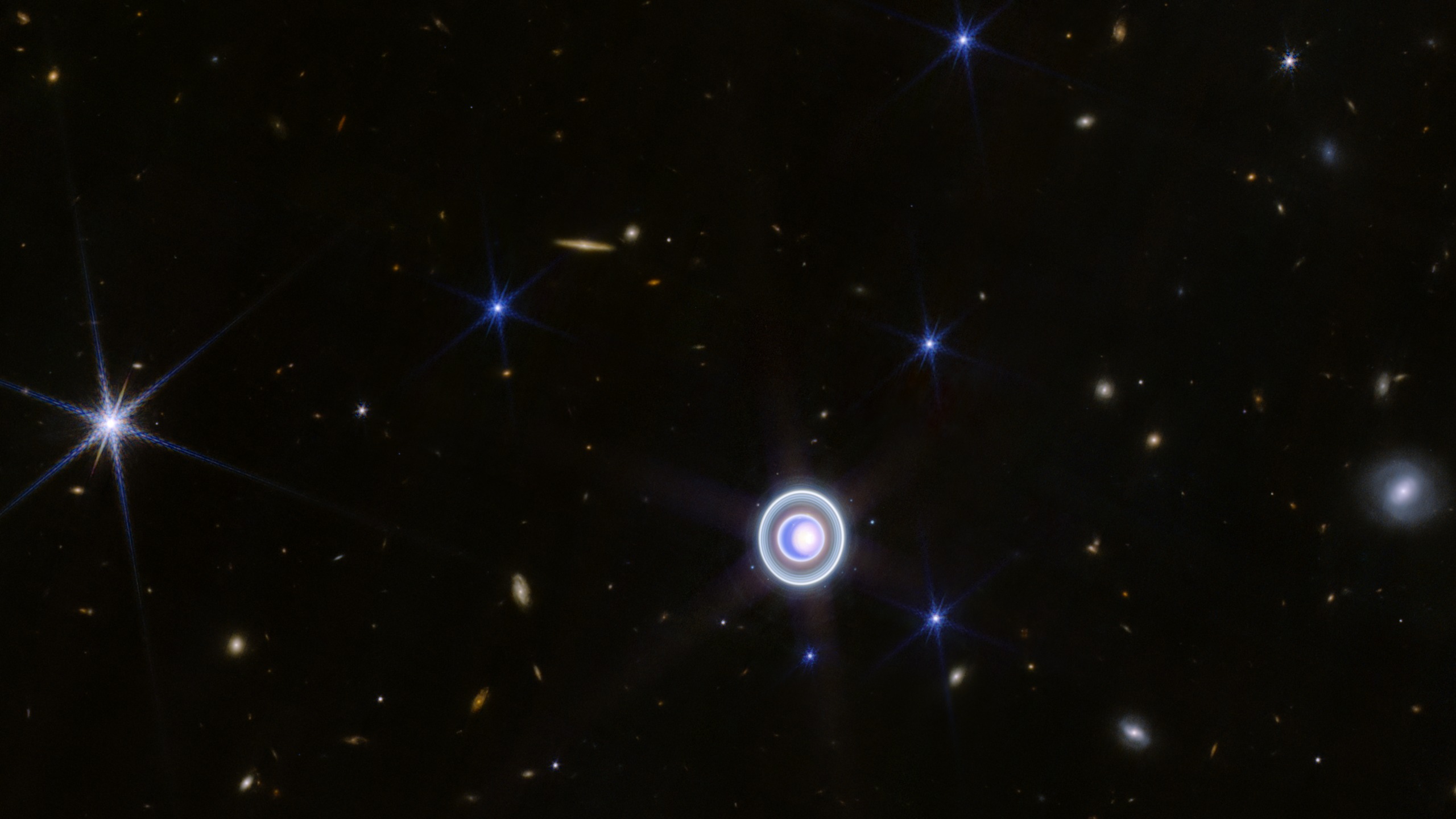
This image of Uranus from NIRCam (Near-Infrared Camera) on NASA's James Webb Space Telescope shows the planet and its rings in new clarity. The planet's seasonal north polar cap gleams in a bright white, and Webb's exquisite sensitivity resolves Uranus' dim inner and outer rings, including the Zeta ring—the extremely faint and diffuse ring closest to the planet. This Webb image also shows 14 of the planet's 27 moons: Oberon, Titania, Umbriel, Juliet, Perdita, Rosalind, Puck, Belinda, Desdemona, Cressida, Ariel, Miranda, Bianca, and Portia. One day on Uranus is about 17 hours, so the planet's rotation is relatively quick. This makes it supremely difficult for observatories with a sharp eye like Webb to capture one simple image of the entire planet – storms and other atmospheric features, and the planet's moons, move visibly within minutes. This image combines several longer and shorter exposures of this dynamic system to correct for those slight changes throughout the observing time. Webb's extreme sensitivity also picks up a smattering of background galaxies—most appear as orange smudges, and there are two larger, fuzzy white galaxies to the right of the planet in this field of view.
17k downloads
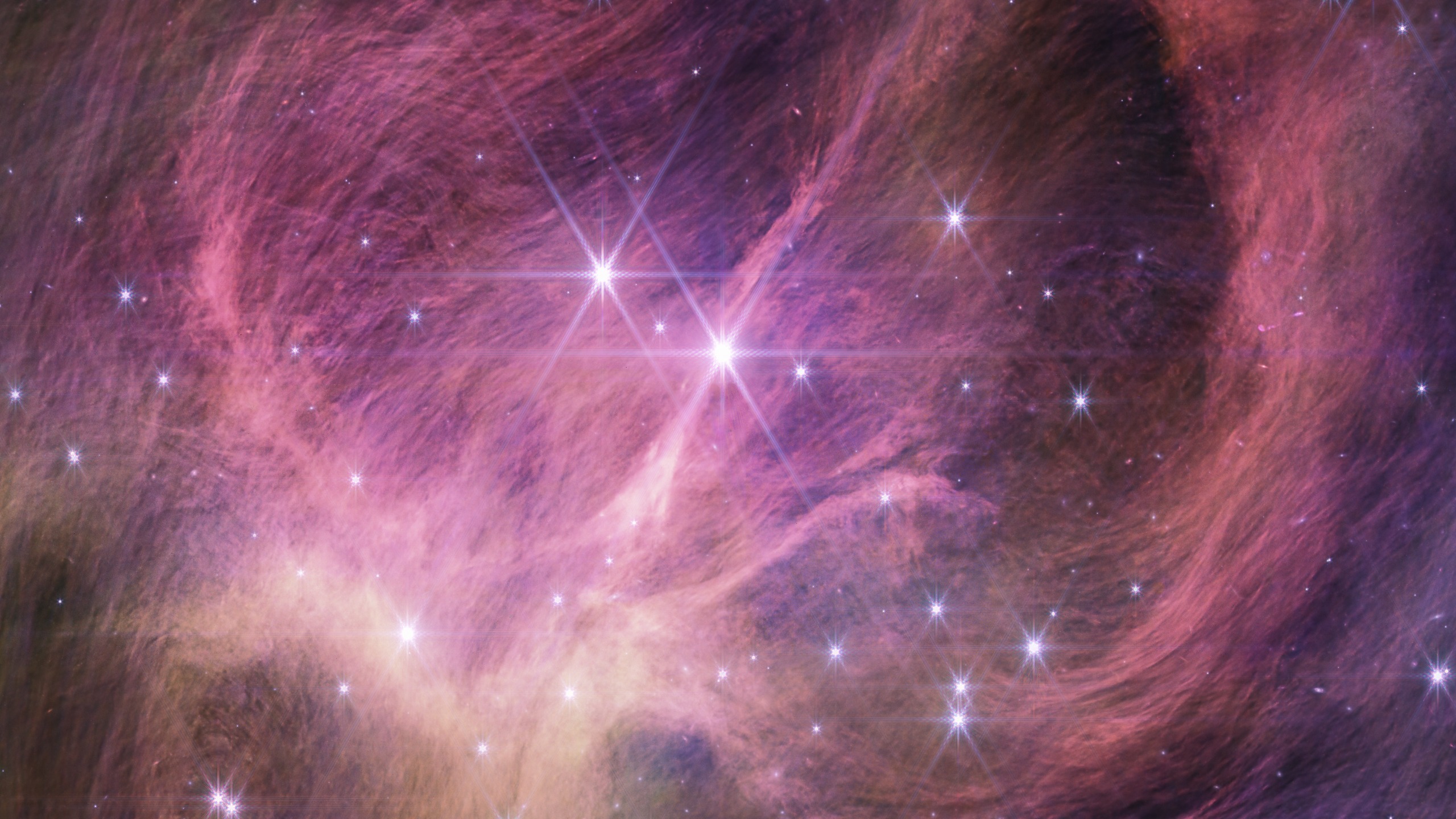
This image from the NIRCam (Near-Infrared Camera) instrument on NASA’s James Webb Space Telescope shows the central portion of the star cluster IC 348. Astronomers combed the cluster in search of tiny, free-floating brown dwarfs: objects too small to be stars but larger than most planets. They found three brown dwarfs that are less than eight times the mass of Jupiter. The smallest weighs just three to four times Jupiter, challenging theories for star formation. The wispy curtains filling the image are interstellar material reflecting the light from the cluster’s stars – what is known as a reflection nebula. The material also includes carbon-containing molecules known as polycyclic aromatic hydrocarbons, or PAHs. The bright star closest to the center of the frame is actually a pair of type B stars in a binary system, which are the most massive stars in the cluster. Winds from these stars may help sculpt the large loop seen on the right side of the field of view.
37.5k downloads
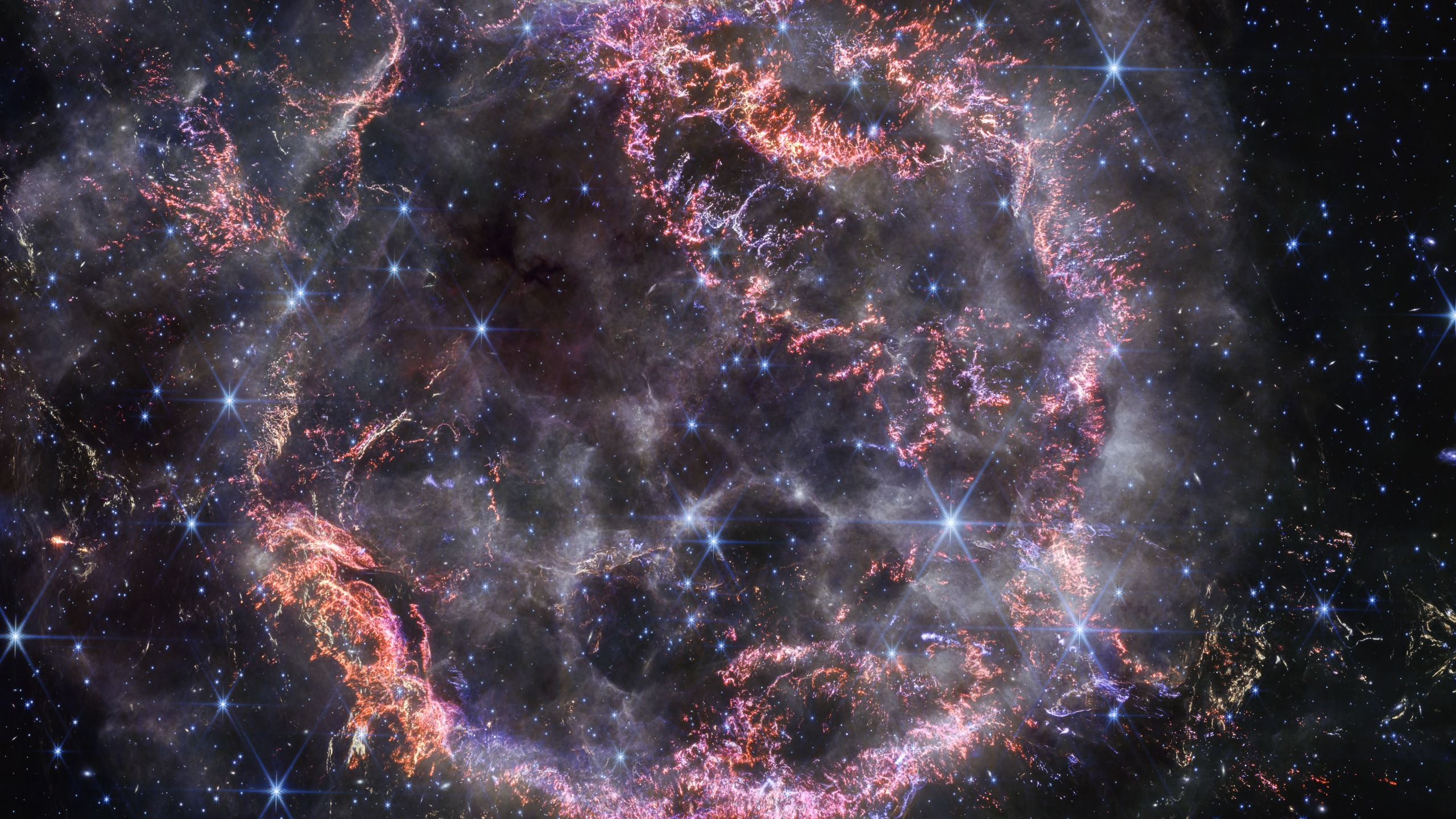
A new high-definition image from NASA’s James Webb Space Telescope’s NIRCam (Near-Infrared Camera) unveils intricate details of supernova remnant Cassiopeia A (Cas A), and shows the expanding shell of material slamming into the gas shed by the star before it exploded. The most noticeable colors in Webb’s newest image are clumps of bright orange and light pink that make up the inner shell of the supernova remnant. These tiny knots of gas, comprised of sulfur, oxygen, argon, and neon from the star itself, are only detectable by NIRCam’s exquisite resolution, and give researchers a hint at how the dying star shattered like glass when it exploded. The outskirts of the main inner shell looks like smoke from a campfire. This marks where ejected material from the exploded star is ramming into surrounding circumstellar material. Researchers say this white color is light from synchrotron radiation, which is generated by charged particles traveling at extremely high speeds spiraling around magnetic field lines. There are also several light echoes visible in this image, most notably in the bottom right corner. This is where light from the star’s long-ago explosion has reached, and is warming distant dust, which is glowing as it cools down.
31.3k downloads
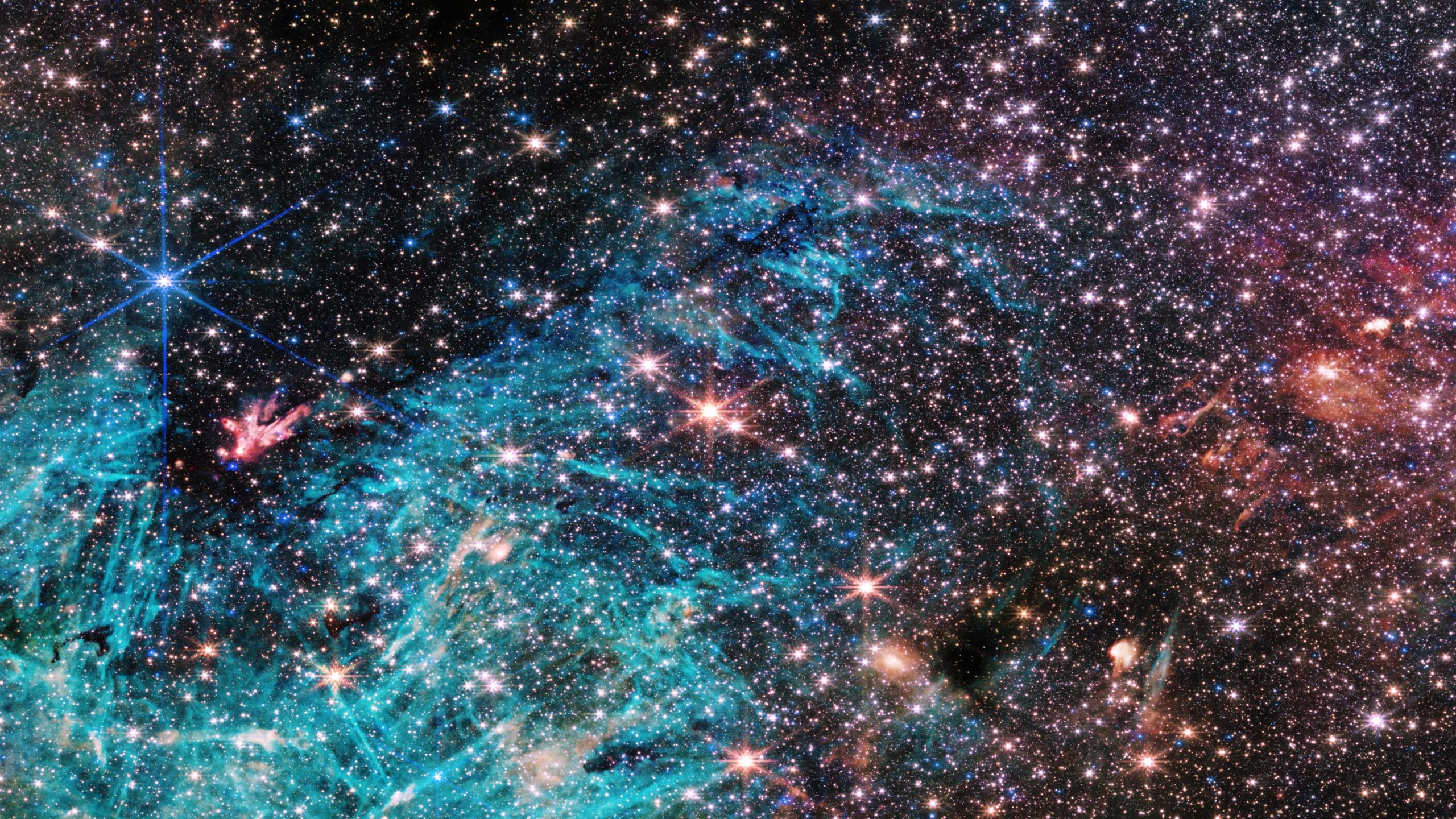
The full view of the James Webb Space Telescope’s NIRCam (Near-Infrared Camera) instrument reveals a 50 light-years-wide portion of the Milky Way’s dense center. An estimated 500,000 stars shine in this image of the Sagittarius C (Sgr C) region, along with some as-yet unidentified features. A vast region of ionized hydrogen, shown in cyan, wraps around an infrared-dark cloud, which is so dense that it blocks the light from distant stars behind it. Intriguing needle-like structures in the ionized hydrogen emission lack any uniform orientation. Researchers note the surprising extent of the ionized region, covering about 25 light-years. A cluster of protostars – stars that are still forming and gaining mass – are producing outflows that glow like a bonfire at the base of the large infrared-dark cloud, indicating that they are emerging from the cloud’s protective cocoon and will soon join the ranks of the more mature stars around them. Smaller infrared-dark clouds dot the scene, appearing like holes in the starfield. Researchers say they have only begun to dig into the wealth of unprecedented high-resolution data that Webb has provided on this region, and many features bear detailed study. This includes the rose-colored clouds on the right side of the image, which have never been seen in such detail.
25.5k downloads
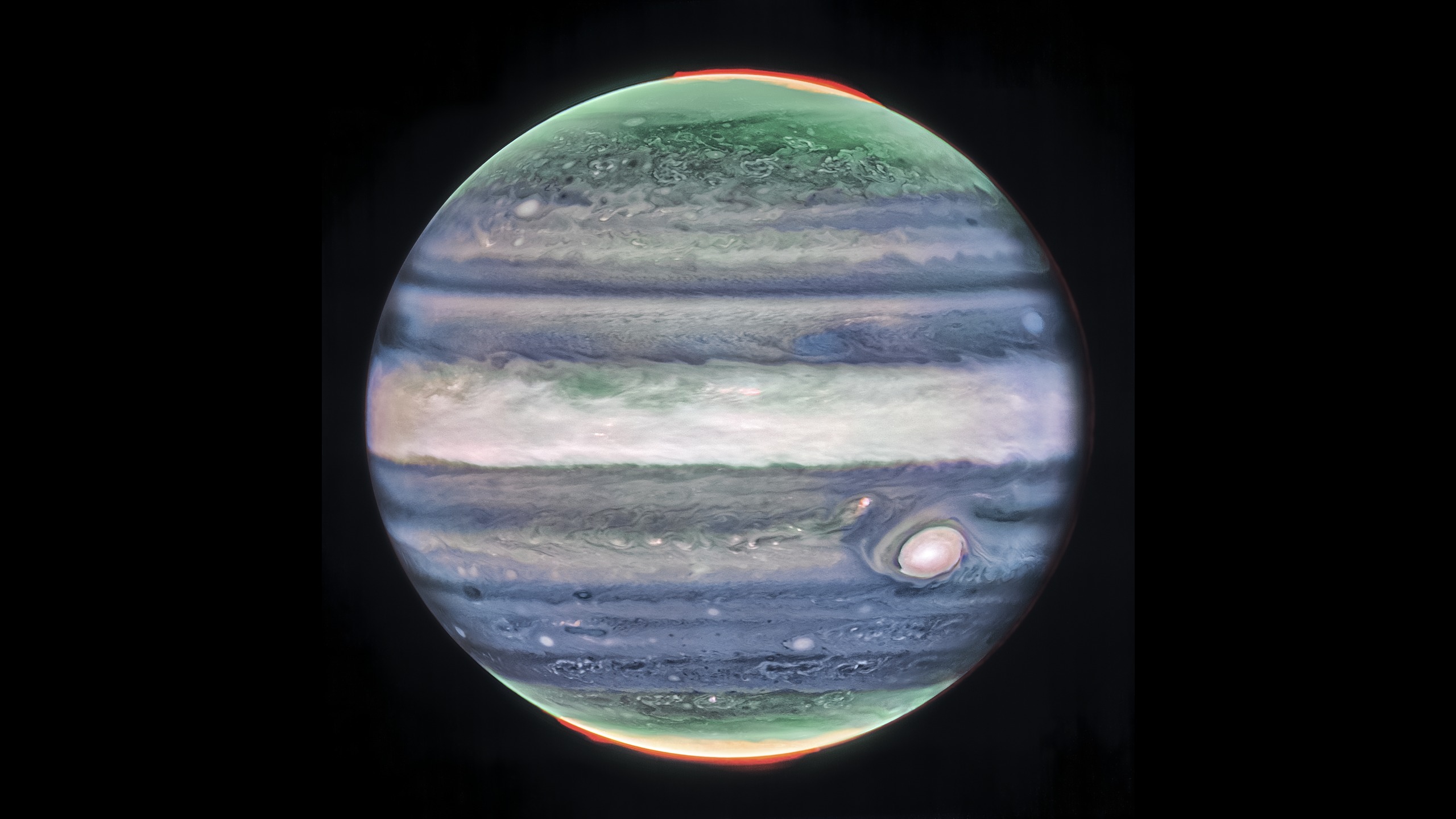
This image of Jupiter from NASA's James Webb Space Telescope's NIRCam (Near-Infrared Camera) shows stunning details of the majestic planet in infrared light. In this image, brightness indicates high altitude. The numerous bright white "spots" and "streaks" are likely very high-altitude cloud tops of condensed convective storms. Auroras, appearing in red in this image, extend to higher altitudes above both the northern and southern poles of the planet. By contrast, dark ribbons north of the equatorial region have little cloud cover. In Webb's images of Jupiter from July 2022, researchers recently discovered a narrow jet stream traveling 320 miles per hour (515 kilometers per hour) sitting over Jupiter's equator above the main cloud decks.
2.3k downloads
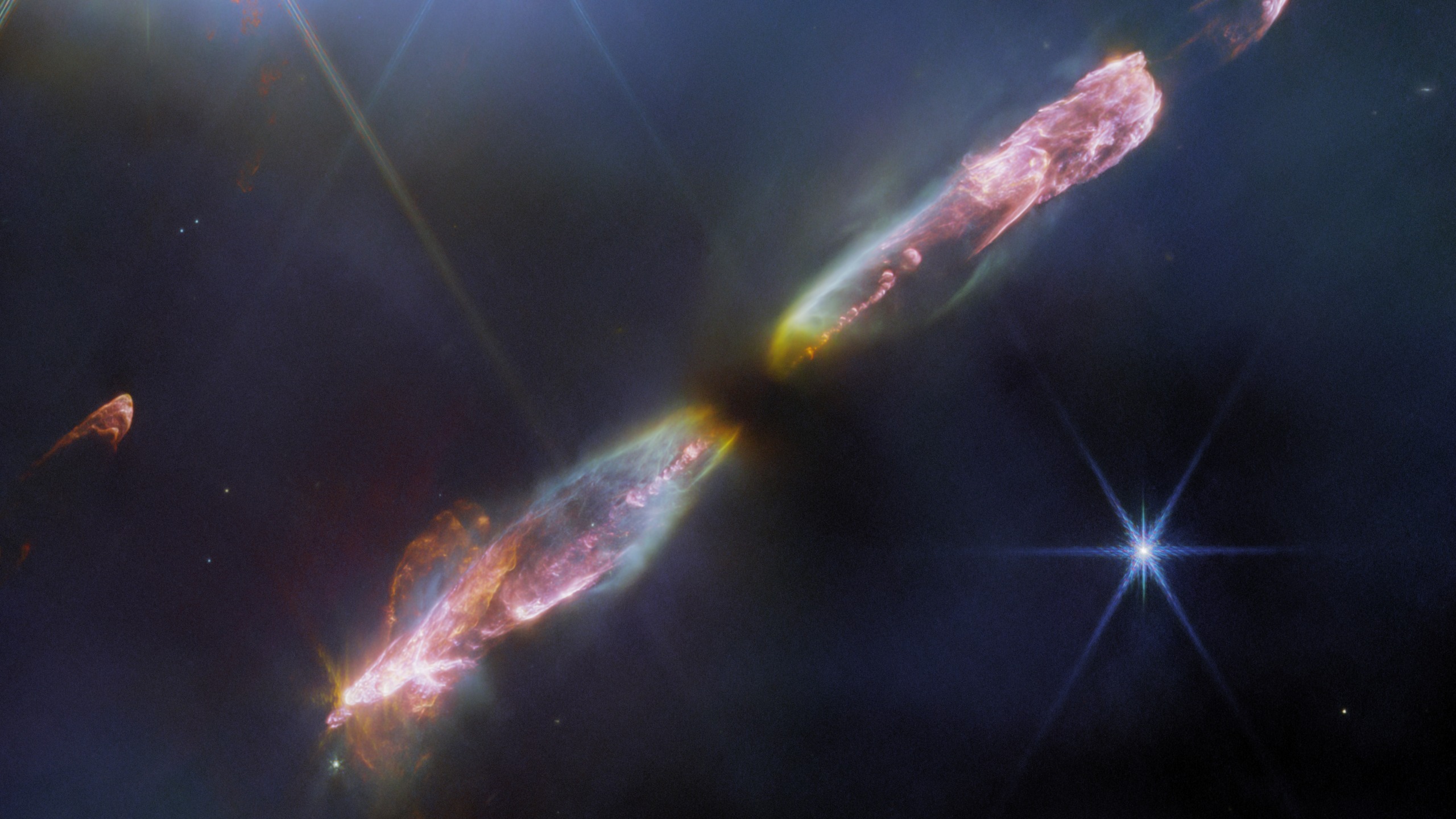
NASA’s James Webb Space Telescope’s high resolution, near-infrared look at Herbig-Haro 211 reveals exquisite detail of the outflow of a young star, an infantile analogue of our Sun. Herbig-Haro objects are formed when stellar winds or jets of gas spewing from newborn stars form shock waves colliding with nearby gas and dust at high speeds The image showcases a series of bow shocks to the southeast (lower-left) and northwest (upper-right) as well as the narrow bipolar jet that powers them in unprecedented detail. Molecules excited by the turbulent conditions, including molecular hydrogen, carbon monoxide and silicon monoxide, emit infrared light, collected by Webb, that map out the structure of the outflows.
6.9k downloads
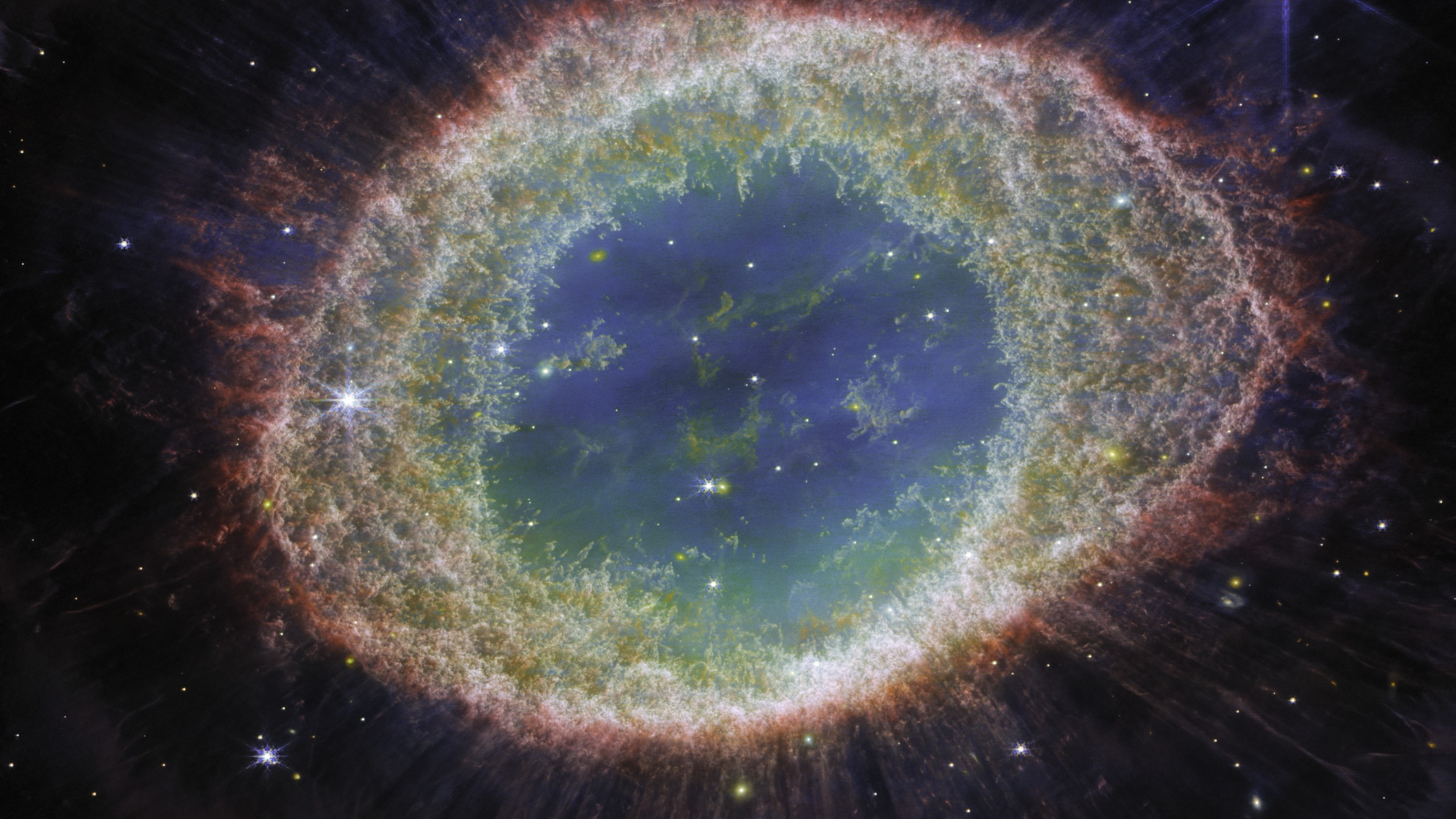
NASA’s James Webb Space Telescope has observed the well-known Ring Nebula in unprecedented detail. Formed by a star throwing off its outer layers as it runs out of fuel, the Ring Nebula is an archetypal planetary nebula. Also known as M57 and NGC 6720, it is relatively close to Earth at roughly 2,500 light-years away. This new image from Webb’s NIRCam (Near-Infrared Camera) provides unprecedented spatial resolution and spectral sensitivity. For example, the intricate details of the filament structure of the inner ring are particularly visible in this dataset. There are some 20,000 dense globules in the nebula, which are rich in molecular hydrogen. In contrast, the inner region shows very hot gas. The main shell contains a thin ring of enhanced emission from carbon-based molecules known as polycyclic aromatic hydrocarbons (PAHs). Roughly ten concentric arcs are located just beyond the outer edge of the main ring. The arcs are thought to originate from the interaction of the central star with a low-mass companion orbiting at a distance comparable to that between the Earth and Pluto. In this way, nebulae like the Ring Nebula reveal a kind of astronomical archaeology, as astronomers study the nebula to learn about the star that created it.
15.6k downloads
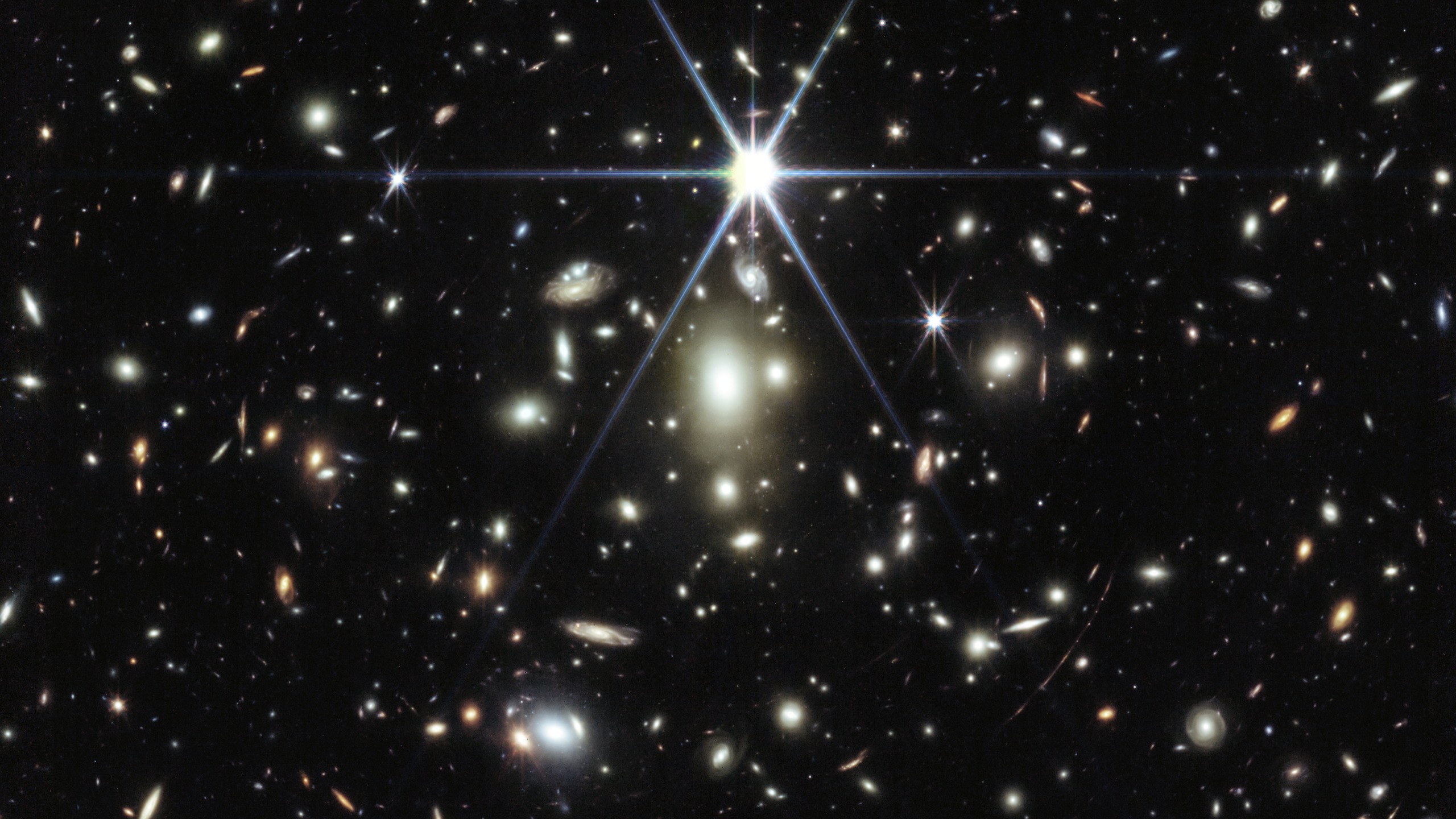
This image from NASA’s James Webb Space Telescope of a massive galaxy cluster called WHL0137-08 contains the most strongly magnified galaxy known in the universe’s first billion years: the Sunrise Arc, and within that galaxy, the most distant star ever detected. The star, nicknamed Earendel, was first discovered by the Hubble Space Telescope. Follow-up observations using Webb’s NIRCam (Near-Infrared Camera) reveals the star to be a massive B-type star more than twice as hot as our Sun, and about a million times more luminous. Earendel is positioned along a wrinkle in spacetime that gives it extreme magnification, allowing it to emerge into view from its host galaxy, which appears as a red smear across the sky. The star is detectable only due to the combined power of human technology and nature via an effect called gravitational lensing. In this image, the Sunrise Arc appears just below the diffraction spike at the 5 o’clock position. The fuzzier, white galaxies at the center of the image are part of the galaxy cluster bound together by gravity. The various redder, curved galaxies are background galaxies picked up by Webb’s sensitive mirror.
5.1k downloads
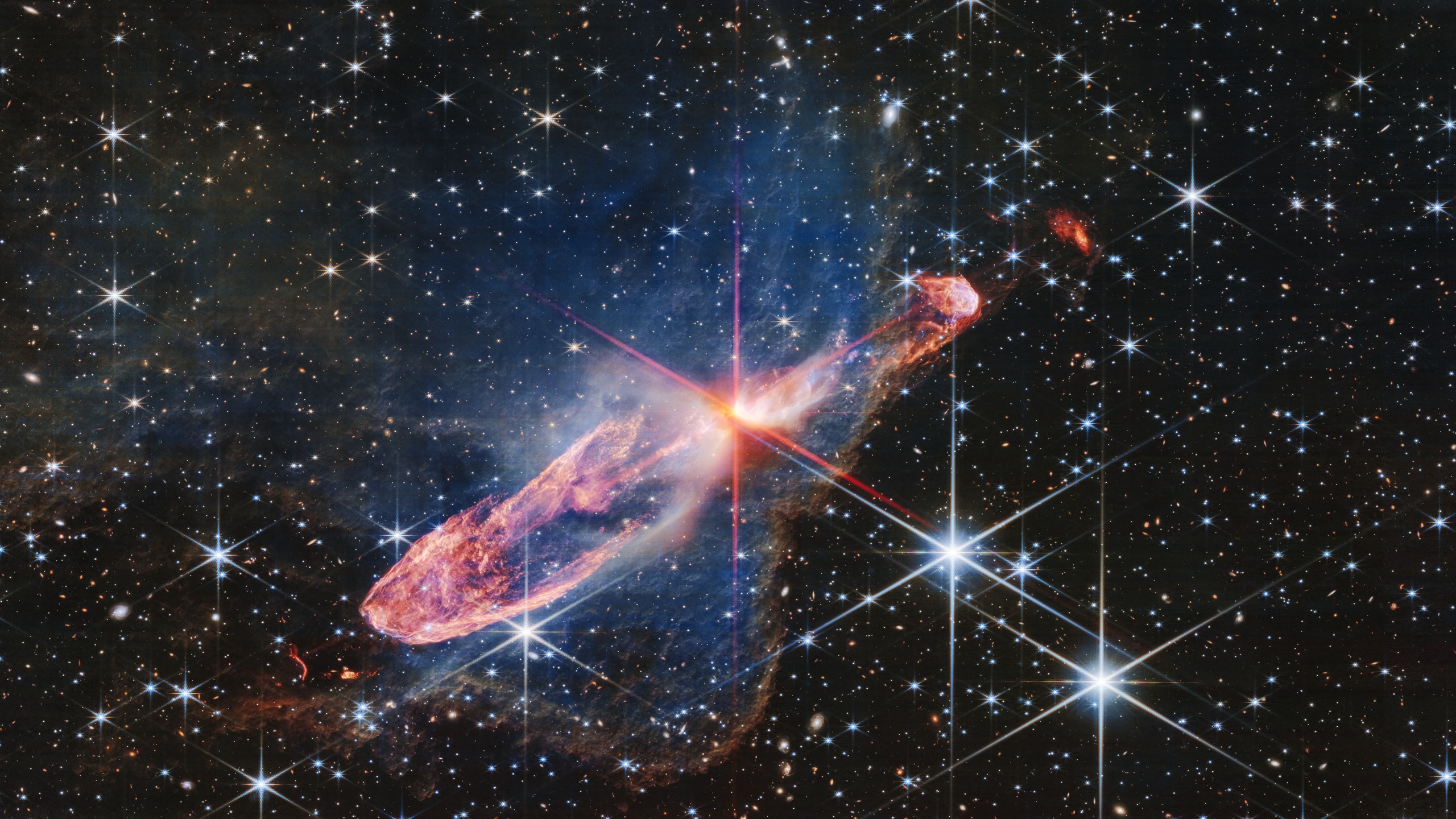
These stars have a lot of energy to let loose! NASA’s James Webb Space Telescope has captured a tightly bound pair of actively forming stars, known as Herbig-Haro 46/47, in high-resolution near-infrared light. Look for them at the center of the red diffraction spikes. The stars are buried deeply, appearing as an orange-white splotch. They are surrounded by a disk of gas and dust that continues to add to their mass. Herbig-Haro 46/47 is an important object to study because it is relatively young – only a few thousand years old. Stars take millions of years to fully form. Targets like this also give researchers insight into how stars gather mass over time, potentially allowing them to model how our own Sun, a low-mass star, formed. The two-sided orange lobes were created by earlier ejections from these stars. The stars’ more recent ejections appear in a thread-like blue, running along the angled diffraction spike that covers the orange lobes. Actively forming stars ingest the gas and dust that immediately surrounds them in a disk (imagine an edge-on circle encasing them). When the stars “eat” too much material in too short a time, they respond by sending out two-sided jets along the opposite axis, settling down the star’s spin, and removing mass from the area. Over millennia, these ejections regulate how much mass the stars retain. Don’t miss the delicate, semi-transparent blue cloud. This is a region of dense dust and gas, known as a nebula. Webb’s crisp near-infrared image lets us see through its gauzy layers, showing off a lot more of Herbig-Haro 46/47, while also revealing a deep range of stars and galaxies that lie far beyond it. The nebula’s edges transform into a soft orange outline, like a backward L along the right and bottom. The blue nebula influences the shapes of the orange jets shot out by the central stars. As ejected material rams into the nebula on the lower left, it takes on wider shapes, because there is more opportunity for the jets to interact with molecules within the nebula. Its material also causes the stars’ ejections to light up. Over millions of years, the stars in Herbig-Haro 46/47 will fully form – clearing the scene. Take a moment to linger on the background. A profusion of extremely distant galaxies dot Webb’s view. Its composite NIRCam (Near-Infrared Camera) image is made up of several exposures, highlighting distant galaxies and stars. Blue objects with diffraction spikes are stars, and the closer they are, the larger they appear. White-and-pink spiral galaxies sometimes appear larger than these stars, but are significantly father away. The tiniest red dots, Webb’s infrared specialty, are often the oldest, most distant galaxies.
12k downloads
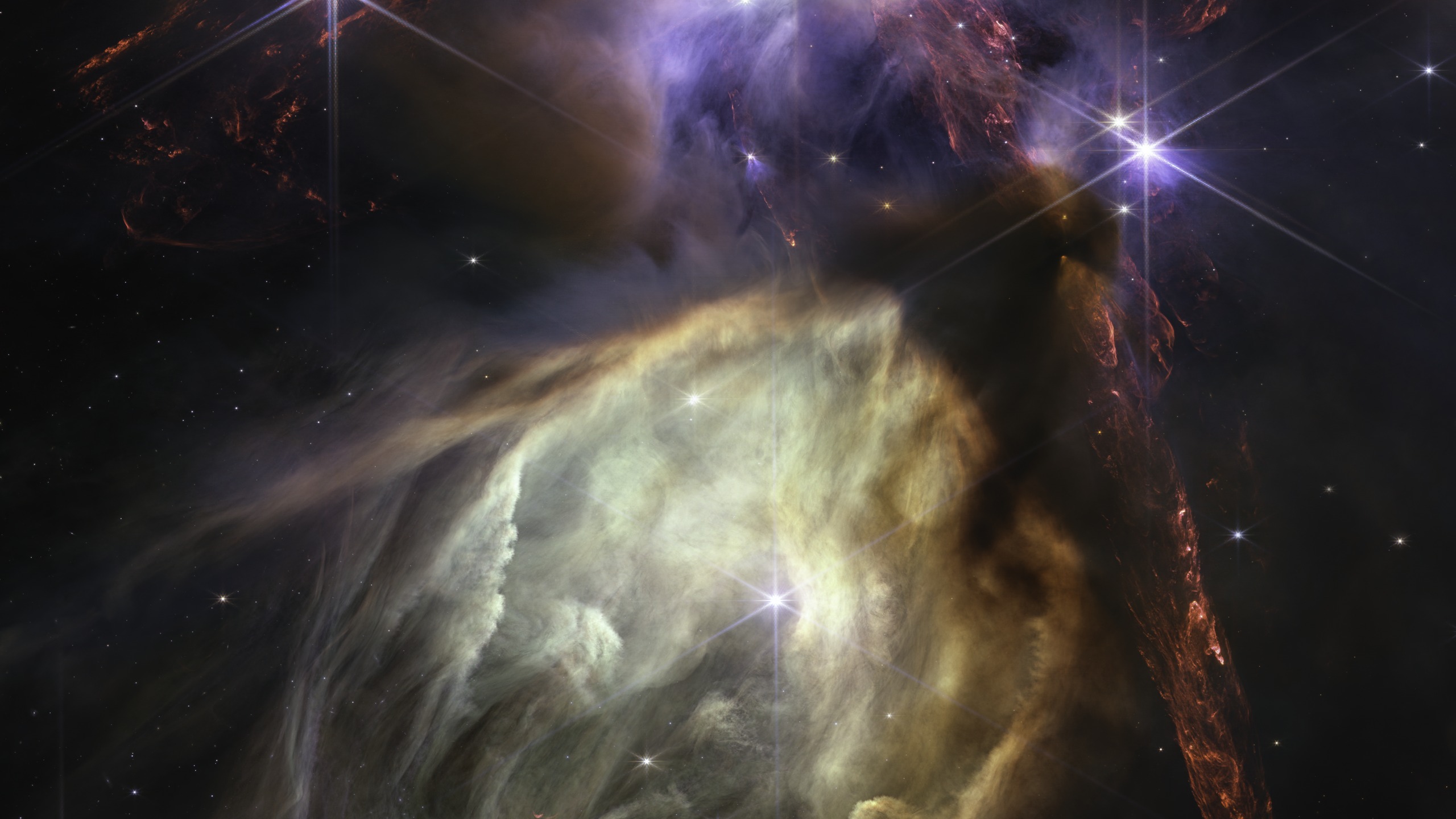
The first anniversary image from NASA’s James Webb Space Telescope displays star birth like it’s never been seen before, full of detailed, impressionistic texture. The subject is the Rho Ophiuchi cloud complex, the closest star-forming region to Earth. It is a relatively small, quiet stellar nursery, but you’d never know it from Webb’s chaotic close-up. Jets bursting from young stars crisscross the image, impacting the surrounding interstellar gas and lighting up molecular hydrogen, shown in red. Some stars display the telltale shadow of a circumstellar disk, the makings of future planetary systems. The young stars at the center of many of these disks are similar in mass to the Sun, or smaller. The heftiest in this image is the star S1, which appears amid a glowing cave it is carving out with its stellar winds in the lower half of the image. The lighter-colored gas surrounding S1 consists of polycyclic aromatic hydrocarbons, a family of carbon-based molecules that are among the most common compounds found in space. For more detail on what is happening where in Webb’s image of Rho Ophiuchi, watch the video tour and read the press release.
7.2k downloads
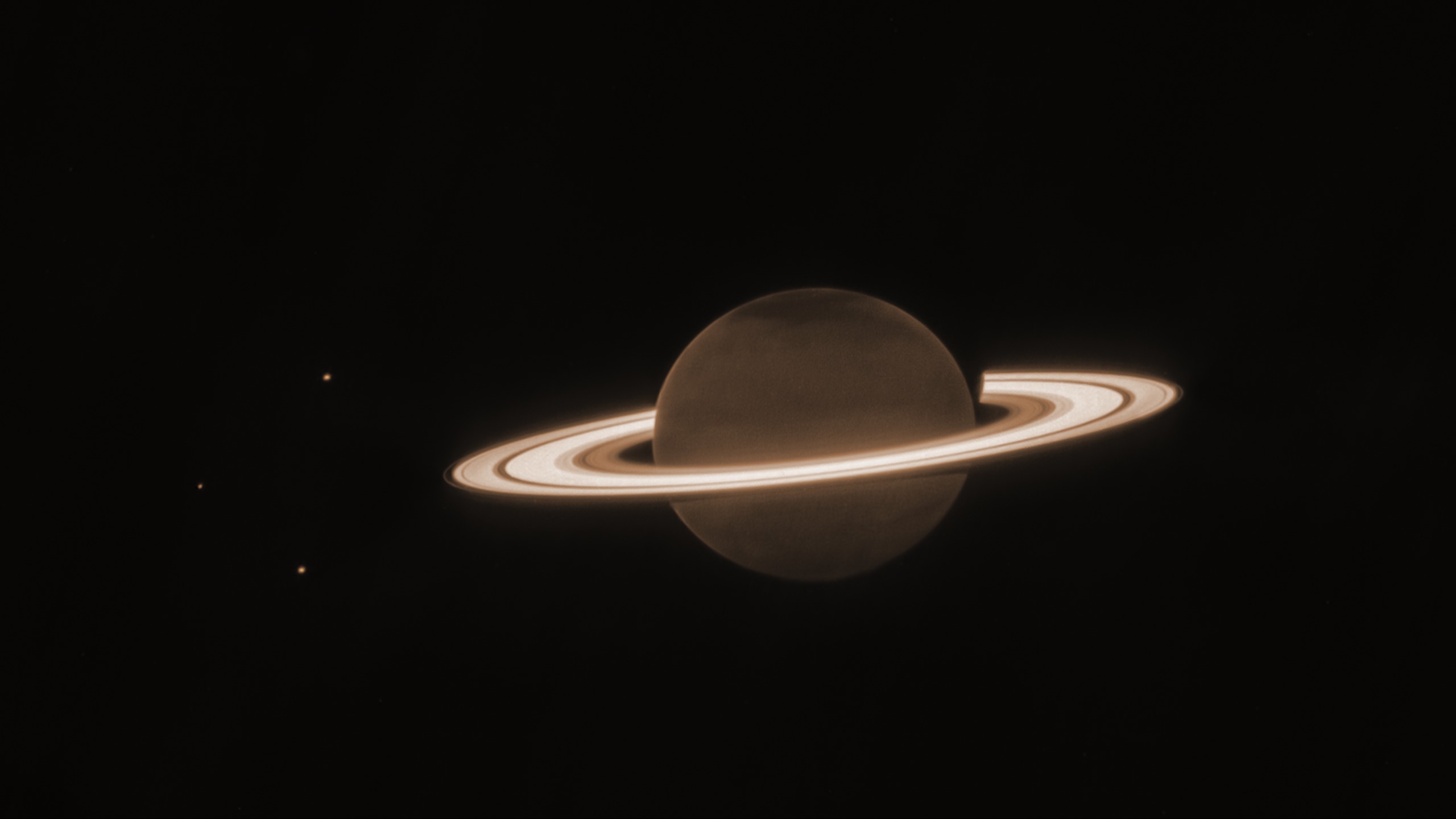
On June 25, 2023, NASA's James Webb Space Telescope turned to famed ringed world Saturn for its first near-infrared observations of the planet. The initial imagery from Webb's NIRCam (Near-Infrared Camera) is already fascinating researchers. Saturn itself appears extremely dark at this infrared wavelength observed by the telescope, as methane gas absorbs almost all of the sunlight falling on the atmosphere. However, the icy rings stay relatively bright, leading to the unusual appearance of Saturn in the Webb image. This image was taken as part of Webb Guaranteed Time Observation program 1247. The program included several very deep exposures of Saturn, which were designed to test the telescope's capacity to detect faint moons around the planet and its bright rings. Any newly discovered moons could garner important clues about the flow of material in the current Saturn system, as well as its past history.
12.5k downloads
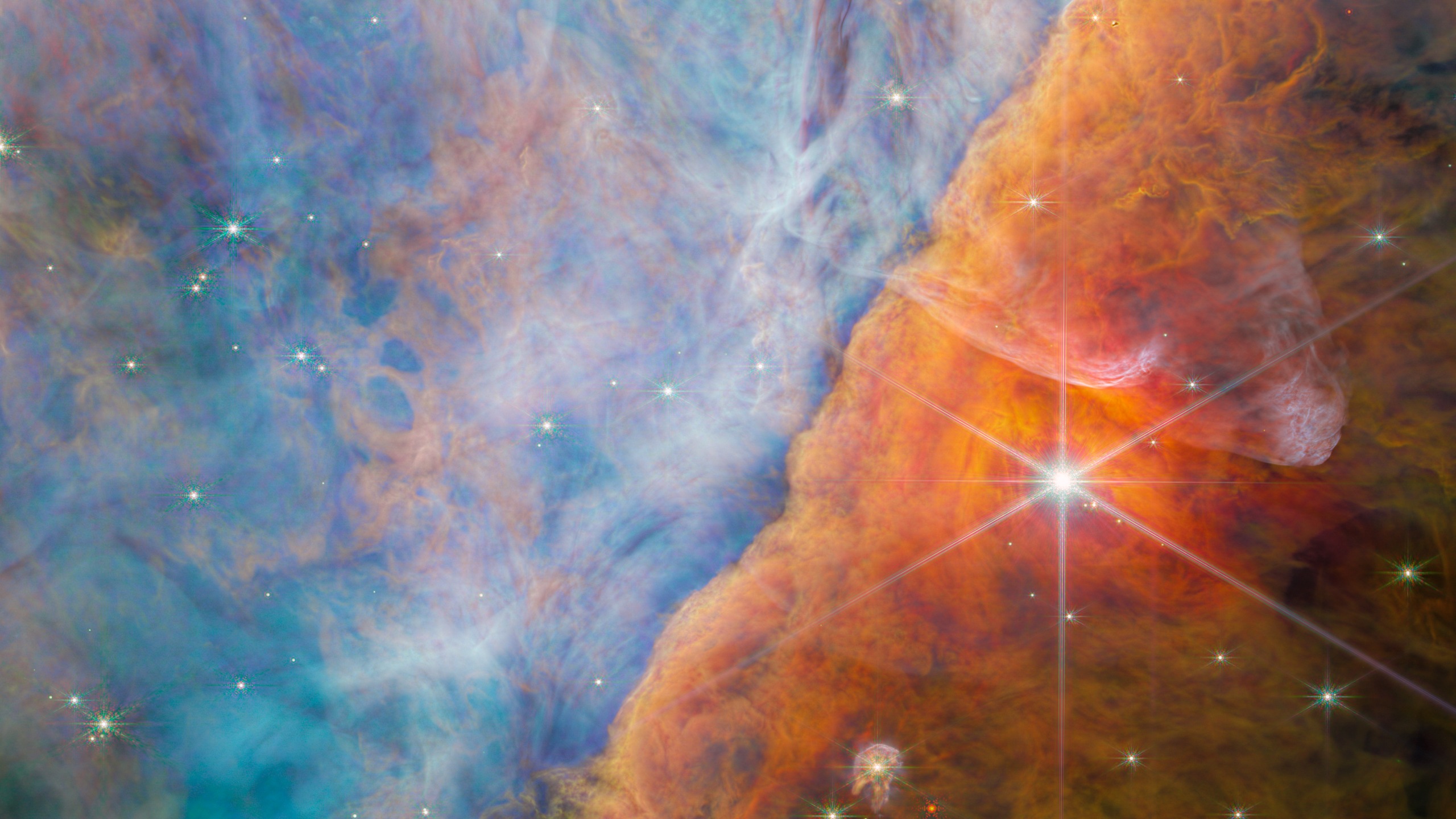
This image taken by Webb’s NIRCam (Near-Infrared Camera) shows a part of the Orion Nebula known as the Orion Bar. It is a region where energetic ultraviolet light from the Trapezium Cluster — located off the upper-left corner — interacts with dense molecular clouds. The energy of the stellar radiation is slowly eroding the Orion Bar, and this has a profound effect on the molecules and chemistry in the protoplanetary disks that have formed around newborn stars here. Within this image lies a young star system known as d203-506, which has a protoplanetary disk. Astronomers used Webb to detect a carbon molecule known as methyl cation in that disk for the first time. That molecule is important because it aids the formation of more complex carbon-based molecules.
18.6k downloads
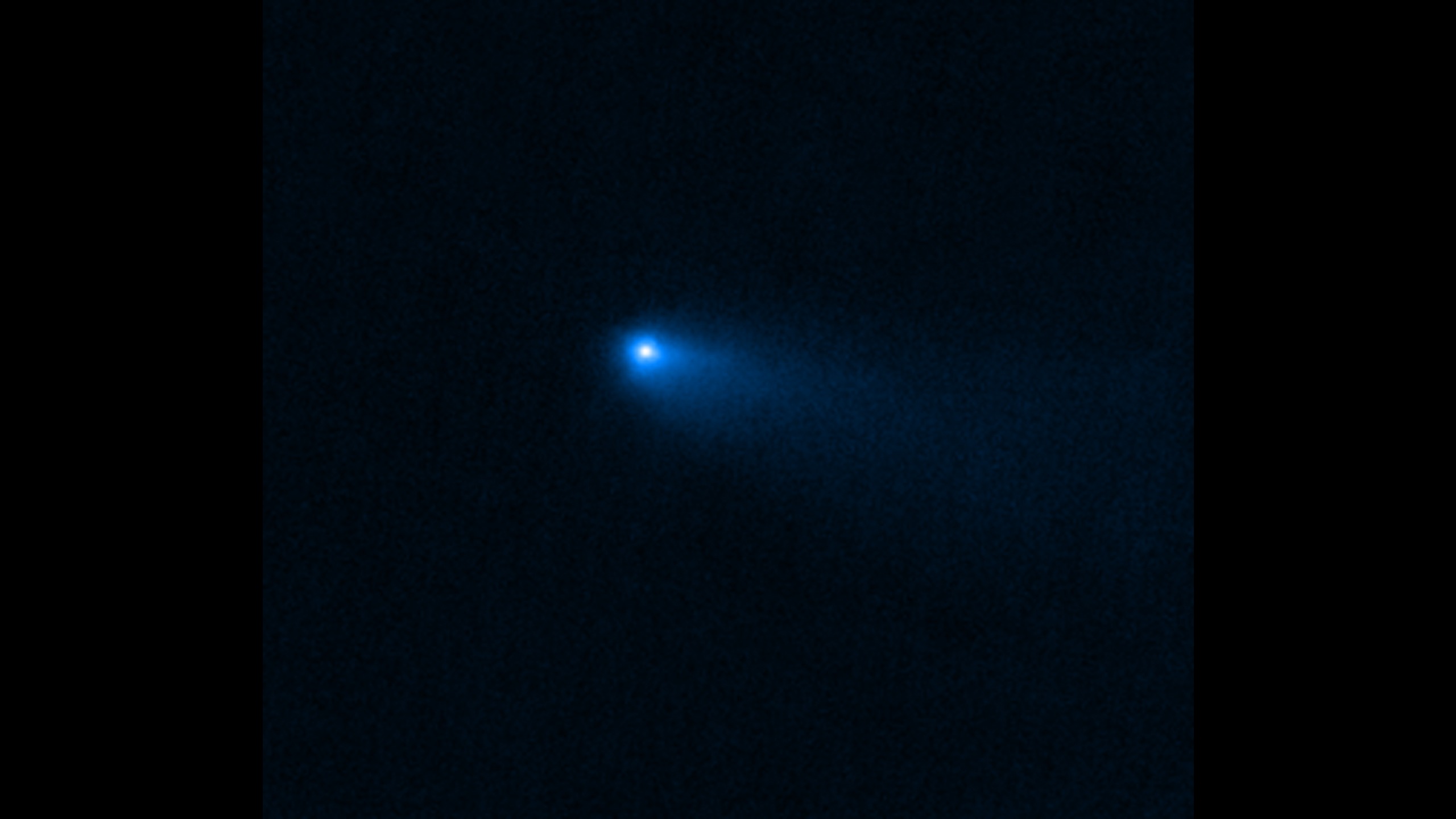
This image of Comet 238P/Read was captured by the NIRCam (Near-Infrared Camera) instrument on NASA’s James Webb Space Telescope on September 8, 2022. It displays the hazy halo, called the coma, and tail that are characteristic of comets, as opposed to asteroids. The dusty coma and tail result from the vaporization of ices as the Sun warms the main body of the comet. Comet Read was among three objects used to define the category of main belt comets in 2006. Before that, comets were understood to reside in the Kuiper Belt and Oort Cloud, beyond the orbit of Neptune, where their ices were preserved farther from the Sun. Since that time scientists have sought to confirm the presence of sublimating material in main belt comets, proving that their coma and tail were due to the same processes that other comets exhibit. With the detection of water vapor on Comet Read, Webb’s sensitive NIRSpec (Near-Infrared Spectrograph) instrument has achieved this goal.
5.9k downloads
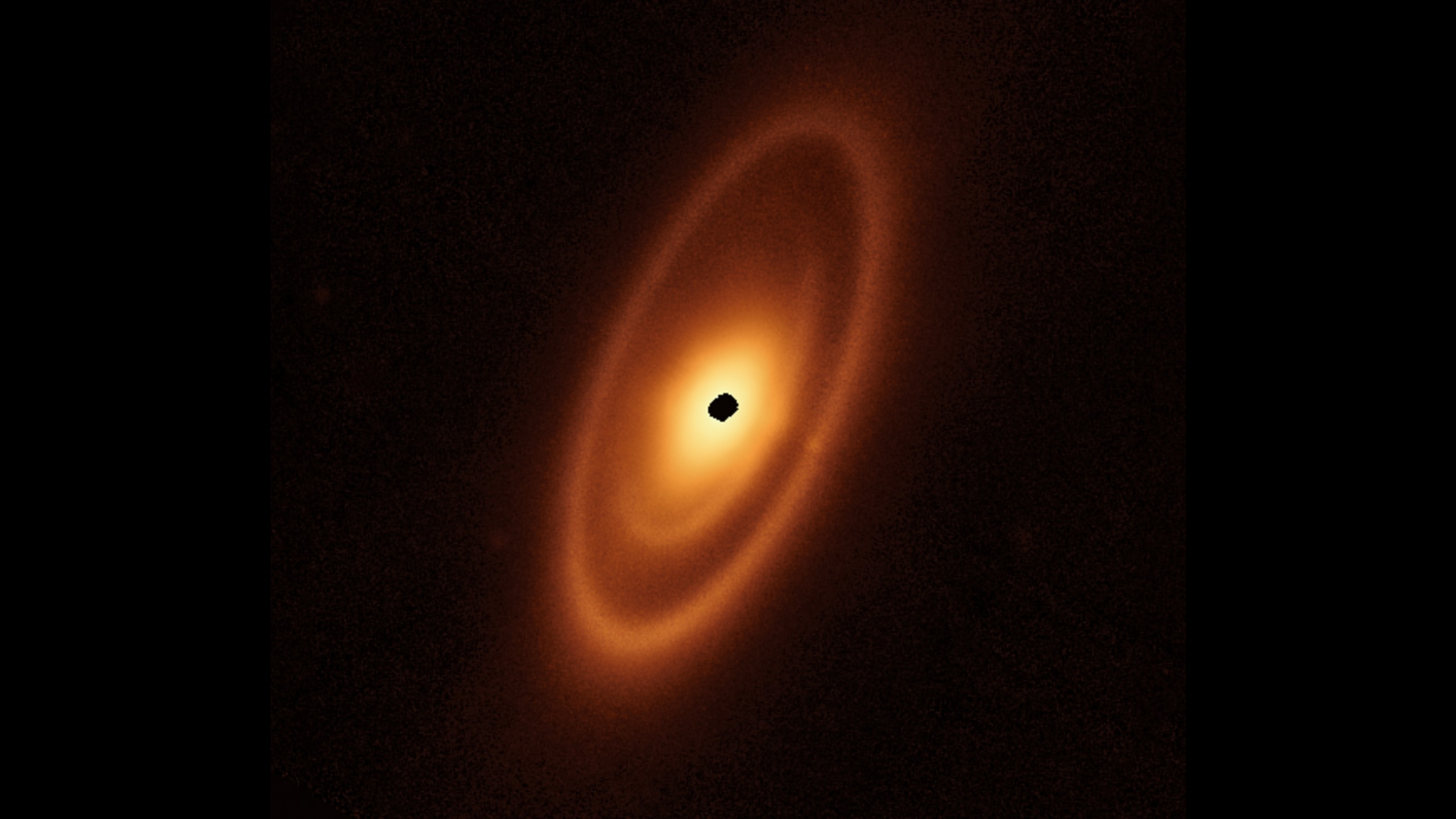
This image of the dusty debris disk surrounding the young star Fomalhaut is from Webb’s Mid-Infrared Instrument (MIRI). It reveals three nested belts extending out to 14 billion miles (23 billion kilometers) from the star. The inner belts – which had never been seen before – were revealed by Webb for the first time. The ragged black spot in the middle indicates a lack of data due to detector saturation. The Hubble Space Telescope and Herschel Space Observatory, as well as the Atacama Large Millimeter/submillimeter Array (ALMA), have previously taken sharp images of the outermost belt. However, none of them found any structure interior to it. These belts most likely are carved by the gravitational forces produced by unseen planets.
10.7k downloads
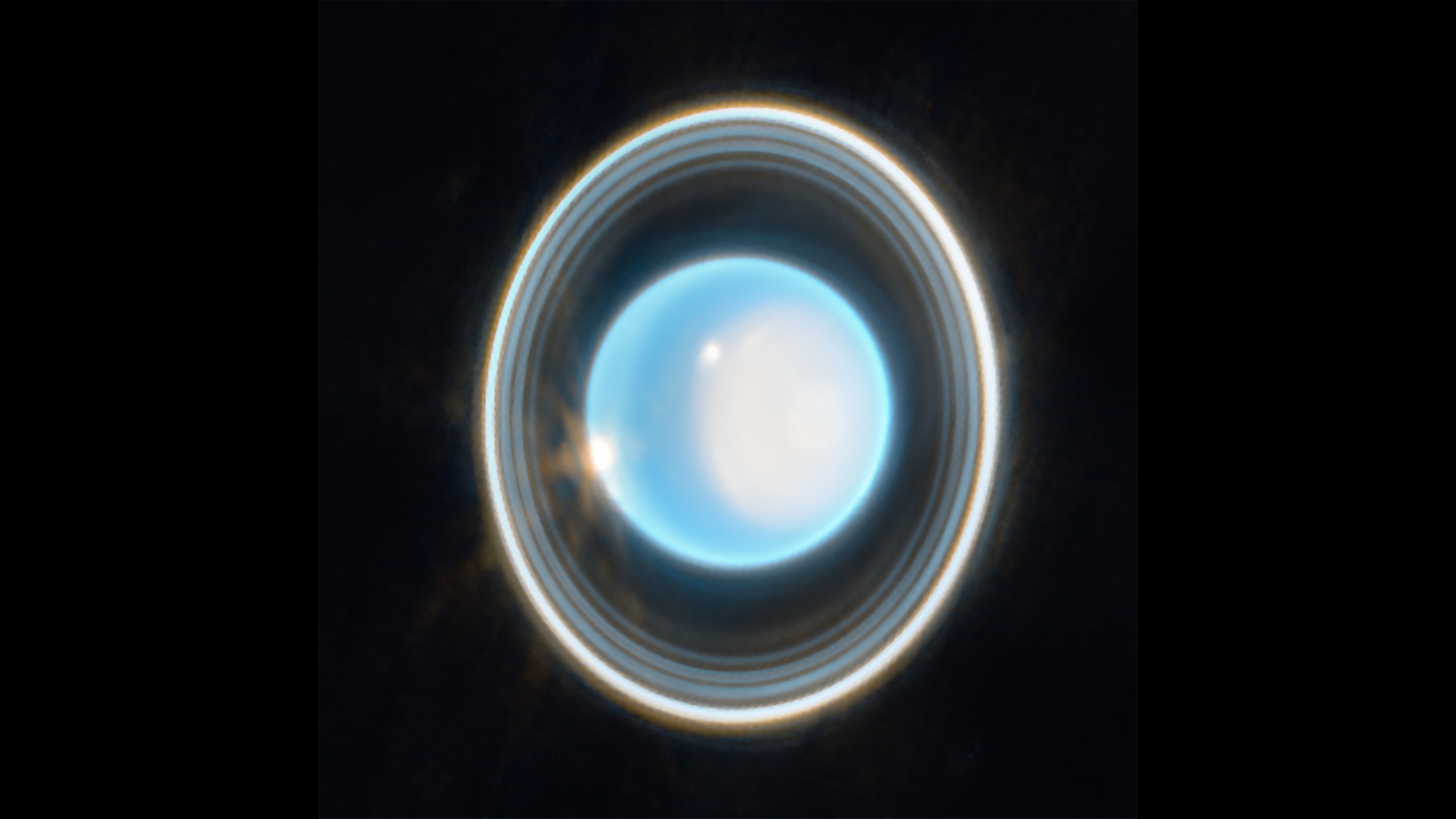
This zoomed-in image of Uranus, captured by Webb’s Near-Infrared Camera (NIRCam) Feb. 6, 2023, reveals stunning views of the planet’s rings. The planet displays a blue hue in this representative-color image, made by combining data from two filters (F140M, F300M) at 1.4 and 3.0 microns, which are shown here as blue and orange, respectively. On the right side of the planet there’s an area of brightening at the pole facing the Sun, known as a polar cap. This polar cap is unique to Uranus because it is the only planet in the solar system tilted on its side, which causes its extreme seasons. A new aspect of the polar cap revealed by Webb is a subtle brightening near the Uranian north pole. At the edge of the polar cap lies a bright cloud as well as a few fainter extended features just northward of the cap’s edge, and a second very bright cloud is seen at the planet’s left limb. Such clouds are typical for Uranus in infrared wavelengths, and likely are connected to storm activity.
36.4k downloads
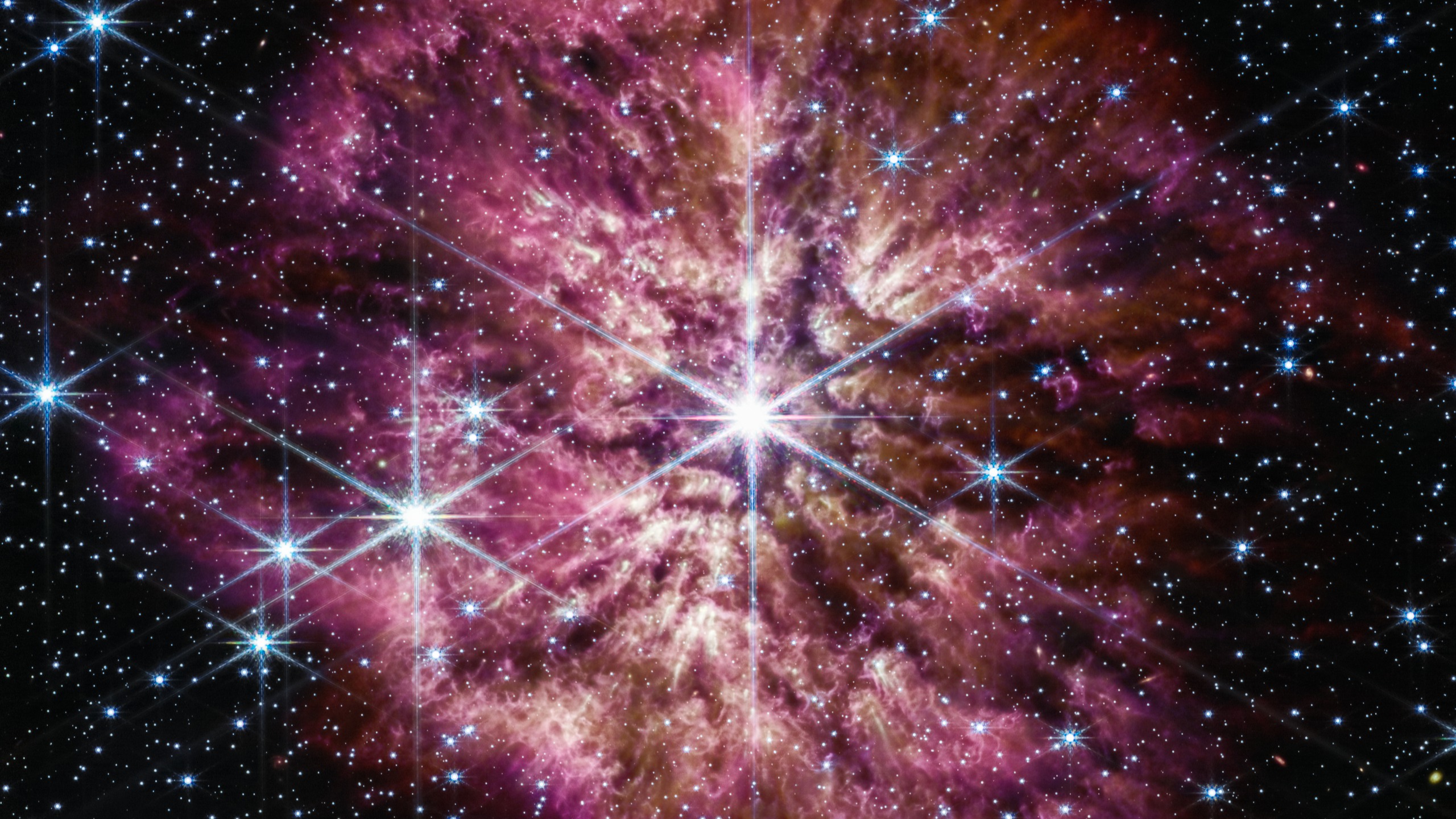
The luminous, hot star Wolf-Rayet 124 (WR 124) is prominent at the center of the James Webb Space Telescope’s composite image combining near-infrared and mid-infrared wavelengths of light. The star displays the characteristic diffraction spikes of Webb’s Near-Infrared Camera (NIRCam), caused by the physical structure of the telescope itself. NIRCam effectively balances the brightness of the star with the fainter gas and dust surrounding it, while Webb’s Mid-Infrared Instrument (MIRI) reveals the nebula’s structure. Background stars and background galaxies populate the field of view and peek through the nebula of gas and dust that has been ejected from the aging massive star to span 10 light-years across space. A history of the star’s past episodes of mass can be read in the nebula’s structure. Rather than smooth shells, the nebula is formed from random, asymmetric ejections. Bright clumps of gas and dust appear like tadpoles swimming toward the star, with tails streaming out behind them, blown back by the stellar wind. This image combines various filters from both Webb imaging instruments, with the color red assigned to wavelengths of 4.44, 4.7, 12.8, and 18 microns (F444W, F470N, F1280W, F1800W), green to 2.1, 3.35, and 11.3 microns (F210M, F335M, F1130W), and blue to 0.9, 1.5, and 7.7 microns (F090W, F150W, F770W).
30.4k downloads