All Wallpapers
65 JWST wallpapers, pre-sized for every device.
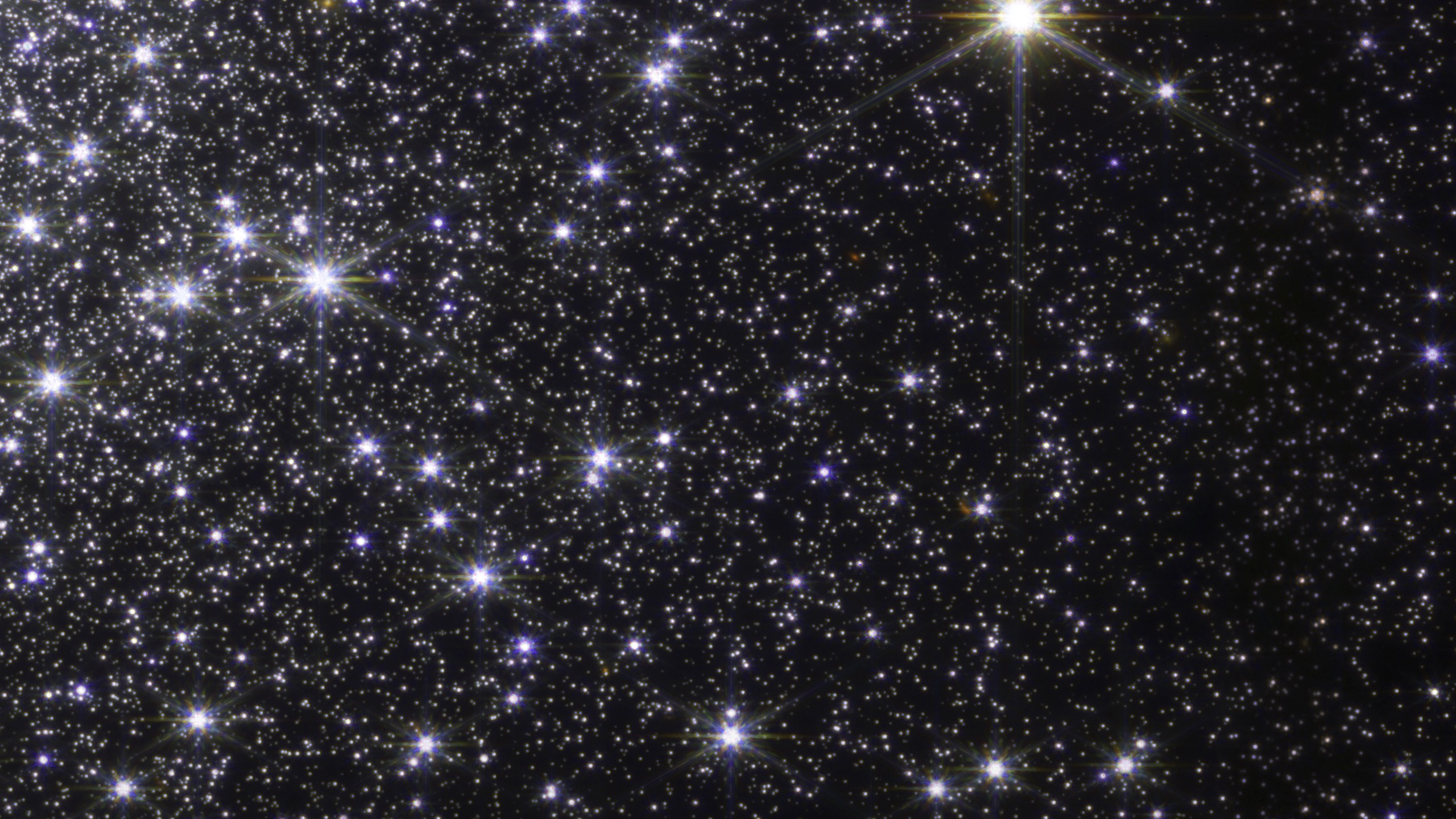
Detail of the globular cluster Messier 92 (M92) captured by Webb’s NIRCam instrument. This field of view covers the lower left quarter of the right half of the full image. Globular clusters are dense masses of tightly packed stars that all formed around the same time. In M92, there are about 300,000 stars packed into a ball about 100 light-years across. The night sky of a planet in the middle of M92 would shine with thousands of stars that appear thousands of times brighter than those in our own sky. The image shows stars at different distances from the center, which helps astronomers understand the motion of stars in the cluster, and the physics of that motion.
3.7k downloads
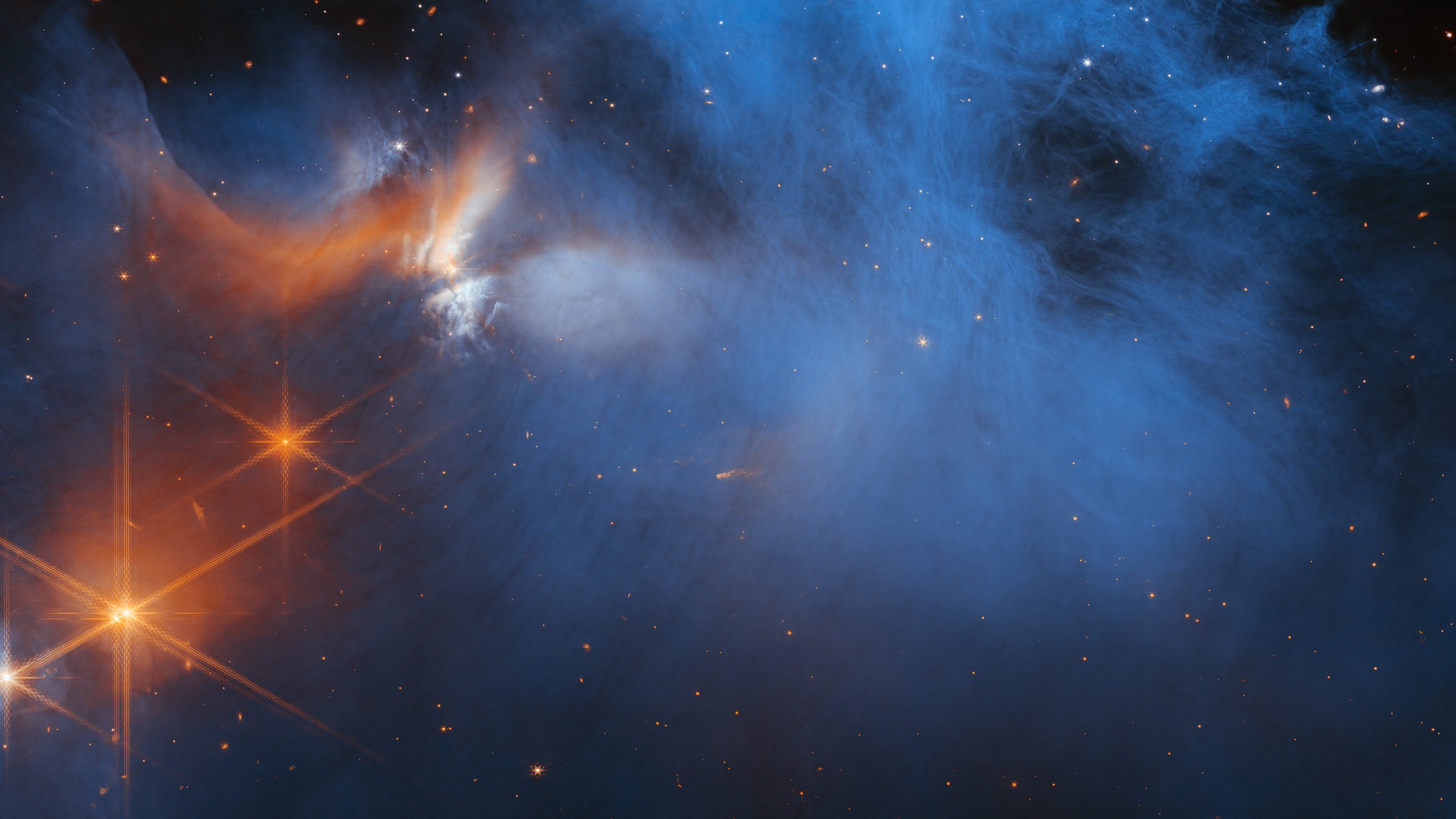
This image by NASA’s James Webb Space Telescope’s Near-Infrared Camera (NIRCam) features the central region of the Chamaeleon I dark molecular cloud, which resides 630 light years away. The cold, wispy cloud material (blue, center) is illuminated in the infrared by the glow of the young, outflowing protostar Ced 110 IRS 4 (orange, upper left). The light from numerous background stars, seen as orange dots behind the cloud, can be used to detect ices in the cloud, which absorb the starlight passing through them. An international team of astronomers has reported the discovery of diverse ices in the darkest regions of a cold molecular cloud measured to date by studying this region. This result allows astronomers to examine the simple icy molecules that will be incorporated into future exoplanets, while opening a new window on the origin of more complex molecules that are the first step in the creation of the building blocks of life.
1.3k downloads
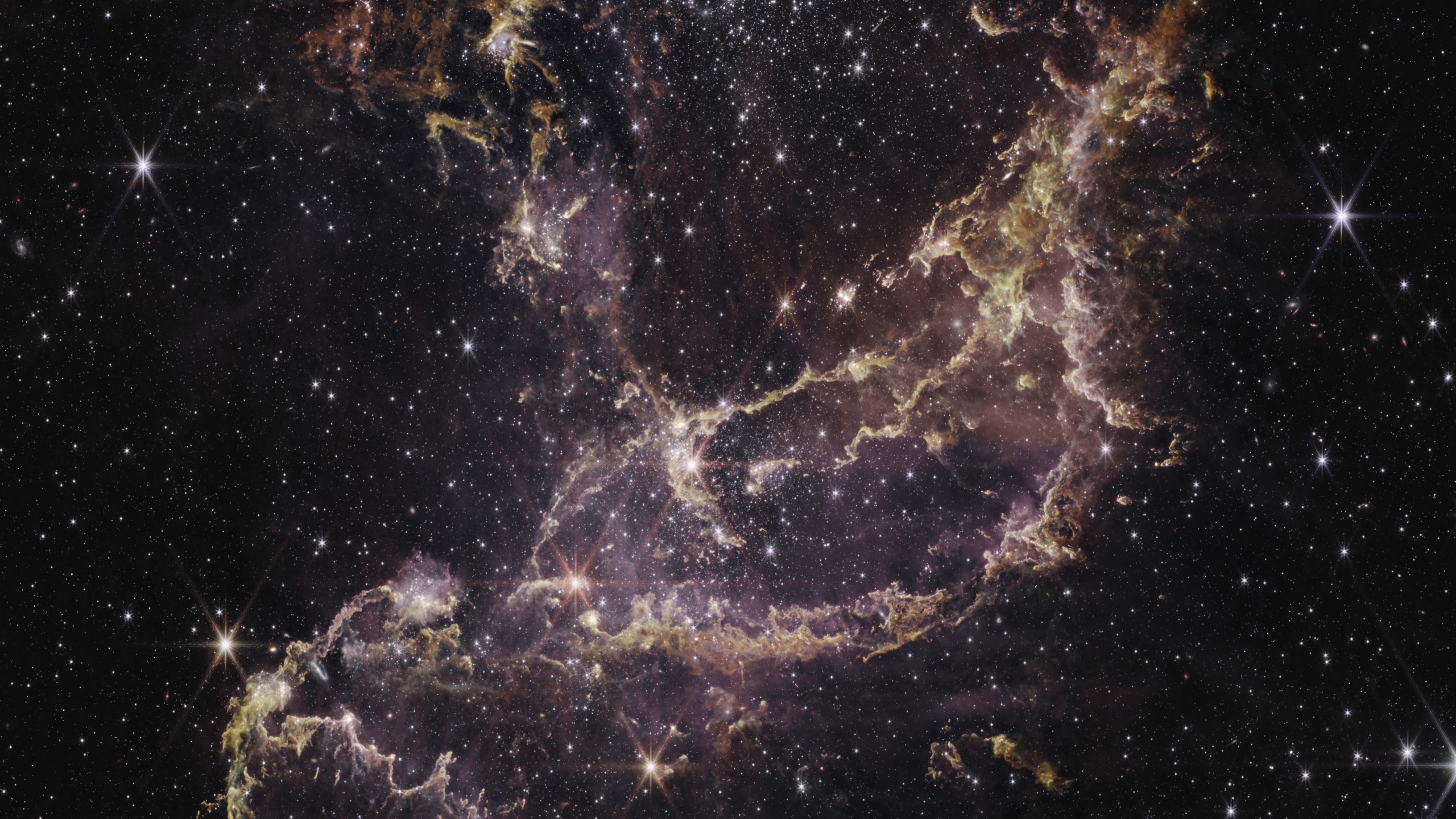
NGC 346, shown here in this image from NASA’s James Webb Space Telescope Near-Infrared Camera (NIRCam), is a dynamic star cluster that lies within a nebula 200,000 light years away. Webb reveals the presence of many more building blocks than previously expected, not only for stars, but also planets, in the form of clouds packed with dust and hydrogen. The plumes and arcs of gas in this image contains two types of hydrogen. The pink gas represents energized hydrogen, which is typically as hot as around 10,000 °C (approximately 18,000 °F) or more, while the more orange gas represents dense, molecular hydrogen, which is much colder at around -200 °C (approximately -300 °F) or less, and associated dust. The colder gas provides an excellent environment for stars to form, and, as they do, they change the environment around them. The effect of this is seen in the various ridges throughout, which are created as the light of these young stars breaks down the dense clouds. The many pillars of glowing gas show the effects of this stellar erosion throughout the region.
4.3k downloads
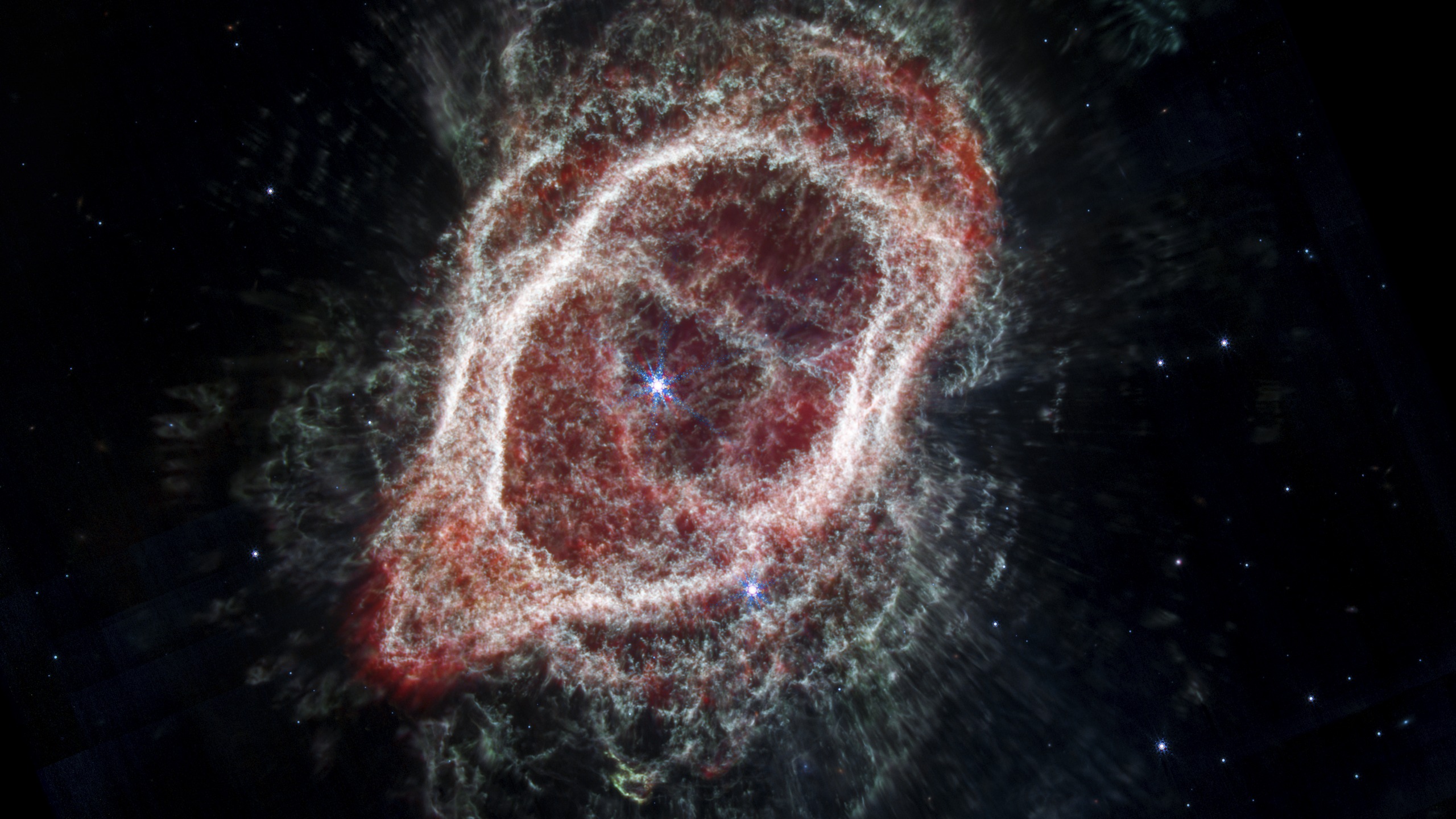
Webb's image traces the star's scattered outflows that have reached farther into the cosmos. Most of the molecular gas that lies outside the band of cooler gas is also cold. It is also far clumpier, consisting of dense knots of molecular gas that form a halo around the central stars. By accounting for the temperatures and gas contents in both areas, inside and outside the band, and by combining Webb's data with precise measurements from other observatories, researchers were able to create far more accurate models to demonstrate when gas was ejected by the central star. What about the third star that is visible at the lower-right edge of the band within the nebula? From Webb's vantage point, it appears within the scene, but isn't part of the nebula itself.
11.4k downloads
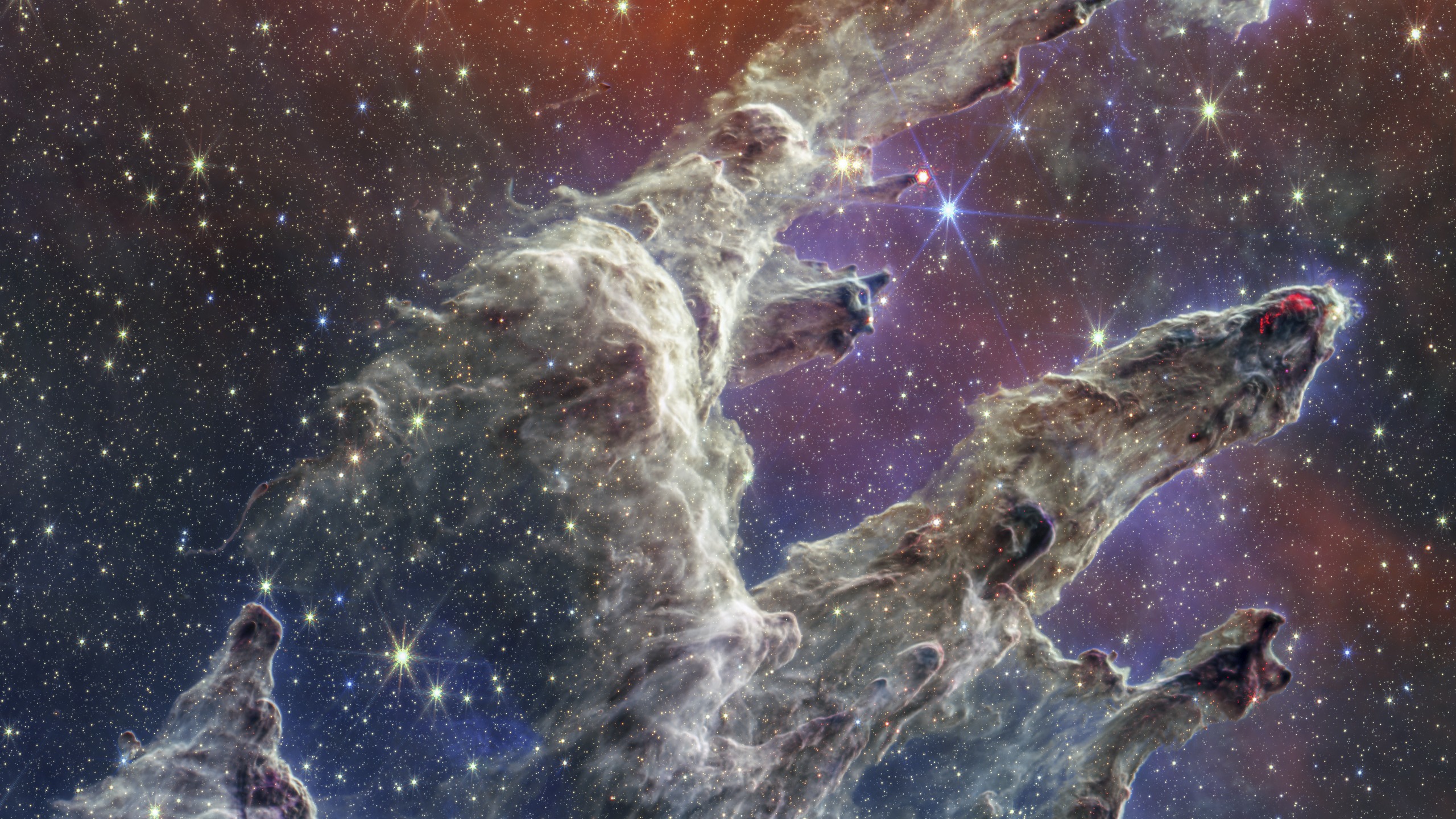
By combining images of the iconic Pillars of Creation from two cameras aboard NASA’s James Webb Space Telescope, the universe has been framed in its infrared glory. Webb’s near-infrared image was fused with its mid-infrared image, setting this star-forming region ablaze with new details. Myriad stars are spread throughout the scene. The stars primarily show up in near-infrared light, marking a contribution of Webb’s Near-Infrared Camera (NIRCam). Near-infrared light also reveals thousands of newly formed stars – look for bright orange spheres that lie just outside the dusty pillars. In mid-infrared light, the dust is on full display. The contributions from Webb’s Mid-Infrared Instrument (MIRI) are most apparent in the layers of diffuse, orange dust that drape the top of the image, relaxing into a V. The densest regions of dust are cast in deep indigo hues, obscuring our view of the activities inside the dense pillars. Dust also makes up the spire-like pillars that extend from the bottom left to the top right. This is one of the reasons why the region is overflowing with stars – dust is a major ingredient of star formation. When knots of gas and dust with sufficient mass form in the pillars, they begin to collapse under their own gravitational attraction, slowly heat up, and eventually form new stars. Newly formed stars are especially apparent at the edges of the top two pillars – they are practically bursting onto the scene. At the top edge of the second pillar, undulating detail in red hints at even more embedded stars. These are even younger, and are quite active as they form. The lava-like regions capture their periodic ejections. As stars form, they periodically send out supersonic jets that can interact within clouds of material, like these thick pillars of gas and dust. These young stars are estimated to be only a few hundred thousand years old, and will continue to form for millions of years. Almost everything you see in this scene is local. The distant universe is largely blocked from our view both by the interstellar medium, which is made up of sparse gas and dust located between the stars, and a thick dust lane in our Milky Way galaxy. As a result, the stars take center stage in Webb’s view of the Pillars of Creation. The Pillars of Creation is a small region within the vast Eagle Nebula, which lies 6,500 light-years away. Revisit Webb’s near-infrared image and its mid-infrared image. The Pillars of Creation was made famous by the Hubble Space Telescope’s 1995 image. NIRCam was built by a team at the University of Arizona and Lockheed Martin’s Advanced Technology Center. MIRI was contributed by ESA and NASA, with the instrument designed and built by a consortium of nationally funded European Institutes (The MIRI European Consortium) in partnership with JPL and the University of Arizona.
20.4k downloads
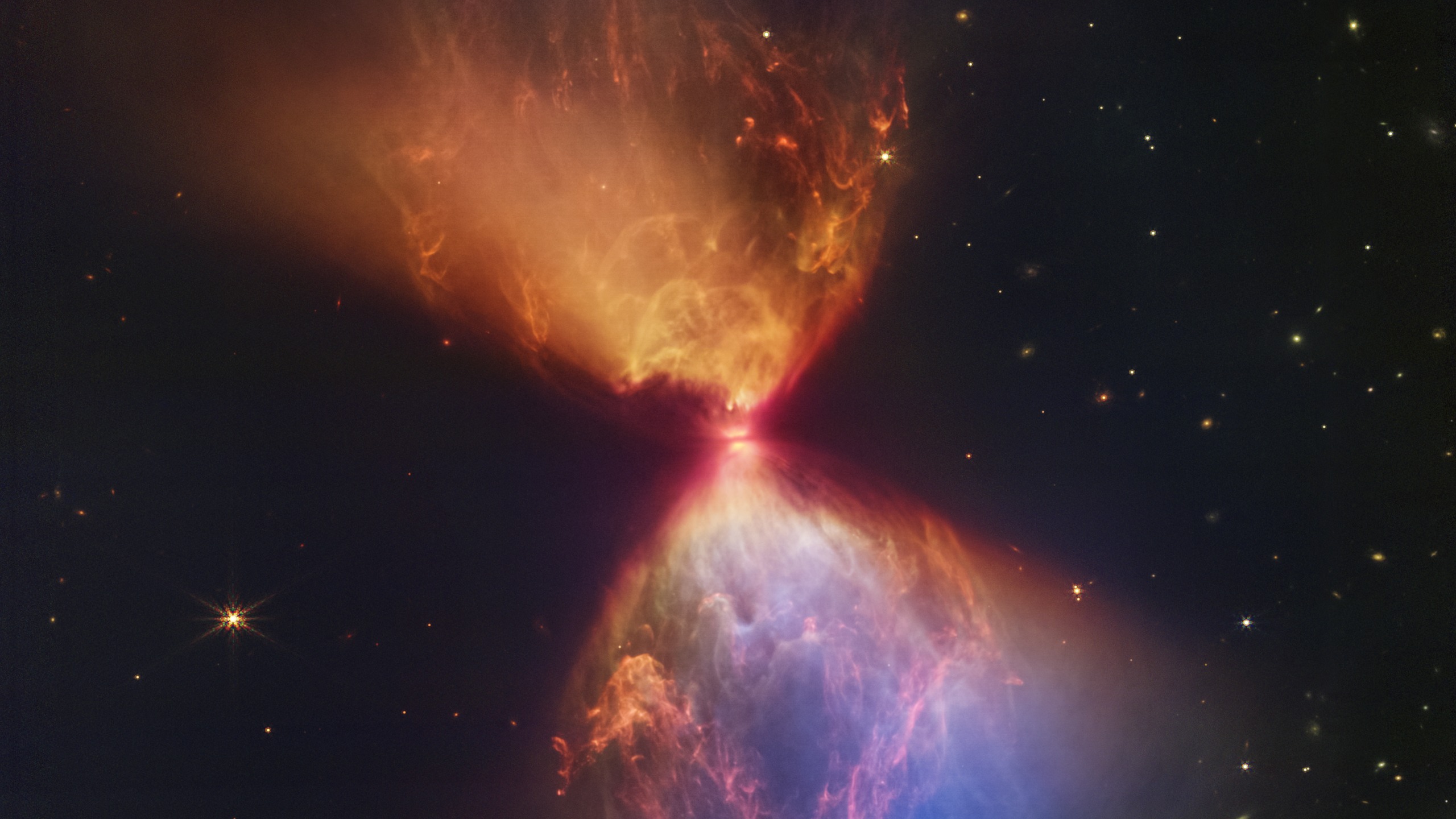
The protostar within the dark cloud L1527, shown in this image from NASA’s James Webb Space Telescope Near-Infrared Camera (NIRCam), is embedded within a cloud of material feeding its growth. Ejections from the star have cleared out cavities above and below it, whose boundaries glow orange and blue in this infrared view. The upper central region displays bubble-like shapes due to stellar “burps,” or sporadic ejections. Webb also detects filaments made of molecular hydrogen that has been shocked by past stellar ejections. The edges of the cavities at upper left and lower right appear straight, while the boundaries at upper right and lower left are curved. The region at lower right appears blue, as there’s less dust between it and Webb than the orange regions above it.
25.4k downloads
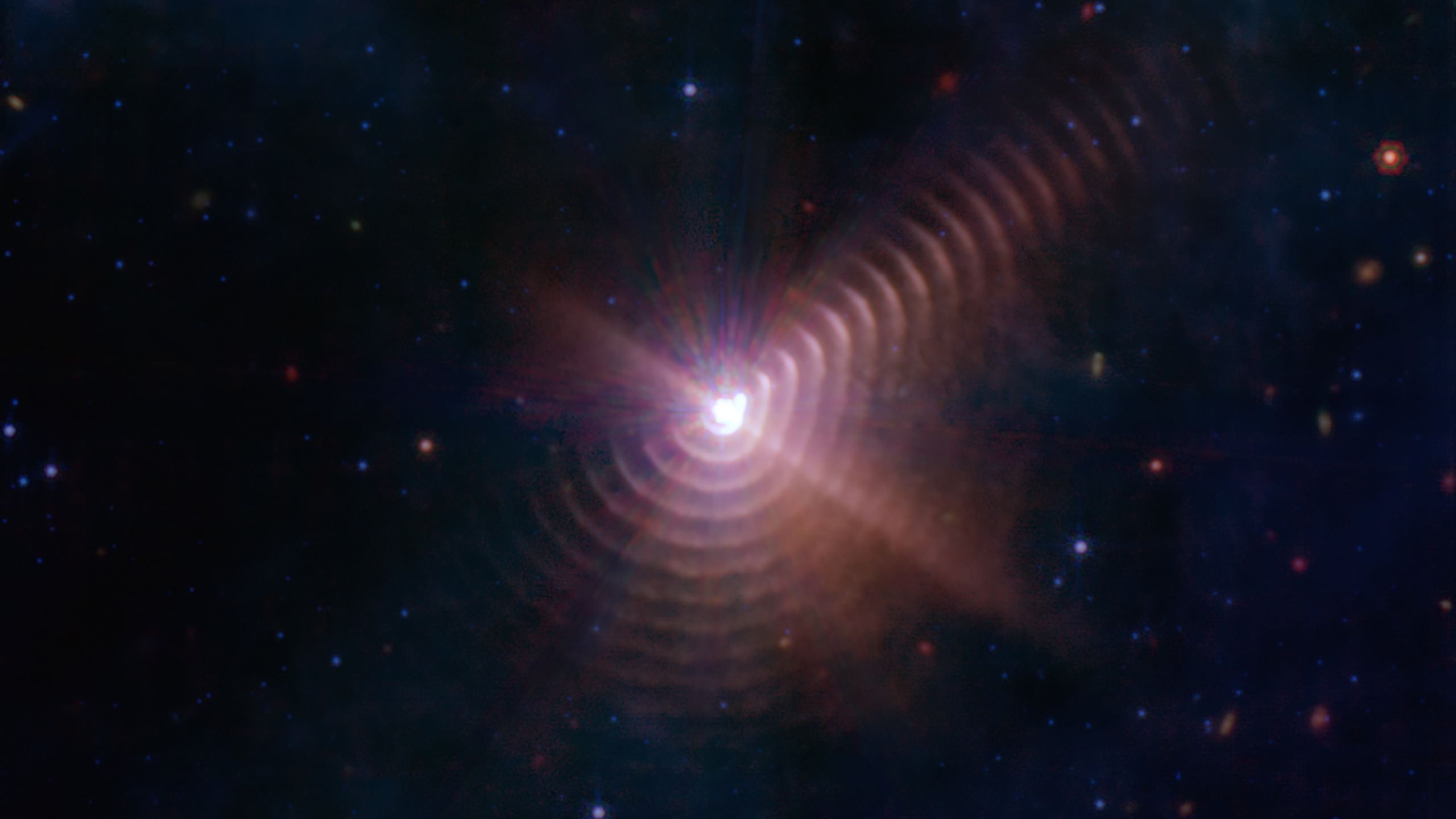
This image from NASA's James Webb Space Telescope reveals at least 17 concentric dust rings emanating from a pair of stars orbiting one another. Located just over 5,000 light-years from Earth, the system is known as Wolf-Rayet 140 because one of the stars is a Wolf-Rayet star. The other is an O-type star, one of the most massive star types known. Each ring was created when the two stars came close together and their stellar winds (streams of gas they blow into space) collided, compressing the gas and forming dust. A ring is produced once per orbit, every 7.93 years. A Wolf-Rayet star is an O-type star born with at least 25 times more mass than our Sun that is nearing the end of its life, when it will likely collapse directly to black hole, or explode as a supernova. These delays between periods of dust production create the unique ring pattern. Some Wolf-Rayet binaries in which the stars are close enough together and have circular orbits produce dust continuously, often forming a pinwheel pattern. WR 140's rings are also referred to as shells because they are not perfectly circular and are thicker and wider than they appear in the image. The rings appear brighter in some areas but are almost invisible in others, rather than forming a perfect "bullseye" pattern. That's because production of dust is variable as the stars get close to one another, and because Webb views the system at an angle and is not looking directly at the orbital plane of the stars. One of the densest regions of dust production creates the bright feature appearing at 2 o'clock. The image was taken by the Mid-Infrared Instrument (MIRI), now managed by the agency's Goddard Space Flight Center. MIRI was developed through a 50-50 partnership between NASA and ESA (European Space Agency).
30.5k downloads
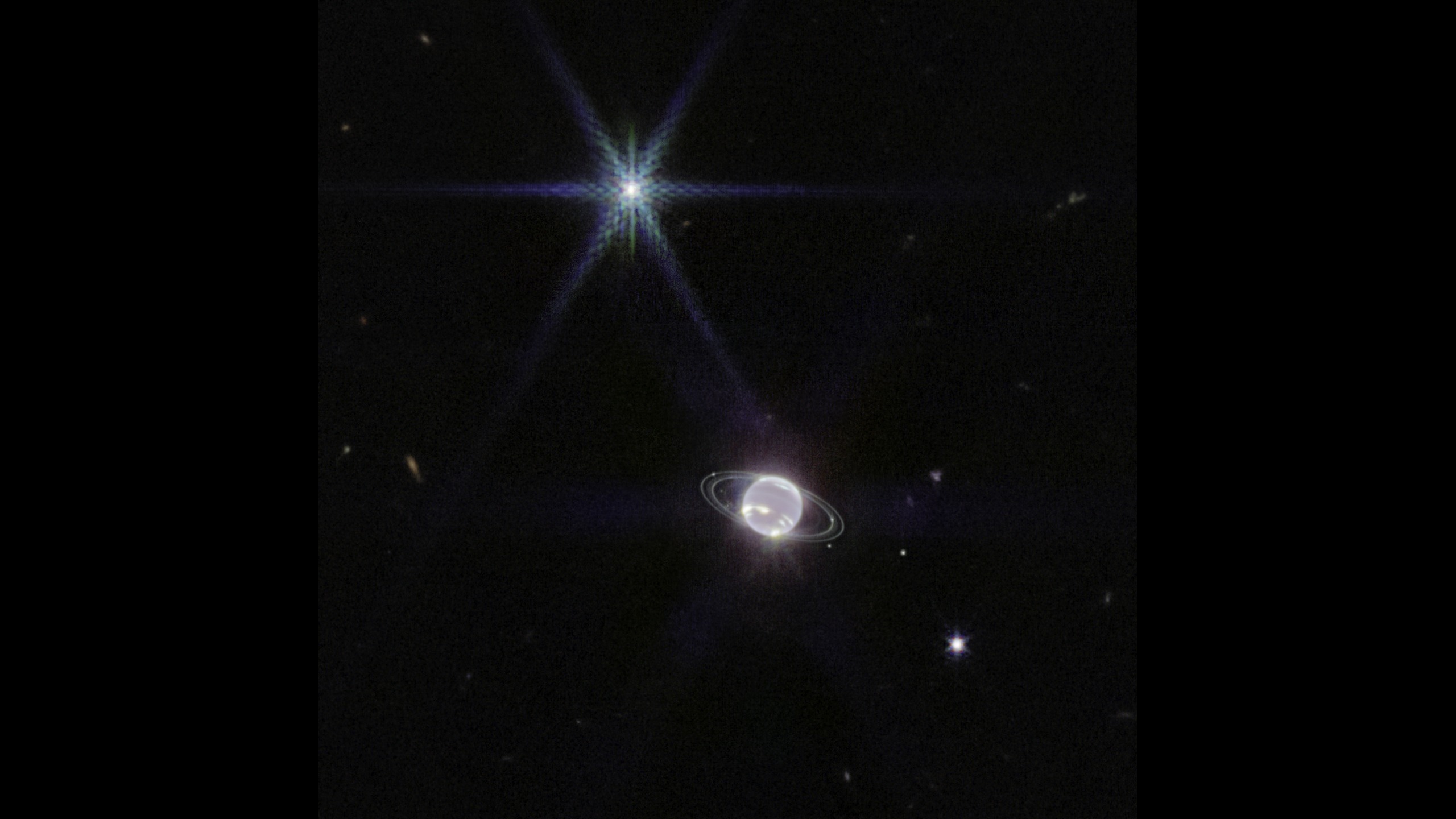
This image of the Neptune system, captured by Webb’s Near-Infrared Camera (NIRCam), reveals stunning views of the planet’s rings, which have not been seen with this clarity in more than three decades. Webb’s new image of Neptune also captures details of the planet’s turbulent, windy atmosphere. Neptune, an ice giant, has an interior that is much richer in elements heavier than hydrogen and helium, like methane, than the gas giants Jupiter and Saturn. Methane appears blue in visible wavelengths but, as evident in Webb’s image, that’s not the case in the near-infrared. Methane so strongly absorbs red and infrared light that the planet is quite dark at near-infrared wavelengths, except where high-altitude clouds are present. These methane-ice clouds are prominent in Webb’s image as bright streaks and spots, which reflect sunlight before it is absorbed by methane gas. To the upper left of the planet in this image, one of Neptune’s moons, Triton, also sports Webb’s distinctive eight diffraction spikes, an artifact of the telescope’s structure. Webb also captured 6 more of Neptune’s 14 known moons, along with a smattering of distant galaxies that appear as dim splotches and a nearby star. NIRCam was built by a team at the University of Arizona and Lockheed Martin’s Advanced Technology Center.
24.2k downloads
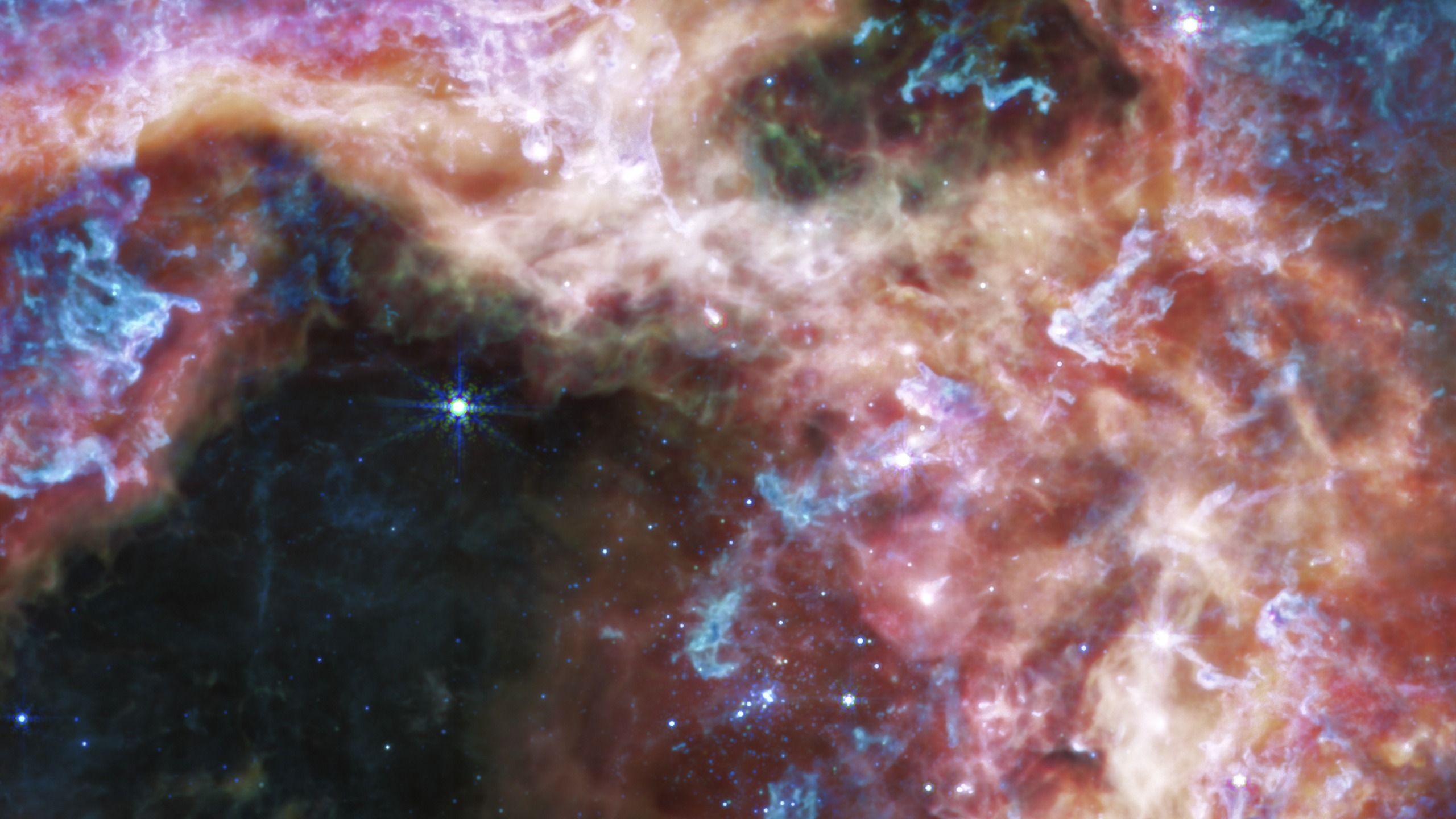
At the longer wavelengths of light captured by its Mid-Infrared Instrument (MIRI), Webb focuses on the area surrounding the central star cluster and unveils a very different view of the Tarantula Nebula. In this light, the young hot stars of the cluster fade in brilliance, and glowing gas and dust come forward. Abundant hydrocarbons light up the surfaces of the dust clouds, shown in blue and purple. Much of the nebula takes on a more ghostly, diffuse appearance because mid-infrared light is able to show more of what is happening deeper inside the clouds. Still-embedded protostars pop into view within their dusty cocoons, including a bright group at the very top edge of the image, left of center. Other areas appear dark, like in the lower-left corner of the image. This indicates the densest areas of dust in the nebula, that even mid-infrared wavelengths cannot penetrate. These could be the sites of future, or current, star formation. MIRI was contributed by ESA and NASA, with the instrument designed and built by a consortium of nationally funded European Institutes (The MIRI European Consortium) in partnership with JPL and the University of Arizona.
38.9k downloads
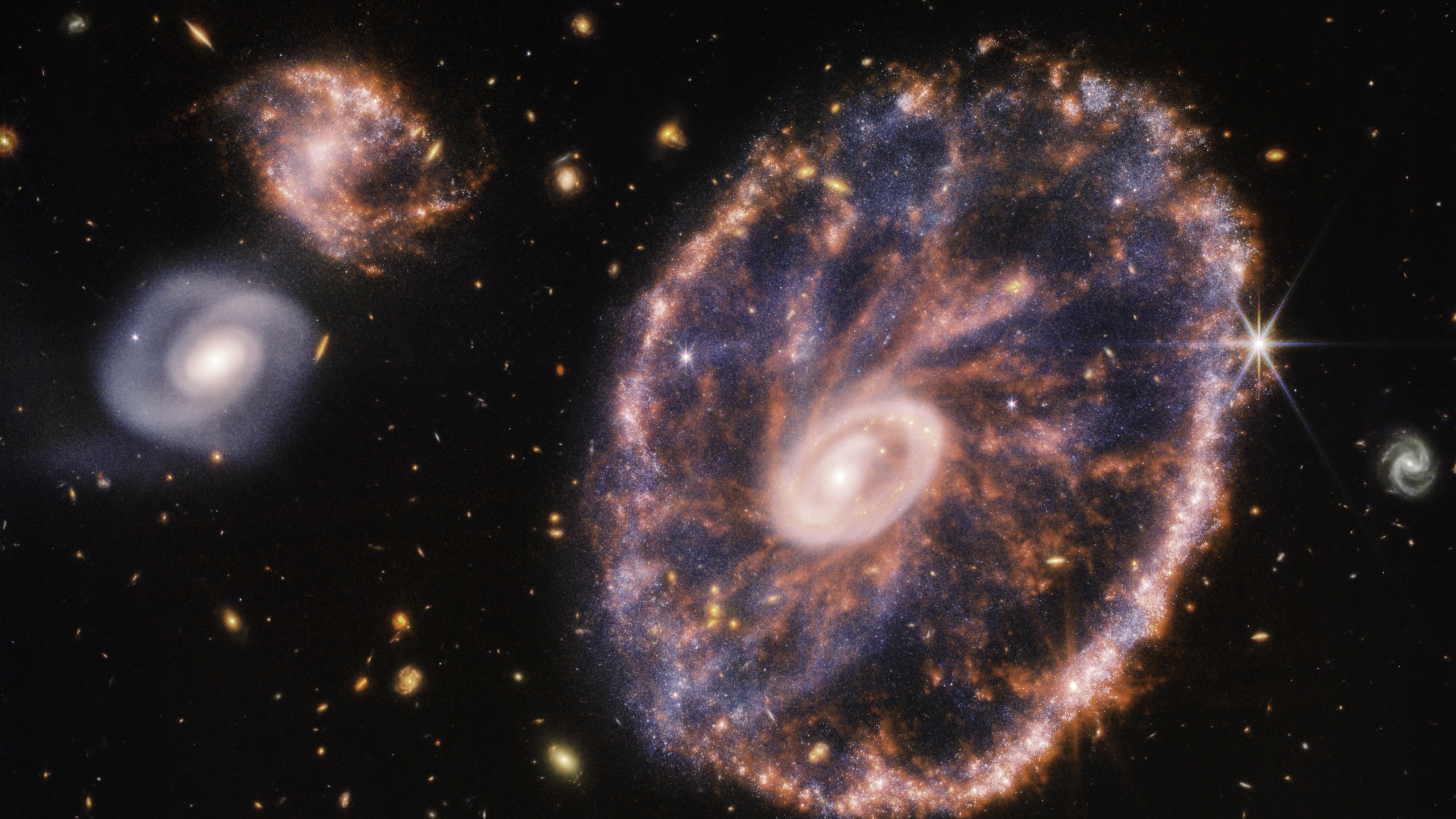
This image of the Cartwheel and its companion galaxies is a composite from Webb’s Near-Infrared Camera (NIRCam) and Mid-Infrared Instrument (MIRI), which reveals details that are difficult to see in the individual images alone. This galaxy formed as the result of a high-speed collision that occurred about 400 million years ago. The Cartwheel is composed of two rings, a bright inner ring and a colorful outer ring. Both rings expand outward from the center of the collision like shockwaves. However, despite the impact, much of the character of the large, spiral galaxy that existed before the collision remains, including its rotating arms. This leads to the “spokes” that inspired the name of the Cartwheel Galaxy, which are the bright red streaks seen between the inner and outer rings. These brilliant red hues, located not only throughout the Cartwheel, but also the companion spiral galaxy at the top left, are caused by glowing, hydrocarbon-rich dust. In this near- and mid-infrared composite image, MIRI data are colored red while NIRCam data are colored blue, orange, and yellow. Amidst the red swirls of dust, there are many individual blue dots, which represent individual stars or pockets of star formation. NIRCam also defines the difference between the older star populations and dense dust in the core and the younger star populations outside of it. Webb’s observations capture the Cartwheel in a very transitory stage. The form that the Cartwheel Galaxy will eventually take, given these two competing forces, is still a mystery. However, this snapshot provides perspective on what happened to the galaxy in the past and what it will do in the future. NIRCam was built by a team at the University of Arizona and Lockheed Martin’s Advanced Technology Center. MIRI was contributed by ESA and NASA, with the instrument designed and built by a consortium of nationally funded European Institutes (The MIRI European Consortium) in partnership with JPL and the University of Arizona.
19.3k downloads
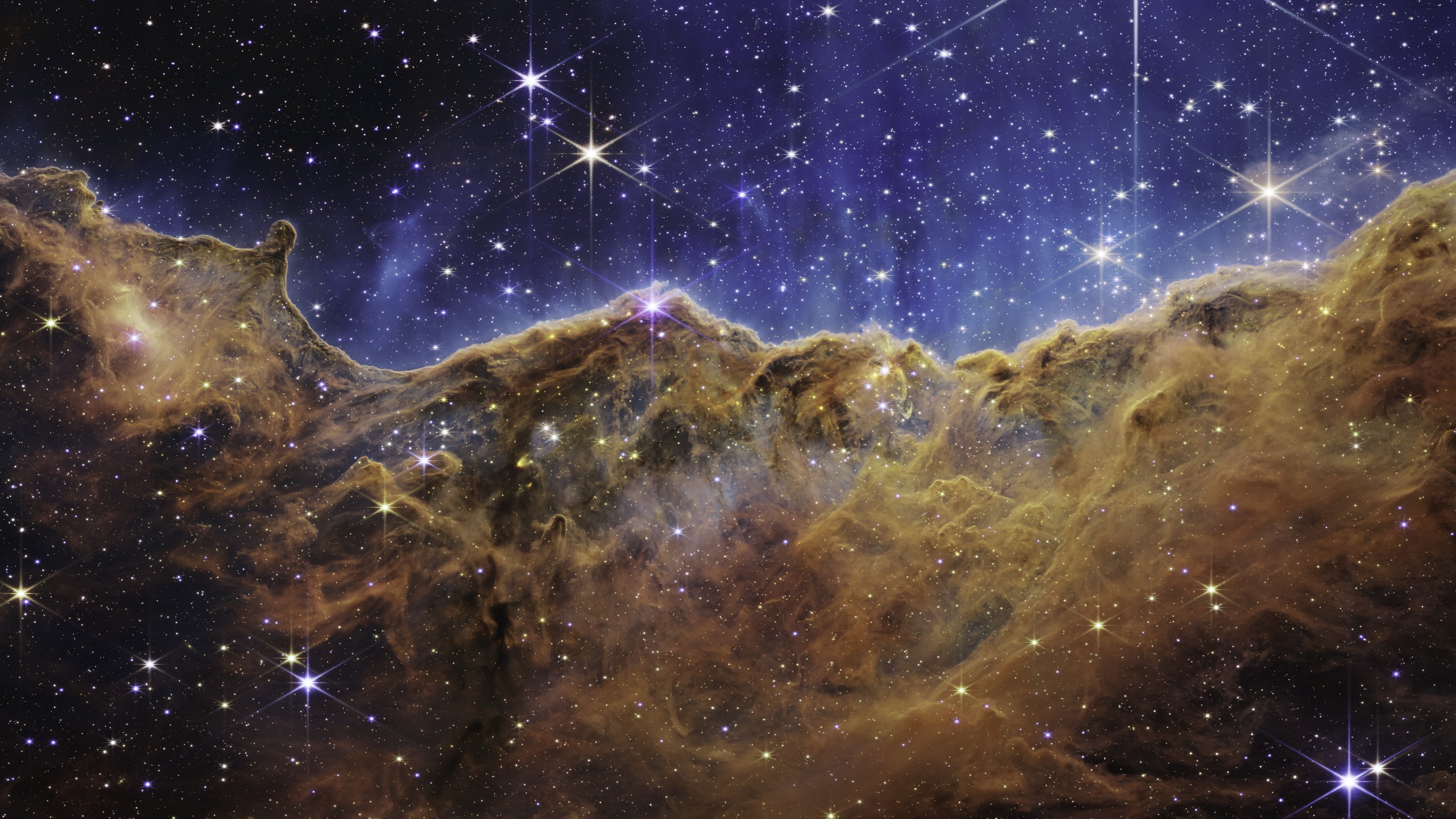
What looks like craggy mountains in moonlight is actually the edge of NGC 3324, a young star-forming region in the Carina Nebula, captured in infrared by Webb's NIRCam. Nicknamed the "Cosmic Cliffs," the region is the edge of a gigantic cavity carved by intense ultraviolet radiation and stellar winds from hot, massive young stars, revealing hundreds of previously hidden stars and background galaxies for the first time.
5.2k downloads
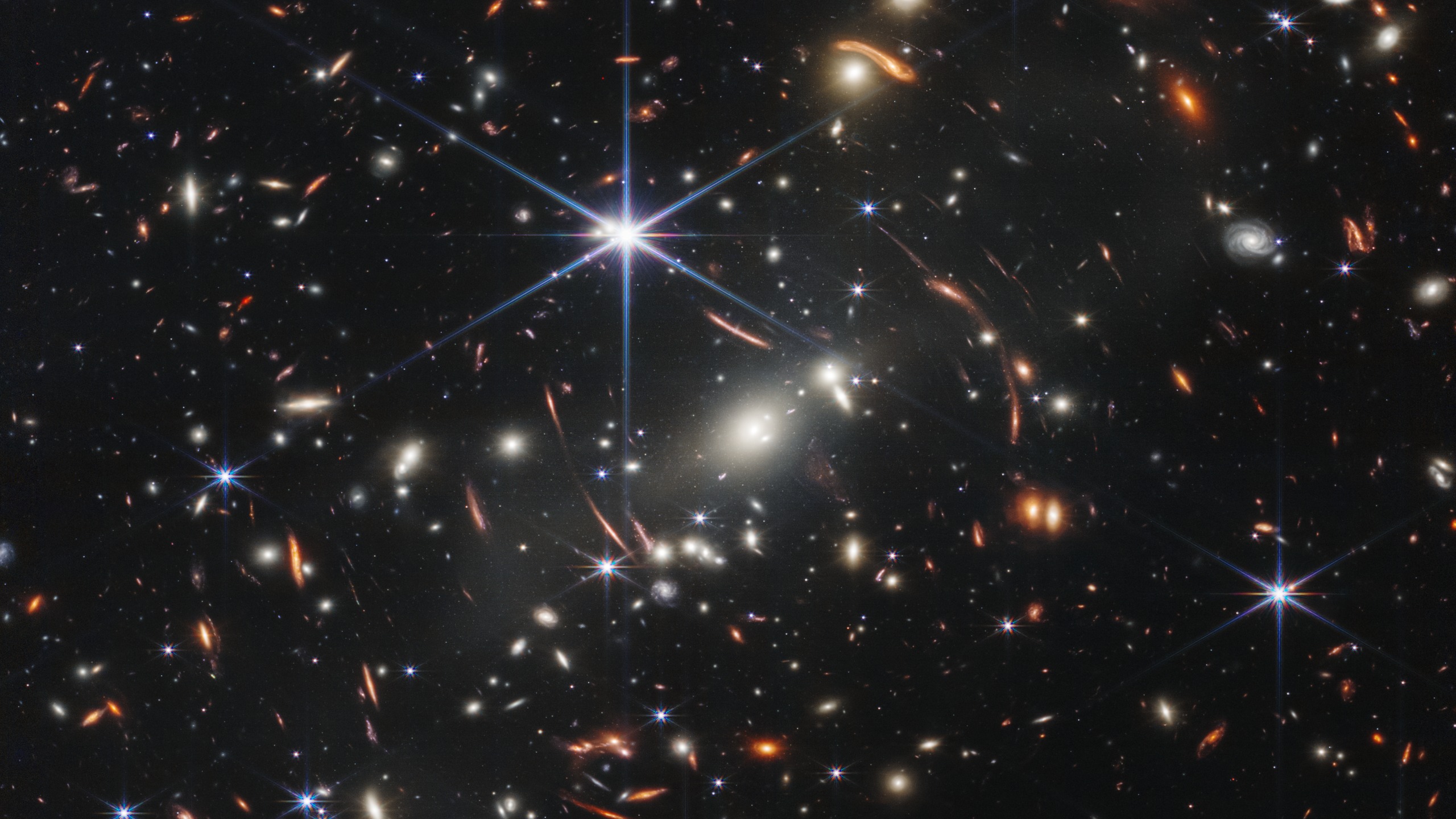
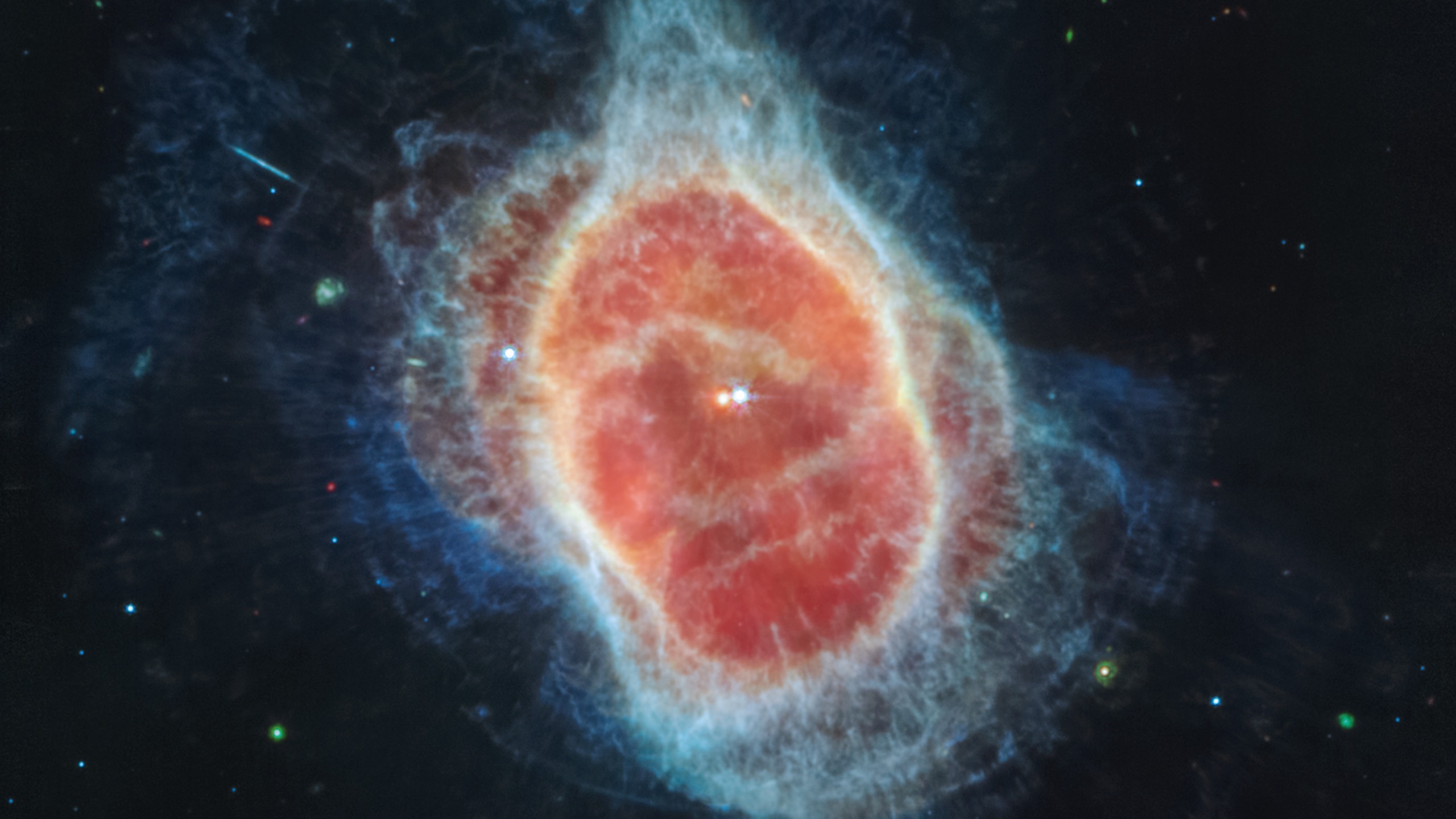
NASA's Webb Telescope has revealed the cloak of dust around the second star, shown at left in red, at the center of the Southern Ring Nebula for the first time. It is a hot, dense white dwarf star. As it transformed into a white dwarf, the star periodically ejected mass, the shells of material you see here. The bluer star at right in this image has also shaped the scene, helping stir up the ejected material. The disk around the stars is also wobbling, shooting out spirals of gas and dust over long periods of time. Webb captured this scene in mid-infrared light, most of which can only be observed from space. Mid-infrared light helps researchers detect objects enshrouded in dust, like the red star. This Mid-Infrared Instrument (MIRI) image also offers an incredible amount of detail, including a cache of distant galaxies in the background.
1k downloads
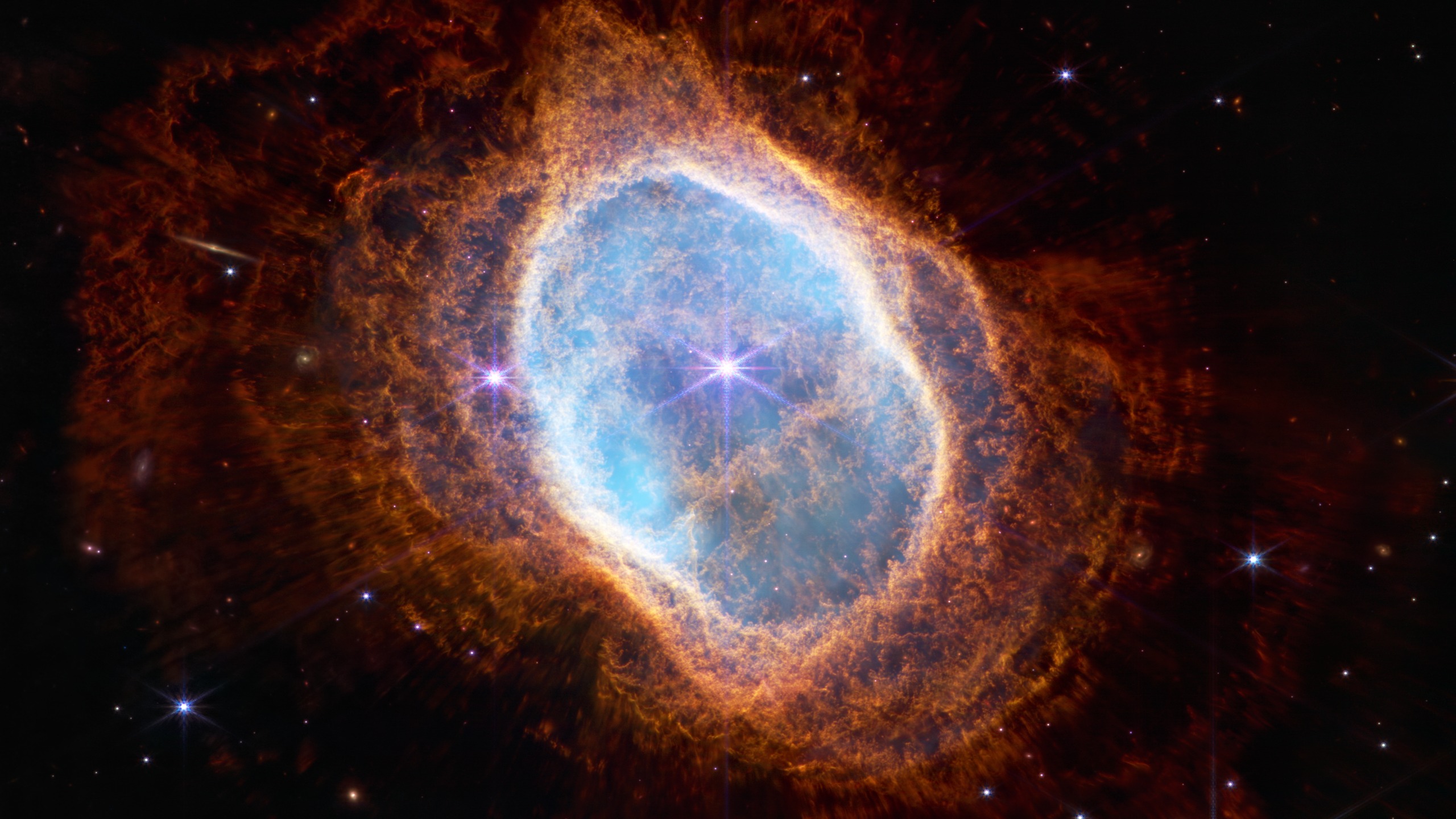
The bright star at the center of NGC 3132, the Southern Ring Nebula, plays a supporting role in sculpting the nebula's rings — a dimmer companion star hidden along one of its diffraction spikes is the true source, having ejected at least eight layers of gas and dust over thousands of years. Webb's near-infrared view also reveals countless background galaxies through the nebula's transparent regions.
2.1k downloads
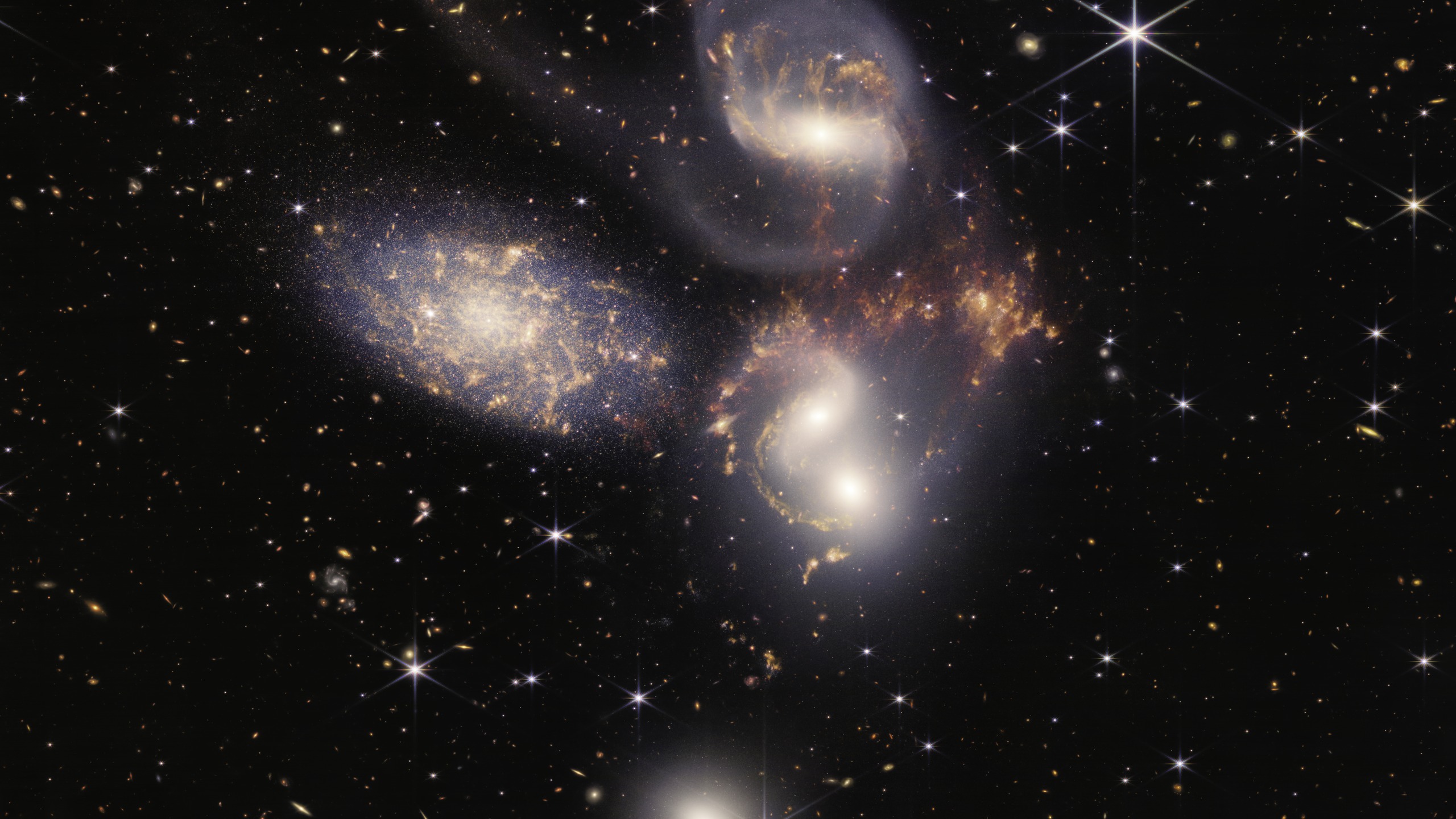
An enormous mosaic of Stephan's Quintet is the largest image to date from NASA's James Webb Space Telescope, covering about one-fifth of the Moon's diameter. It contains over 150 million pixels and is constructed from almost 1,000 separate image files. The visual grouping of five galaxies was captured by Webb's Near-Infrared Camera (NIRCam) and Mid-Infrared Instrument (MIRI). With its powerful, infrared vision and extremely high spatial resolution, Webb shows never-before-seen details in this galaxy group. Sparkling clusters of millions of young stars and starburst regions of fresh star birth grace the image. Sweeping tails of gas, dust and stars are being pulled from several of the galaxies due to gravitational interactions. Most dramatically, Webb's MIRI instrument captures huge shock waves as one of the galaxies, NGC 7318B, smashes through the cluster.
21.3k downloads
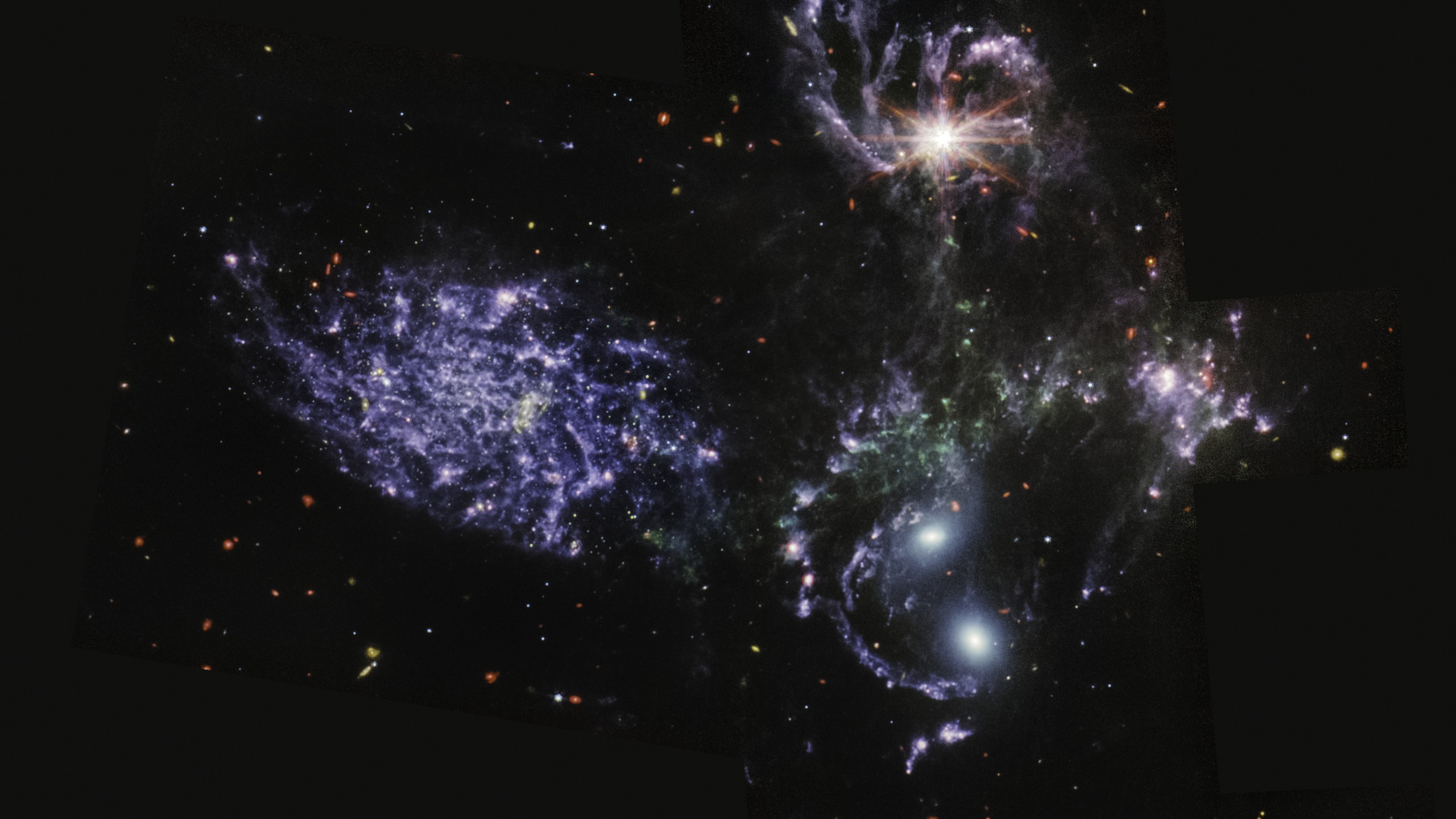
With its powerful, mid-infrared vision, the Mid-Infrared Instrument (MIRI) shows never-before-seen details of Stephan’s Quintet, a visual grouping of five galaxies. MIRI pierced through dust-enshrouded regions to reveal huge shock waves and tidal tails, gas and stars stripped from the outer regions of the galaxies by interactions. It also unveiled hidden areas of star formation. The new information from MIRI provides invaluable insights into how galactic interactions may have driven galaxy evolution in the early universe. This image contains one more MIRI filter than was used in the NIRCam-MIRI composite picture. The image processing specialists at the Space Telescope Science Institute in Baltimore opted to use all three MIRI filters and the colors red, green and blue to most clearly differentiate the galaxy features from each other and the shock waves between the galaxies. In this image, red denotes dusty, star-forming regions, as well as extremely distant, early galaxies and galaxies enshrouded in thick dust. Blue point sources show stars or star clusters without dust. Diffuse areas of blue indicate dust that has a significant amount of large hydrocarbon molecules. For small background galaxies scattered throughout the image, the green and yellow colors represent more distant, earlier galaxies that are rich in these hydrocarbons as well. Stephan’s Quintet’s topmost galaxy – NGC 7319 – harbors a supermassive black hole 24 million times the mass of the Sun. It is actively accreting material and puts out light energy equivalent to 40 billion Suns. MIRI sees through the dust surrounding this black hole to unveil the strikingly bright active galactic nucleus. As a bonus, the deep mid-infrared sensitivity of MIRI revealed a sea of previously unresolved background galaxies reminiscent of Hubble’s Deep Fields. Together, the five galaxies of Stephan’s Quintet are also known as the Hickson Compact Group 92 (HCG 92). Although called a “quintet,” only four of the galaxies are truly close together and caught up in a cosmic dance. The fifth and leftmost galaxy, called NGC 7320, is well in the foreground compared with the other four. NGC 7320 resides 40 million light-years from Earth, while the other four galaxies (NGC 7317, NGC 7318A, NGC 7318B, and NGC 7319) are about 290 million light-years away. This is still fairly close in cosmic terms, compared with more distant galaxies billions of light-years away. Studying these relatively nearby galaxies helps scientists better understand structures seen in a much more distant universe. This proximity provides astronomers a ringside seat for witnessing the merging of and interactions between galaxies that are so crucial to all of galaxy evolution. Rarely do scientists see in so much exquisite detail how interacting galaxies trigger star formation in each other, and how the gas in these galaxies is being disturbed. Stephan’s Quintet is a fantastic “laboratory” for studying these processes fundamental to all galaxies. Tight groups like this may have been more common in the early universe when their superheated, infalling material may have fueled very energetic black holes called quasars. Even today, the topmost galaxy in the group – NGC 7319 – harbors an active galactic nucleus, a supermassive black hole that is actively pulling in material. MIRI was contributed by ESA and NASA, with the instrument designed and built by a consortium of nationally funded European Institutes (The MIRI European Consortium) in partnership with JPL and the University of Arizona. For a full array of Webb’s first images and spectra, including downloadable files, please visit: https://webbtelescope.org/news/first-images
22.6k downloads
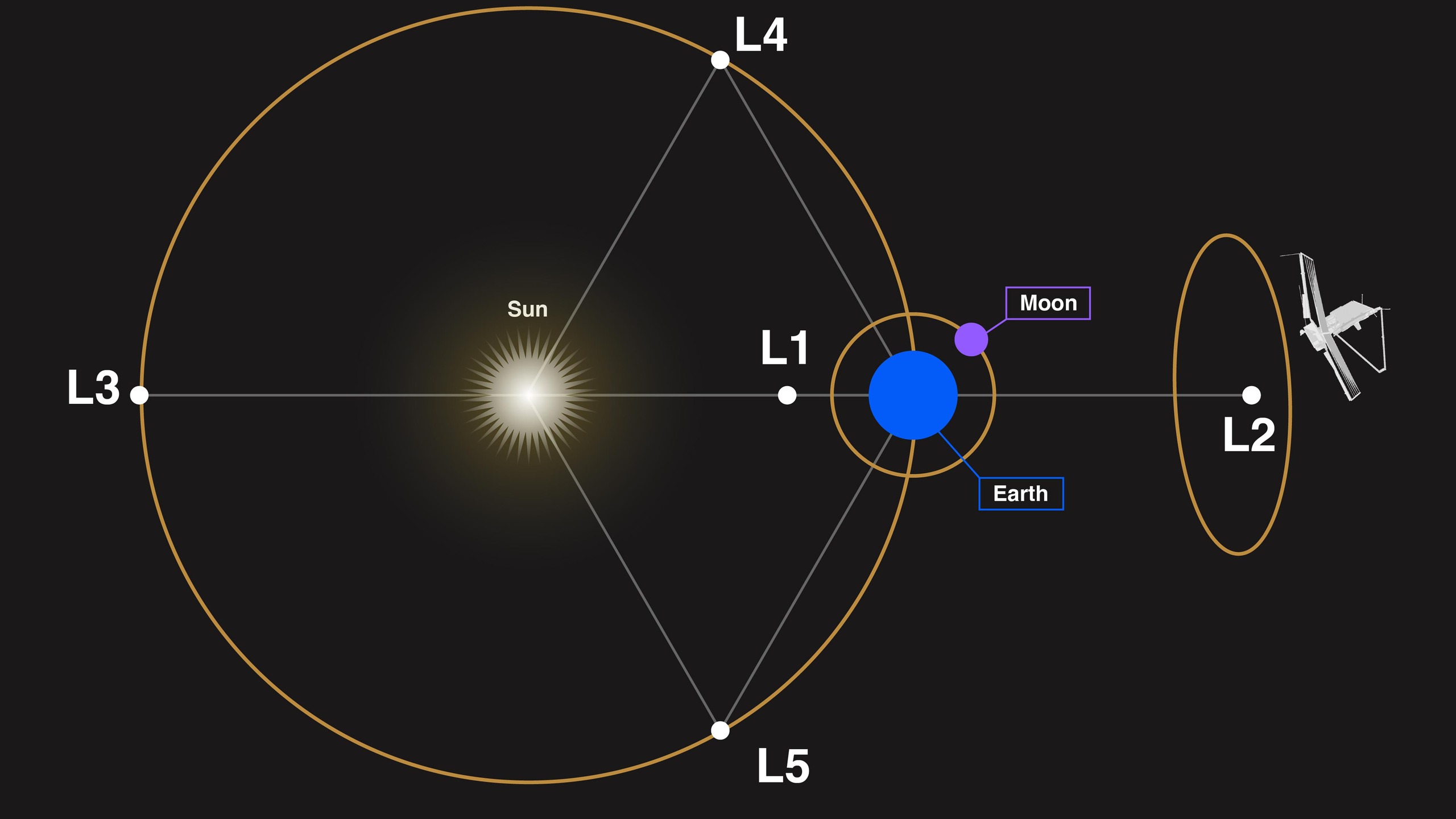
The James Webb Space Telescope orbits the Sun near Sun-Earth Lagrange point 2 (L2), approximately 1.5 million kilometers (1 million miles) from Earth. L2 is one of five Sun-Earth Lagrange points, positions in space where the gravitational pull of the Sun and Earth combine such that small objects in that region have the same orbital period (length of year) as Earth. This makes it possible for Webb to remain in constant communication with Earth. Webb is not located at L2, but instead orbits L2, completing one circuit every 168 days. This "halo orbit" around L2 is highly elliptical and is roughly perpendicular to its orbital path around the Sun. The distance between Webb and L2 varies between about 250,000 and 830,000 kilometers (150,000 - 500,000 miles). Because of this complex orbit , Webb's precise distance from Earth varies over time. Sizes and distances in this illustration are not to scale. The actual distance between the Sun and Earth is about 100 times the distance between Earth and L2. The distance between Earth and L1 is almost the same as between Earth and L2. L2 is about four times farther from Earth than the Moon. The long diameter (major axis) of the halo orbit around L2 is around the same as the distance between Earth and L2.
13.1k downloads