Steam Deck Wallpapers
65 JWST wallpapers available for Steam Deck.
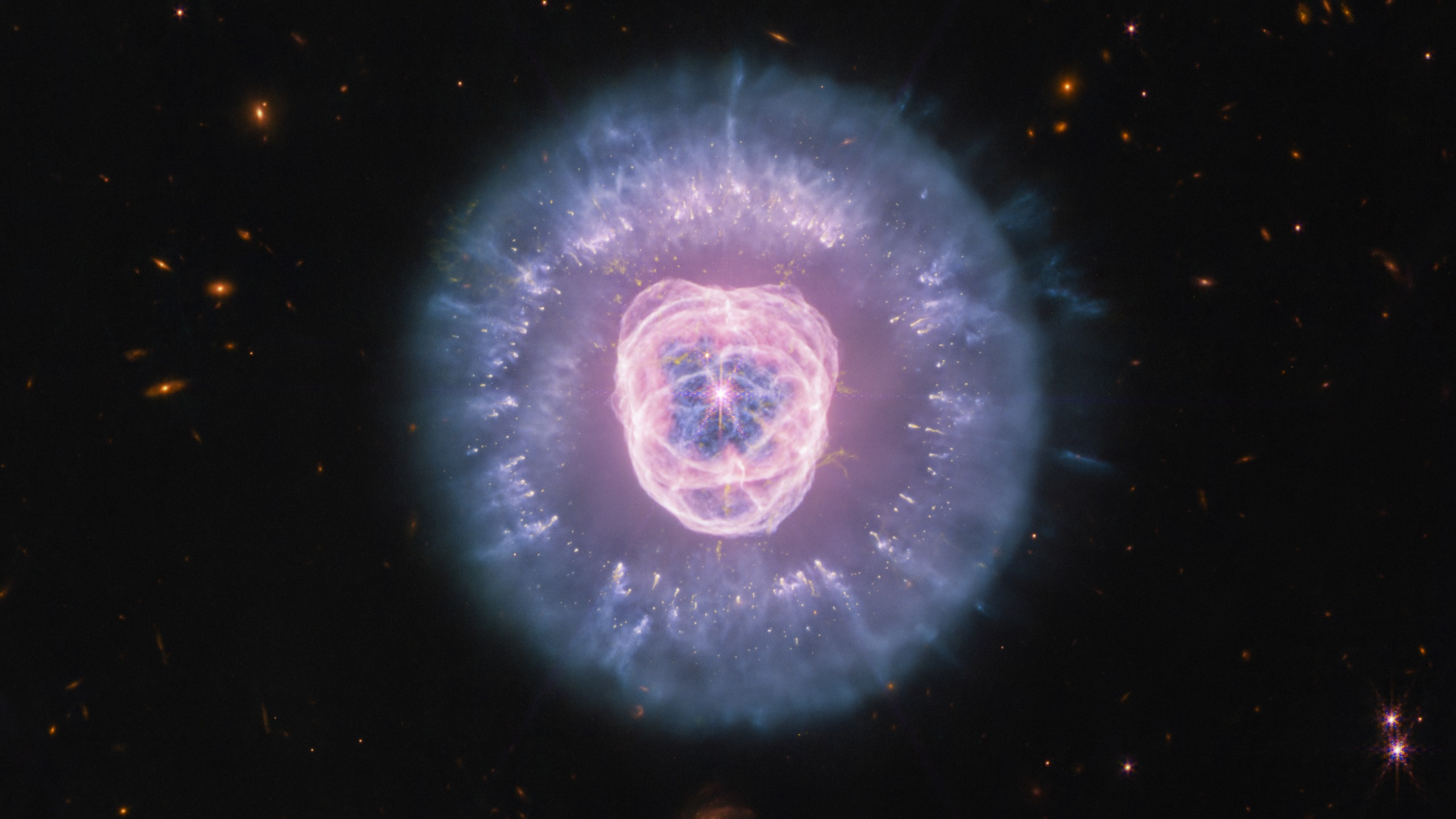
NASA’s James Webb Space Telescope’s NIRCam (Near Infrared Camera) and MIRI (Mid Infrared Instrument) instruments recently imaged planetary nebula NGC 2392, which is nicknamed the Lion Nebula due to its distinct shape. This near- and mid-infrared composite image reveals the complex structure of the nebula, which has formed and continues to be sculpted by the remains of a dying star. The stellar core, also known as a white dwarf, is located at the center and looks like the button nose of the lion. The central dying star is so hot that its radiation is “cooking” everything from the inside and producing a bubble of ionized hydrogen gas as it does. The gas bubble, which is the lion’s “face,” features cavernous shells and rings with tendrils that are expanding and destroying dust upon encounter. However, not all dust is obliterated from the scene. The lion’s mane is the interior of a dust shell that is being illuminated by the central star’s core. Within the mane some compact clumps of dust (red and orange) have managed to survive so far and are protecting the material that lies behind them. Additional clumps of molecular hydrogen appear yellow. The Lion Nebula is a snapshot in time. It’s taken several thousand years for the gas and dust to be shaped in this way, and it continues to change as the star drives away the material. Astronomers estimate NGC 2392 will eventually disperse in about 10,000 years, which is a relatively short period in astronomical terms.
40.5k downloads
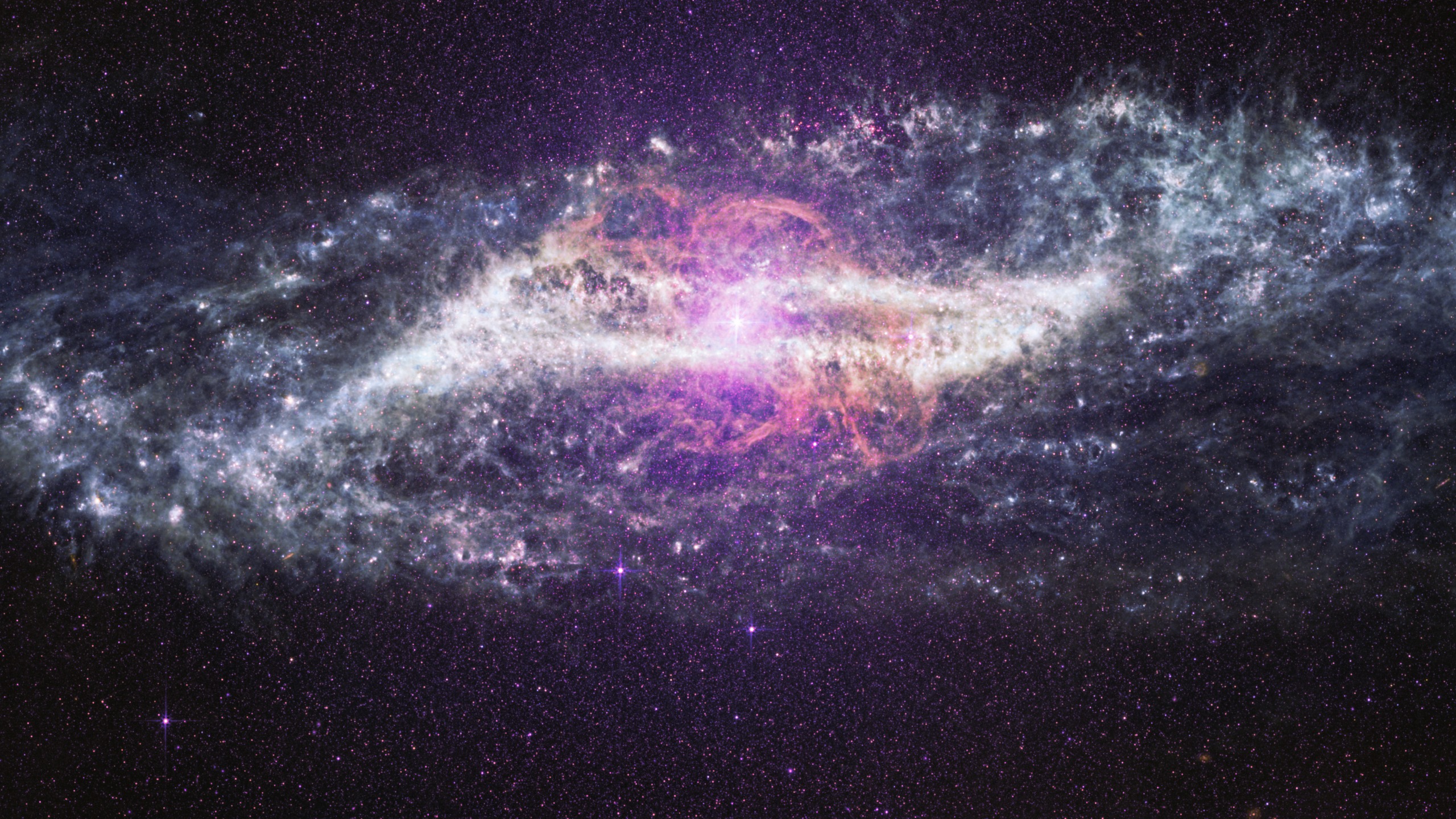
NASA’s James Webb Space Telescope’s Mid-Infrared Instrument (MIRI) reveals the nearby galaxy Centaurus A, exposing the dusty structures and hidden activity that shape this unusual system. Webb’s infrared vision unveils intricate filaments, loops, and glowing clouds of warm dust stretching across its center. At the heart of the galaxy, an actively feeding supermassive black hole shines brightly, surrounded by complex structures sculpted by a past galactic collision and ongoing activity. Deeper Dive Explore tours and points of interest in the interactive map below.
27.3k downloads
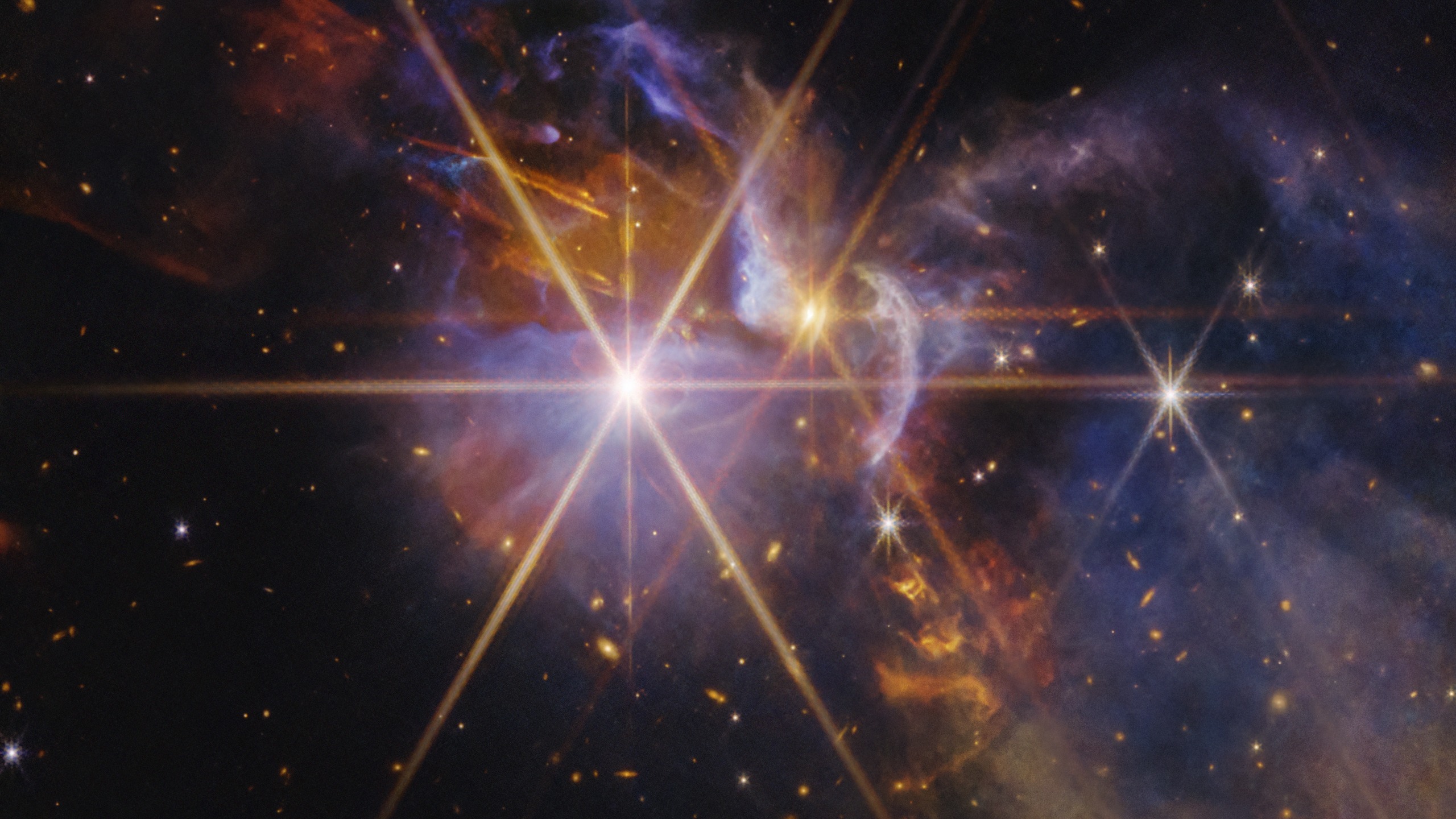
NASA's James Webb Space Telescope captures the infrared light from bright protostars in young star system FS Tau. FS Tau A, a pair of protostars that creates the largest diffraction pattern slightly to the left of center, is about half the mass of our Sun. FS Tau B, the orange protostar slightly right of center, is thought to be responsible for the red (molecular hydrogen) and orange (soot-like molecules known as polycyclic aromatic hydrocarbons) outflows that we see amid the dusty region. The blue ridges are areas where light has been scattered by dust.
12.3k downloads
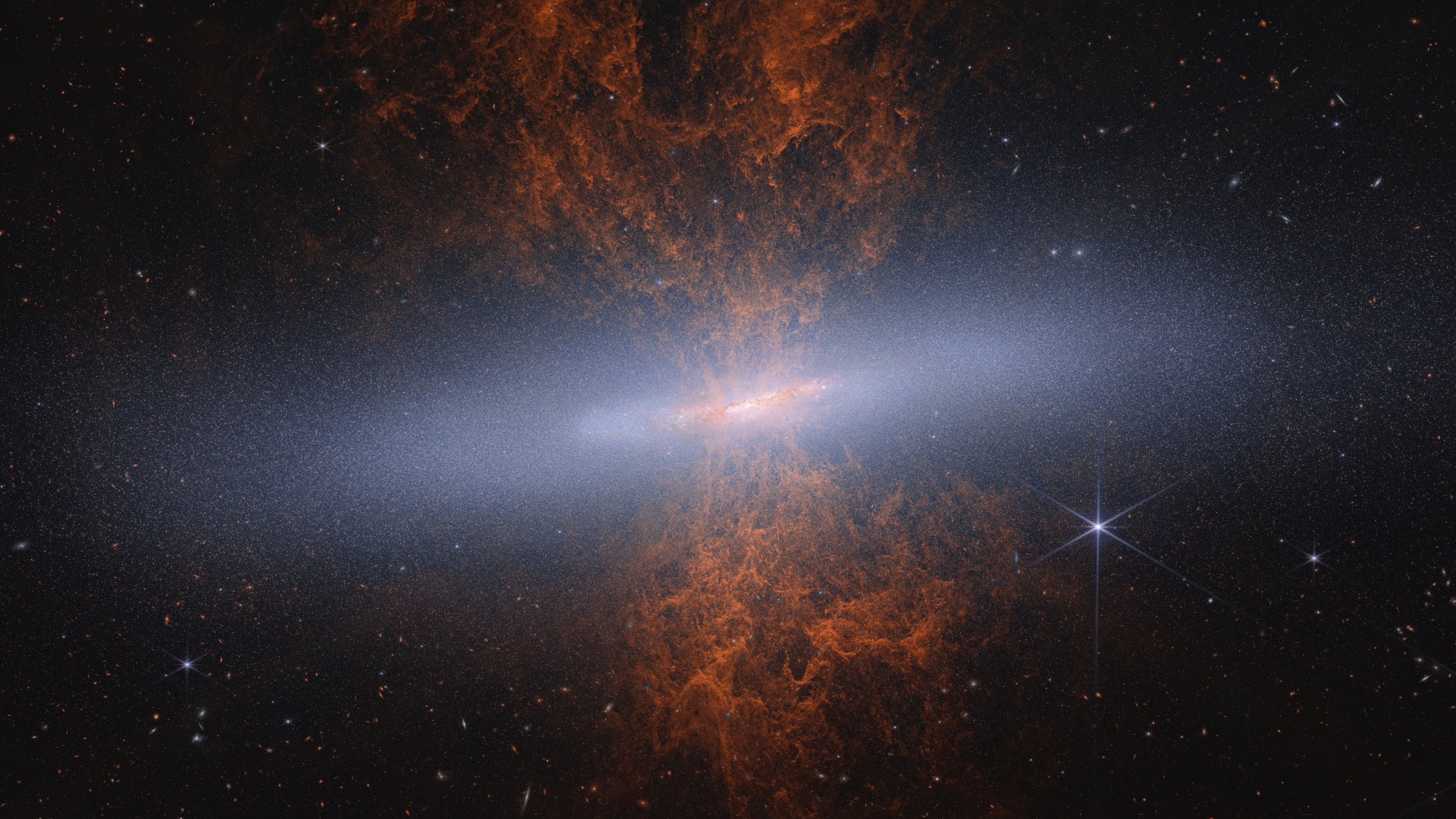
NASA's James Webb Space Telescope recently observed edge-on starburst galaxy Messier 82 (M82), nicknamed the Cigar Galaxy. Webb's near-infrared-light view is a snapshot in time, revealing a scene that has been evolving over a couple hundred million years. In near-infrared light, astronomers can see the galaxy's distended disk structure and millions of individual stars — approximately 16.5 million — for the first time. Webb's imaging survey of the galaxy is helping astronomers investigate the formation history of M82 and will also shed light on the current processes occurring within the starburst galaxy.
40.8k downloads
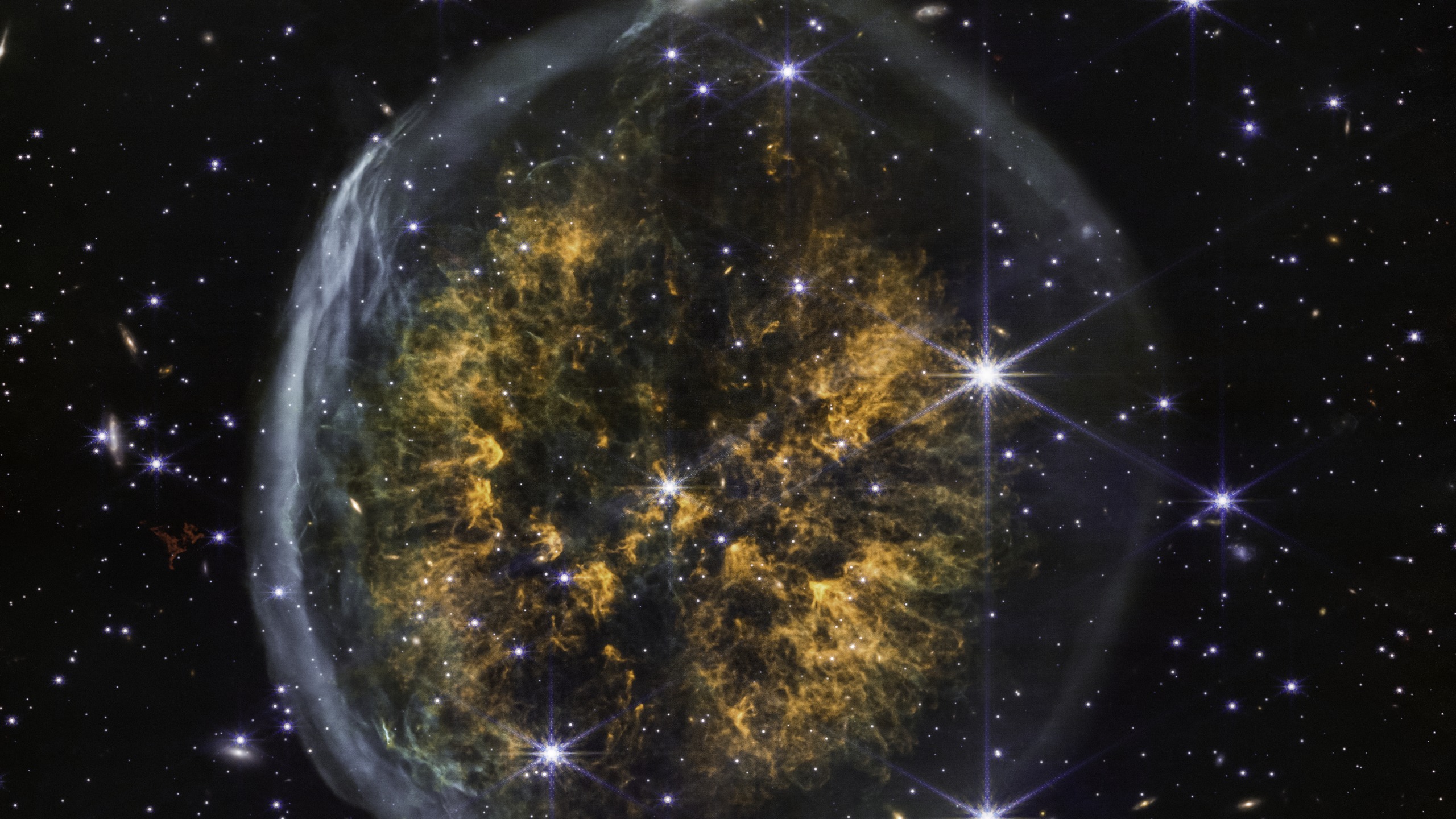
NASA's James Webb Space Telescope captured this near-infrared view of the PMR 1 "Exposed Cranium" nebula using its NIRCam instrument. More stars and background galaxies shine through in this near-infrared light, and the dark center lane that gives the nebula its distinctive brain-like appearance is especially noticeable here.
36k downloads
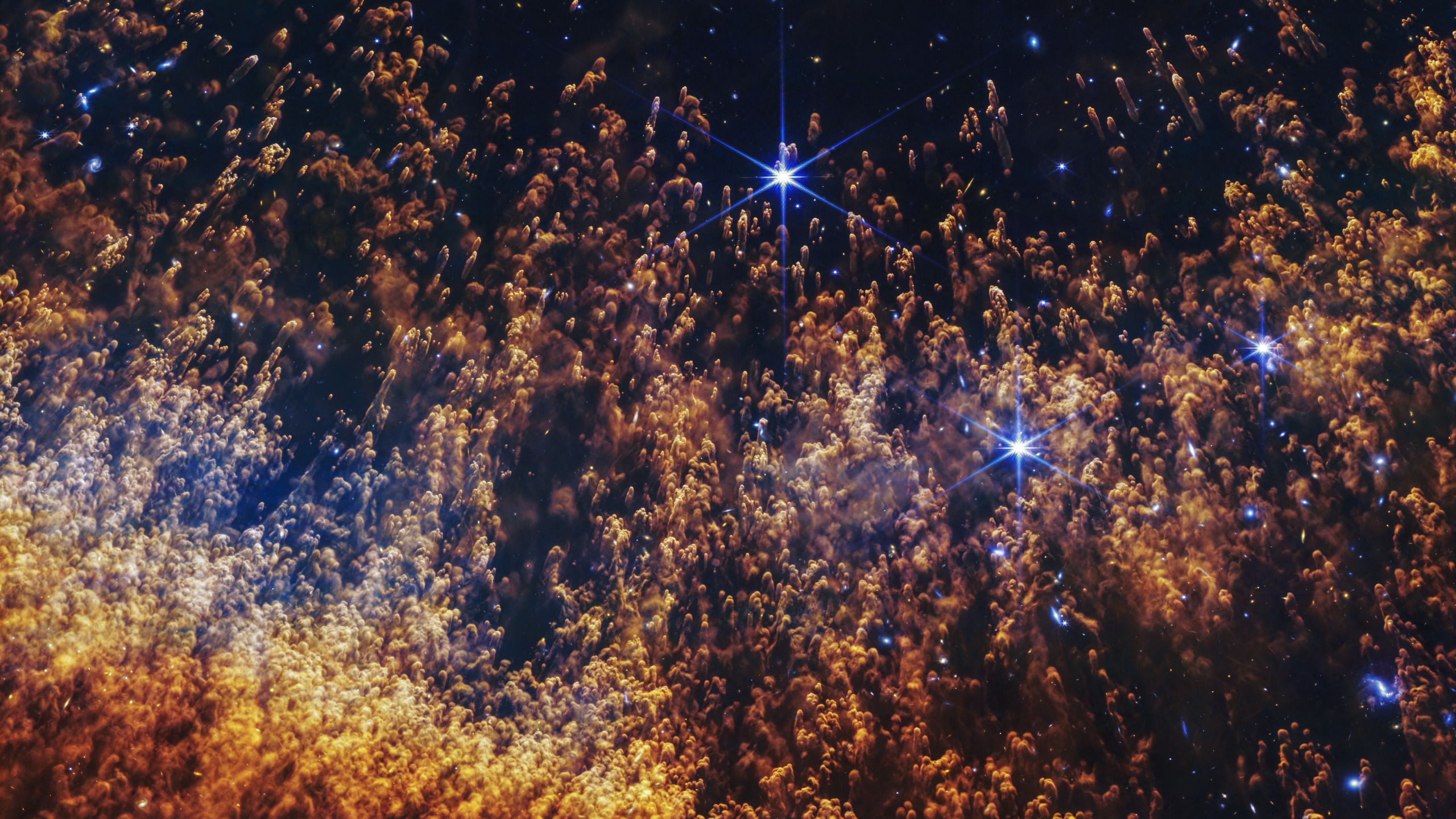
This new image of a portion of the Helix Nebula from NASA’s James Webb Space Telescope highlights comet-like knots shaped by fierce stellar winds and layers of gas and dust shed off by a dying star interacting with its surrounding environment. Webb’s image also shows the stark transition between the hottest gas to the coolest gas as the shell expands out from the central white dwarf.
23.5k downloads
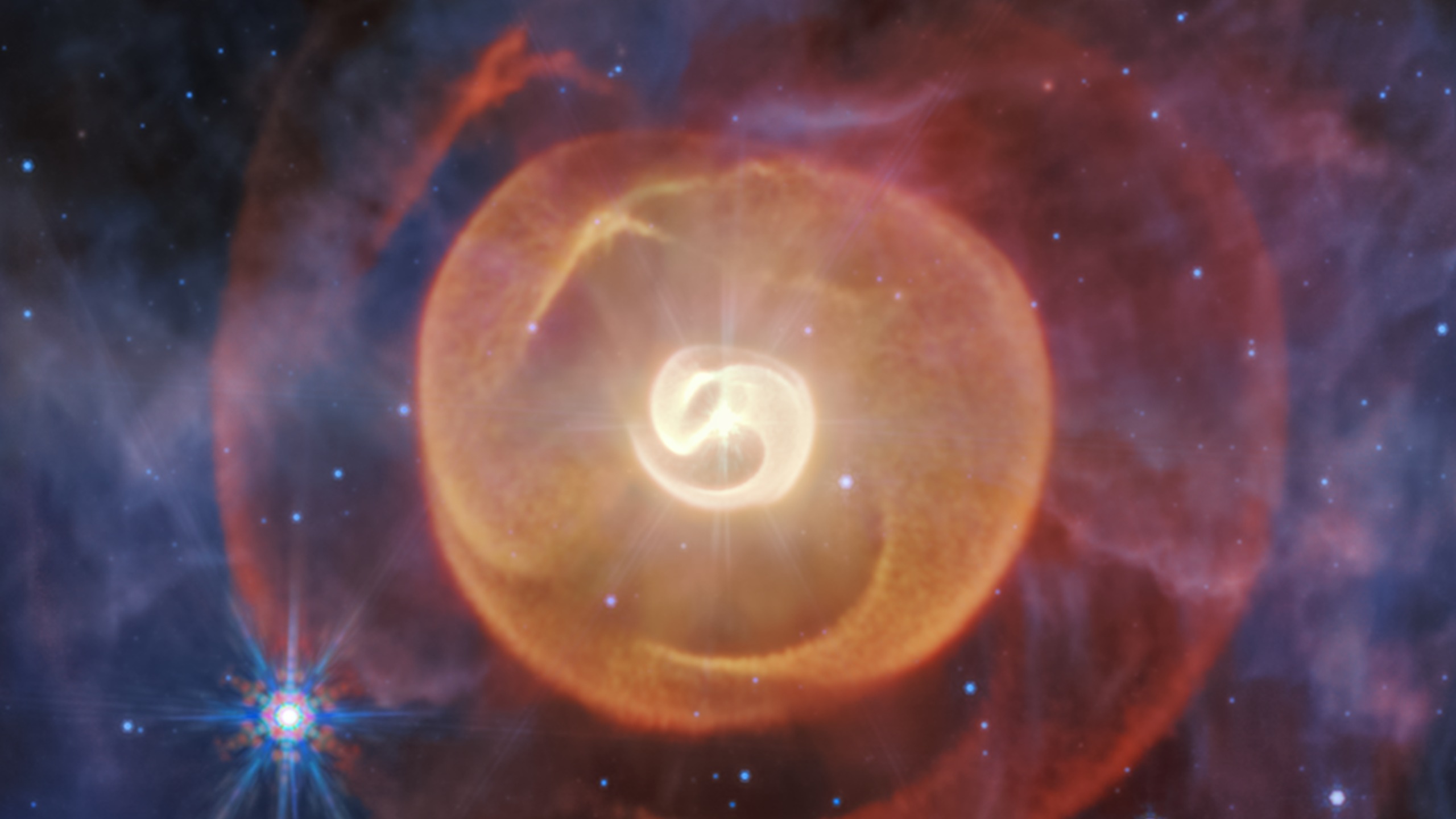
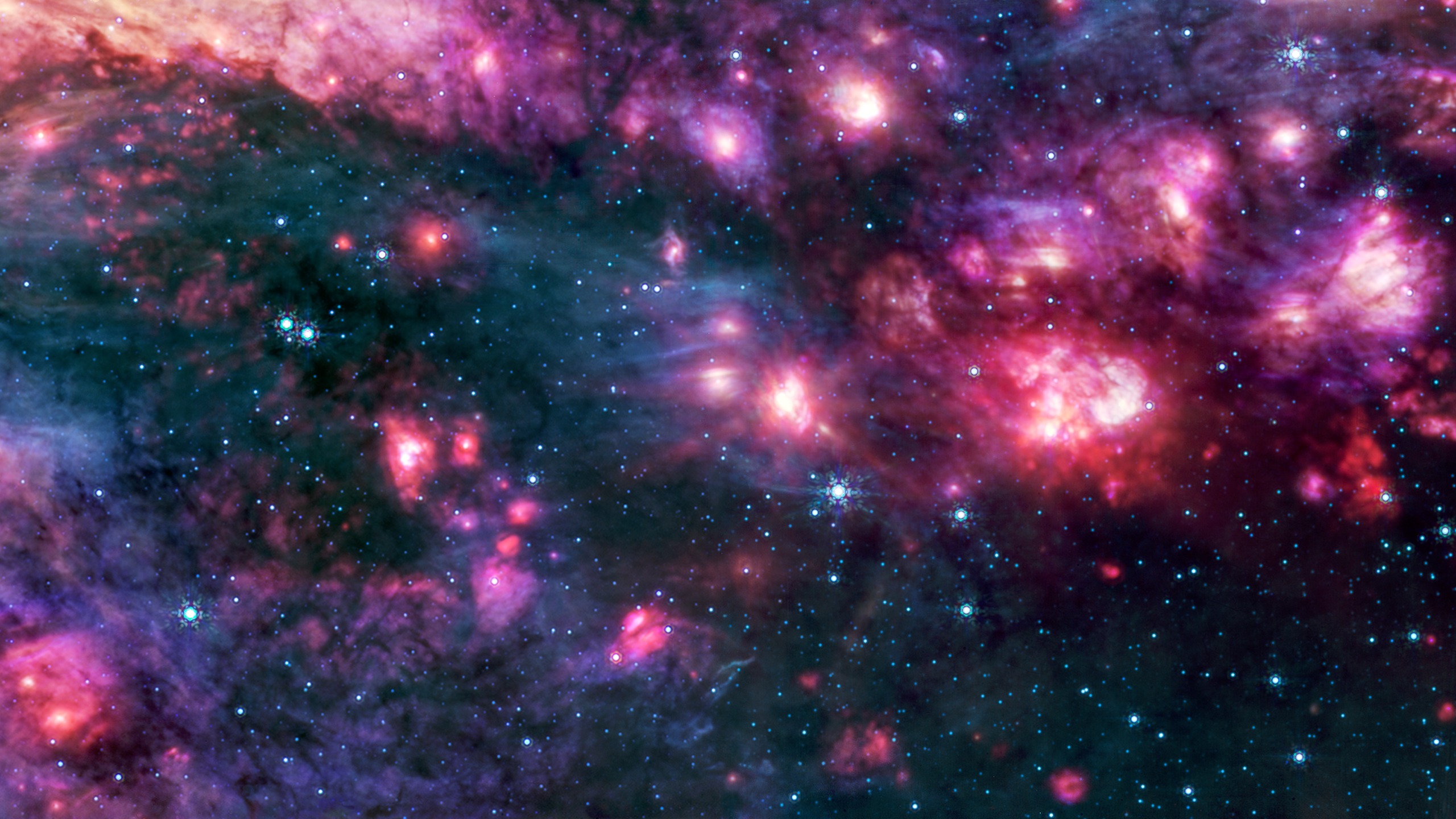
Webb's MIRI (Mid-Infrared Instrument) shows the Sagittarius B2 (Sgr B2) region in mid-infrared light, with warm dust glowing brightly. To the right is one clump of clouds that captured astronomers' attention. It is redder than the rest of the clouds in the image and corresponds to an area that other telescopes have shown to be one of the most molecularly rich regions known.
15k downloads
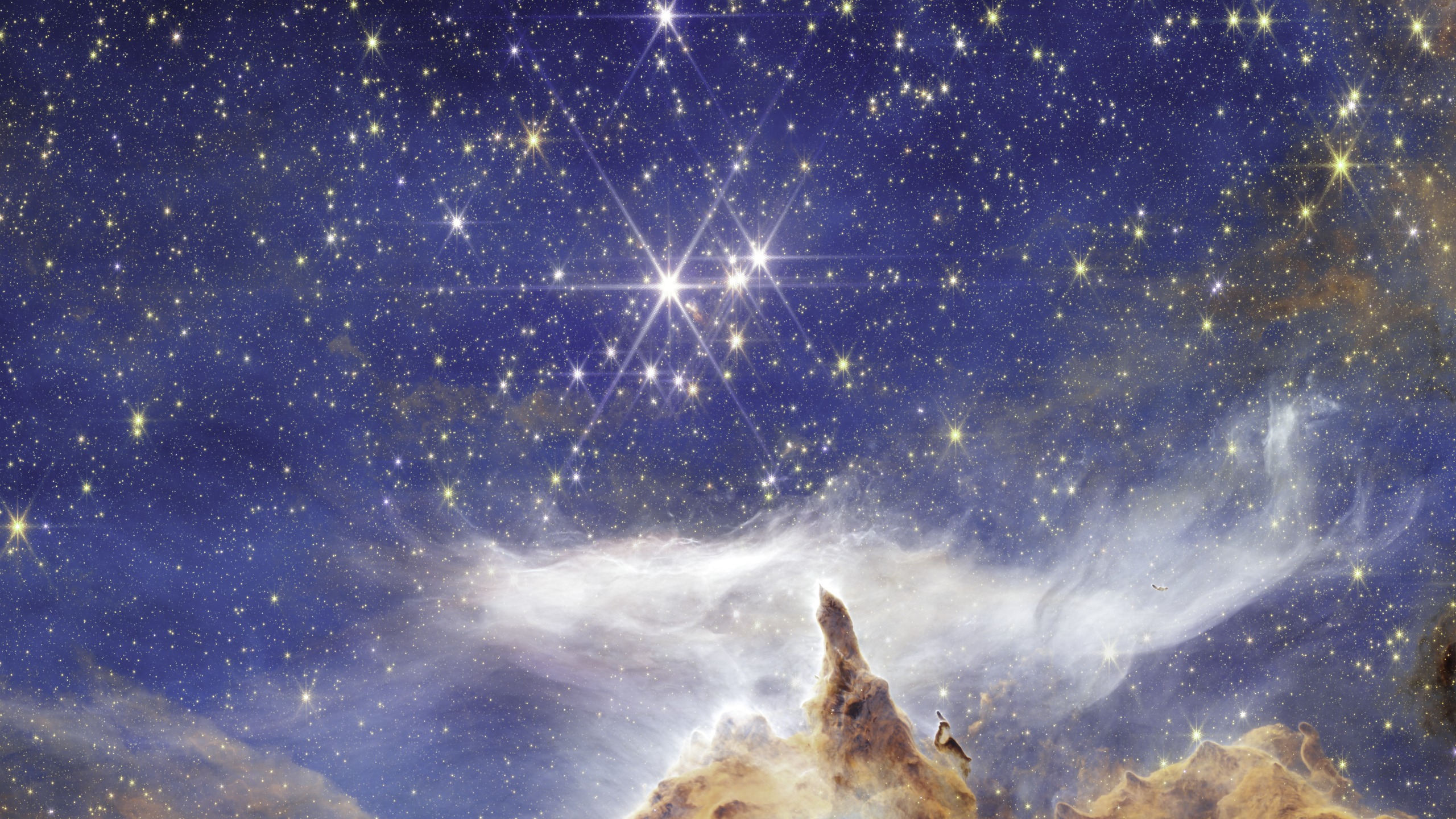
Webb captured this sparkling scene of star birth in Pismis 24, a young star cluster about 5,500 light-years from Earth in the constellation Scorpius. This region is one of the best places to explore the properties of hot young stars and how they evolve. Read the full image description.
16.8k downloads
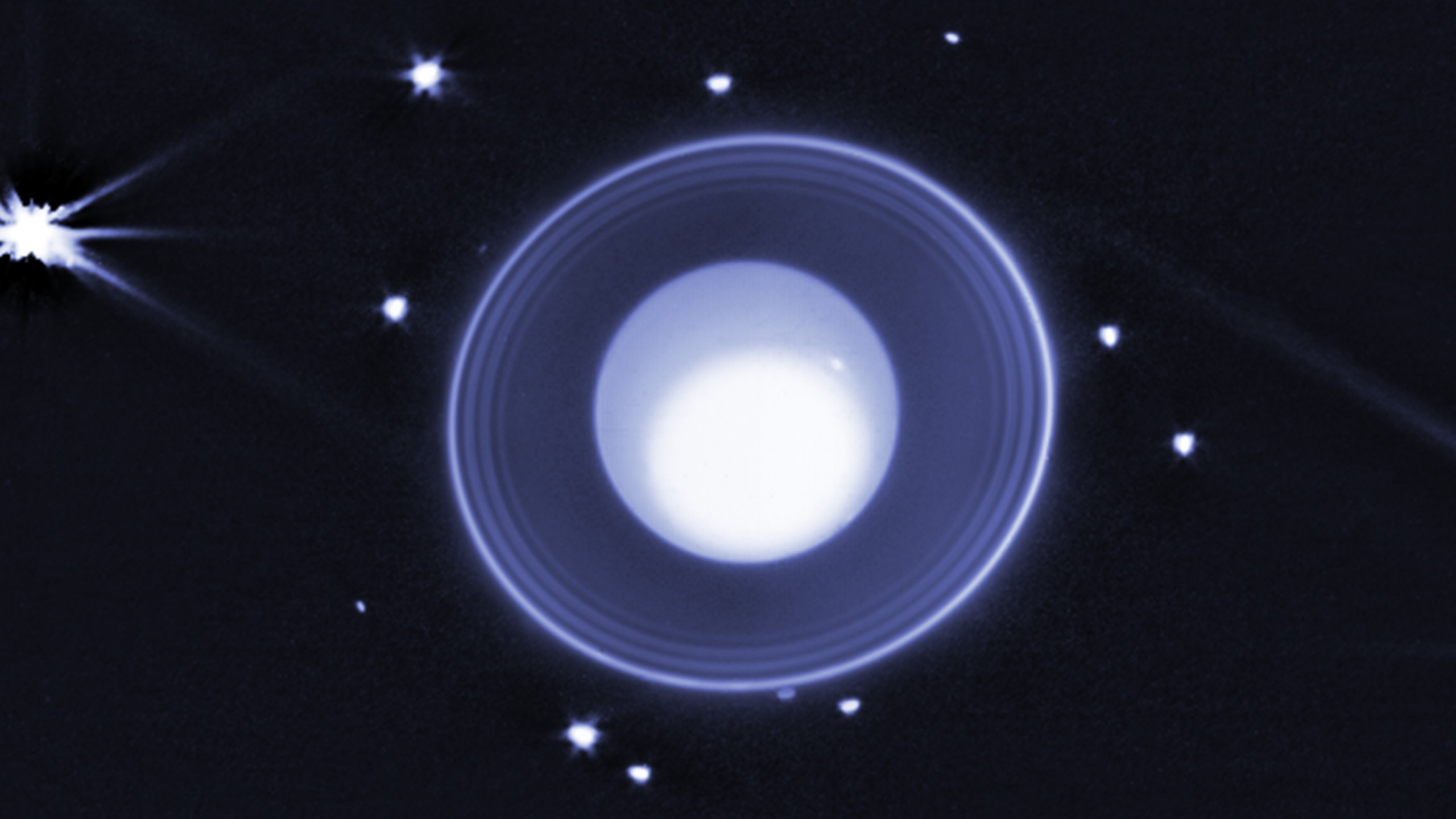
Astronomers using NASA’s James Webb Space Telescope discovered a new moon orbiting Uranus in images taken by Webb’s NIRCam (Near-Infrared Camera). This image shows the moon, designated S/2025 U1, as well as 13 of the 28 other known moons orbiting the planet. (The small moon Cordelia orbits just inside the outermost ring, but is not visible in these views due to glare from the rings.) Due to the drastic differences in brightness levels, the image is a composite of three different treatments of the data, allowing the viewer to see details in the planetary atmosphere, the surrounding rings, and the orbiting moons. The data was taken with NIRCam’s wide band F150W2 filter that transmits infrared wavelengths from about 1.0 to 2.4 microns.
32k downloads
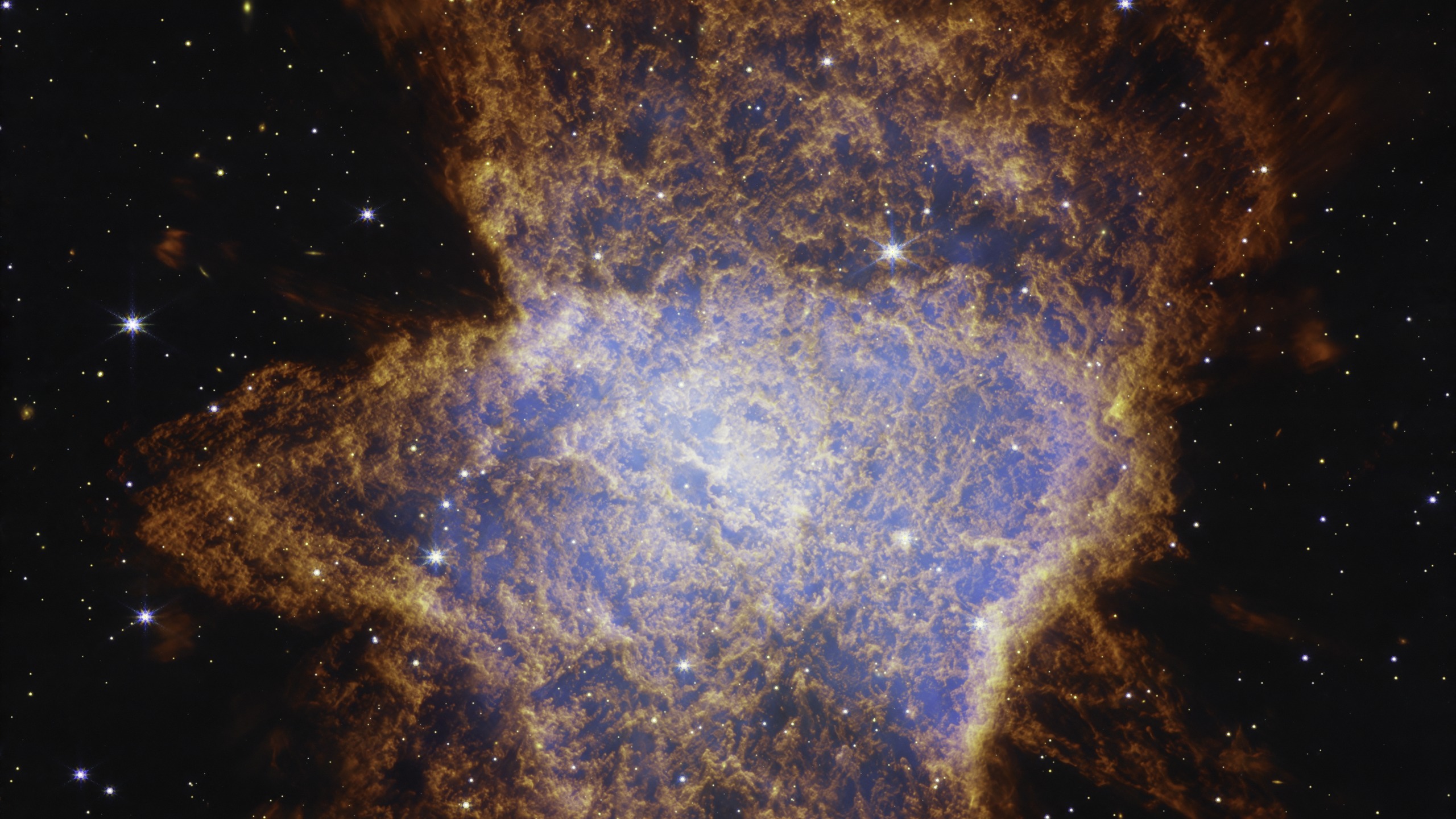
NASA’s James Webb Space Telescope’s view of planetary nebula NGC 6072 in the near-infrared shows a complex scene of multiple outflows expanding out at different angles from a dying star at the center of the scene. There is one stretching from roughly 11 to 5 o’clock, another from 1 to 7 o’clock, and possibly a third from 12 to 6 o’clock. These outflows push gas toward the equatorial plane, forming a disk that appears to span from 9 to 3 o’clock. Astronomers suspect there is at least one other star interacting with the material cast off by the central dying star, creating the abnormal appearance of this planetary nebula. In this image, the red areas represent cool molecular gas, for example, molecular hydrogen. Read the full image description.
27.2k downloads
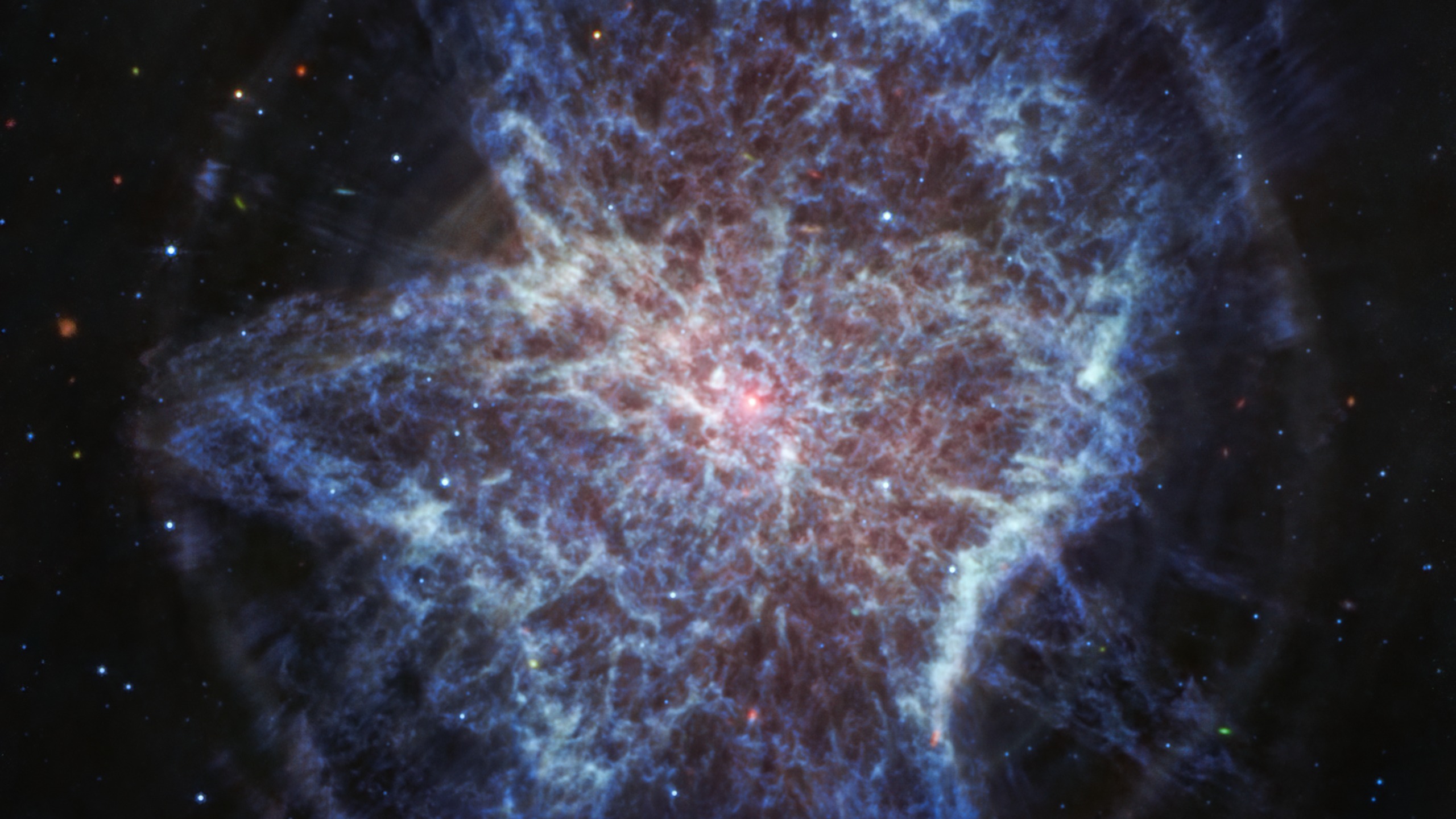
The mid-infrared view of planetary nebula NGC 6072 from NASA's James Webb Space Telescope shows expanding circular shells around the outflows from the dying central star, which astronomers suspect is the pinkish white dot at the center of the image. The longer wavelengths captured by Webb's MIRI (Mid-Infrared Instrument) highlight the dust being cast off by the central dying star. In this image, the blue represents cool molecular gas that is seen in red in the near-infrared image from Webb's NIRCam (Near-Infrared Camera) due to color mapping.
38.7k downloads
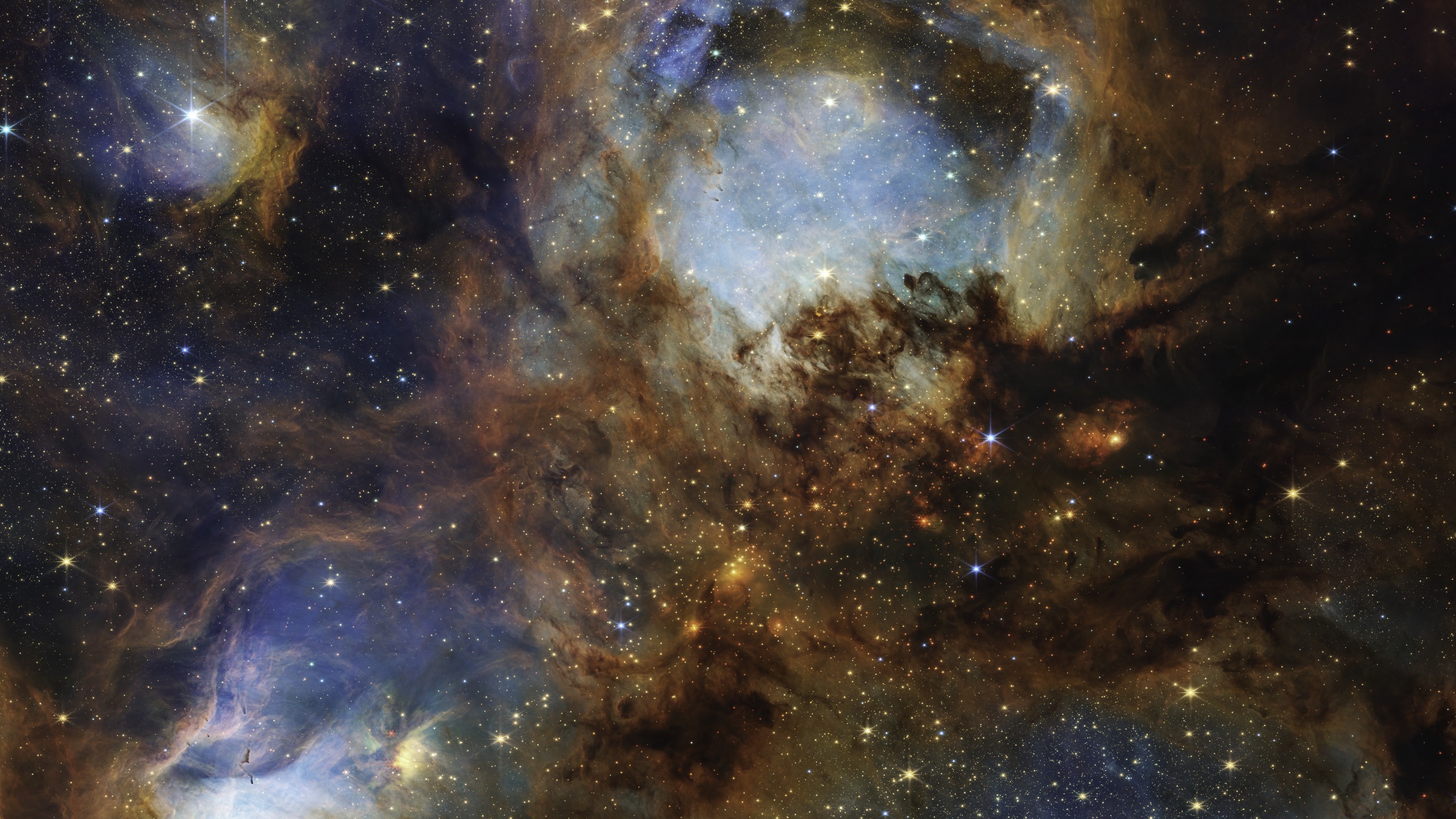
To celebrate NASA’s James Webb Space Telescope’s third year of highly productive science, astronomers used the telescope to scratch beyond the surface of the Cat’s Paw Nebula (NGC 6334), a massive, local star-forming region. This area is of great interest to scientists, having been subject to previous study by NASA’s Hubble and retired Spitzer space telescopes, as they seek to understand the multiple steps required for a turbulent molecular cloud to transition to stars. With its near-infrared capabilities and sharp resolution, the telescope “clawed” back a portion of a singular “toe bean,” revealing a subset of mini toe bean-reminiscent structures composed of gas, dust, and young stars. Webb’s view reveals a chaotic scene still in development: Massive young stars are carving away at nearby gas and dust, while their bright starlight is producing a bright nebulous glow represented in blue. This is only a chapter in the region’s larger story. The disruptive young stars, with their relatively short lifespans and luminosity, will eventually quench the local star formation process. The Cat’s Paw Nebula is located approximately 4,000 light-years away in the constellation Scorpius. To dive deeper into Webb’s image of the Cat’s Paw, embark on a narrated tour, get closer to the image, or read the press release. Additionally, learn more about Webb’s three years of science observations.
38.1k downloads
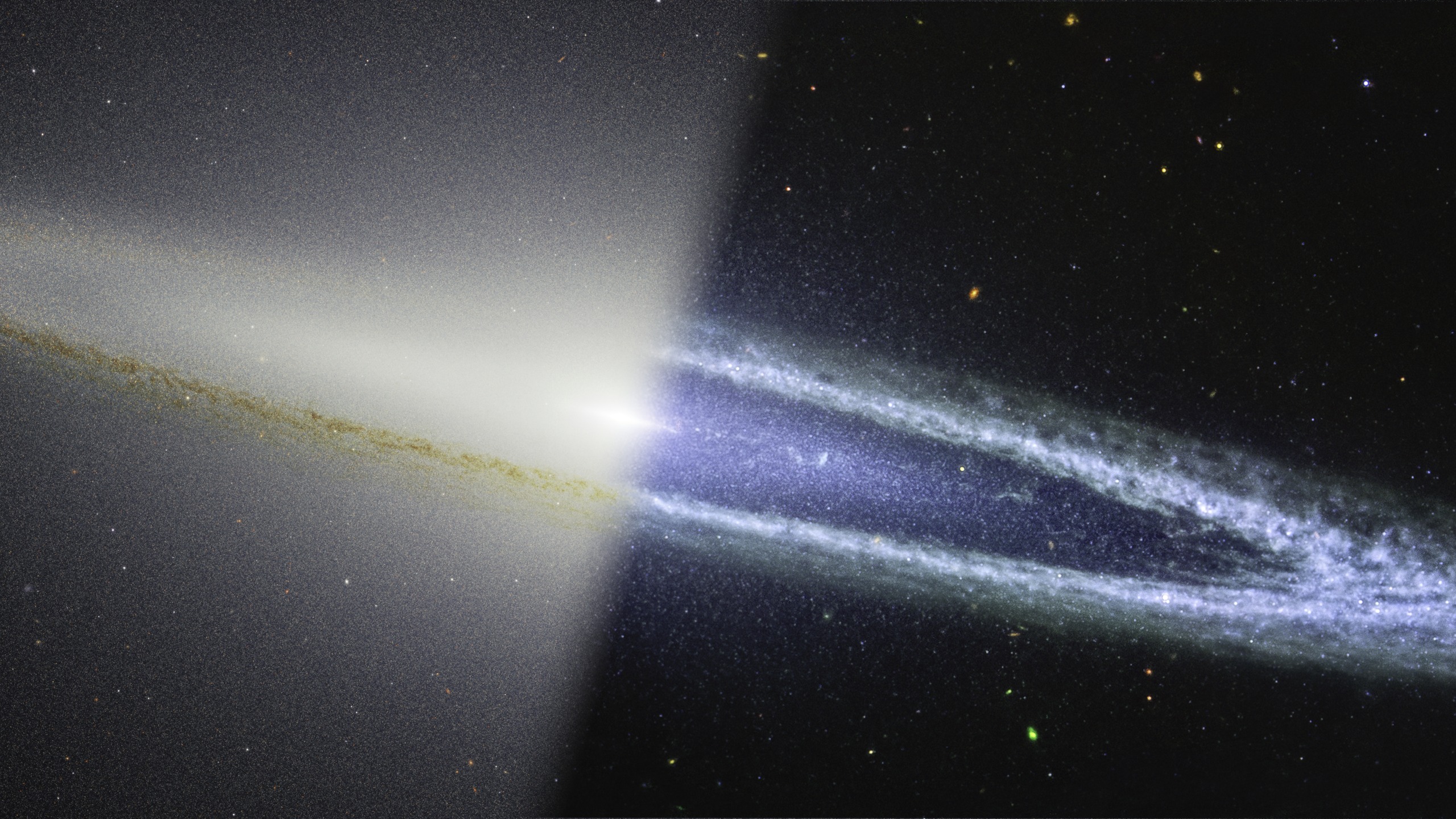
The Sombrero galaxy is split diagonally in this image: near-infrared observations from NASA’s James Webb Space Telescope are at the left, and mid-infrared observations from Webb are at the right. The near-infrared image shows where dust from the outer ring blocks stellar light from the inner portions of the galaxy. Then, in the mid-infrared image actually shows that dust glowing. The powerful resolution of Webb’s NIRCam also allows us to resolve individual stars outside of, but not necessarily at the same distance as, the galaxy, some of which appear red. These are called red giants, which are cooler stars, but their large surface area causes them to glow brightly in this image. These red giants also are detected in the mid-infrared, while the smaller, bluer stars in the near-infrared “disappear” in the longer wavelengths.
41.7k downloads
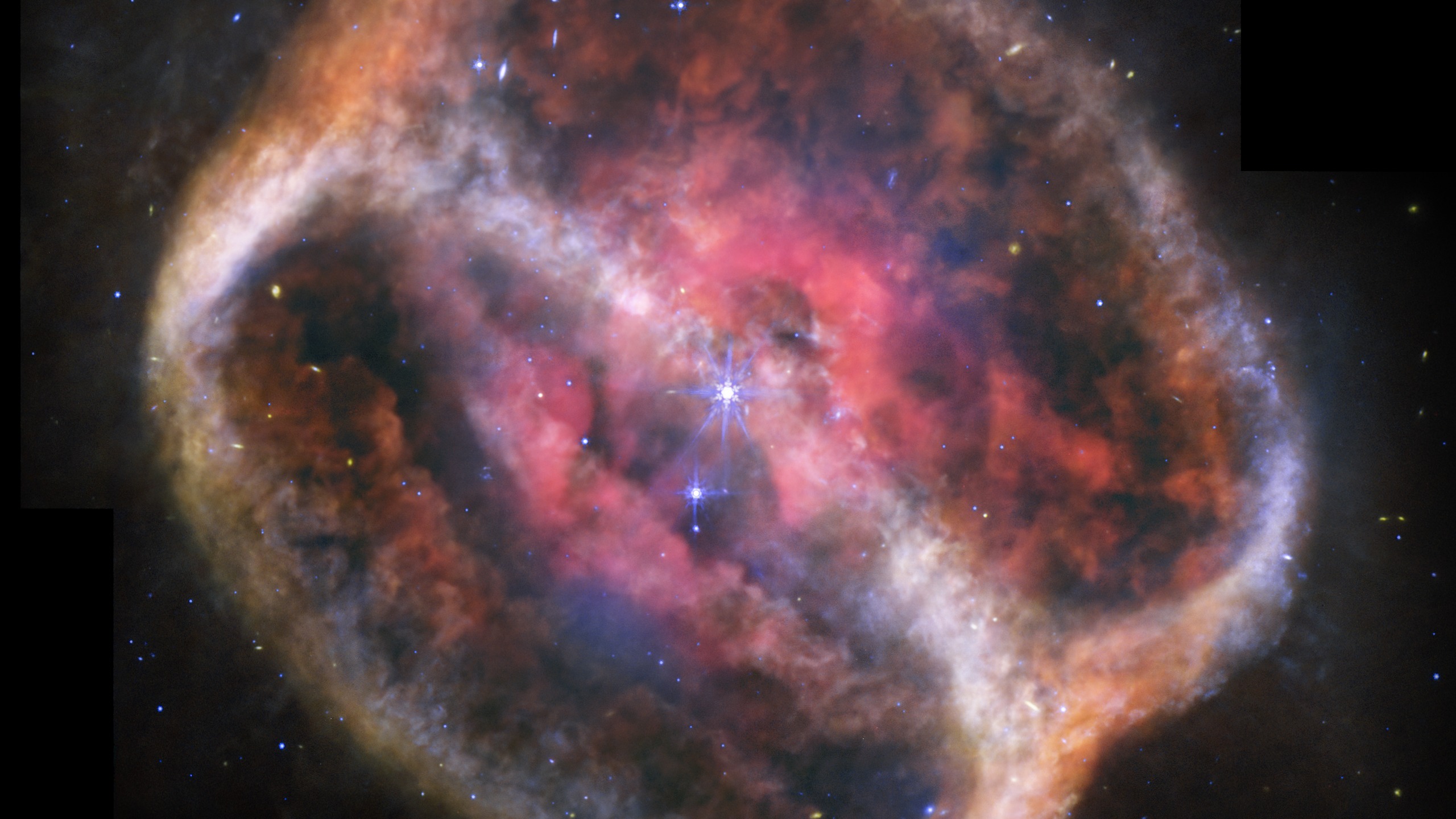
NASA’s James Webb Space Telescope has taken the most detailed image of planetary nebula NGC 1514 to date thanks to its unique mid-infrared observations. Webb shows its rings as intricate clumps of dust. It’s also easier to see holes punched through the bright pink central region.
23.9k downloads
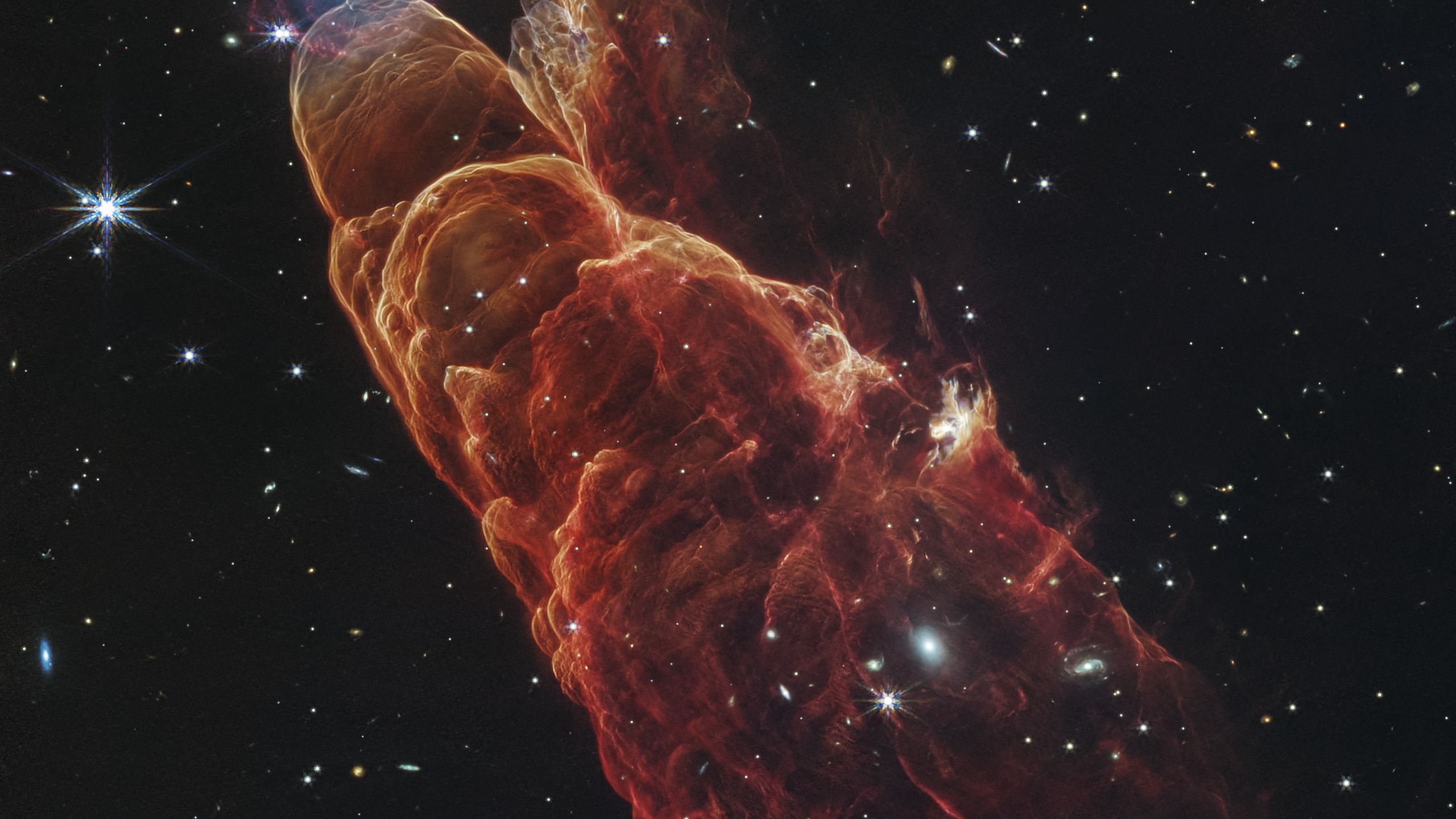
NASA’s James Webb Space Telescope observed Herbig-Haro 49/50, an outflow from a nearby still-forming star, in high-resolution near- and mid-infrared light. The young star is off to the lower right corner of the Webb image.Intricate features of the outflow, represented in reddish-orange color, provide detailed clues about how young stars form and how their jet activity affects the environment around them. A chance alignment in this direction of the sky provides a beautiful juxtaposition of this nearby Herbig-Haro object (located within our Milky Way) with a face-on spiral galaxy in the distant background. Protostars are young stars in the process of formation that generally launch narrow jets of material. These jets move through the surrounding environment, in some cases extending to large distances away from the protostar. Like the water wake generated by a speeding boat, the arcs in this image are created by the fast-moving jet slamming into surrounding dust and gas. This ambient material is compressed and heats up, then cools by emitting light at visible and infrared wavelengths. In particular, the infrared light captured here by Webb highlights molecular hydrogen and carbon monoxide. The galaxy that appears by happenstance at the tip of Herbig-Haro 49/50 is a much more distant spiral galaxy. It has a prominent central bulge represented in blue that shows the location of older stars. It also displays hints of “side lobes,” suggesting that this could be a barred-spiral galaxy. Reddish clumps within the spiral arms show the locations of warm dust and groups of forming stars. There are many more galaxies at further distances in the surrounding background, including ones that shine through the diffuse infrared glow of the nearby Herbig-Haro object.
2.7k downloads
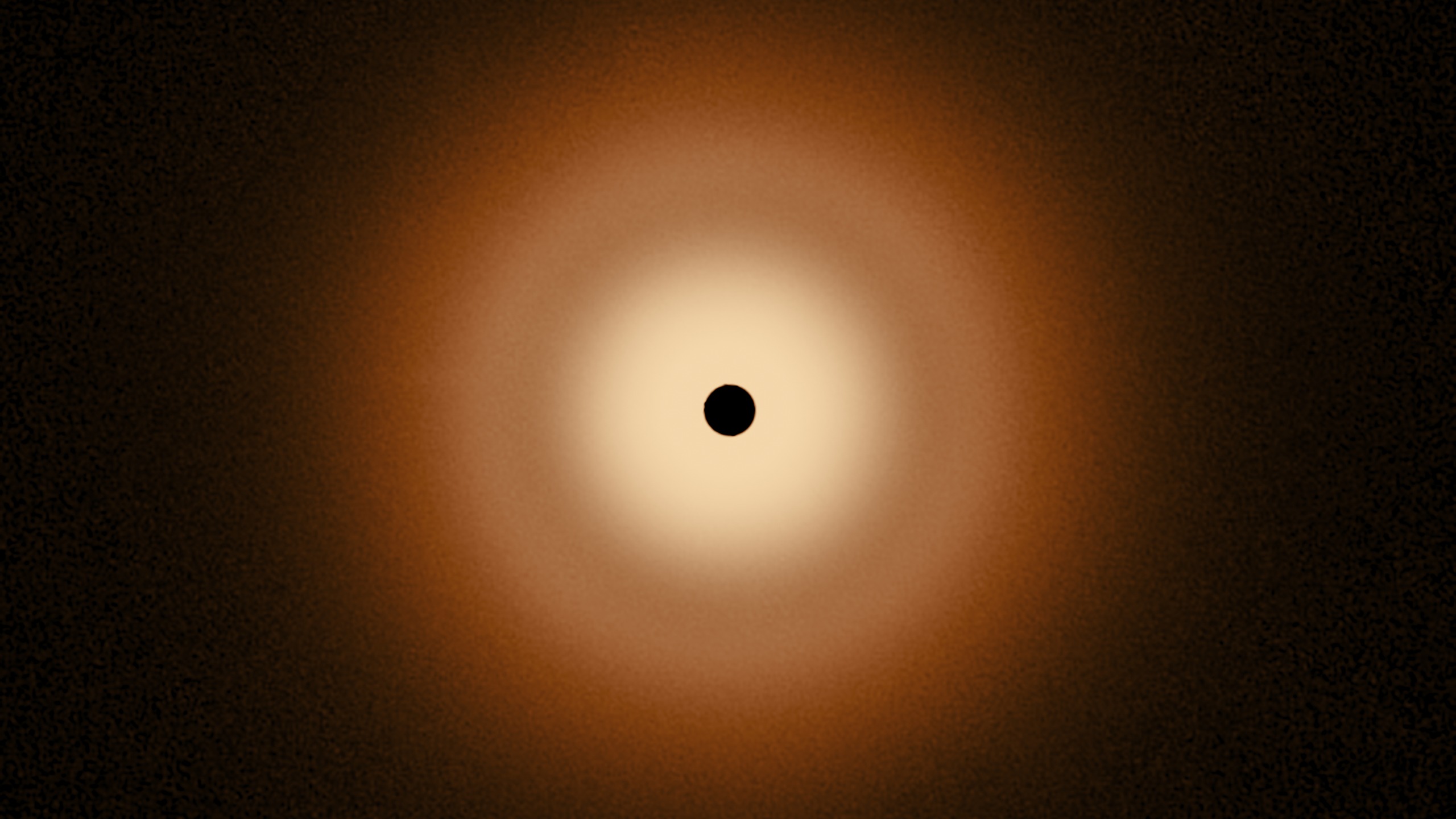
The James Webb Space Telescope resolves the glow of warm dust in a disk halo, at 23 billion miles out. The outer disk (analogous to the solar system's Kuiper Belt) extends from 7 billion miles to 15 billion miles. The inner disk extends from the inner edge of the outer disk down to close proximity to the star. There is a notable dip in surface brightness of the inner disk from approximately 3.7 to 7.2 billion miles. The black spot at the center is due to lack of data from saturation.
4.5k downloads
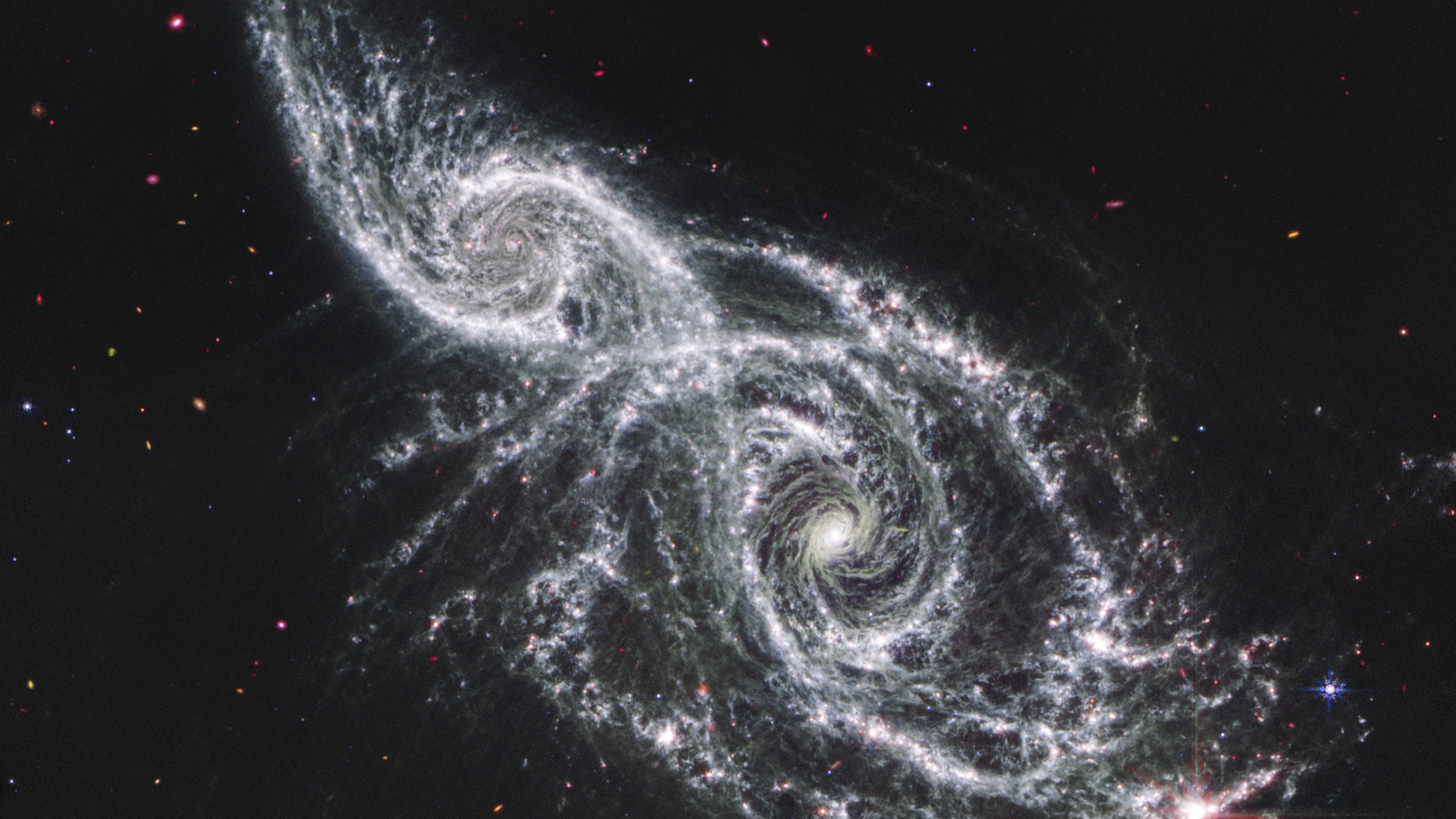
The James Webb Space Telescope’s mid-infrared image of galaxies IC 2163 and NGC 2207 recalls the iciness of long-dead bones mixed with eerie vapors. Two large luminous “eyes” lie at the galaxies’ cores, and gauzy spiral arms reach out into the vast distances of space. Webb’s mid-infrared image excels at showing where the cold dust glows throughout these galaxies — and helps pinpoint where stars and star clusters are buried within the dust. Find these regions by looking for the pink dots along the spiral arms. Many of these areas are home to actively forming stars that are still encased in the gas and dust that feeds their growth. Other pink dots may be objects that lie well behind these galaxies, including extremely distant active supermassive black holes known as quasars. The largest, brightest pink region that glimmers with eight prominent diffraction spikes at the bottom right is a mini starburst — a location where many stars are forming in quick succession. Find the lace-like holes in the spiral arms. These areas are brimming with star formation. Finally, scan the black background of space, where objects shine brightly in a rainbow of colors. Blue circles with tiny diffraction spikes are foreground stars. Objects without spikes are very distant galaxies. Compare the Hubble and Webb images. Extended Description and Image Alt Text
18.4k downloads
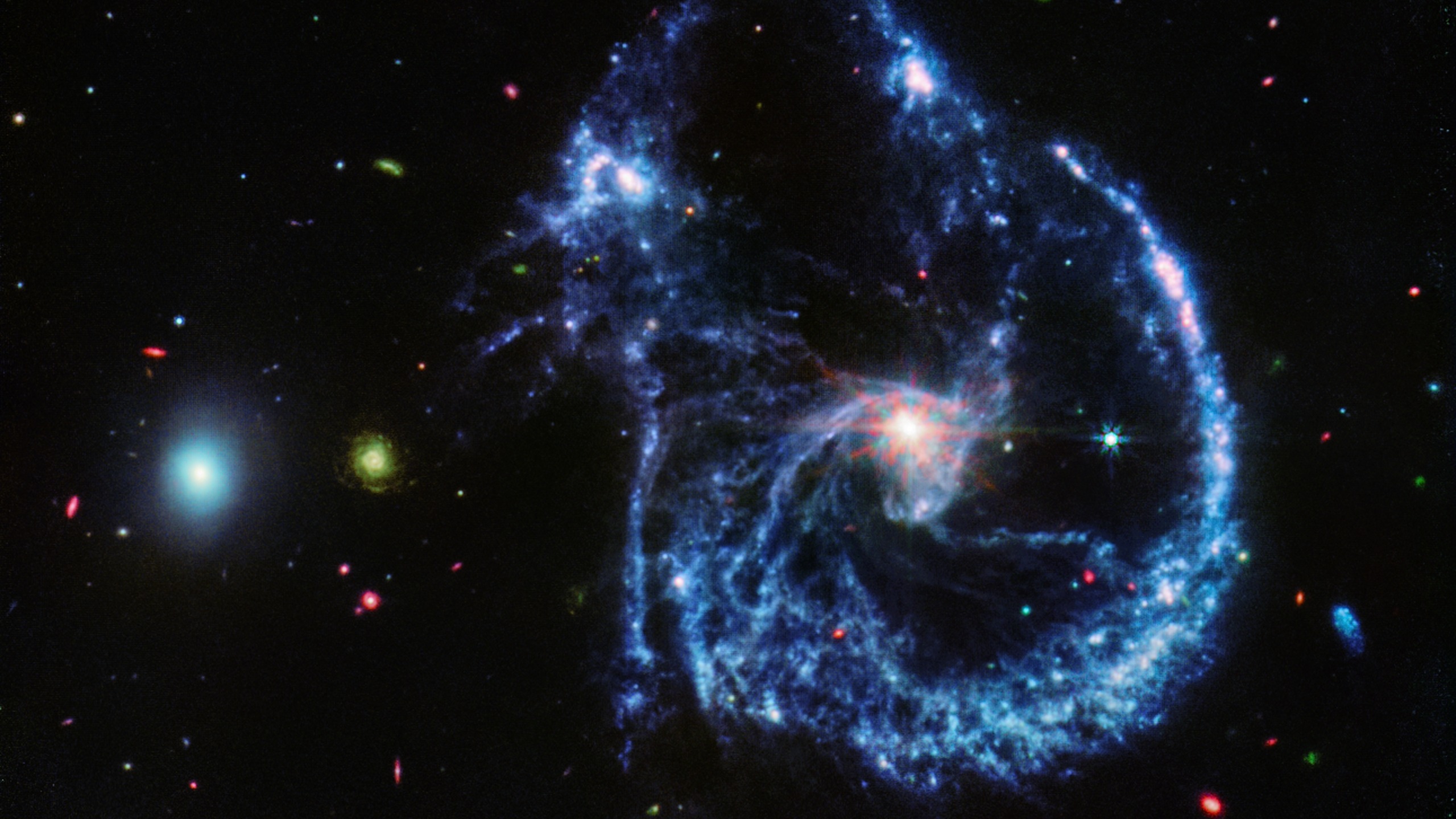
This image of Arp 107, shown by Webb’s MIRI (Mid-Infrared Instrument), reveals the supermassive black hole that lies in the center of the large spiral galaxy to the right. This black hole, which pulls much of the dust into lanes, also display’s Webb’s characteristic diffraction spikes, caused by the light that it emits interacting with the structure of the telescope itself. Perhaps the defining feature of the region, which MIRI reveals, are the millions of young stars that are forming, highlighted in blue. These stars are surrounded by dusty silicates and soot-like molecules known as polycyclic aromatic hydrocarbons. The small elliptical galaxy to the left, which has already gone through much of its star formation, is composed of many of these organic molecules.
36.7k downloads
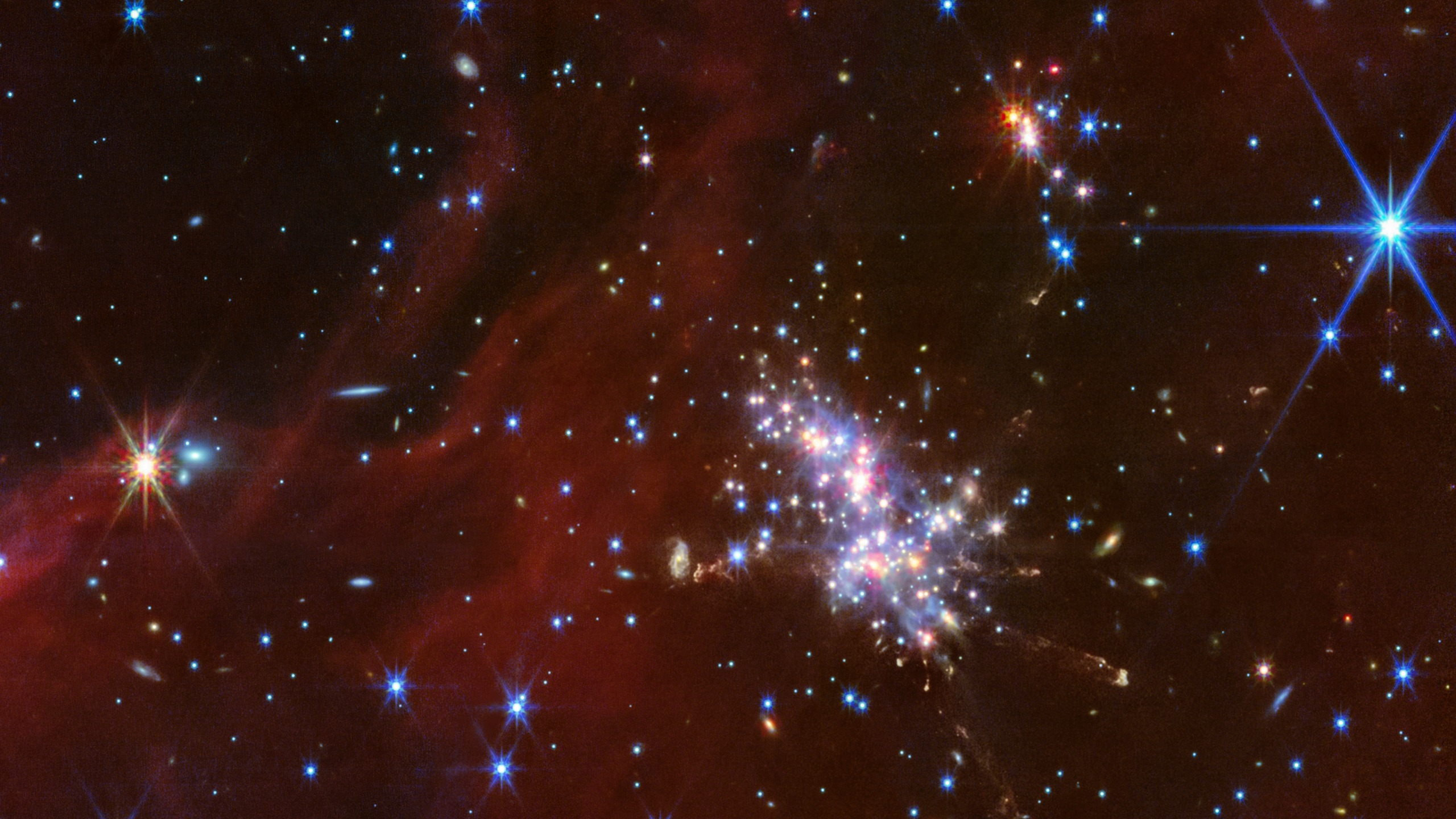
NASA’s James Webb Space Telescope observed the outskirts of our Milky Way galaxy. Known as the Extreme Outer Galaxy, this region is located more than 58,000 light-years from the Galactic Center. To learn more about how a local environment affects the star formation process within it, a team of scientists directed the telescope’s NIRCam (Near-Infrared Camera) and MIRI (Mid-Infrared Instrument) toward a total of four star-forming areas within Digel Clouds 1 and 2: 1A, 1B, 2N, and 2S. In the case of Cloud 2S, shown here, Webb revealed a luminous main cluster that contains newly formed stars. Several of these young stars are emitting extended jets of material from their poles. To the main cluster’s top right is a sub-cluster of stars, a feature that scientists previously suspected to exist but has now been confirmed with Webb. Additionally, the telescope revealed a deep sea of background galaxies and red nebulous structures that are being carved away by winds and radiation from nearby stars.
26.5k downloads
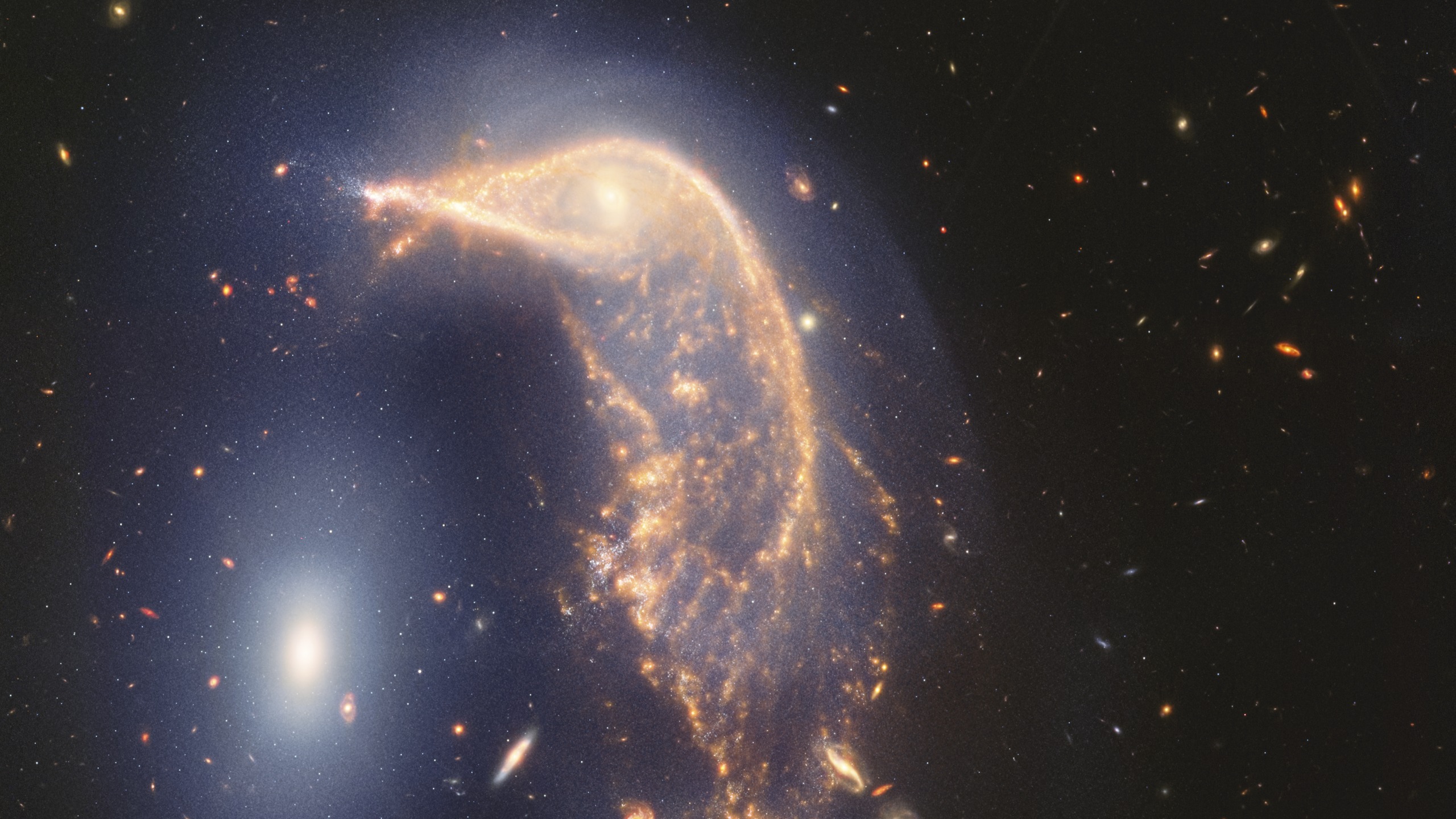
This “penguin party” is loud! The distorted spiral galaxy at center, the Penguin, and the compact elliptical galaxy at left, the Egg, are locked in an active embrace. A new near- and mid-infrared image from the James Webb Space Telescope, taken to mark its second year of science, shows that their interaction is marked by a faint upside-down U-shaped blue glow. The pair, known jointly as Arp 142, made their first pass between 25 and 75 million years ago — causing “fireworks,” or new star formation, in the Penguin. In the most extreme cases, mergers can cause galaxies to form thousands of new stars per year, for a few million years. For the Penguin, research has shown that about 100 to 200 stars have formed per year. By comparison, our Milky Way galaxy (which is not interacting with a galaxy of the same size) forms roughly six to seven new stars per year. This gravitational shimmy also remade the Penguin’s appearance. Its coiled spiral arms unwound, and gas and dust were pulled in an array of directions, like it was releasing confetti. It is rare for individual stars to collide when galaxies interact (space is vast), but galaxies’ mingling disrupts stars’ orbits. Today, the Penguin’s galactic center looks like an eye set within a head, and the galaxy has prominent star trails that take the shape of a beak, backbone, and fanned-out tail. A faint, but prominent dust lane extends from its beak down to its tail. Despite the Penguin appearing far larger than the Egg, these galaxies have approximately the same mass. This is one reason why the smaller-looking Egg hasn’t yet merged with the Penguin. (If one was less massive, it may have merged earlier.) The oval Egg is filled with old stars, and little gas and dust, which is why it isn’t sending out “streamers” or tidal tails of its own and instead has maintained a compact oval shape. If you look closely, the Egg has four prominent diffraction spikes — the galaxy’s stars are so concentrated that it gleams. Now, find the bright, edge-on galaxy at top right. It may look like a party crasher, but it’s not nearby. Cataloged PGC 1237172, it lies 100 million light-years closer to Earth. It is relatively young and isn’t overflowing with dust, which is why it practically disappears in Webb’s mid-infrared view. The background of this image is overflowing with far more distant galaxies. This is a testament to the sensitivity and resolution of Webb’s infrared cameras. Additional images of Arp 142 are available at left, under the Download Options, including a cropped image (like the one above) that features only near-infrared light, and a wider near-infrared field of view, which features an even greater number of distant galaxies. Arp 142 lies 326 million light-years from Earth in the constellation Hydra. Extended Description and Image Alt Text
36.8k downloads
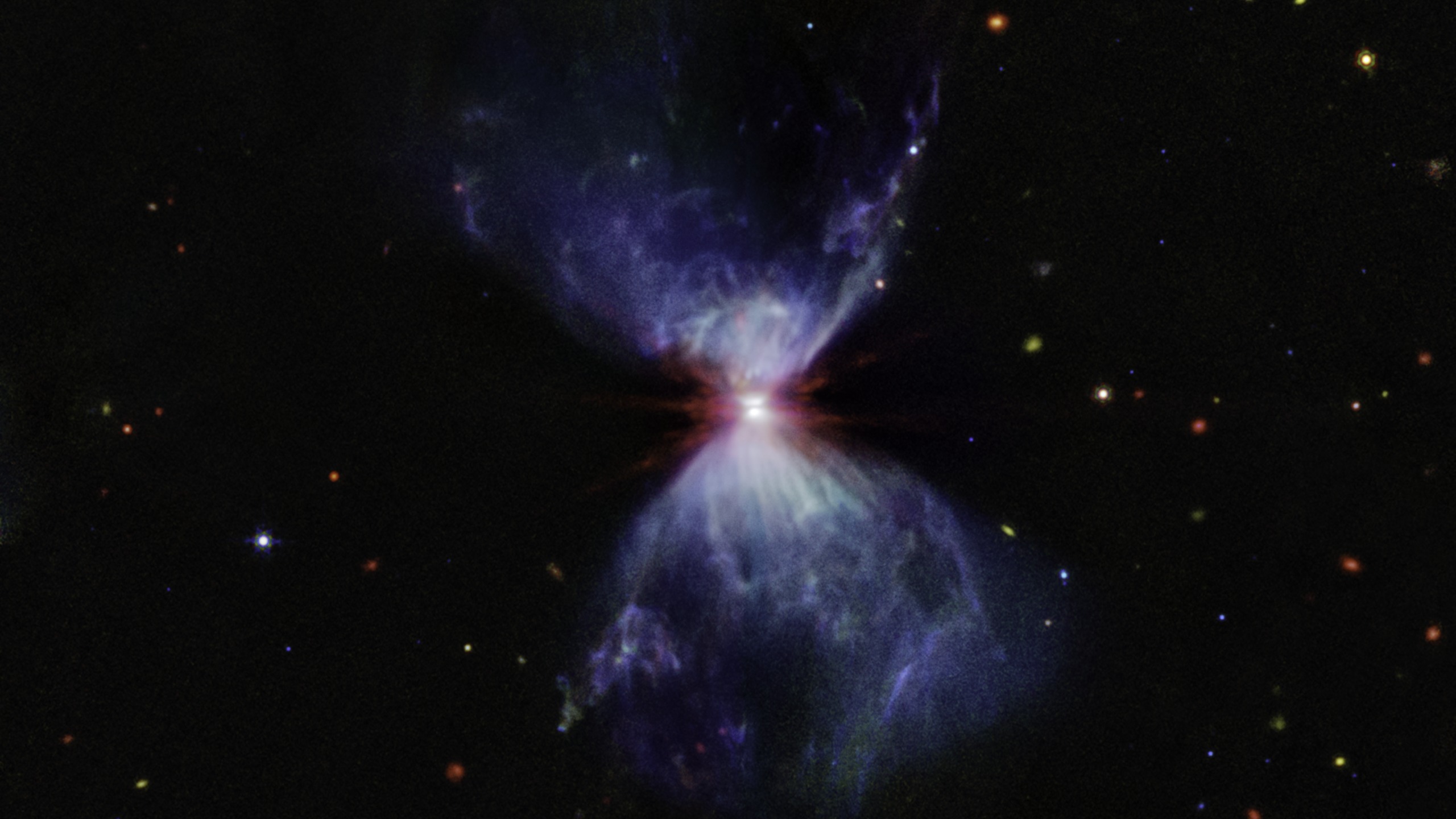
L1527, shown in this image from NASA’s James Webb Space Telescope’s MIRI (Mid-Infrared Instrument), is a molecular cloud that harbors a protostar. It resides about 460 light-years from Earth in the constellation Taurus. The more diffuse blue light and the filamentary structures in the image come from organic compounds known as polycyclic aromatic hydrocarbons (PAHs), while the red at the center of this image is an energized, thick layer of gases and dust that surrounds the protostar. The region in between, which shows up in white, is a mixture of PAHs, ionized gas, and other molecules. This image includes filters representing 7.7 microns light as blue, 12.8 microns light as green, and 18 microns light as red.
831 downloads
![Serpens Nebula, HBC 672, [EC 92] 82](https://pub-cec02c1cd1fa469cb88cc3510c091268.r2.dev/wallpapers/serpens-nebula/serpens-nebula-2560x1440.jpg)
In this image of the Serpens Nebula from the Near-Infrared Camera (NIRCam) on NASA’s James Webb Space Telescope, astronomers found a grouping of aligned protostellar outflows within one small region (the top left corner). In the Webb image, these jets are signified by bright clumpy streaks that appear red, which are shockwaves from the jet hitting surrounding gas and dust. The Serpens Nebula, located 1,300 light-years from Earth, is home to a particularly dense cluster of newly forming stars (~100,000 years old), some of which will eventually grow to the mass of our Sun. This region has been home to other coincidental discoveries, including the flapping “Bat Shadow,” which earned its name when 2020 data from NASA’s Hubble Space Telescope revealed a shadow from a star’s planet-forming disk to flap, or shift. This feature is visible at the center of the Webb image. To the right of the “Bat Shadow” lies another intriguing feature—an eye-shaped crevice, which appears as if a star is bursting through. However, astronomers say looks may be deceiving here. This could just be gases of different densities layered on top of one another, similar to what is seen in the famous Pillars of Creation. And to the right of that, an extremely dark patch could be a similar occurrence. This gas and dust are so dense in comparison to the rest of the region, no near-infrared light is getting through.
30.3k downloads
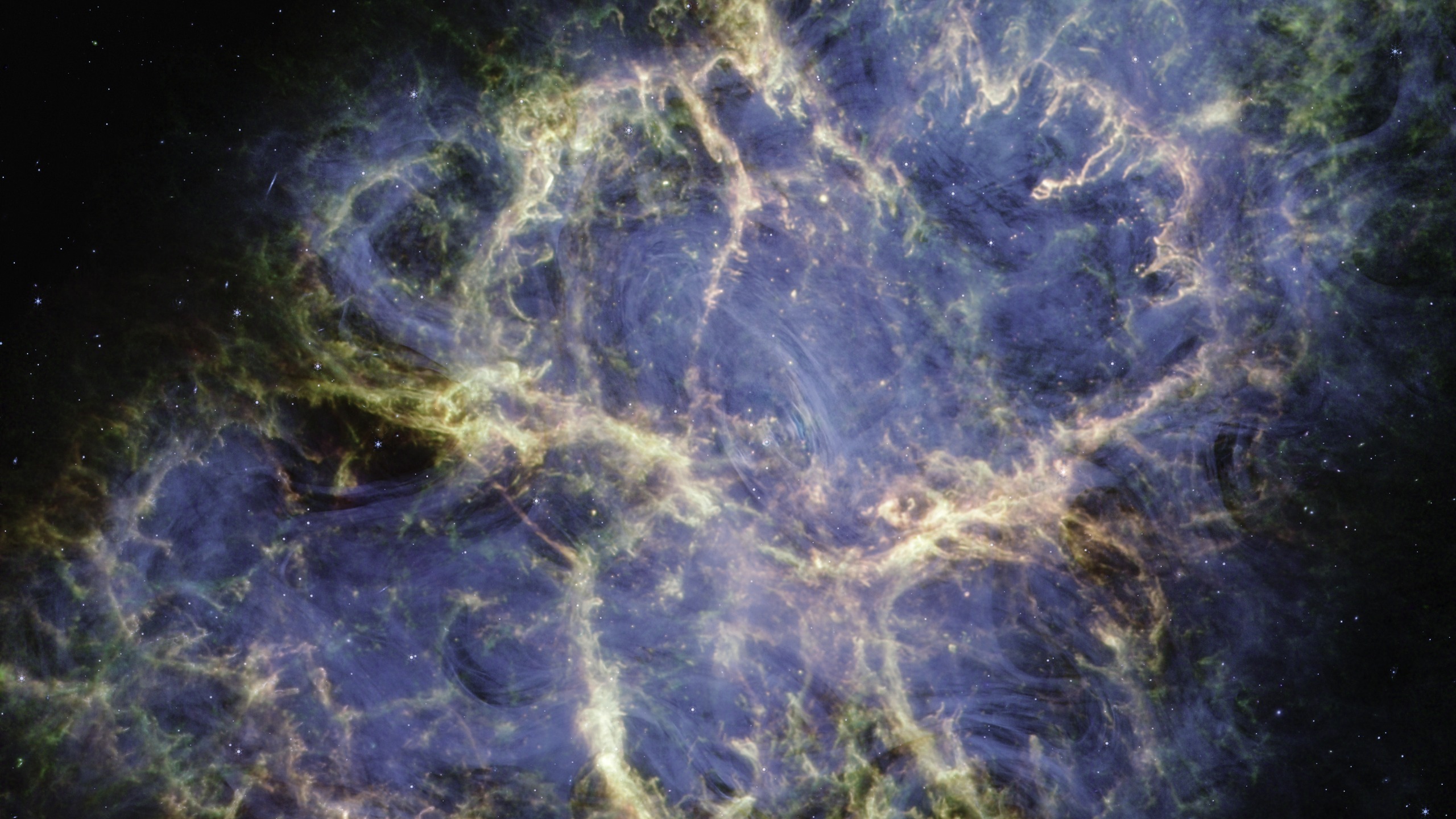
NASA’s James Webb Space Telescope dissected the Crab Nebula’s structure, aiding astronomers as they continue to evaluate leading theories about the supernova remnant’s origins. With the data collected by Webb’s NIRCam (Near-Infrared Camera) and MIRI (Mid-Infrared Instrument), a team of scientists were able to closely inspect some of the Crab Nebula’s major components. For the first time ever, astronomers mapped the warm dust emission throughout this supernova remnant. Represented as fluffy magenta material, the dust grains form a cage-like structure that is most apparent toward the lower left and upper right portions of the remnant. Filaments of dust are also threaded throughout the Crab’s interior and sometimes coincide with regions of doubly ionized sulfur (sulfur III) colored in green. Yellow-white mottled filaments, which form large loop-like structures around the supernova remnant’s center, represent areas where dust and doubly ionized sulfur overlap. The dust’s cage-like structure helps constrain some, but not all of the ghostly synchrotron emission represented in blue. The emission resembles wisps of smoke, most notable toward the Crab’s center. The thin blue ribbons follow the magnetic field lines created by the Crab’s pulsar heart — a rapidly rotating neutron star.
13.1k downloads
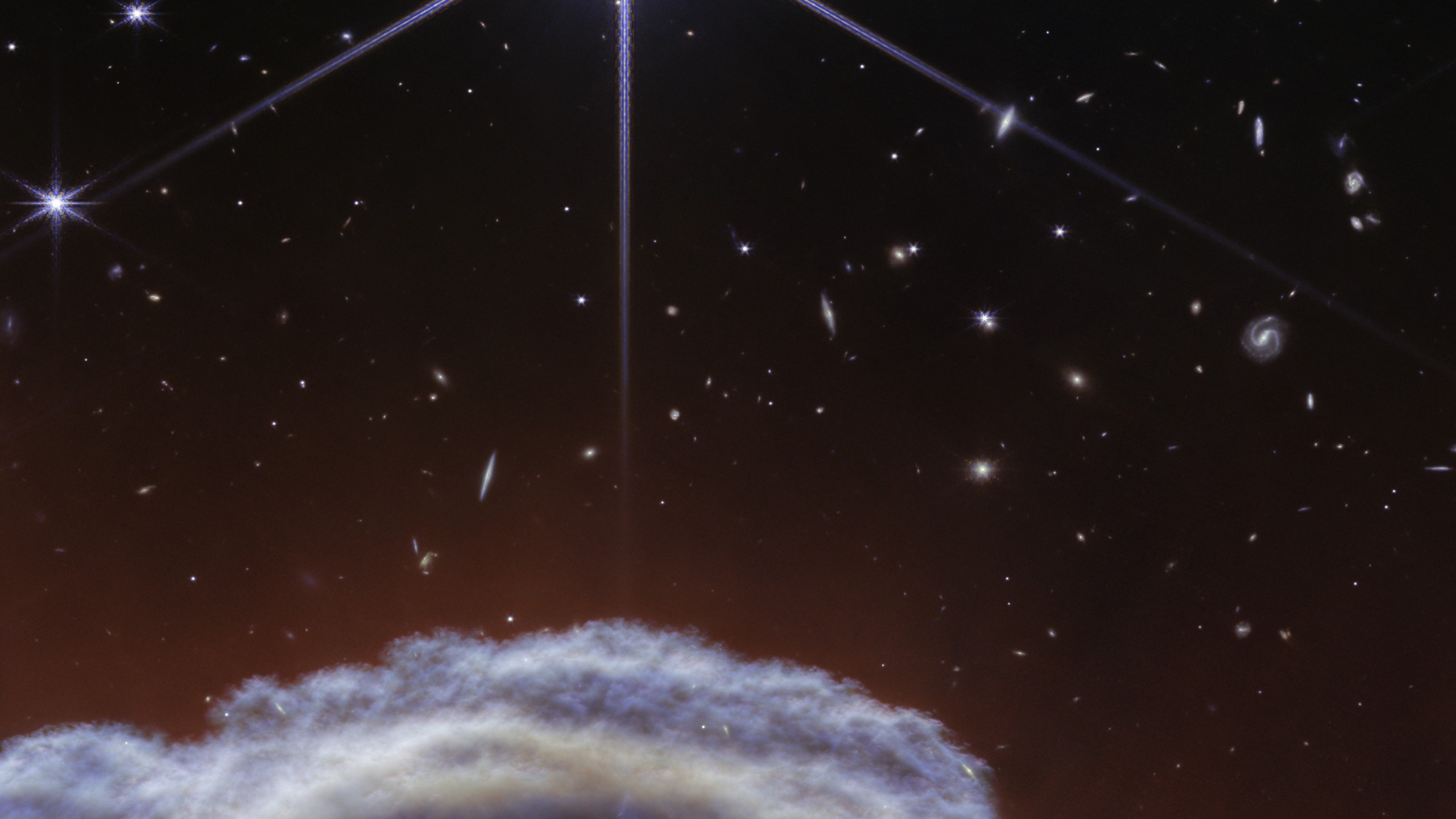
This image of the Horsehead Nebula from NASA’s James Webb Space Telescope focuses on a portion of the horse’s “mane” that is about 0.8 light-years in width. It was taken with Webb’s NIRCam (Near-infrared Camera). The ethereal clouds that appear blue at the bottom of the image are filled with a variety of materials including hydrogen, methane, and water ice. Red-colored wisps extending above the main nebula represent both atomic and molecular hydrogen. In this area, known as a photodissociation region, ultraviolet light from nearby young, massive stars creates a mostly neutral, warm area of gas and dust between the fully ionized gas above and the nebula below. As with many Webb images, distant galaxies are sprinkled in the background. This image is composed of light at wavelengths of 1.4 and 2.5 microns (represented in blue), 3.0 and 3.23 microns (cyan), 3.35 microns (green), 4.3 microns (yellow), and 4.7 and 4.05 microns (red).
24.2k downloads
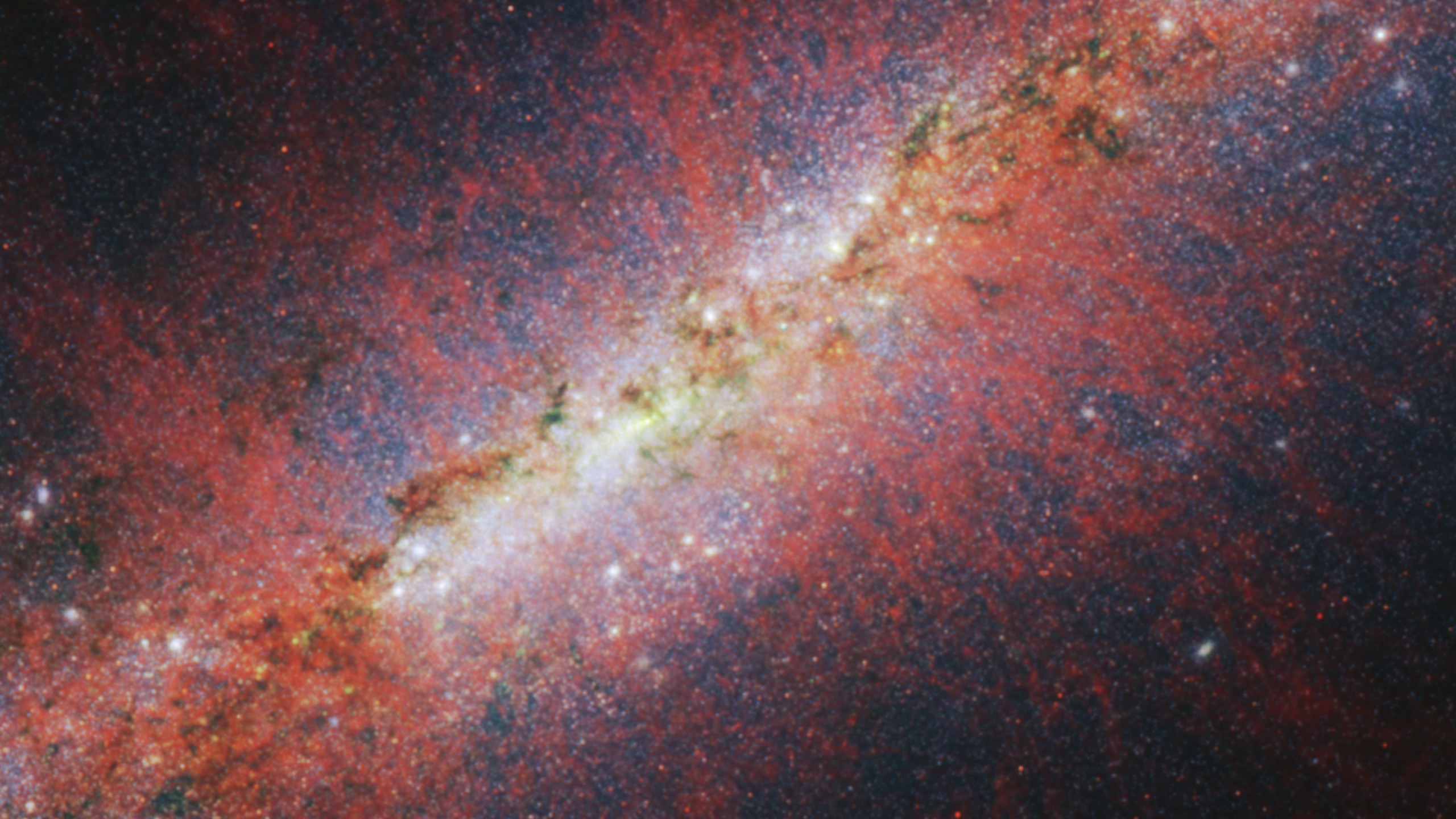
Astronomers used the James Webb Space Telescope to look toward M82’s center, where a galactic wind is being launched as a result of rapid star formation and subsequent supernovas. Studying the galactic wind can offer insight into how the loss of gas shapes the future growth of the galaxy. This image from Webb’s NIRCam (Near-Infrared Camera) instrument shows M82’s galactic wind via emission from sooty chemical molecules known as polycyclic aromatic hydrocarbons (PAHs). PAHs are very small dust grains that survive in cooler temperatures but are destroyed in hot conditions. The structure of the emission resembles that of hot, ionized gas, suggesting PAHs may be replenished by continued ionization of molecular gas. In this image, light at 3.35 microns is colored red, 2.50 microns is green, and 1.64 microns is blue (filters F335M, F250M, and F164N, respectively).
23.3k downloads
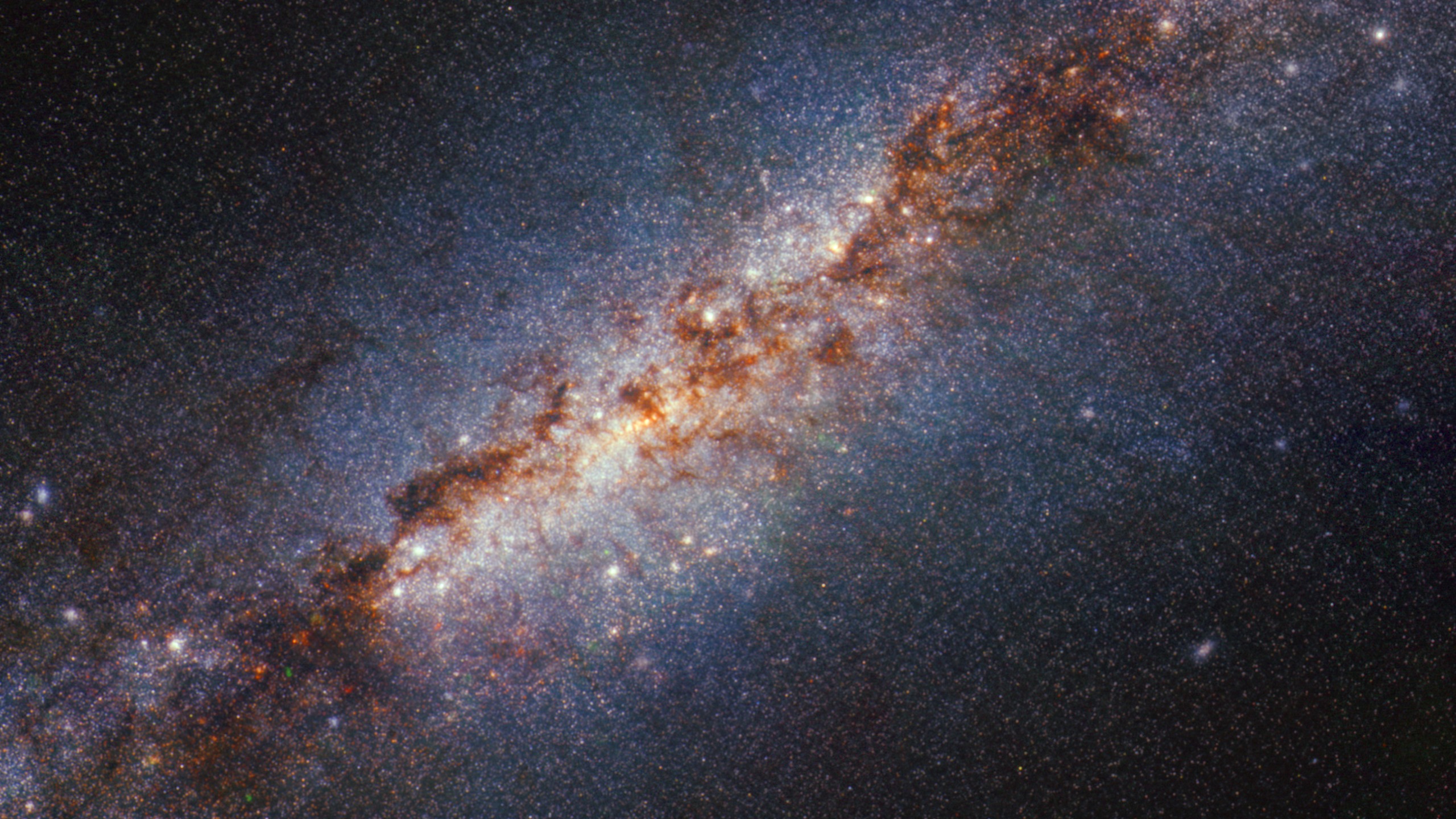
A team of astronomers used NASA’s James Webb Space Telescope to survey the starburst galaxy Messier 82 (M82), which is located 12 million light-years away in the constellation Ursa Major. M82 hosts a frenzy of star formation, sprouting new stars 10 times faster than the Milky Way galaxy. Webb’s infrared capabilities enabled scientists to peer through curtains of dust and gas that have historically obscured the star formation process. This image from Webb’s NIRCam (Near-Infrared Camera) instrument shows M82’s center in an unprecedented level of detail. With Webb’s resolution, astronomers can distinguish small, bright compact sources that are either individual stars or star clusters. Obtaining an accurate count of the stars and clusters that compose M82’s center can help astronomers understand the different phases of star formation and the timelines for each stage. In this image, light at 2.12 microns is colored red, 1.64 microns is green, and 1.40 microns is blue (filters F212N, 164N, and F140M, respectively).
34.5k downloads
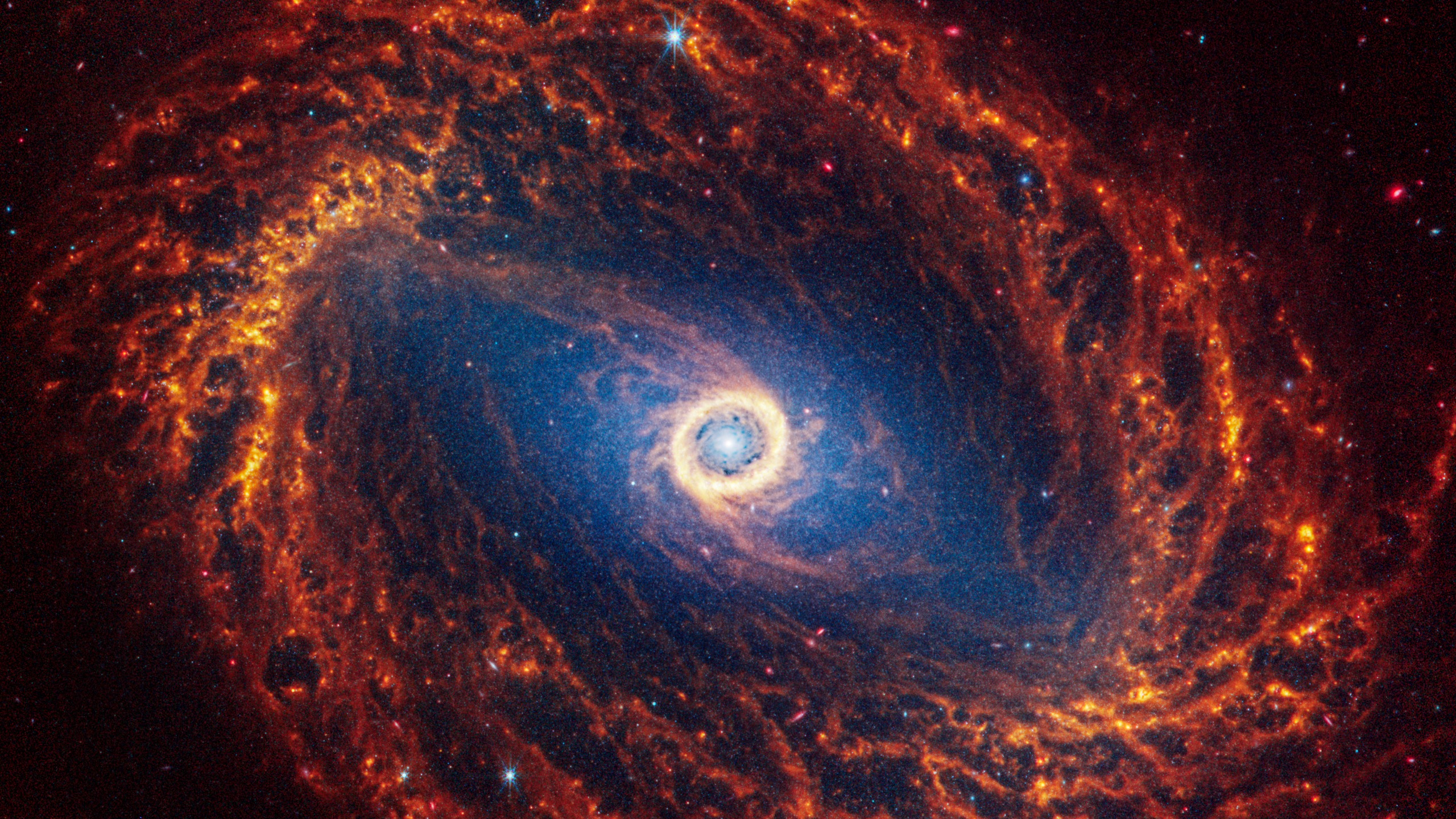
Face-on barred spiral galaxy, NGC 1512, is split diagonally in this image: The James Webb Space Telescope’s observations appear at top left, and the Hubble Space Telescope’s on bottom right. Webb and Hubble’s images show a striking contrast, an inverse of darkness and light. Why? Webb’s observations combine near- and mid-infrared light and Hubble’s showcase visible and ultraviolet light. Dust absorbs ultraviolet and visible light, and then re-emits it in the infrared. In Webb's images, we see dust glowing in infrared light. In Hubble’s images, dark regions are where starlight is absorbed by dust. The individual Webb and Hubble images are available for download using the links on the left side of this page. Background galaxies Webb’s image includes distant galaxies that are located well behind the tightly cropped foreground galaxy. Look for bright blue and pink disks, some seen edge-on, like a plate with a central sphere. Redder galaxies are more distant. In Hubble’s view, distant galaxies are often light orange if they are slightly closer. Like in Webb's image, those that are deeper red are also more distant. Galaxy NGC 1512 was observed as part of the Physics at High Angular resolution in Nearby GalaxieS (PHANGS) program, a large project that includes observations from several space- and ground-based telescopes of many galaxies to help researchers study all phases of the star formation cycle, from the formation of stars within dusty gas clouds to the energy released in the process that creates the intricate structures revealed by Webb’s new images. NGC 1512 is 30 million light-years away in the constellation Horologium. Extended Description and Image Alt Text
23.9k downloads
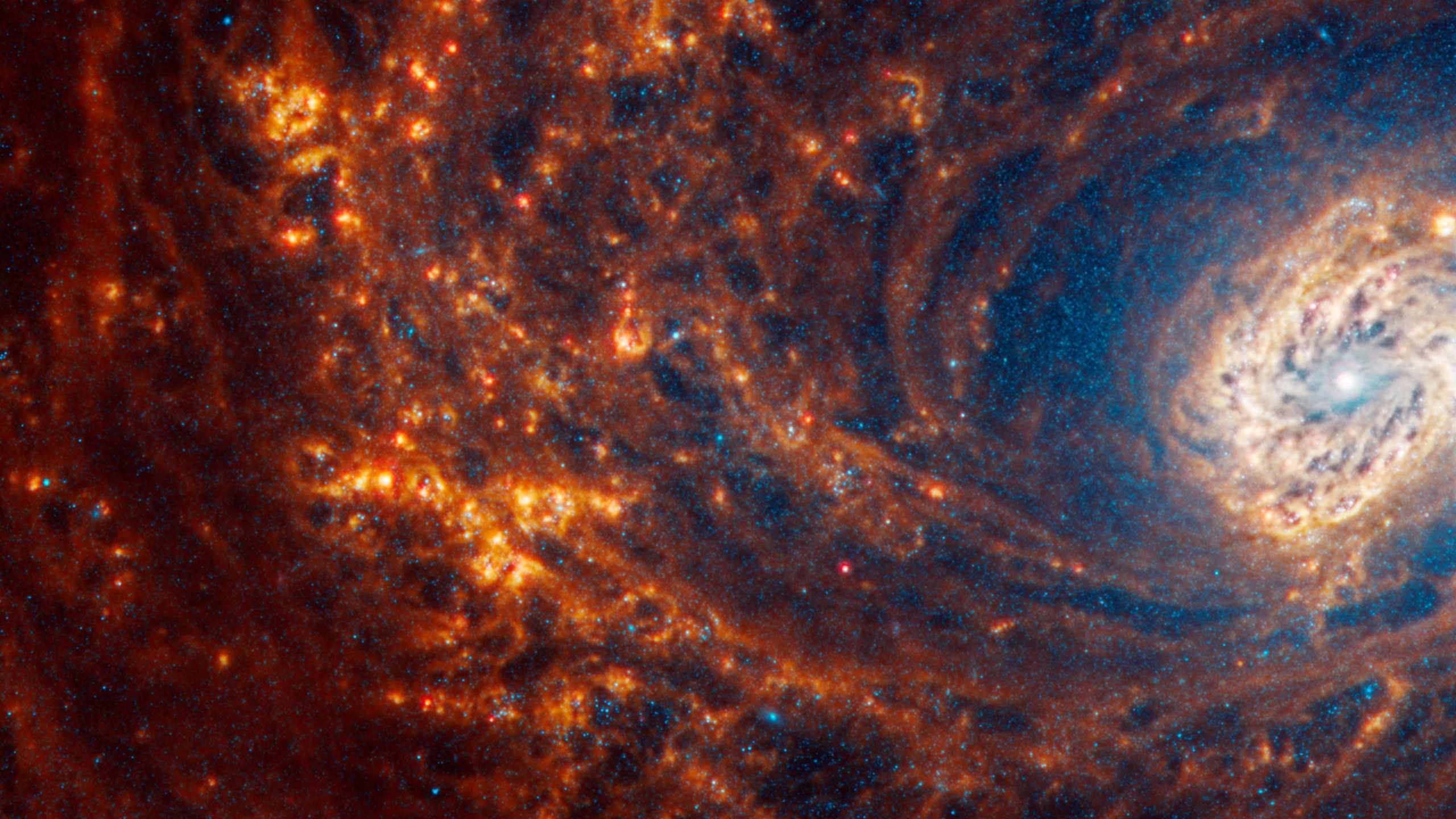
Face-on spiral galaxy, NGC 4321, is split diagonally in this image: The James Webb Space Telescope’s observations appear at bottom left, and the Hubble Space Telescope’s on top right. Webb and Hubble’s images show a striking contrast, an inverse of darkness and light. Why? Webb’s observations combine near- and mid-infrared light and Hubble’s showcase visible light. Dust absorbs ultraviolet and visible light, and then re-emits it in the infrared. In Webb's images, we see dust glowing in infrared light. In Hubble’s images, dark regions are where starlight is absorbed by dust. Background Galaxies Webb’s image includes distant galaxies that are located well behind the tightly cropped foreground galaxy. Look for bright blue and pink disks, some seen edge-on, like a plate with a central sphere. Redder galaxies are more distant. In Hubble’s view, distant galaxies are often light orange if they are slightly closer. Like in Webb's image, those that are deeper red are also more distant. Galaxy NGC 4321 was observed as part of the Physics at High Angular resolution in Nearby GalaxieS (PHANGS) program, a large project that includes observations from several space- and ground-based telescopes of many galaxies to help researchers study all phases of the star formation cycle, from the formation of stars within dusty gas clouds to the energy released in the process that creates the intricate structures revealed by Webb’s new images. NGC 4321 is 55 million light-years away in the constellation Coma Berenices. Extended Description and Image Alt Text
27.4k downloads
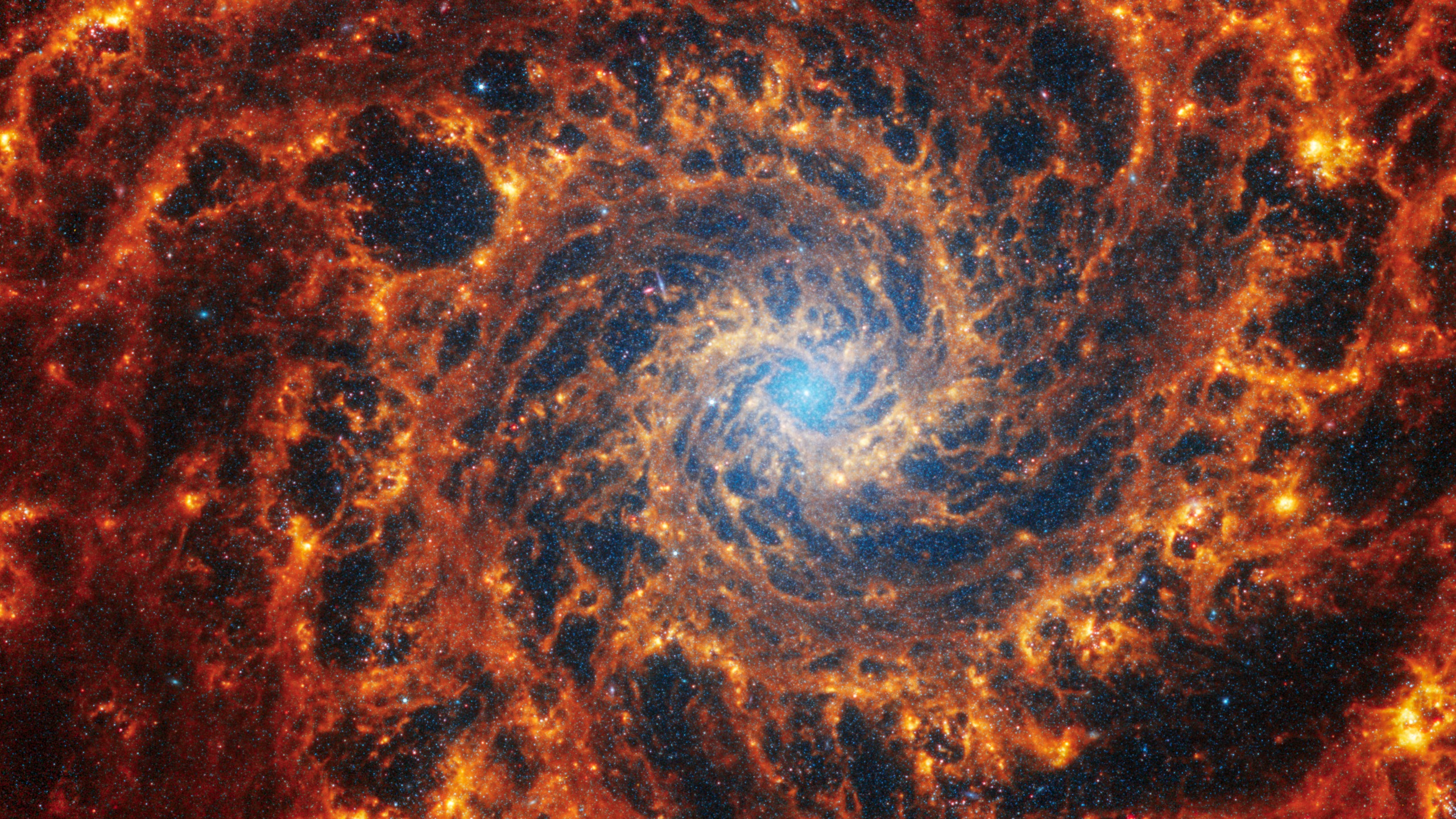
Face-on spiral galaxy, NGC 628, is split diagonally in this image: The James Webb Space Telescope’s observations appear at top left, and the Hubble Space Telescope’s on bottom right. Webb and Hubble’s images show a striking contrast, an inverse of darkness and light. Why? Webb’s observations combine near- and mid-infrared light and Hubble’s showcase visible light. Dust absorbs ultraviolet and visible light, and then re-emits it in the infrared. In Webb's images, we see dust glowing in infrared light. In Hubble’s images, dark regions are where starlight is absorbed by dust. Webb’s image includes distant galaxies that are located well behind the tightly cropped foreground galaxy. Look for bright blue and pink disks, some seen edge-on, like a plate with a central sphere. Redder galaxies are more distant. In Hubble’s view, distant galaxies are often light orange if they are slightly closer. Like in Webb's image, those that are deeper red are also more distant. Galaxy NGC 628 was observed as part of the Physics at High Angular resolution in Nearby GalaxieS (PHANGS) program, a large project that includes observations from several space- and ground-based telescopes of many galaxies to help researchers study all phases of the star formation cycle, from the formation of stars within dusty gas clouds to the energy released in the process that creates the intricate structures revealed by Webb’s new images. NGC 628 is 32 million light-years away in the constellation Pisces. Extended Description and Image Alt Text
21.8k downloads
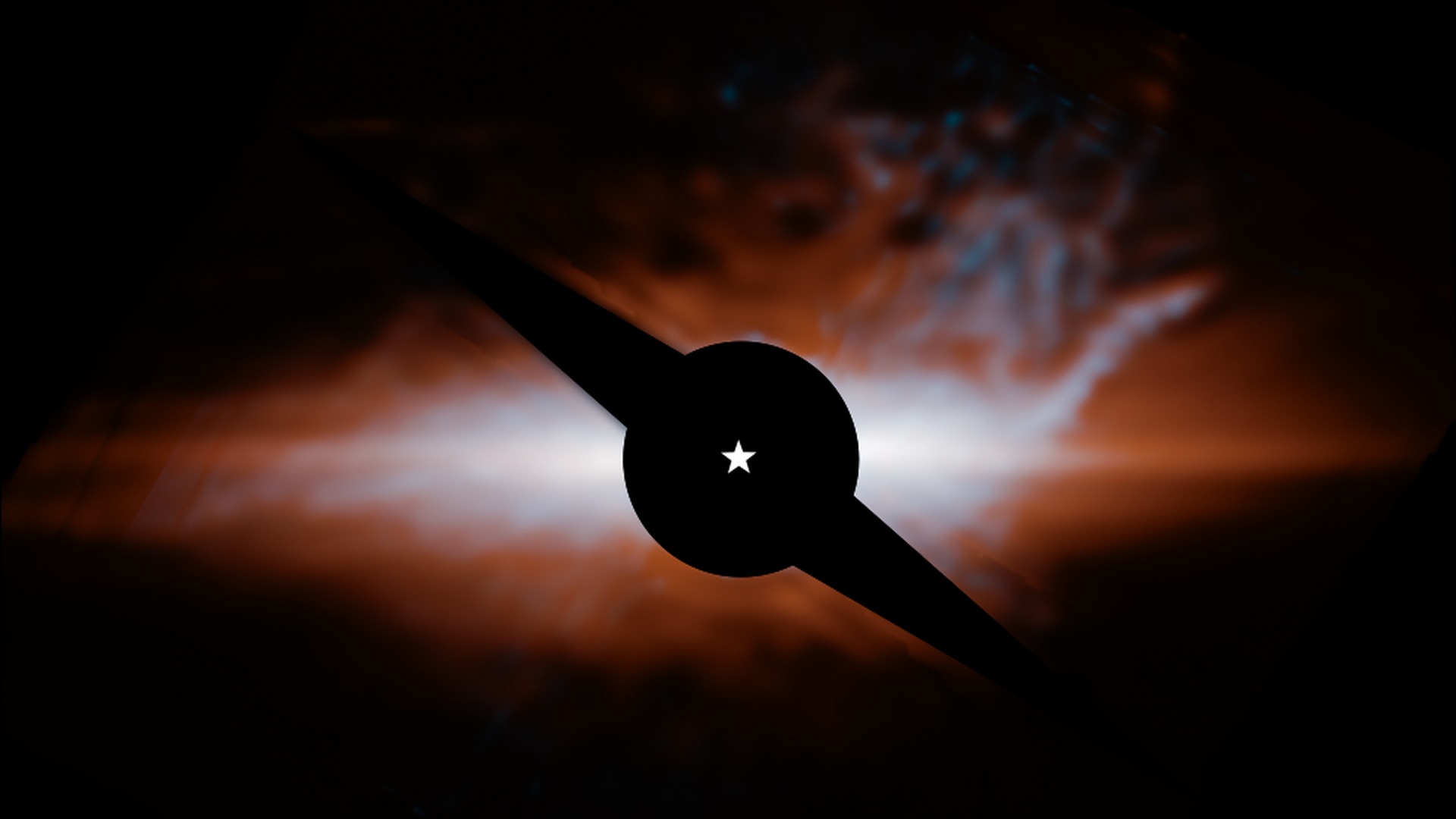
The dark circle and two smaller disks at the center of this image are a coronagraph, deliberately blocking the light of Beta Pictoris' central star (its actual position is marked with a small white star shape) so the much fainter dust disks surrounding it become visible. NASA's James Webb Space Telescope used this technique to image star system Beta Pictoris in detail. Webb's MIRI (Mid-Infrared Instrument) enabled a team of astronomers to investigate the composition of Beta Pic's main and secondary debris disks, the latter a feature previously detected by the Hubble Space Telescope. Unexpectedly, Webb's infrared capabilities detected a new feature of the Beta Pic system: a curvy branch of dust that resembles the shape of a cat's tail. This tail, only noticeable in the MIRI data, extends from the southwest portion of the secondary debris disk and is estimated to span 10 billion miles. The dust that forms the tail may be similar to the matter found on the surfaces of comets and asteroids in our solar system. The team believes a dust production event, such as a collision between asteroids, comets, or planetesimals, is responsible. In this image, light at 15.5 microns is colored cyan and 23 microns is orange (filters F1550C and F2300C).
10.8k downloads
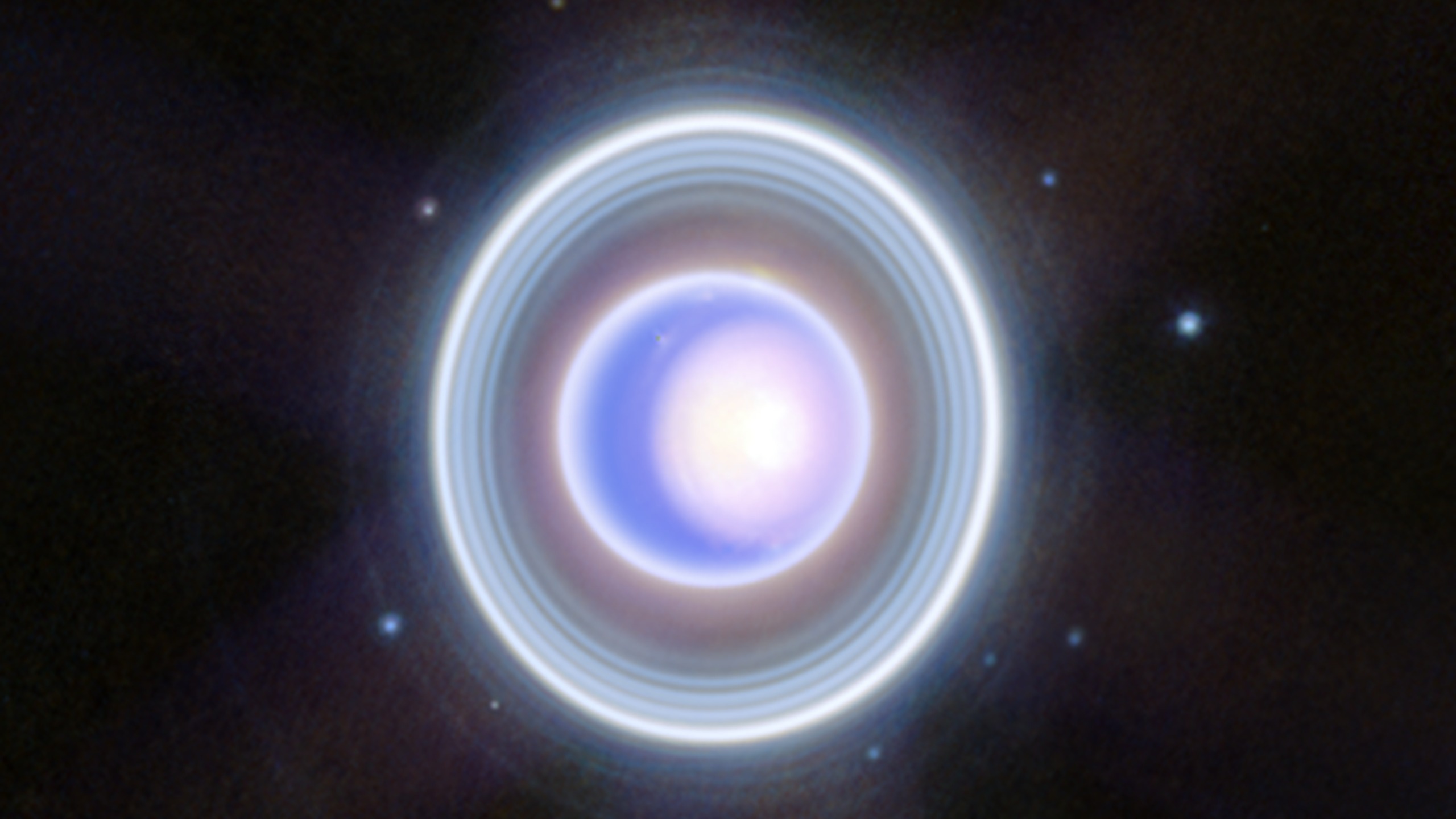
This image of Uranus from NIRCam (Near-Infrared Camera) on NASA's James Webb Space Telescope shows the planet and its rings in new clarity. The Webb image exquisitely captures Uranus's seasonal north polar cap, including the bright, white, inner cap and the dark lane in the bottom of the polar cap. Uranus' dim inner and outer rings are also visible in this image, including the elusive Zeta ring, the extremely faint and diffuse ring closest to the planet. Nine of the planet's 27 known moons are also visible around the rings: Rosalind, Puck, Belinda, Desdemona, Cressida, Bianca, Portia, Juliet, and Perdita.
8.8k downloads
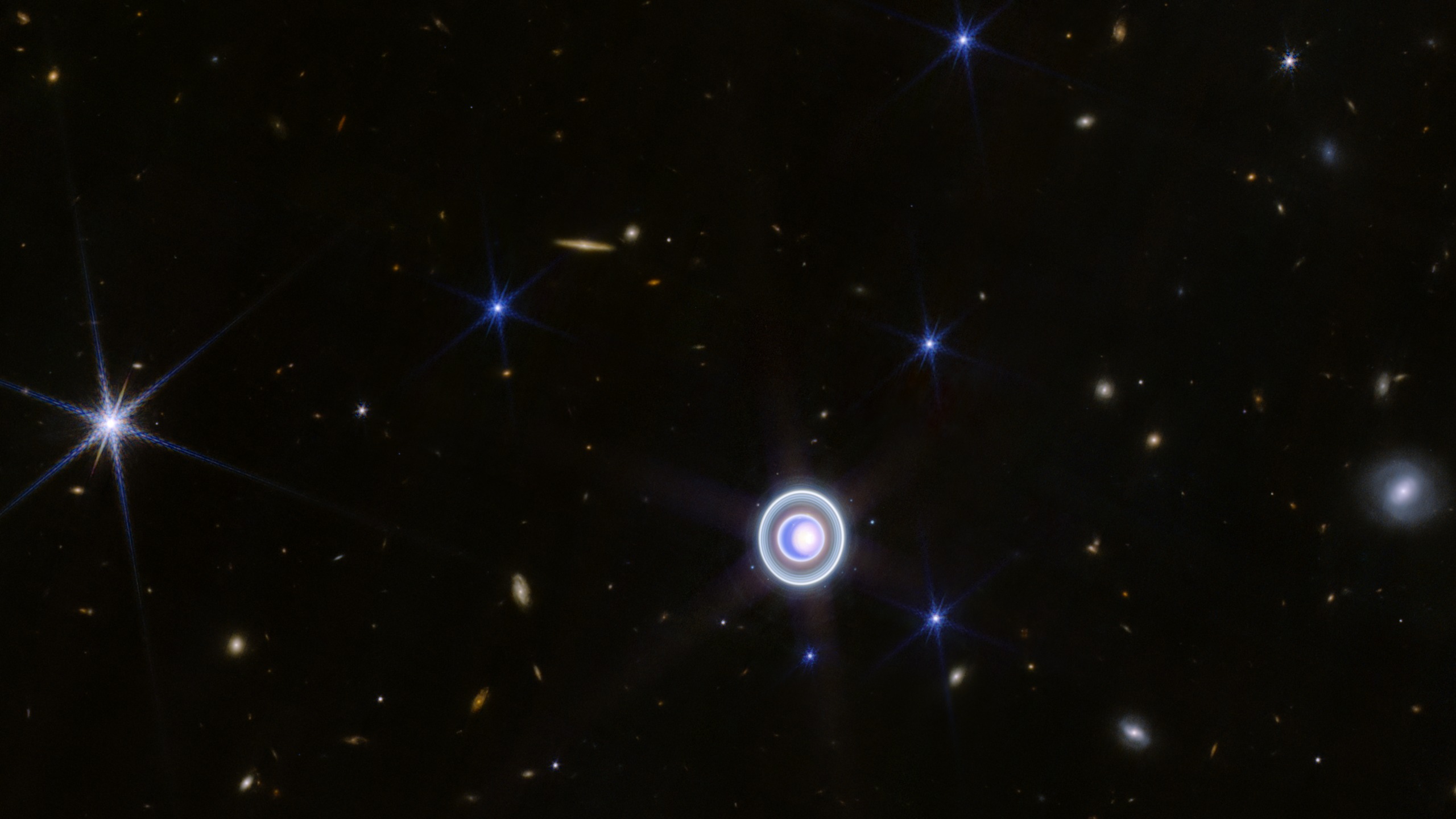
This image of Uranus from NIRCam (Near-Infrared Camera) on NASA's James Webb Space Telescope shows the planet and its rings in new clarity. The planet's seasonal north polar cap gleams in a bright white, and Webb's exquisite sensitivity resolves Uranus' dim inner and outer rings, including the Zeta ring—the extremely faint and diffuse ring closest to the planet. This Webb image also shows 14 of the planet's 27 moons: Oberon, Titania, Umbriel, Juliet, Perdita, Rosalind, Puck, Belinda, Desdemona, Cressida, Ariel, Miranda, Bianca, and Portia. One day on Uranus is about 17 hours, so the planet's rotation is relatively quick. This makes it supremely difficult for observatories with a sharp eye like Webb to capture one simple image of the entire planet – storms and other atmospheric features, and the planet's moons, move visibly within minutes. This image combines several longer and shorter exposures of this dynamic system to correct for those slight changes throughout the observing time. Webb's extreme sensitivity also picks up a smattering of background galaxies—most appear as orange smudges, and there are two larger, fuzzy white galaxies to the right of the planet in this field of view.
17k downloads
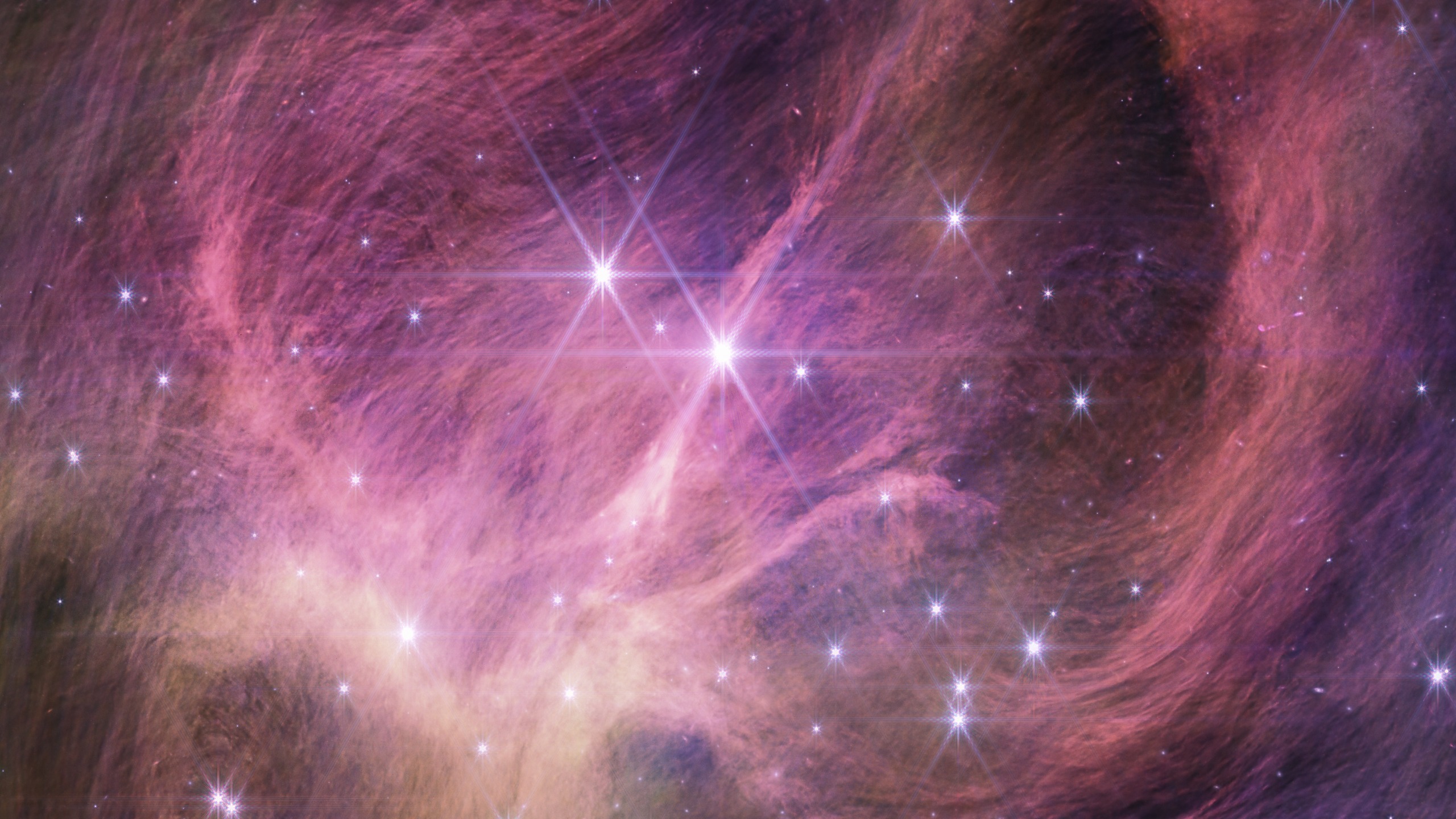
This image from the NIRCam (Near-Infrared Camera) instrument on NASA’s James Webb Space Telescope shows the central portion of the star cluster IC 348. Astronomers combed the cluster in search of tiny, free-floating brown dwarfs: objects too small to be stars but larger than most planets. They found three brown dwarfs that are less than eight times the mass of Jupiter. The smallest weighs just three to four times Jupiter, challenging theories for star formation. The wispy curtains filling the image are interstellar material reflecting the light from the cluster’s stars – what is known as a reflection nebula. The material also includes carbon-containing molecules known as polycyclic aromatic hydrocarbons, or PAHs. The bright star closest to the center of the frame is actually a pair of type B stars in a binary system, which are the most massive stars in the cluster. Winds from these stars may help sculpt the large loop seen on the right side of the field of view.
37.5k downloads
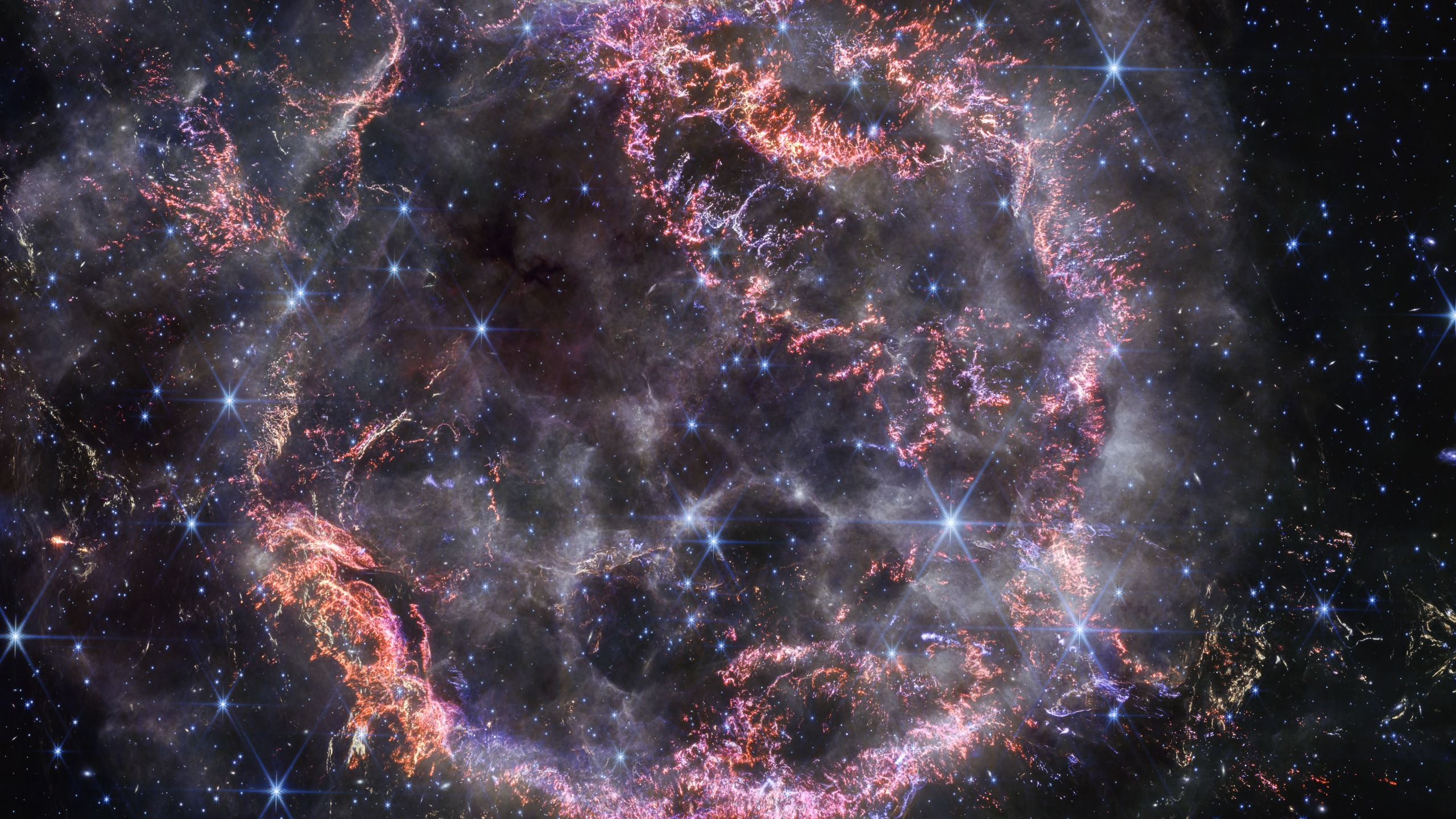
A new high-definition image from NASA’s James Webb Space Telescope’s NIRCam (Near-Infrared Camera) unveils intricate details of supernova remnant Cassiopeia A (Cas A), and shows the expanding shell of material slamming into the gas shed by the star before it exploded. The most noticeable colors in Webb’s newest image are clumps of bright orange and light pink that make up the inner shell of the supernova remnant. These tiny knots of gas, comprised of sulfur, oxygen, argon, and neon from the star itself, are only detectable by NIRCam’s exquisite resolution, and give researchers a hint at how the dying star shattered like glass when it exploded. The outskirts of the main inner shell looks like smoke from a campfire. This marks where ejected material from the exploded star is ramming into surrounding circumstellar material. Researchers say this white color is light from synchrotron radiation, which is generated by charged particles traveling at extremely high speeds spiraling around magnetic field lines. There are also several light echoes visible in this image, most notably in the bottom right corner. This is where light from the star’s long-ago explosion has reached, and is warming distant dust, which is glowing as it cools down.
31.3k downloads
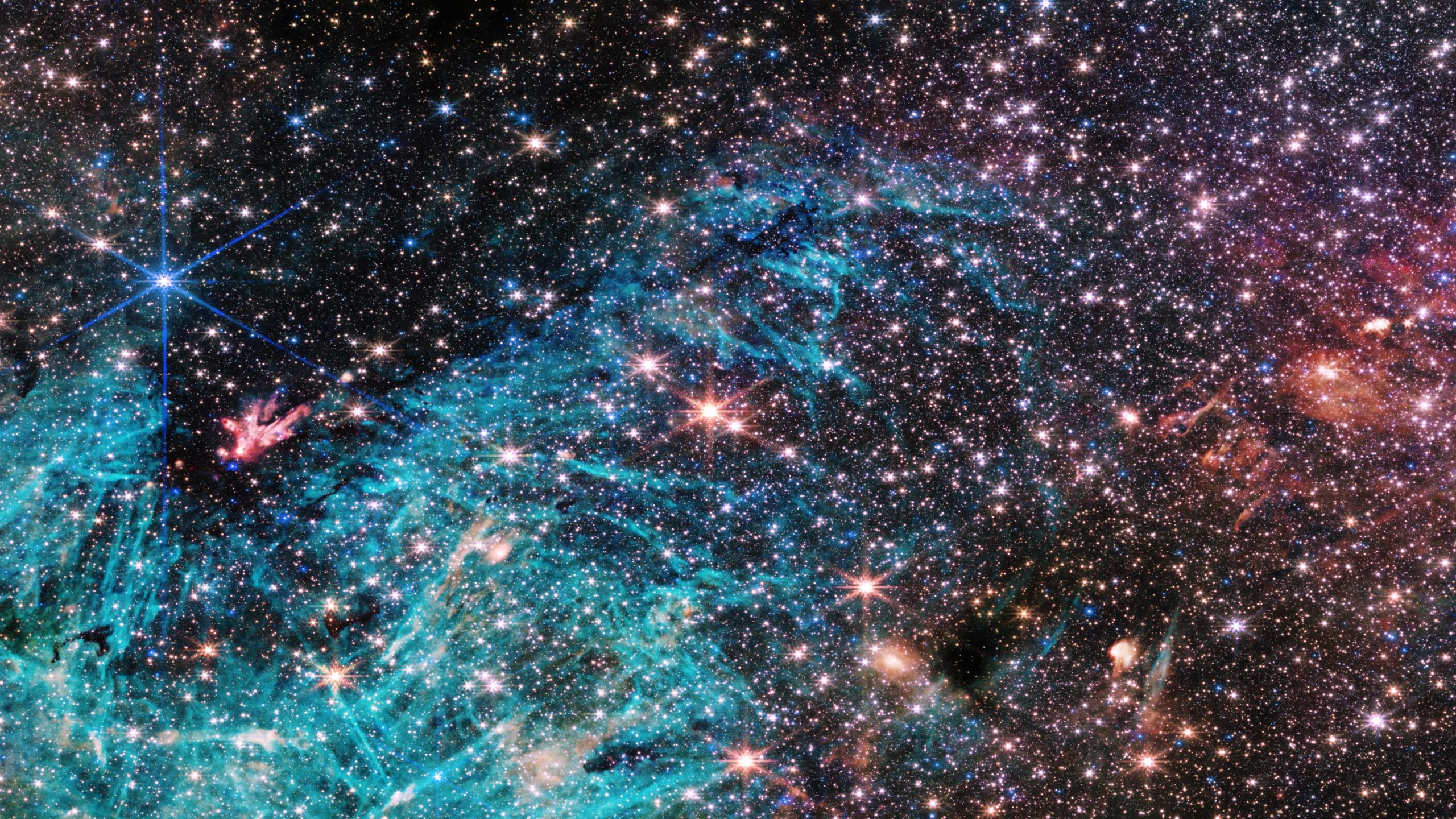
The full view of the James Webb Space Telescope’s NIRCam (Near-Infrared Camera) instrument reveals a 50 light-years-wide portion of the Milky Way’s dense center. An estimated 500,000 stars shine in this image of the Sagittarius C (Sgr C) region, along with some as-yet unidentified features. A vast region of ionized hydrogen, shown in cyan, wraps around an infrared-dark cloud, which is so dense that it blocks the light from distant stars behind it. Intriguing needle-like structures in the ionized hydrogen emission lack any uniform orientation. Researchers note the surprising extent of the ionized region, covering about 25 light-years. A cluster of protostars – stars that are still forming and gaining mass – are producing outflows that glow like a bonfire at the base of the large infrared-dark cloud, indicating that they are emerging from the cloud’s protective cocoon and will soon join the ranks of the more mature stars around them. Smaller infrared-dark clouds dot the scene, appearing like holes in the starfield. Researchers say they have only begun to dig into the wealth of unprecedented high-resolution data that Webb has provided on this region, and many features bear detailed study. This includes the rose-colored clouds on the right side of the image, which have never been seen in such detail.
25.5k downloads
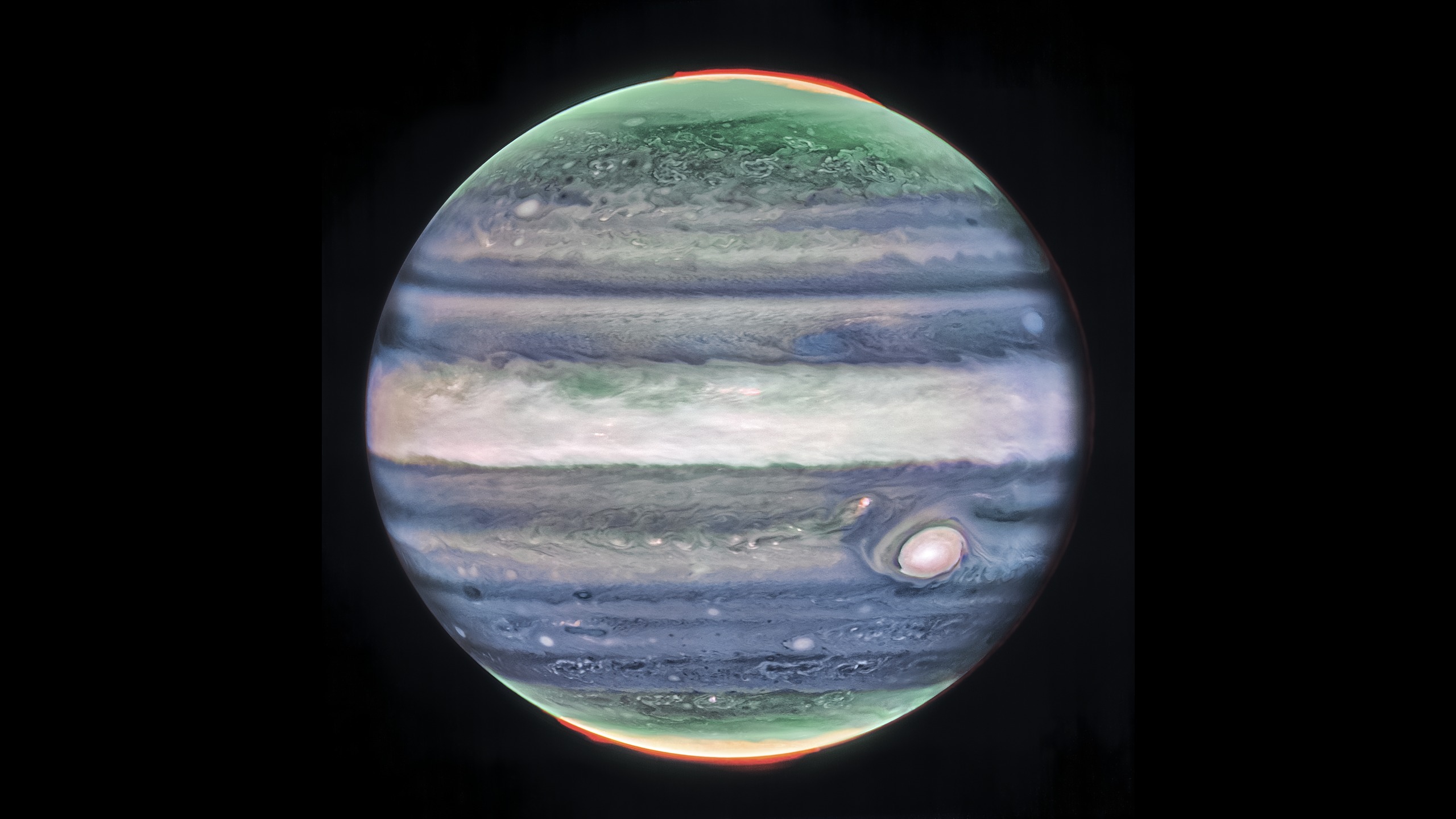
This image of Jupiter from NASA's James Webb Space Telescope's NIRCam (Near-Infrared Camera) shows stunning details of the majestic planet in infrared light. In this image, brightness indicates high altitude. The numerous bright white "spots" and "streaks" are likely very high-altitude cloud tops of condensed convective storms. Auroras, appearing in red in this image, extend to higher altitudes above both the northern and southern poles of the planet. By contrast, dark ribbons north of the equatorial region have little cloud cover. In Webb's images of Jupiter from July 2022, researchers recently discovered a narrow jet stream traveling 320 miles per hour (515 kilometers per hour) sitting over Jupiter's equator above the main cloud decks.
2.3k downloads
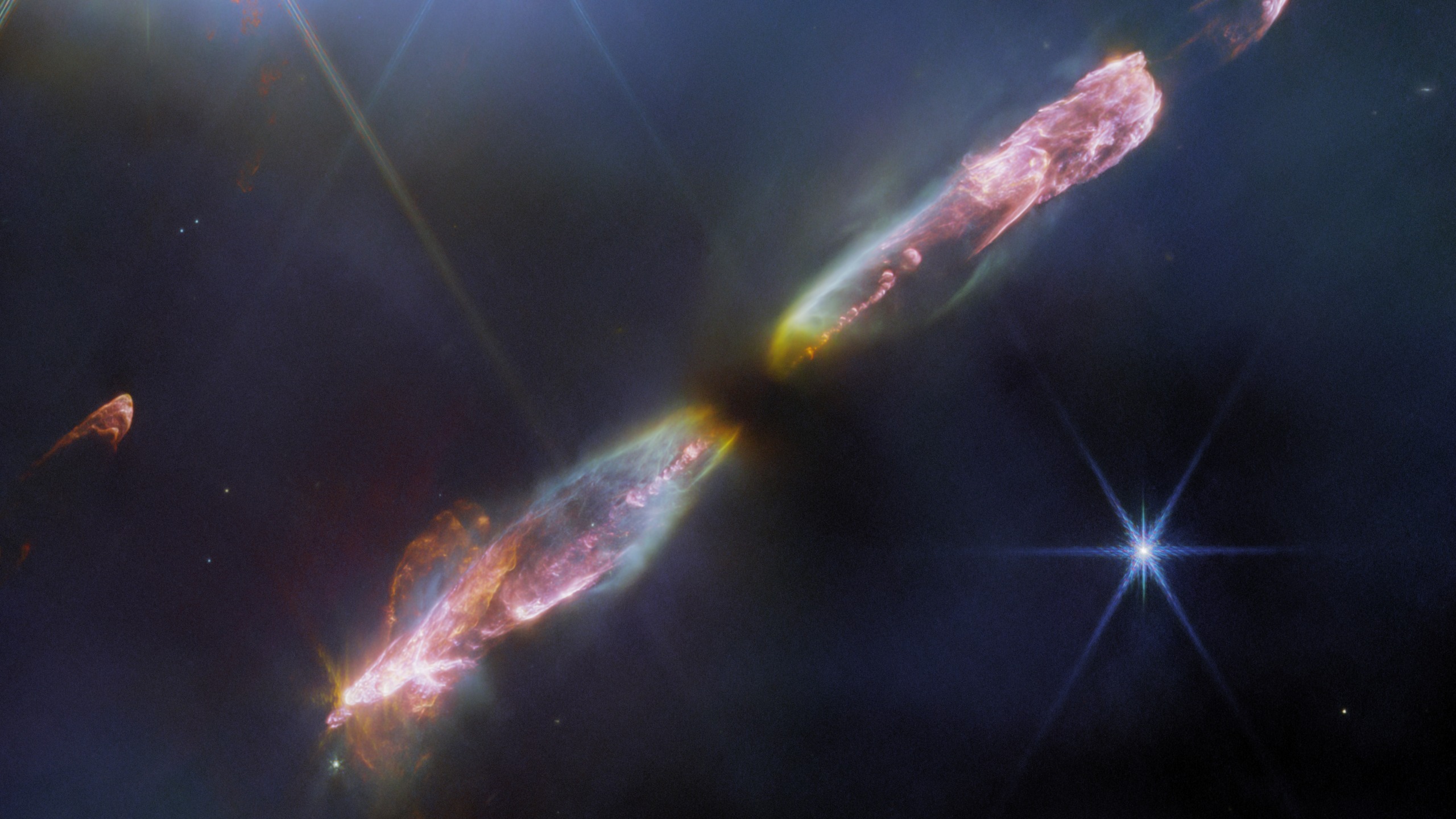
NASA’s James Webb Space Telescope’s high resolution, near-infrared look at Herbig-Haro 211 reveals exquisite detail of the outflow of a young star, an infantile analogue of our Sun. Herbig-Haro objects are formed when stellar winds or jets of gas spewing from newborn stars form shock waves colliding with nearby gas and dust at high speeds The image showcases a series of bow shocks to the southeast (lower-left) and northwest (upper-right) as well as the narrow bipolar jet that powers them in unprecedented detail. Molecules excited by the turbulent conditions, including molecular hydrogen, carbon monoxide and silicon monoxide, emit infrared light, collected by Webb, that map out the structure of the outflows.
6.9k downloads
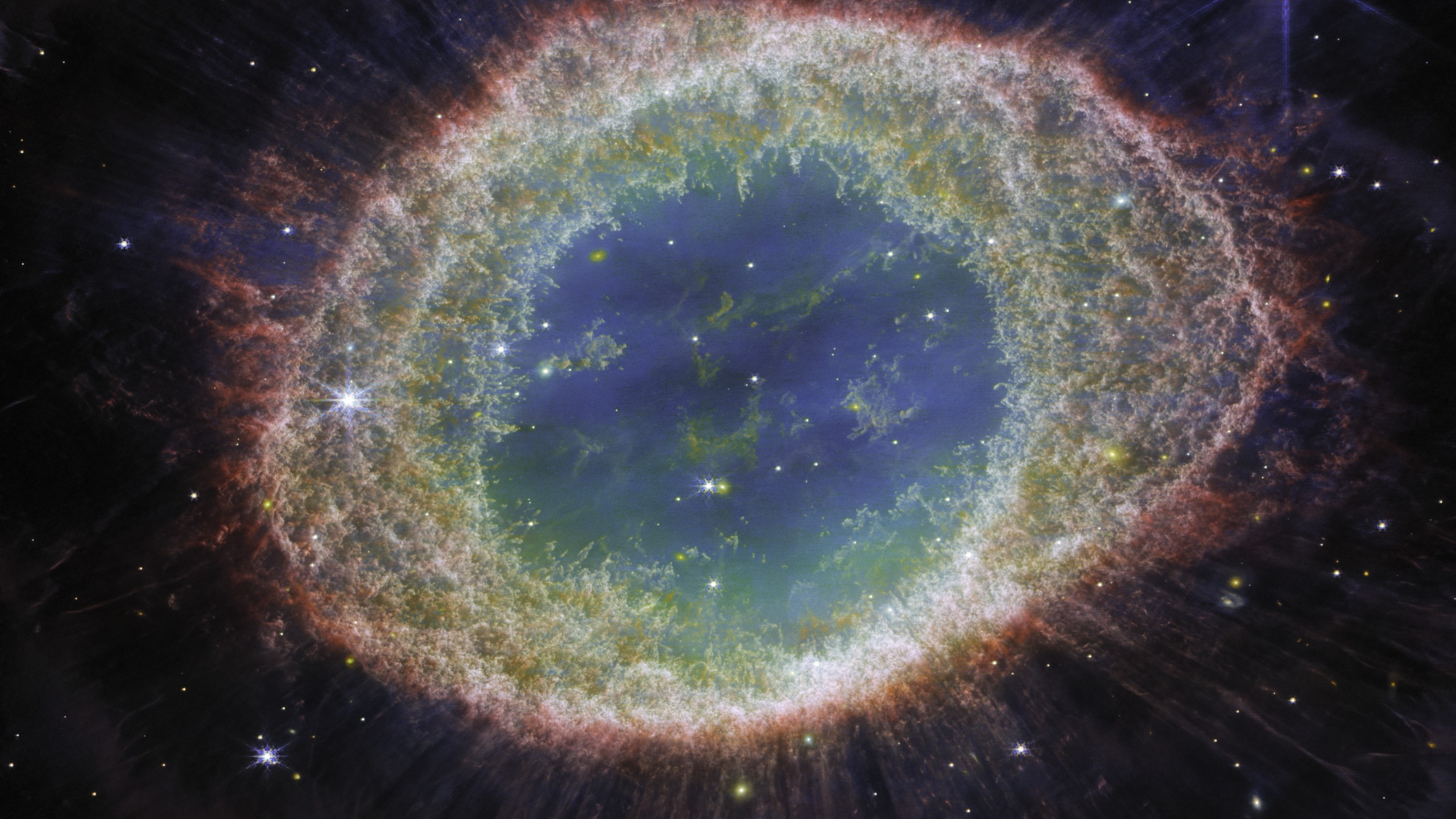
NASA’s James Webb Space Telescope has observed the well-known Ring Nebula in unprecedented detail. Formed by a star throwing off its outer layers as it runs out of fuel, the Ring Nebula is an archetypal planetary nebula. Also known as M57 and NGC 6720, it is relatively close to Earth at roughly 2,500 light-years away. This new image from Webb’s NIRCam (Near-Infrared Camera) provides unprecedented spatial resolution and spectral sensitivity. For example, the intricate details of the filament structure of the inner ring are particularly visible in this dataset. There are some 20,000 dense globules in the nebula, which are rich in molecular hydrogen. In contrast, the inner region shows very hot gas. The main shell contains a thin ring of enhanced emission from carbon-based molecules known as polycyclic aromatic hydrocarbons (PAHs). Roughly ten concentric arcs are located just beyond the outer edge of the main ring. The arcs are thought to originate from the interaction of the central star with a low-mass companion orbiting at a distance comparable to that between the Earth and Pluto. In this way, nebulae like the Ring Nebula reveal a kind of astronomical archaeology, as astronomers study the nebula to learn about the star that created it.
15.6k downloads
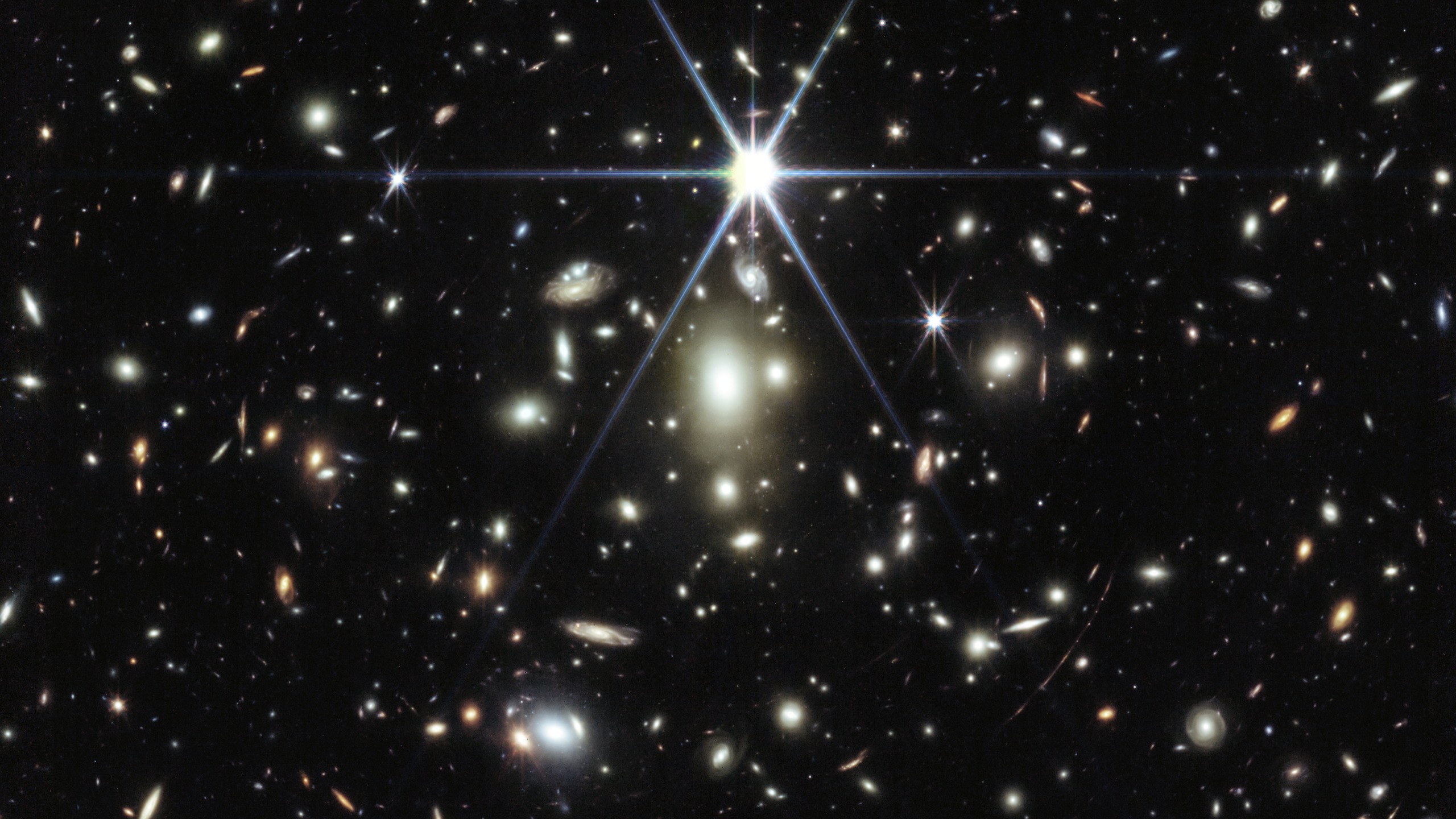
This image from NASA’s James Webb Space Telescope of a massive galaxy cluster called WHL0137-08 contains the most strongly magnified galaxy known in the universe’s first billion years: the Sunrise Arc, and within that galaxy, the most distant star ever detected. The star, nicknamed Earendel, was first discovered by the Hubble Space Telescope. Follow-up observations using Webb’s NIRCam (Near-Infrared Camera) reveals the star to be a massive B-type star more than twice as hot as our Sun, and about a million times more luminous. Earendel is positioned along a wrinkle in spacetime that gives it extreme magnification, allowing it to emerge into view from its host galaxy, which appears as a red smear across the sky. The star is detectable only due to the combined power of human technology and nature via an effect called gravitational lensing. In this image, the Sunrise Arc appears just below the diffraction spike at the 5 o’clock position. The fuzzier, white galaxies at the center of the image are part of the galaxy cluster bound together by gravity. The various redder, curved galaxies are background galaxies picked up by Webb’s sensitive mirror.
5.1k downloads
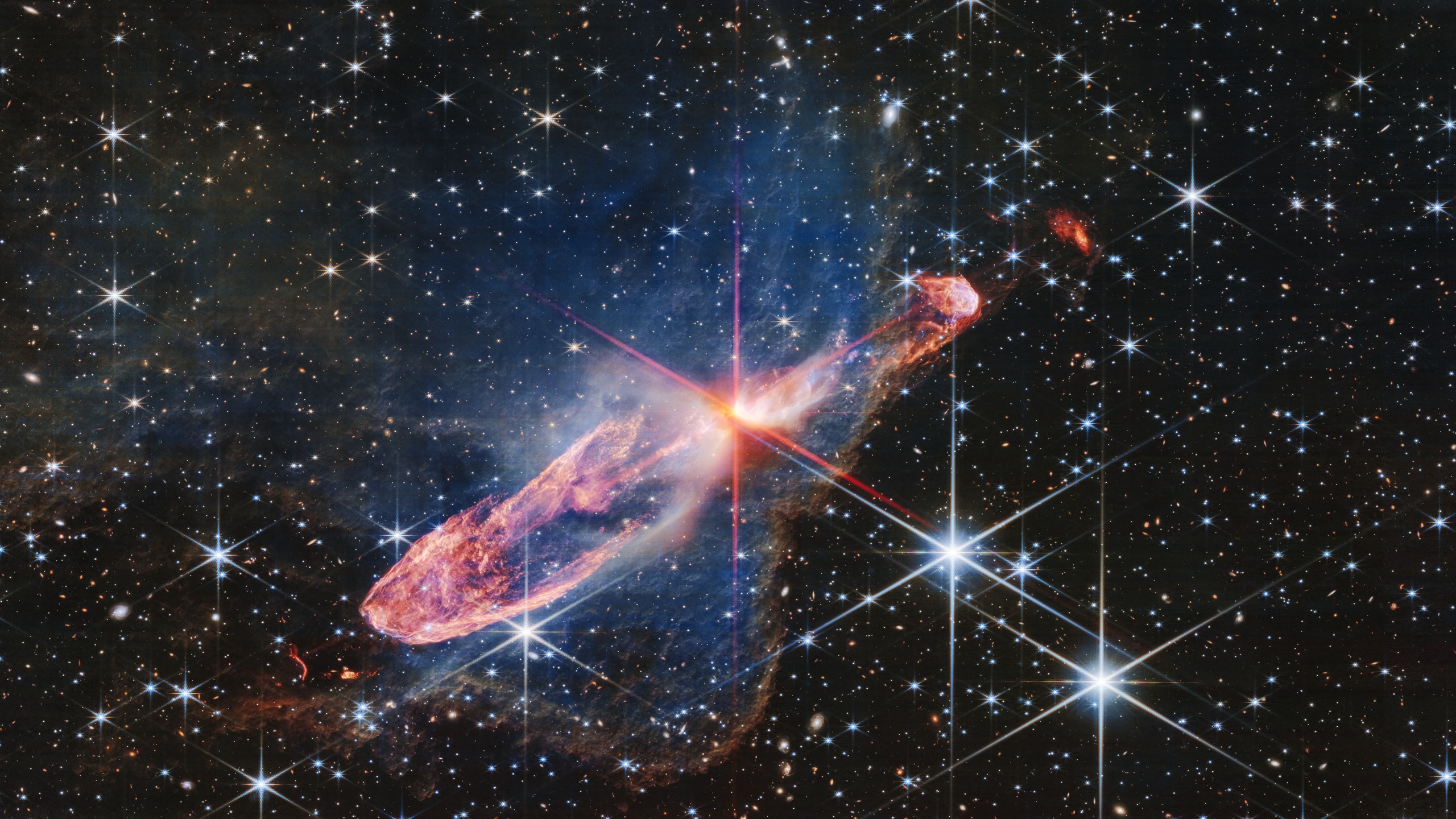
These stars have a lot of energy to let loose! NASA’s James Webb Space Telescope has captured a tightly bound pair of actively forming stars, known as Herbig-Haro 46/47, in high-resolution near-infrared light. Look for them at the center of the red diffraction spikes. The stars are buried deeply, appearing as an orange-white splotch. They are surrounded by a disk of gas and dust that continues to add to their mass. Herbig-Haro 46/47 is an important object to study because it is relatively young – only a few thousand years old. Stars take millions of years to fully form. Targets like this also give researchers insight into how stars gather mass over time, potentially allowing them to model how our own Sun, a low-mass star, formed. The two-sided orange lobes were created by earlier ejections from these stars. The stars’ more recent ejections appear in a thread-like blue, running along the angled diffraction spike that covers the orange lobes. Actively forming stars ingest the gas and dust that immediately surrounds them in a disk (imagine an edge-on circle encasing them). When the stars “eat” too much material in too short a time, they respond by sending out two-sided jets along the opposite axis, settling down the star’s spin, and removing mass from the area. Over millennia, these ejections regulate how much mass the stars retain. Don’t miss the delicate, semi-transparent blue cloud. This is a region of dense dust and gas, known as a nebula. Webb’s crisp near-infrared image lets us see through its gauzy layers, showing off a lot more of Herbig-Haro 46/47, while also revealing a deep range of stars and galaxies that lie far beyond it. The nebula’s edges transform into a soft orange outline, like a backward L along the right and bottom. The blue nebula influences the shapes of the orange jets shot out by the central stars. As ejected material rams into the nebula on the lower left, it takes on wider shapes, because there is more opportunity for the jets to interact with molecules within the nebula. Its material also causes the stars’ ejections to light up. Over millions of years, the stars in Herbig-Haro 46/47 will fully form – clearing the scene. Take a moment to linger on the background. A profusion of extremely distant galaxies dot Webb’s view. Its composite NIRCam (Near-Infrared Camera) image is made up of several exposures, highlighting distant galaxies and stars. Blue objects with diffraction spikes are stars, and the closer they are, the larger they appear. White-and-pink spiral galaxies sometimes appear larger than these stars, but are significantly father away. The tiniest red dots, Webb’s infrared specialty, are often the oldest, most distant galaxies.
12k downloads
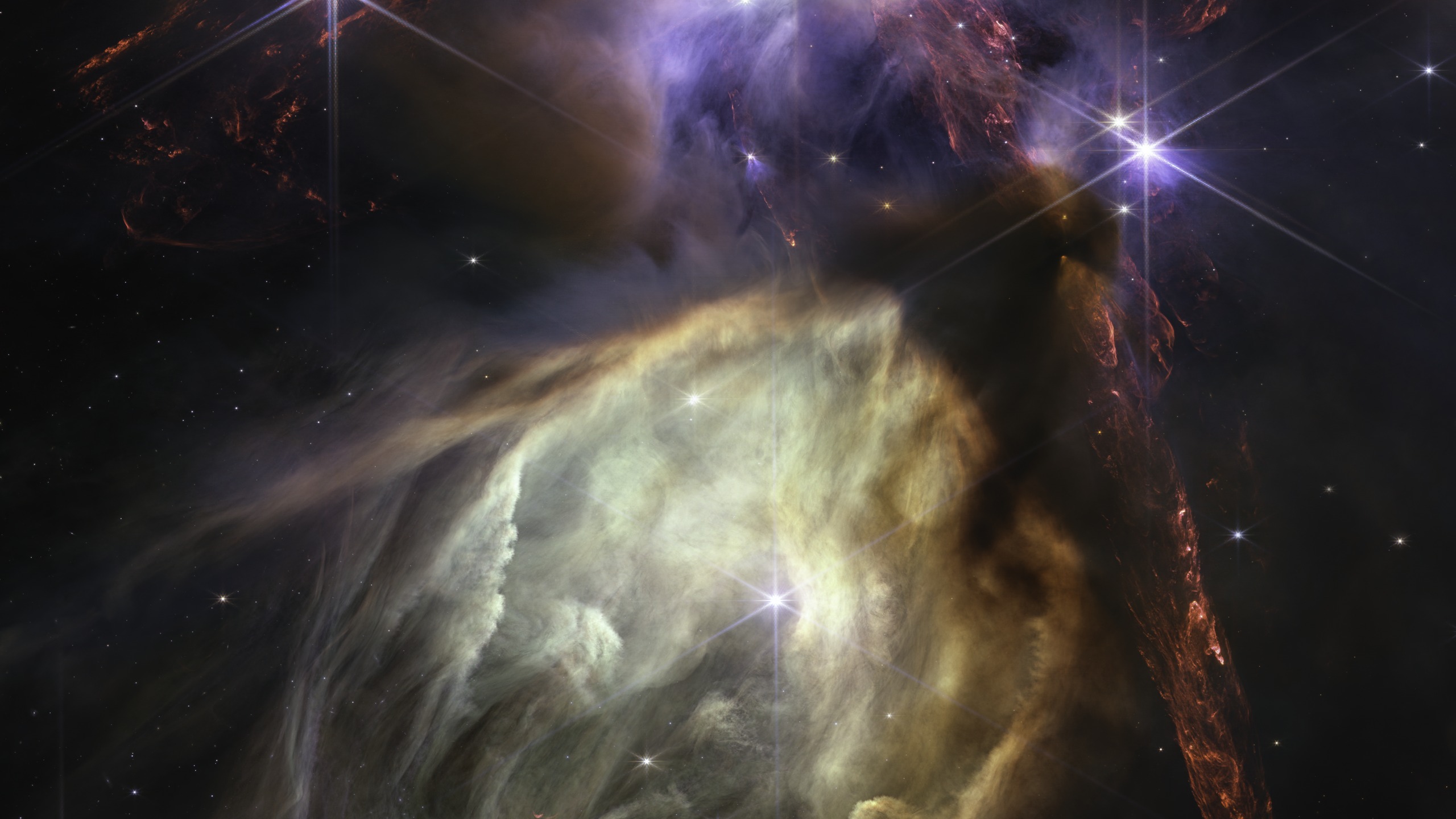
The first anniversary image from NASA’s James Webb Space Telescope displays star birth like it’s never been seen before, full of detailed, impressionistic texture. The subject is the Rho Ophiuchi cloud complex, the closest star-forming region to Earth. It is a relatively small, quiet stellar nursery, but you’d never know it from Webb’s chaotic close-up. Jets bursting from young stars crisscross the image, impacting the surrounding interstellar gas and lighting up molecular hydrogen, shown in red. Some stars display the telltale shadow of a circumstellar disk, the makings of future planetary systems. The young stars at the center of many of these disks are similar in mass to the Sun, or smaller. The heftiest in this image is the star S1, which appears amid a glowing cave it is carving out with its stellar winds in the lower half of the image. The lighter-colored gas surrounding S1 consists of polycyclic aromatic hydrocarbons, a family of carbon-based molecules that are among the most common compounds found in space. For more detail on what is happening where in Webb’s image of Rho Ophiuchi, watch the video tour and read the press release.
7.2k downloads
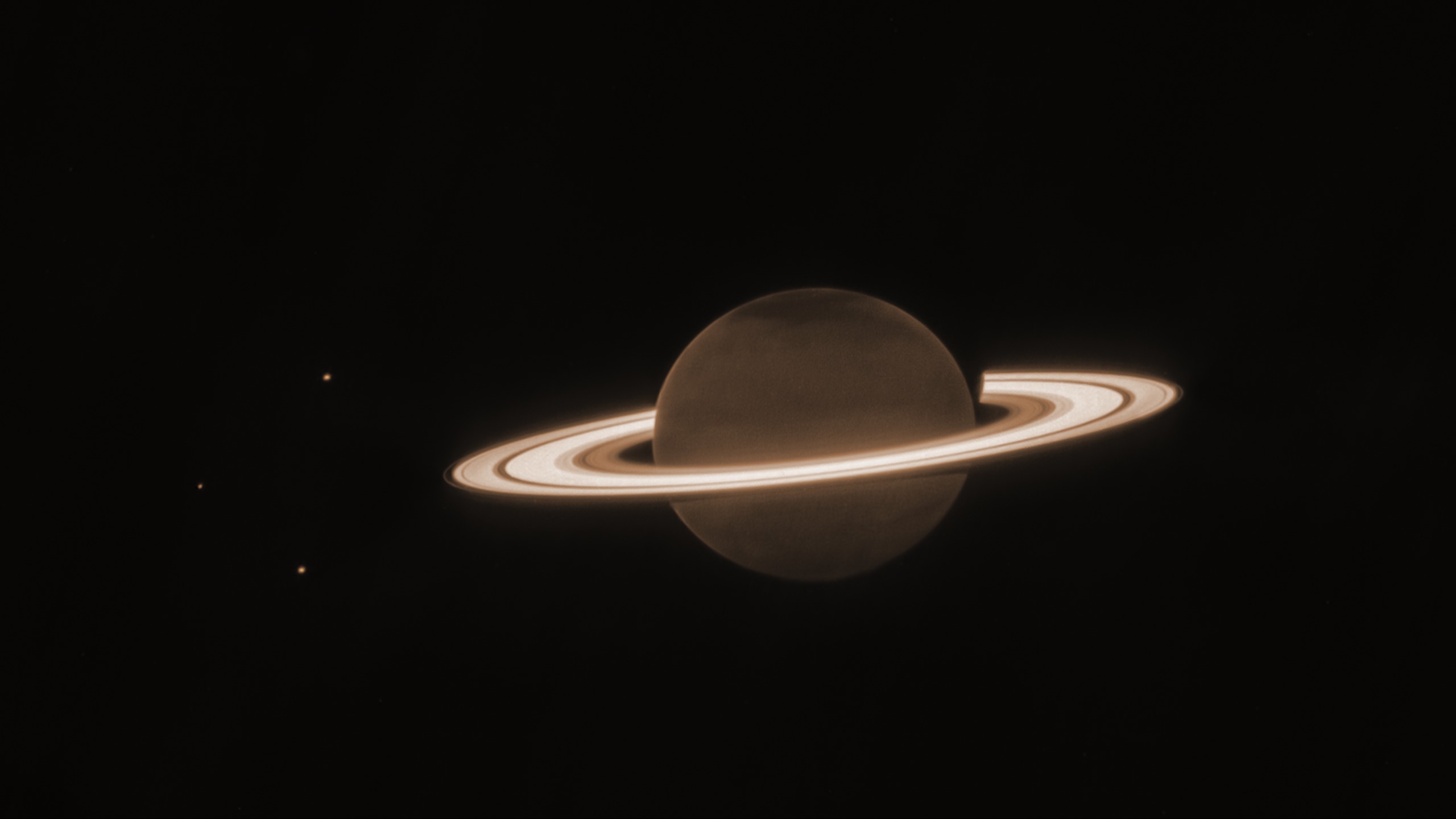
On June 25, 2023, NASA's James Webb Space Telescope turned to famed ringed world Saturn for its first near-infrared observations of the planet. The initial imagery from Webb's NIRCam (Near-Infrared Camera) is already fascinating researchers. Saturn itself appears extremely dark at this infrared wavelength observed by the telescope, as methane gas absorbs almost all of the sunlight falling on the atmosphere. However, the icy rings stay relatively bright, leading to the unusual appearance of Saturn in the Webb image. This image was taken as part of Webb Guaranteed Time Observation program 1247. The program included several very deep exposures of Saturn, which were designed to test the telescope's capacity to detect faint moons around the planet and its bright rings. Any newly discovered moons could garner important clues about the flow of material in the current Saturn system, as well as its past history.
12.5k downloads
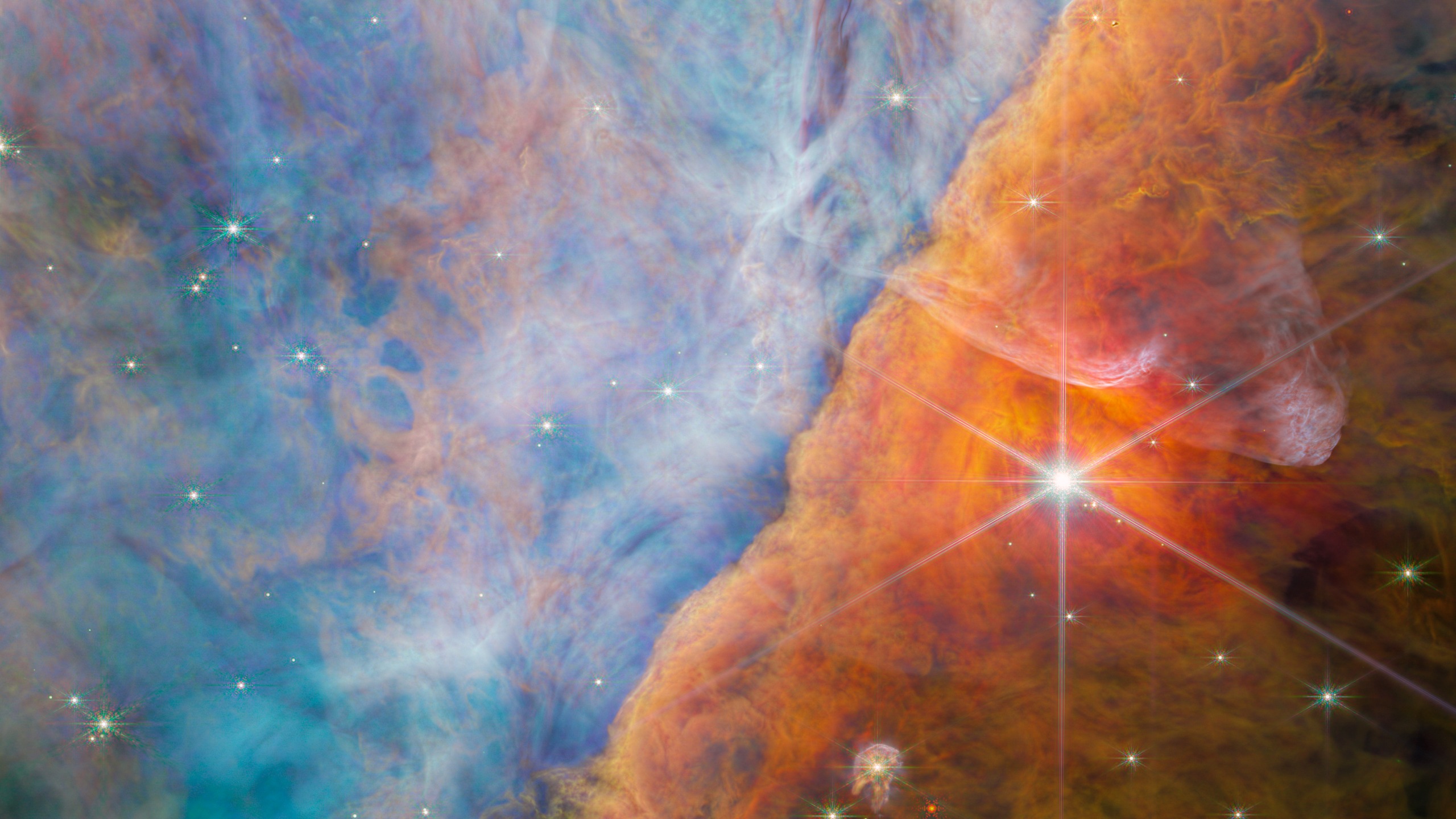
This image taken by Webb’s NIRCam (Near-Infrared Camera) shows a part of the Orion Nebula known as the Orion Bar. It is a region where energetic ultraviolet light from the Trapezium Cluster — located off the upper-left corner — interacts with dense molecular clouds. The energy of the stellar radiation is slowly eroding the Orion Bar, and this has a profound effect on the molecules and chemistry in the protoplanetary disks that have formed around newborn stars here. Within this image lies a young star system known as d203-506, which has a protoplanetary disk. Astronomers used Webb to detect a carbon molecule known as methyl cation in that disk for the first time. That molecule is important because it aids the formation of more complex carbon-based molecules.
18.6k downloads
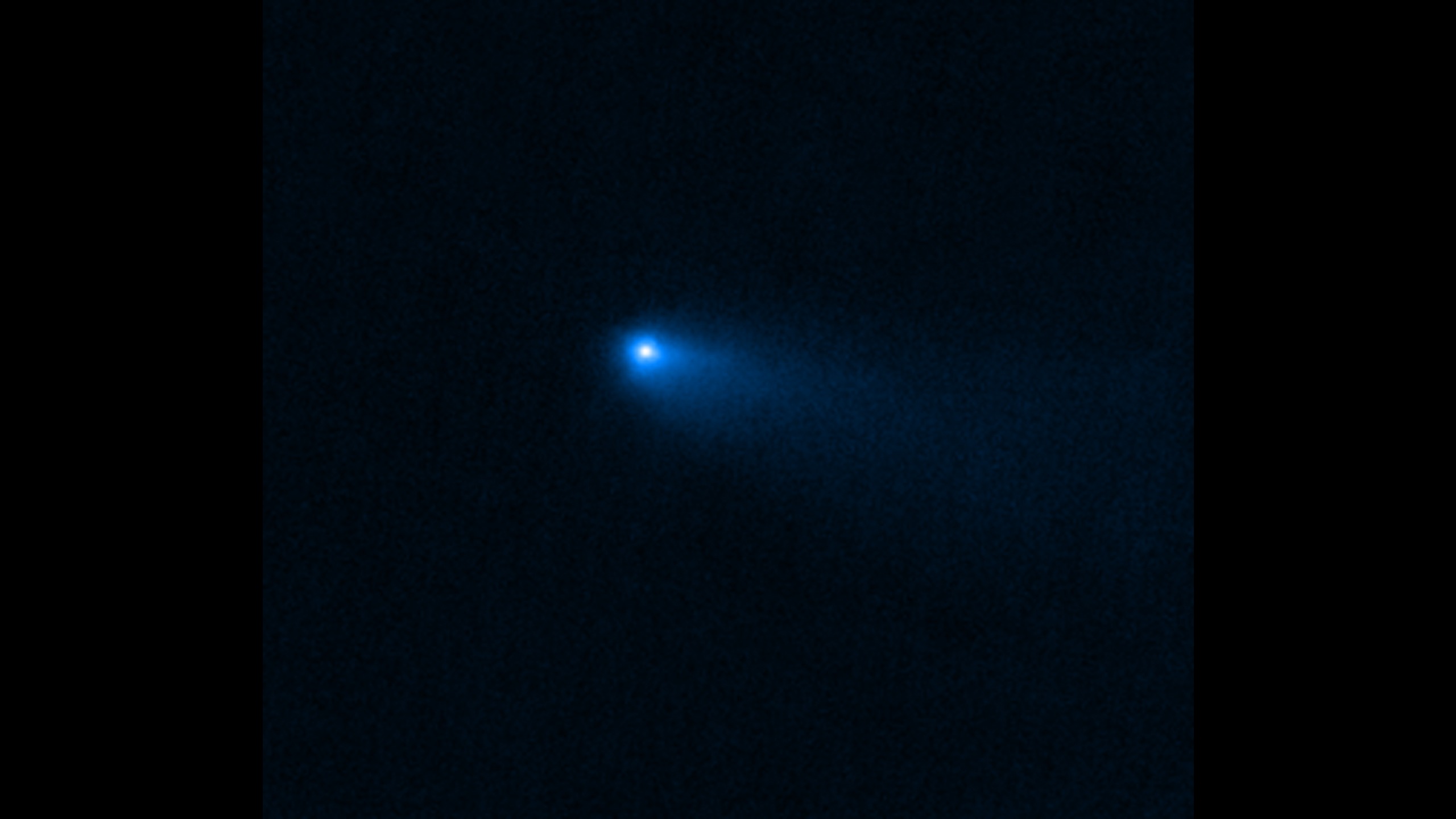
This image of Comet 238P/Read was captured by the NIRCam (Near-Infrared Camera) instrument on NASA’s James Webb Space Telescope on September 8, 2022. It displays the hazy halo, called the coma, and tail that are characteristic of comets, as opposed to asteroids. The dusty coma and tail result from the vaporization of ices as the Sun warms the main body of the comet. Comet Read was among three objects used to define the category of main belt comets in 2006. Before that, comets were understood to reside in the Kuiper Belt and Oort Cloud, beyond the orbit of Neptune, where their ices were preserved farther from the Sun. Since that time scientists have sought to confirm the presence of sublimating material in main belt comets, proving that their coma and tail were due to the same processes that other comets exhibit. With the detection of water vapor on Comet Read, Webb’s sensitive NIRSpec (Near-Infrared Spectrograph) instrument has achieved this goal.
5.9k downloads
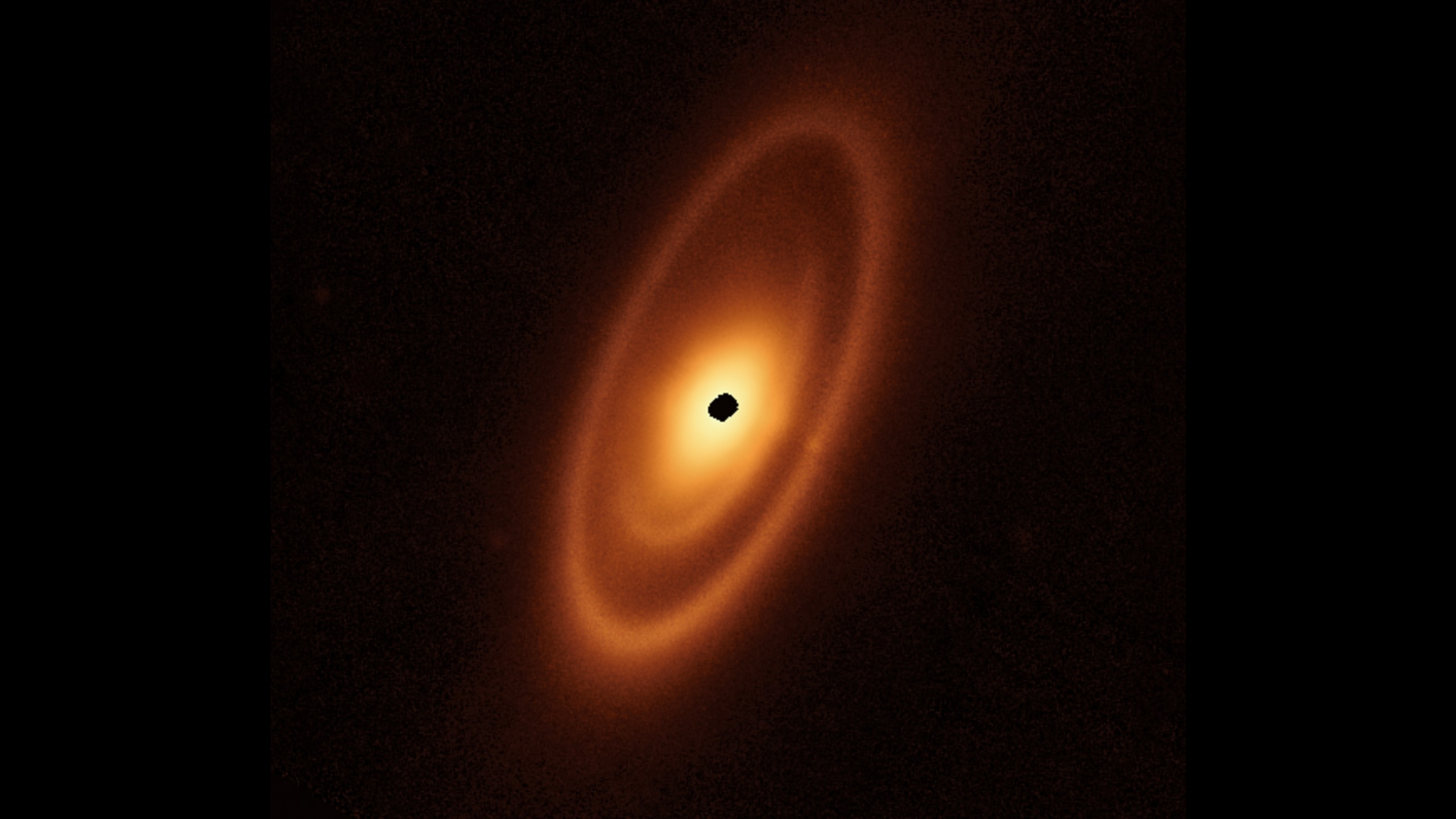
This image of the dusty debris disk surrounding the young star Fomalhaut is from Webb’s Mid-Infrared Instrument (MIRI). It reveals three nested belts extending out to 14 billion miles (23 billion kilometers) from the star. The inner belts – which had never been seen before – were revealed by Webb for the first time. The ragged black spot in the middle indicates a lack of data due to detector saturation. The Hubble Space Telescope and Herschel Space Observatory, as well as the Atacama Large Millimeter/submillimeter Array (ALMA), have previously taken sharp images of the outermost belt. However, none of them found any structure interior to it. These belts most likely are carved by the gravitational forces produced by unseen planets.
10.7k downloads
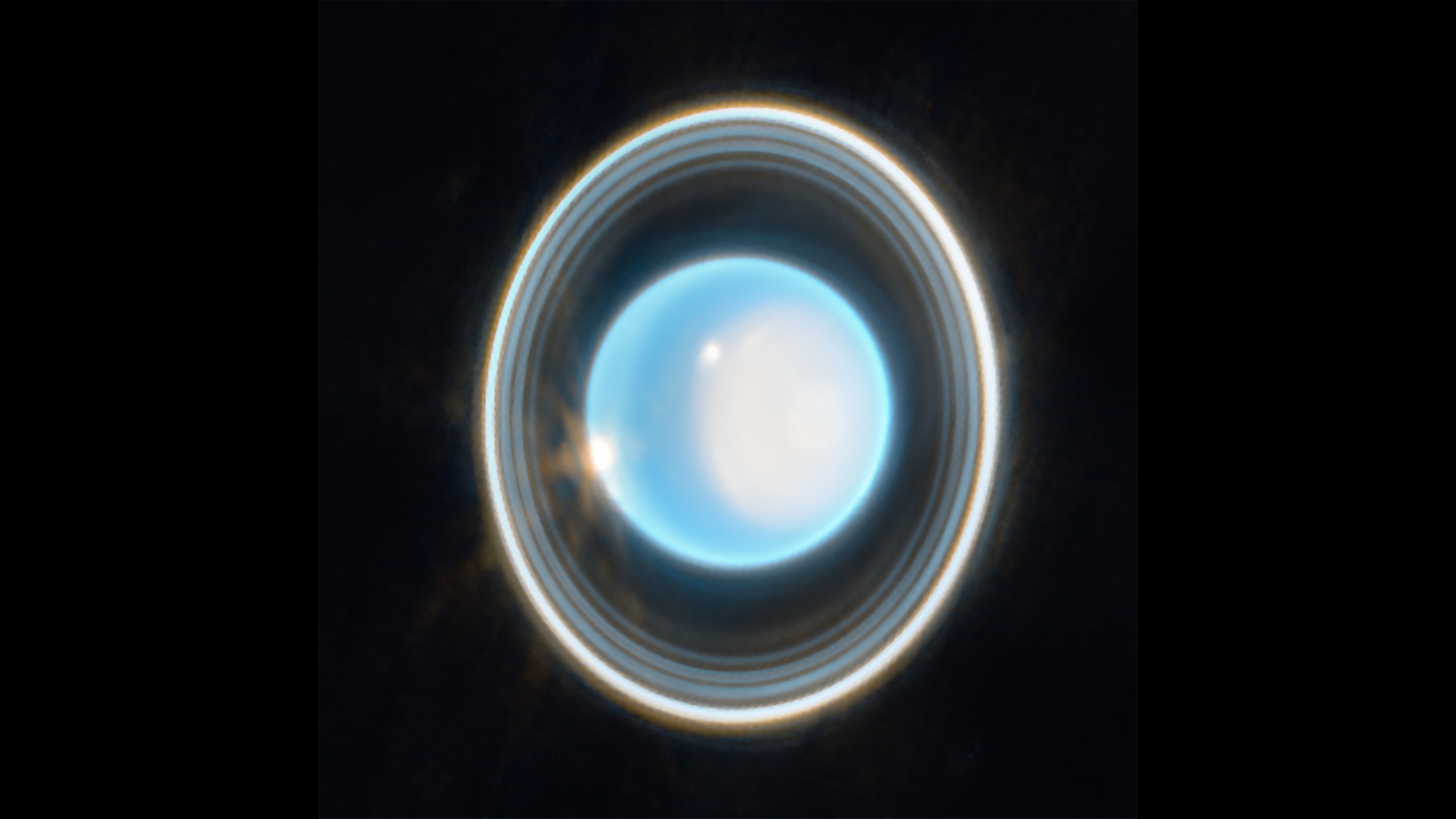
This zoomed-in image of Uranus, captured by Webb’s Near-Infrared Camera (NIRCam) Feb. 6, 2023, reveals stunning views of the planet’s rings. The planet displays a blue hue in this representative-color image, made by combining data from two filters (F140M, F300M) at 1.4 and 3.0 microns, which are shown here as blue and orange, respectively. On the right side of the planet there’s an area of brightening at the pole facing the Sun, known as a polar cap. This polar cap is unique to Uranus because it is the only planet in the solar system tilted on its side, which causes its extreme seasons. A new aspect of the polar cap revealed by Webb is a subtle brightening near the Uranian north pole. At the edge of the polar cap lies a bright cloud as well as a few fainter extended features just northward of the cap’s edge, and a second very bright cloud is seen at the planet’s left limb. Such clouds are typical for Uranus in infrared wavelengths, and likely are connected to storm activity.
36.4k downloads
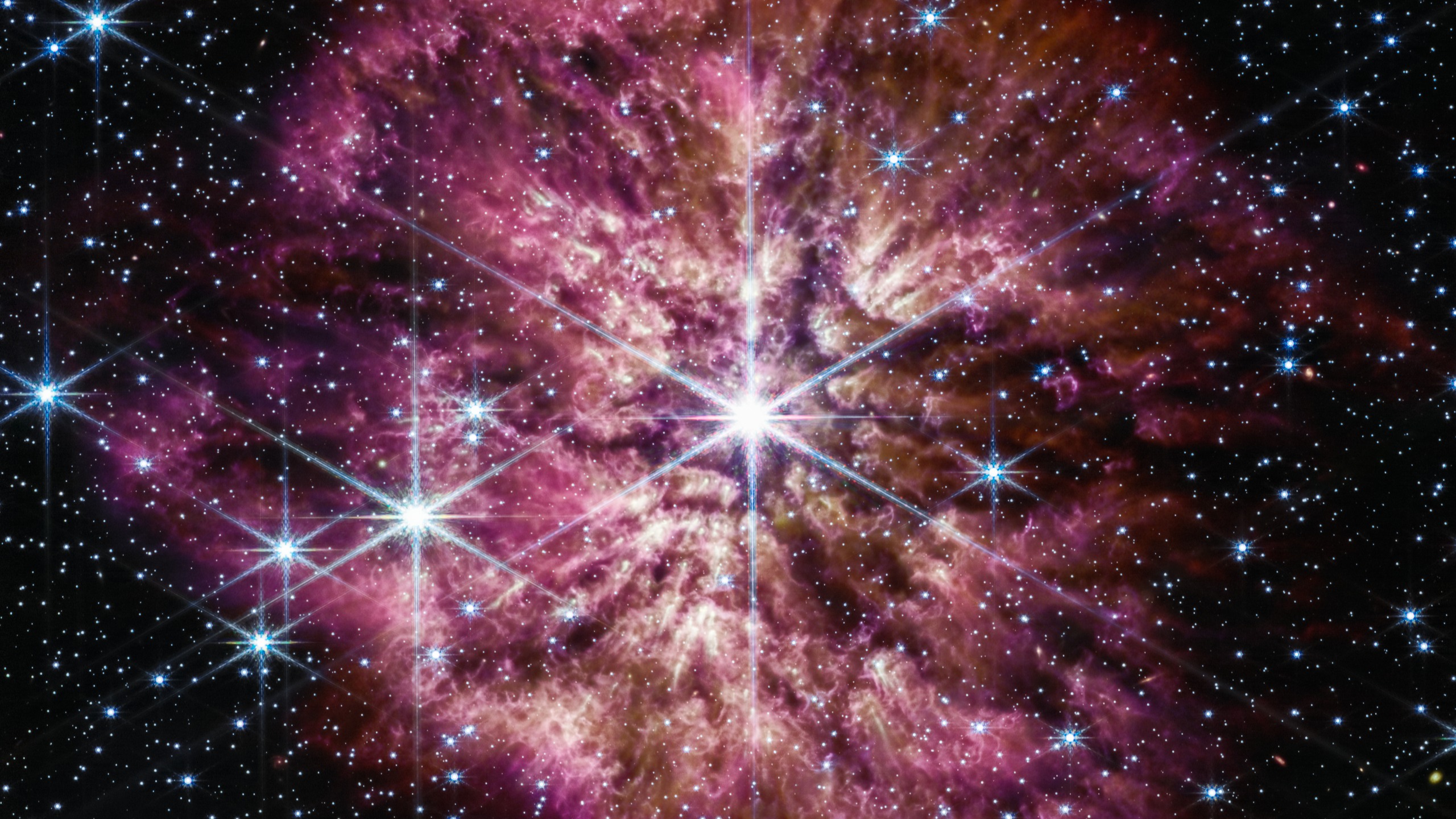
The luminous, hot star Wolf-Rayet 124 (WR 124) is prominent at the center of the James Webb Space Telescope’s composite image combining near-infrared and mid-infrared wavelengths of light. The star displays the characteristic diffraction spikes of Webb’s Near-Infrared Camera (NIRCam), caused by the physical structure of the telescope itself. NIRCam effectively balances the brightness of the star with the fainter gas and dust surrounding it, while Webb’s Mid-Infrared Instrument (MIRI) reveals the nebula’s structure. Background stars and background galaxies populate the field of view and peek through the nebula of gas and dust that has been ejected from the aging massive star to span 10 light-years across space. A history of the star’s past episodes of mass can be read in the nebula’s structure. Rather than smooth shells, the nebula is formed from random, asymmetric ejections. Bright clumps of gas and dust appear like tadpoles swimming toward the star, with tails streaming out behind them, blown back by the stellar wind. This image combines various filters from both Webb imaging instruments, with the color red assigned to wavelengths of 4.44, 4.7, 12.8, and 18 microns (F444W, F470N, F1280W, F1800W), green to 2.1, 3.35, and 11.3 microns (F210M, F335M, F1130W), and blue to 0.9, 1.5, and 7.7 microns (F090W, F150W, F770W).
30.4k downloads
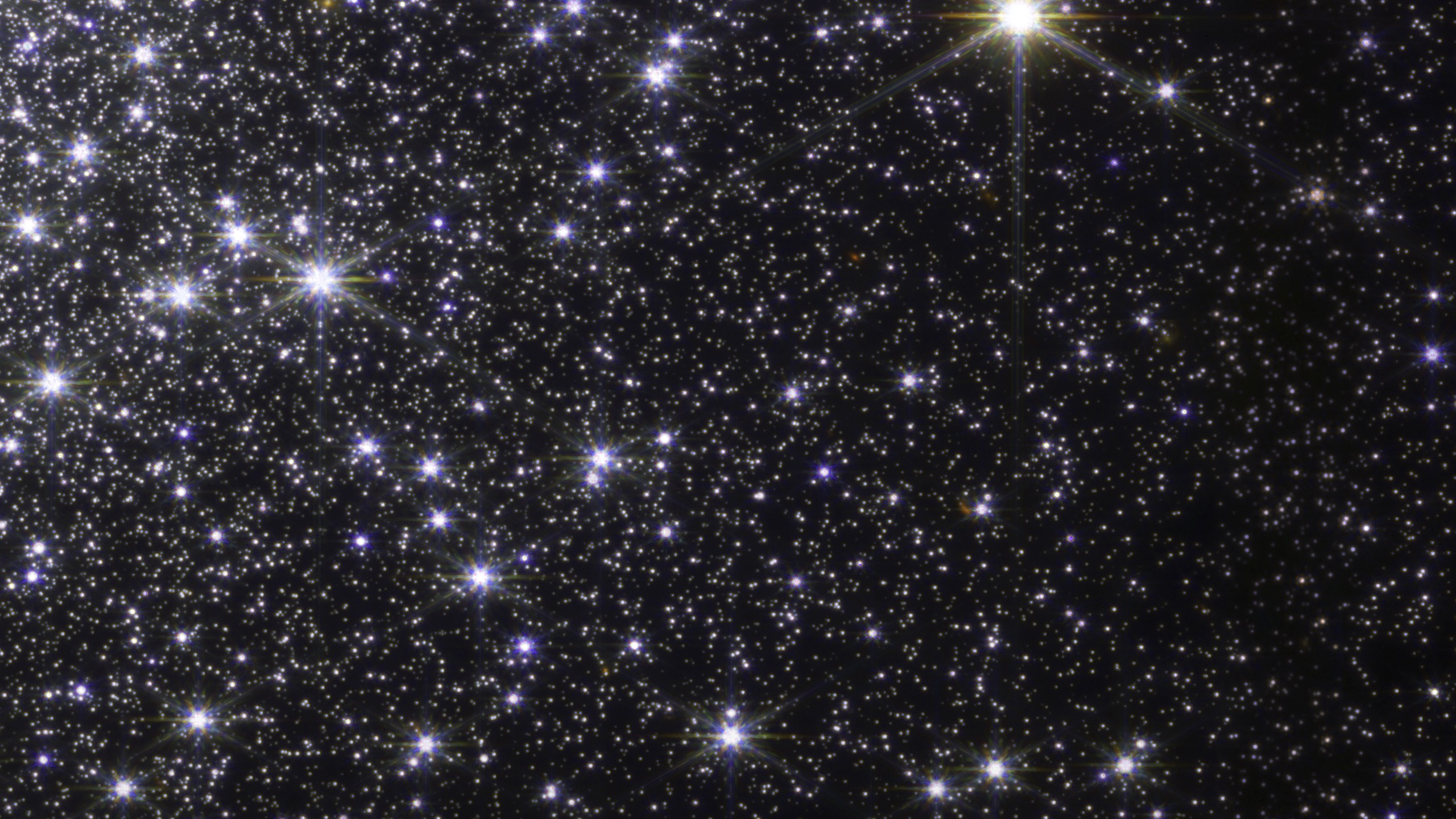
Detail of the globular cluster Messier 92 (M92) captured by Webb’s NIRCam instrument. This field of view covers the lower left quarter of the right half of the full image. Globular clusters are dense masses of tightly packed stars that all formed around the same time. In M92, there are about 300,000 stars packed into a ball about 100 light-years across. The night sky of a planet in the middle of M92 would shine with thousands of stars that appear thousands of times brighter than those in our own sky. The image shows stars at different distances from the center, which helps astronomers understand the motion of stars in the cluster, and the physics of that motion.
3.7k downloads
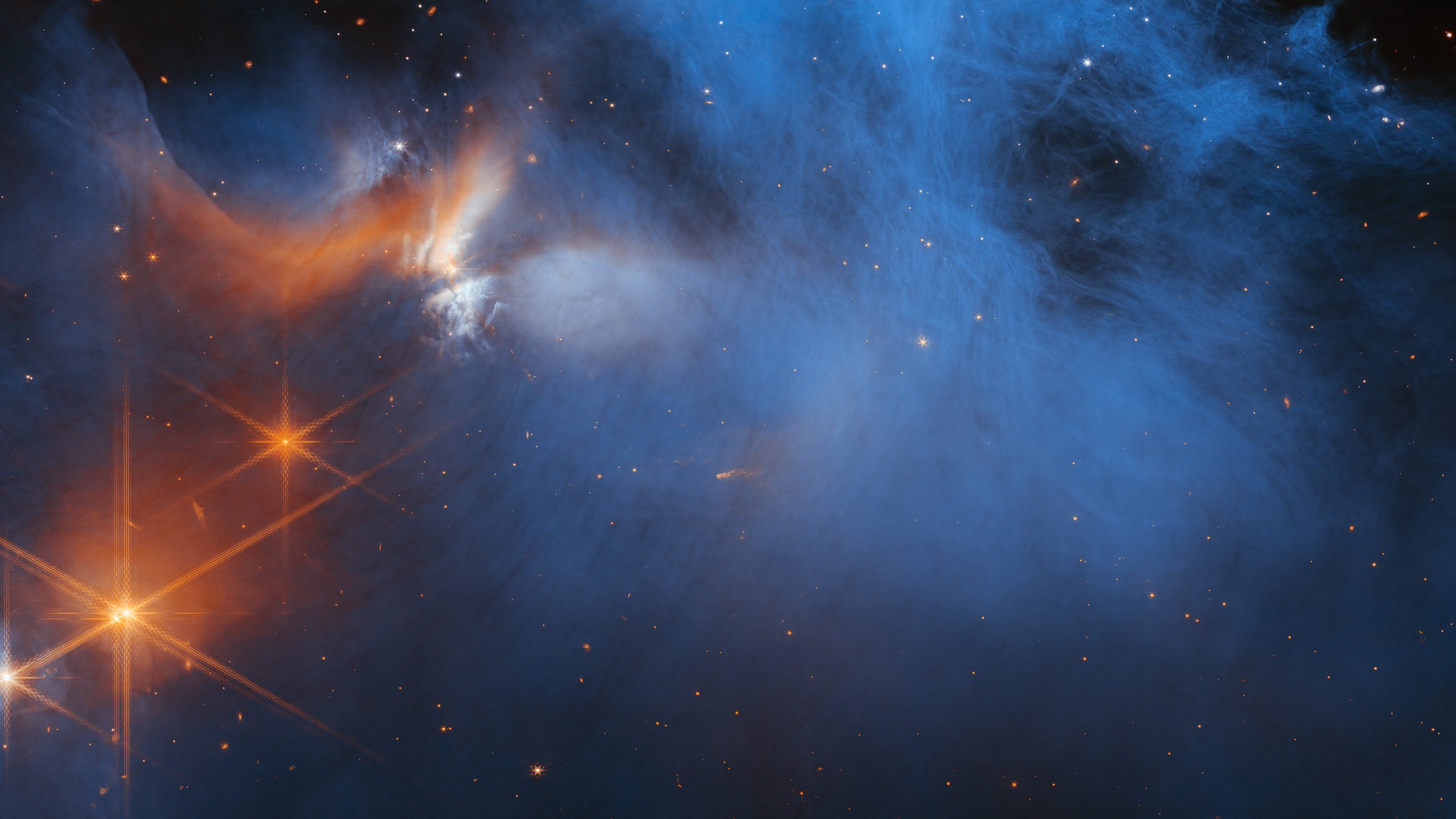
This image by NASA’s James Webb Space Telescope’s Near-Infrared Camera (NIRCam) features the central region of the Chamaeleon I dark molecular cloud, which resides 630 light years away. The cold, wispy cloud material (blue, center) is illuminated in the infrared by the glow of the young, outflowing protostar Ced 110 IRS 4 (orange, upper left). The light from numerous background stars, seen as orange dots behind the cloud, can be used to detect ices in the cloud, which absorb the starlight passing through them. An international team of astronomers has reported the discovery of diverse ices in the darkest regions of a cold molecular cloud measured to date by studying this region. This result allows astronomers to examine the simple icy molecules that will be incorporated into future exoplanets, while opening a new window on the origin of more complex molecules that are the first step in the creation of the building blocks of life.
1.3k downloads
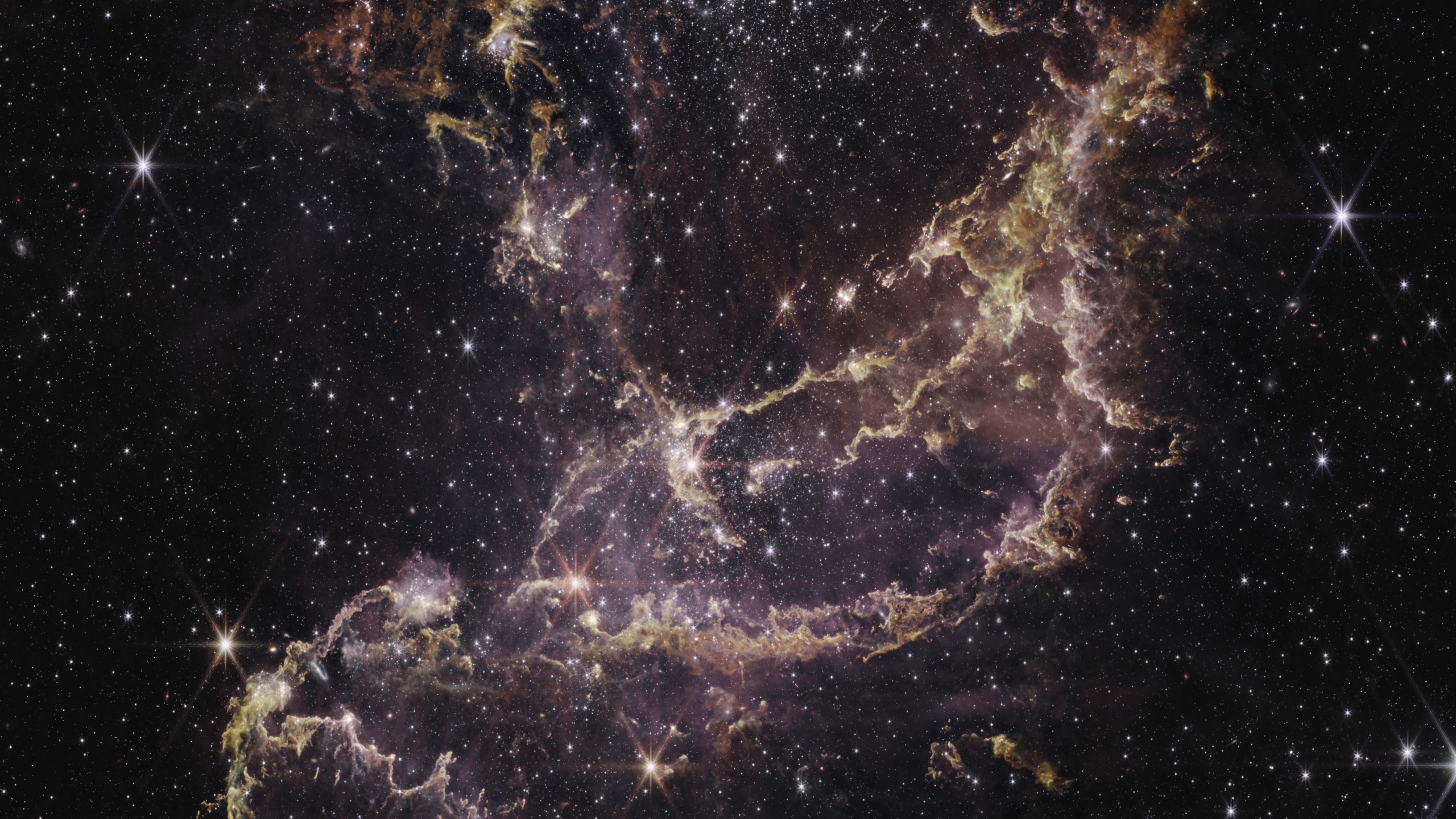
NGC 346, shown here in this image from NASA’s James Webb Space Telescope Near-Infrared Camera (NIRCam), is a dynamic star cluster that lies within a nebula 200,000 light years away. Webb reveals the presence of many more building blocks than previously expected, not only for stars, but also planets, in the form of clouds packed with dust and hydrogen. The plumes and arcs of gas in this image contains two types of hydrogen. The pink gas represents energized hydrogen, which is typically as hot as around 10,000 °C (approximately 18,000 °F) or more, while the more orange gas represents dense, molecular hydrogen, which is much colder at around -200 °C (approximately -300 °F) or less, and associated dust. The colder gas provides an excellent environment for stars to form, and, as they do, they change the environment around them. The effect of this is seen in the various ridges throughout, which are created as the light of these young stars breaks down the dense clouds. The many pillars of glowing gas show the effects of this stellar erosion throughout the region.
4.3k downloads
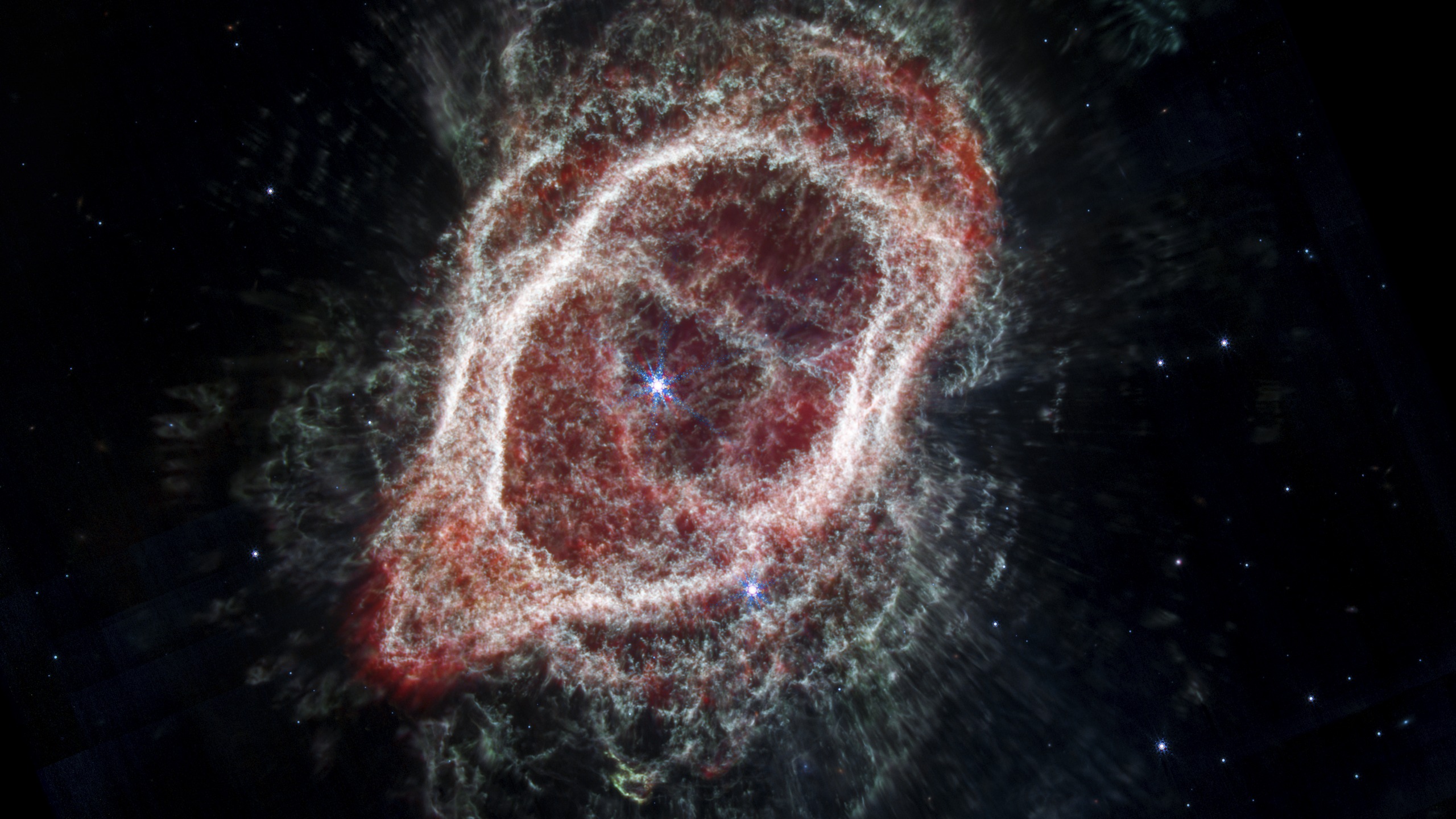
Webb's image traces the star's scattered outflows that have reached farther into the cosmos. Most of the molecular gas that lies outside the band of cooler gas is also cold. It is also far clumpier, consisting of dense knots of molecular gas that form a halo around the central stars. By accounting for the temperatures and gas contents in both areas, inside and outside the band, and by combining Webb's data with precise measurements from other observatories, researchers were able to create far more accurate models to demonstrate when gas was ejected by the central star. What about the third star that is visible at the lower-right edge of the band within the nebula? From Webb's vantage point, it appears within the scene, but isn't part of the nebula itself.
11.4k downloads
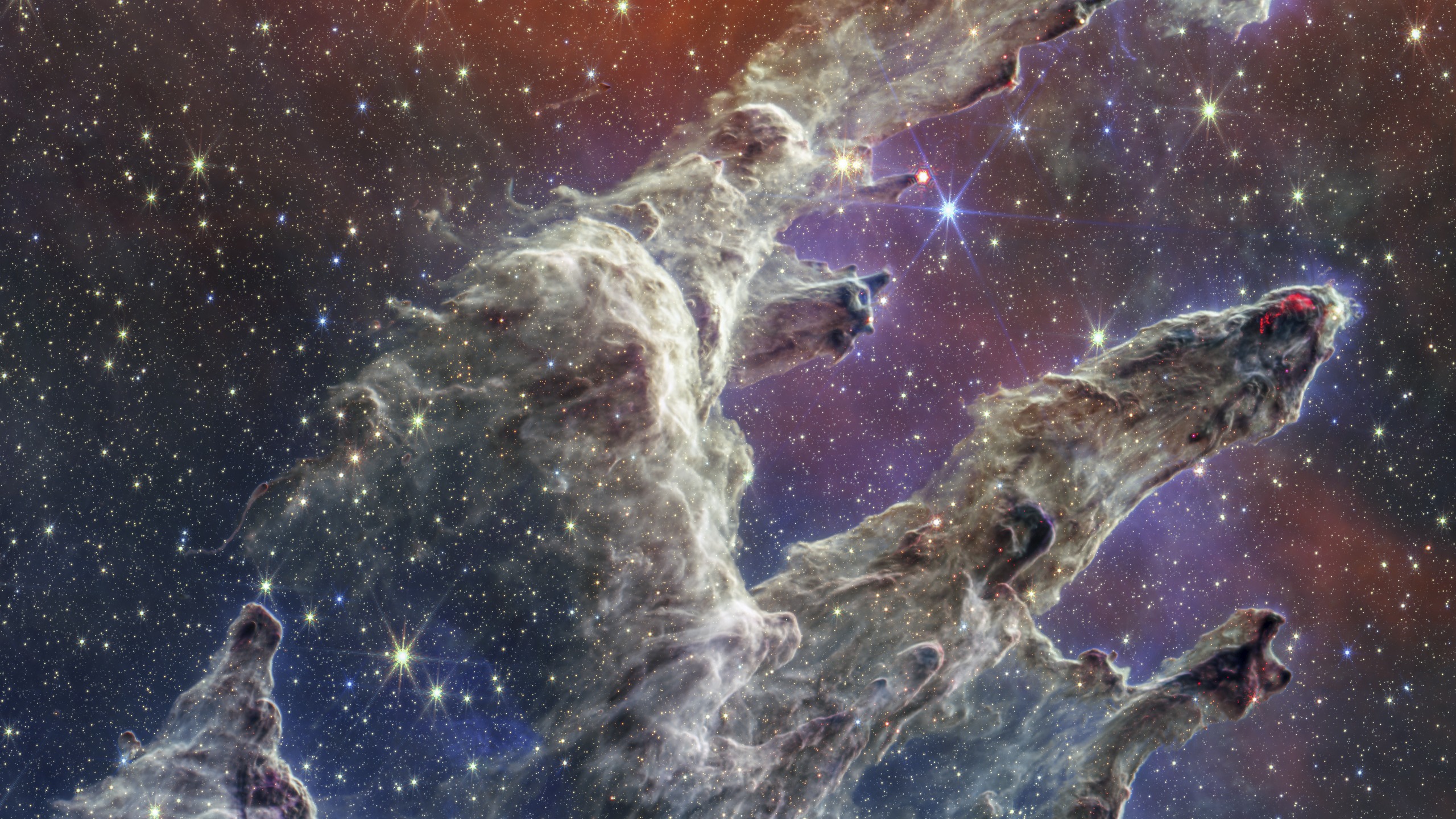
By combining images of the iconic Pillars of Creation from two cameras aboard NASA’s James Webb Space Telescope, the universe has been framed in its infrared glory. Webb’s near-infrared image was fused with its mid-infrared image, setting this star-forming region ablaze with new details. Myriad stars are spread throughout the scene. The stars primarily show up in near-infrared light, marking a contribution of Webb’s Near-Infrared Camera (NIRCam). Near-infrared light also reveals thousands of newly formed stars – look for bright orange spheres that lie just outside the dusty pillars. In mid-infrared light, the dust is on full display. The contributions from Webb’s Mid-Infrared Instrument (MIRI) are most apparent in the layers of diffuse, orange dust that drape the top of the image, relaxing into a V. The densest regions of dust are cast in deep indigo hues, obscuring our view of the activities inside the dense pillars. Dust also makes up the spire-like pillars that extend from the bottom left to the top right. This is one of the reasons why the region is overflowing with stars – dust is a major ingredient of star formation. When knots of gas and dust with sufficient mass form in the pillars, they begin to collapse under their own gravitational attraction, slowly heat up, and eventually form new stars. Newly formed stars are especially apparent at the edges of the top two pillars – they are practically bursting onto the scene. At the top edge of the second pillar, undulating detail in red hints at even more embedded stars. These are even younger, and are quite active as they form. The lava-like regions capture their periodic ejections. As stars form, they periodically send out supersonic jets that can interact within clouds of material, like these thick pillars of gas and dust. These young stars are estimated to be only a few hundred thousand years old, and will continue to form for millions of years. Almost everything you see in this scene is local. The distant universe is largely blocked from our view both by the interstellar medium, which is made up of sparse gas and dust located between the stars, and a thick dust lane in our Milky Way galaxy. As a result, the stars take center stage in Webb’s view of the Pillars of Creation. The Pillars of Creation is a small region within the vast Eagle Nebula, which lies 6,500 light-years away. Revisit Webb’s near-infrared image and its mid-infrared image. The Pillars of Creation was made famous by the Hubble Space Telescope’s 1995 image. NIRCam was built by a team at the University of Arizona and Lockheed Martin’s Advanced Technology Center. MIRI was contributed by ESA and NASA, with the instrument designed and built by a consortium of nationally funded European Institutes (The MIRI European Consortium) in partnership with JPL and the University of Arizona.
20.4k downloads
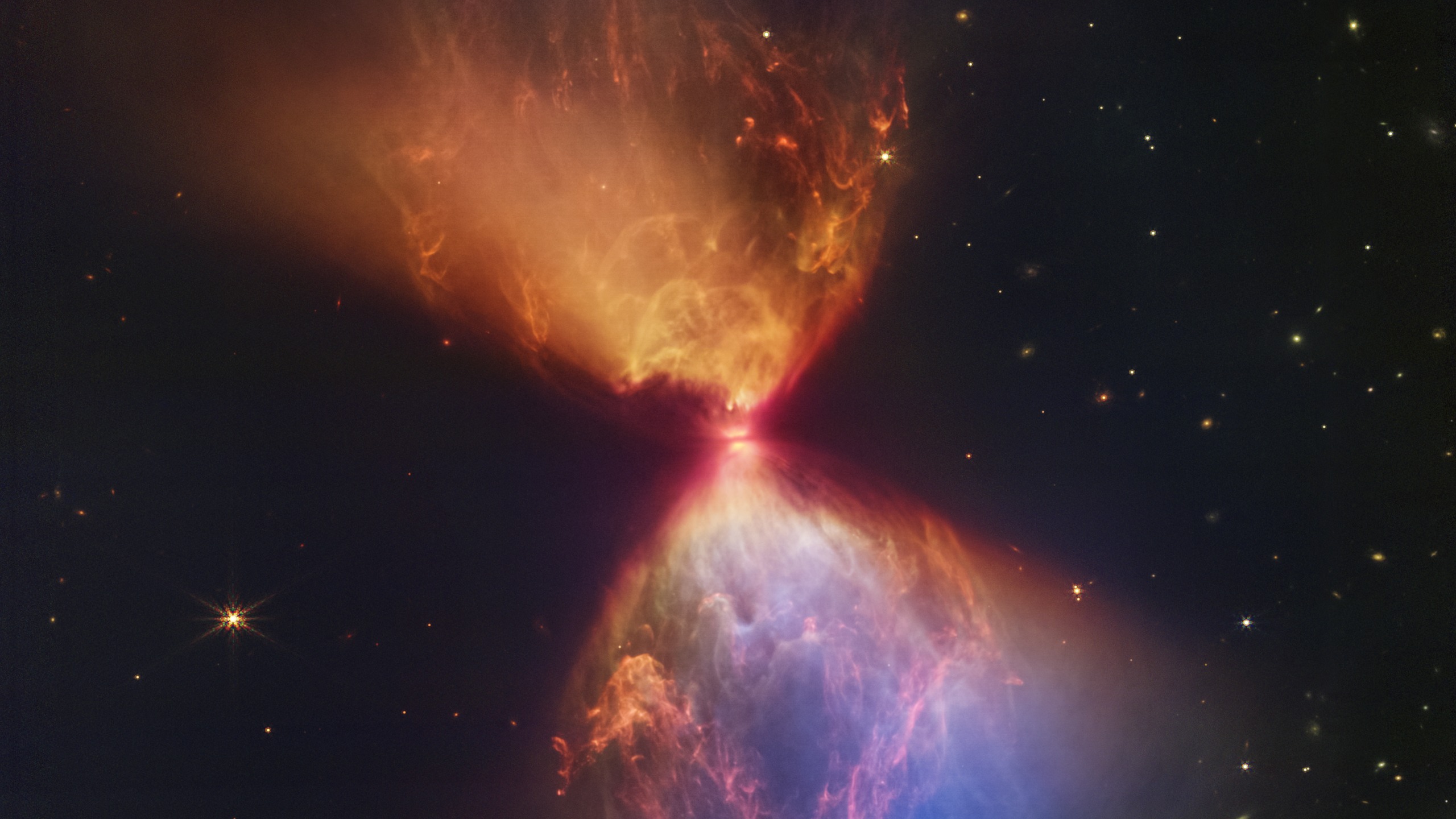
The protostar within the dark cloud L1527, shown in this image from NASA’s James Webb Space Telescope Near-Infrared Camera (NIRCam), is embedded within a cloud of material feeding its growth. Ejections from the star have cleared out cavities above and below it, whose boundaries glow orange and blue in this infrared view. The upper central region displays bubble-like shapes due to stellar “burps,” or sporadic ejections. Webb also detects filaments made of molecular hydrogen that has been shocked by past stellar ejections. The edges of the cavities at upper left and lower right appear straight, while the boundaries at upper right and lower left are curved. The region at lower right appears blue, as there’s less dust between it and Webb than the orange regions above it.
25.4k downloads
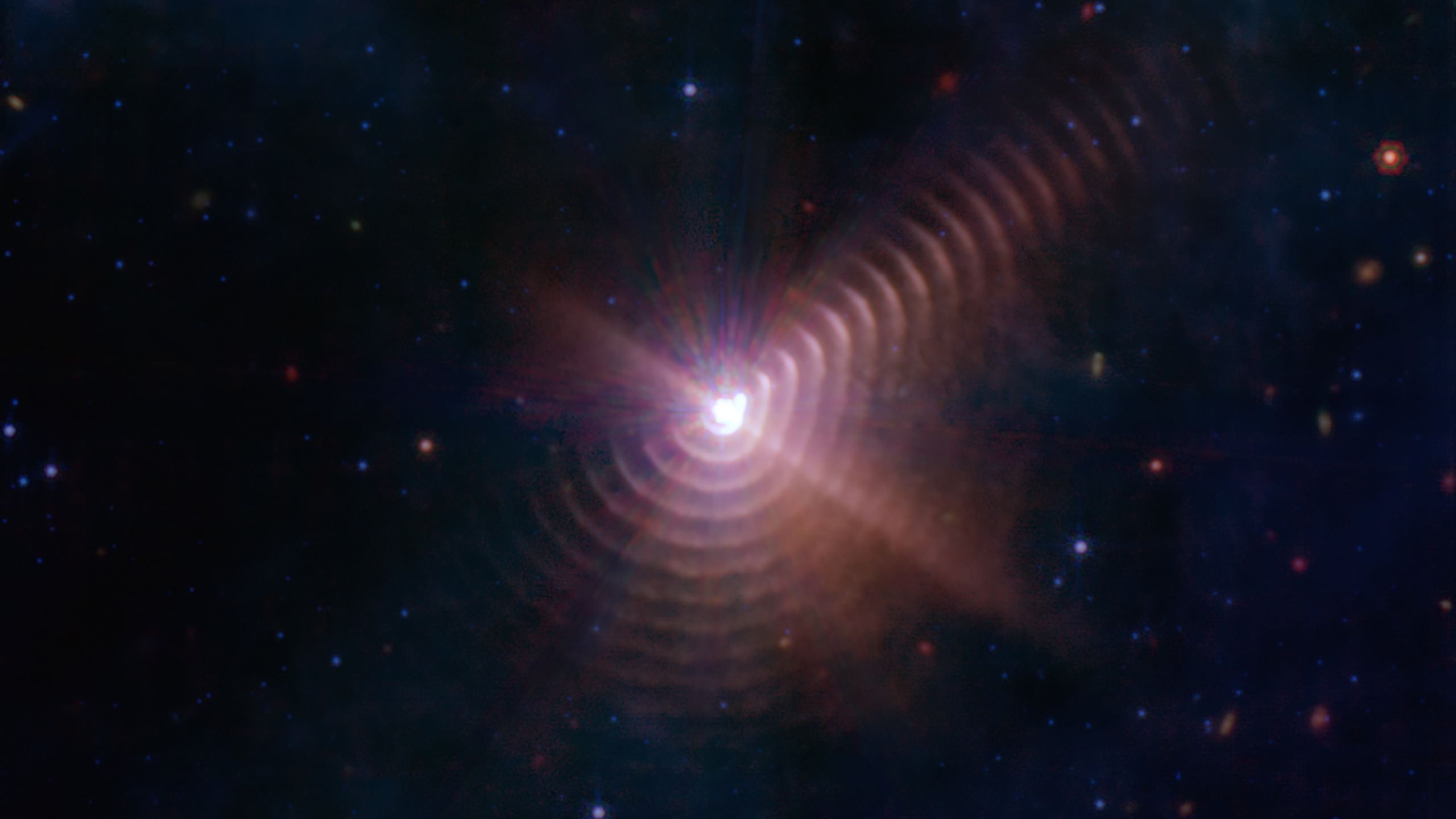
This image from NASA's James Webb Space Telescope reveals at least 17 concentric dust rings emanating from a pair of stars orbiting one another. Located just over 5,000 light-years from Earth, the system is known as Wolf-Rayet 140 because one of the stars is a Wolf-Rayet star. The other is an O-type star, one of the most massive star types known. Each ring was created when the two stars came close together and their stellar winds (streams of gas they blow into space) collided, compressing the gas and forming dust. A ring is produced once per orbit, every 7.93 years. A Wolf-Rayet star is an O-type star born with at least 25 times more mass than our Sun that is nearing the end of its life, when it will likely collapse directly to black hole, or explode as a supernova. These delays between periods of dust production create the unique ring pattern. Some Wolf-Rayet binaries in which the stars are close enough together and have circular orbits produce dust continuously, often forming a pinwheel pattern. WR 140's rings are also referred to as shells because they are not perfectly circular and are thicker and wider than they appear in the image. The rings appear brighter in some areas but are almost invisible in others, rather than forming a perfect "bullseye" pattern. That's because production of dust is variable as the stars get close to one another, and because Webb views the system at an angle and is not looking directly at the orbital plane of the stars. One of the densest regions of dust production creates the bright feature appearing at 2 o'clock. The image was taken by the Mid-Infrared Instrument (MIRI), now managed by the agency's Goddard Space Flight Center. MIRI was developed through a 50-50 partnership between NASA and ESA (European Space Agency).
30.5k downloads
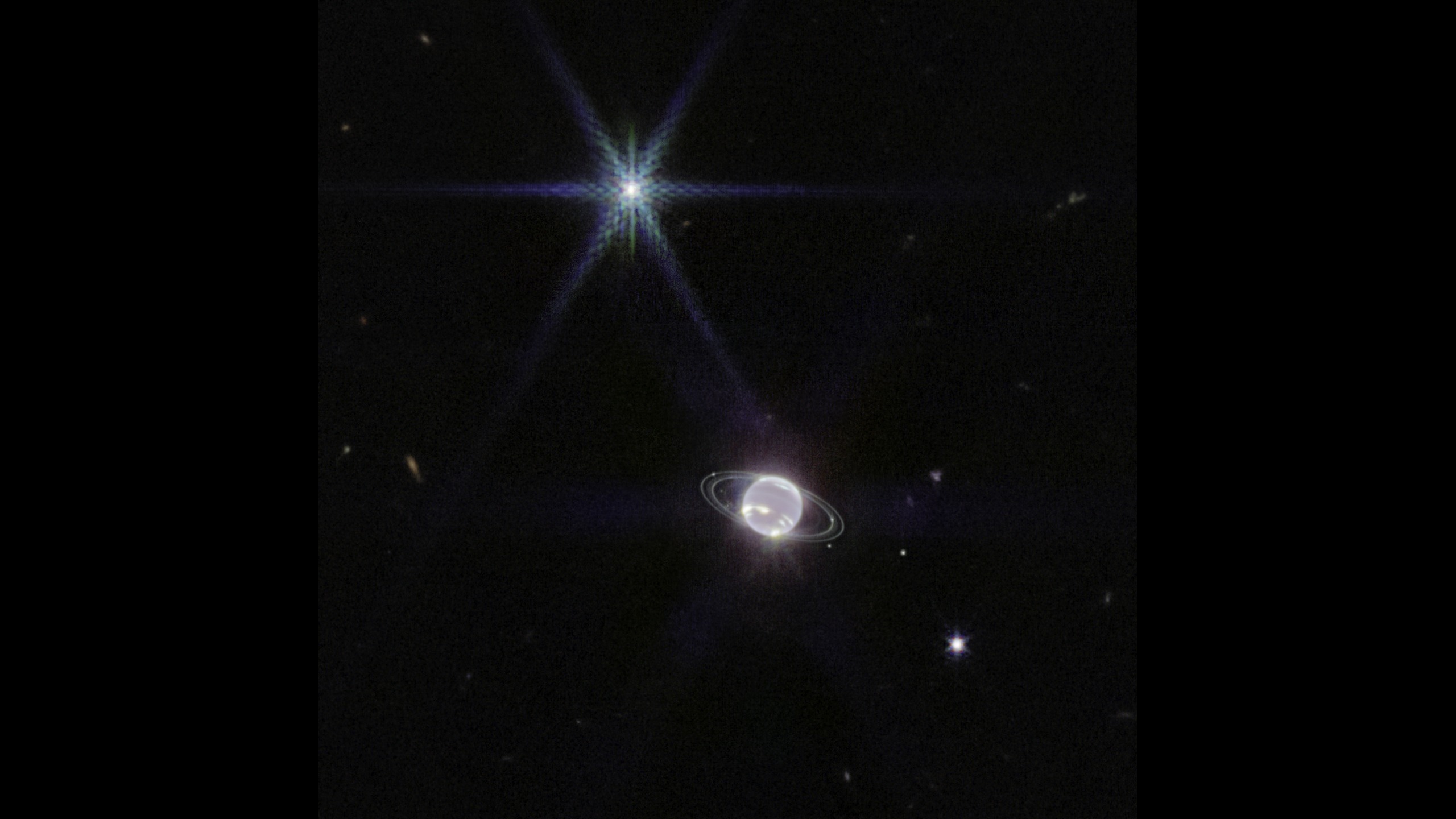
This image of the Neptune system, captured by Webb’s Near-Infrared Camera (NIRCam), reveals stunning views of the planet’s rings, which have not been seen with this clarity in more than three decades. Webb’s new image of Neptune also captures details of the planet’s turbulent, windy atmosphere. Neptune, an ice giant, has an interior that is much richer in elements heavier than hydrogen and helium, like methane, than the gas giants Jupiter and Saturn. Methane appears blue in visible wavelengths but, as evident in Webb’s image, that’s not the case in the near-infrared. Methane so strongly absorbs red and infrared light that the planet is quite dark at near-infrared wavelengths, except where high-altitude clouds are present. These methane-ice clouds are prominent in Webb’s image as bright streaks and spots, which reflect sunlight before it is absorbed by methane gas. To the upper left of the planet in this image, one of Neptune’s moons, Triton, also sports Webb’s distinctive eight diffraction spikes, an artifact of the telescope’s structure. Webb also captured 6 more of Neptune’s 14 known moons, along with a smattering of distant galaxies that appear as dim splotches and a nearby star. NIRCam was built by a team at the University of Arizona and Lockheed Martin’s Advanced Technology Center.
24.2k downloads
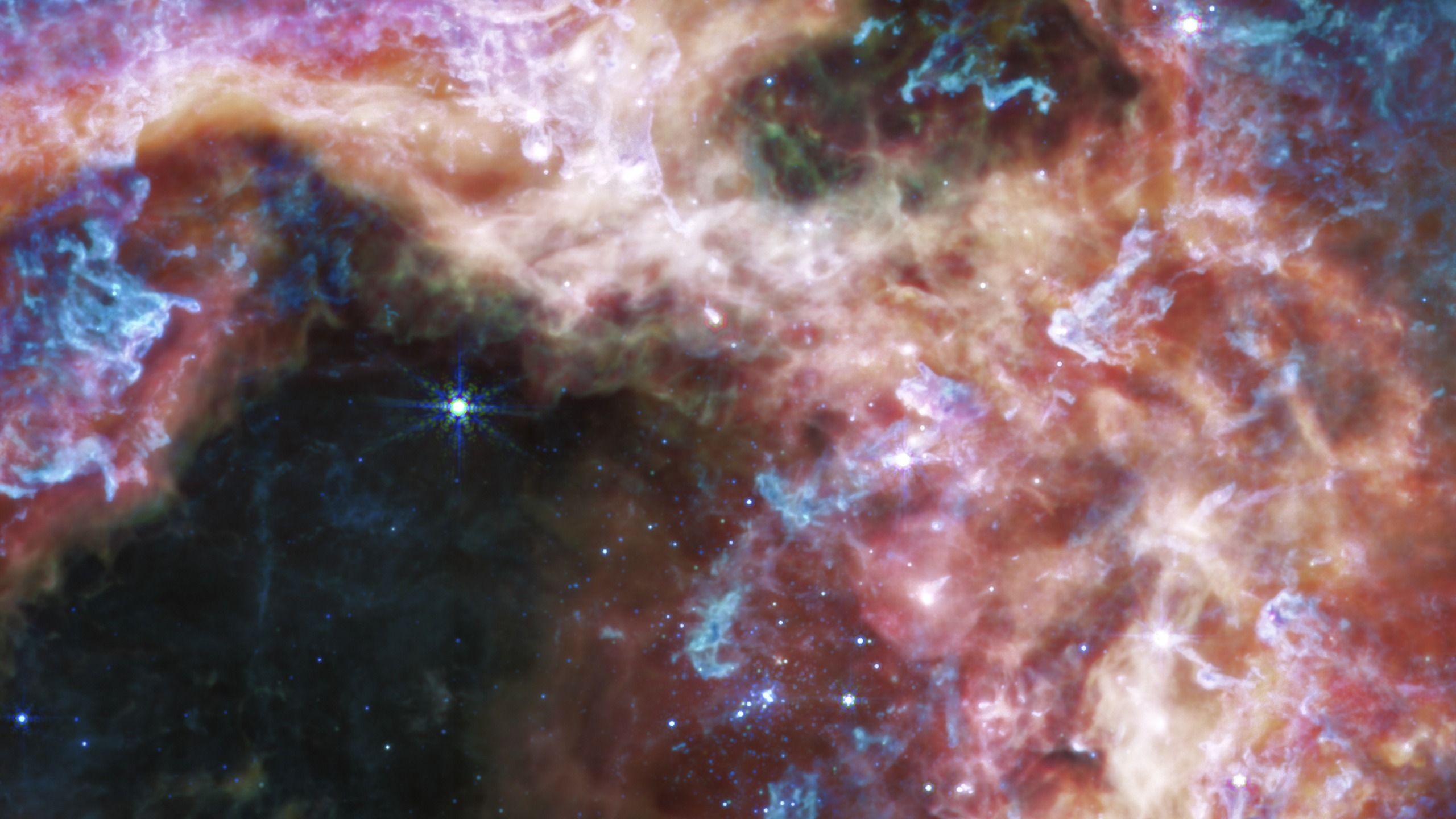
At the longer wavelengths of light captured by its Mid-Infrared Instrument (MIRI), Webb focuses on the area surrounding the central star cluster and unveils a very different view of the Tarantula Nebula. In this light, the young hot stars of the cluster fade in brilliance, and glowing gas and dust come forward. Abundant hydrocarbons light up the surfaces of the dust clouds, shown in blue and purple. Much of the nebula takes on a more ghostly, diffuse appearance because mid-infrared light is able to show more of what is happening deeper inside the clouds. Still-embedded protostars pop into view within their dusty cocoons, including a bright group at the very top edge of the image, left of center. Other areas appear dark, like in the lower-left corner of the image. This indicates the densest areas of dust in the nebula, that even mid-infrared wavelengths cannot penetrate. These could be the sites of future, or current, star formation. MIRI was contributed by ESA and NASA, with the instrument designed and built by a consortium of nationally funded European Institutes (The MIRI European Consortium) in partnership with JPL and the University of Arizona.
38.9k downloads
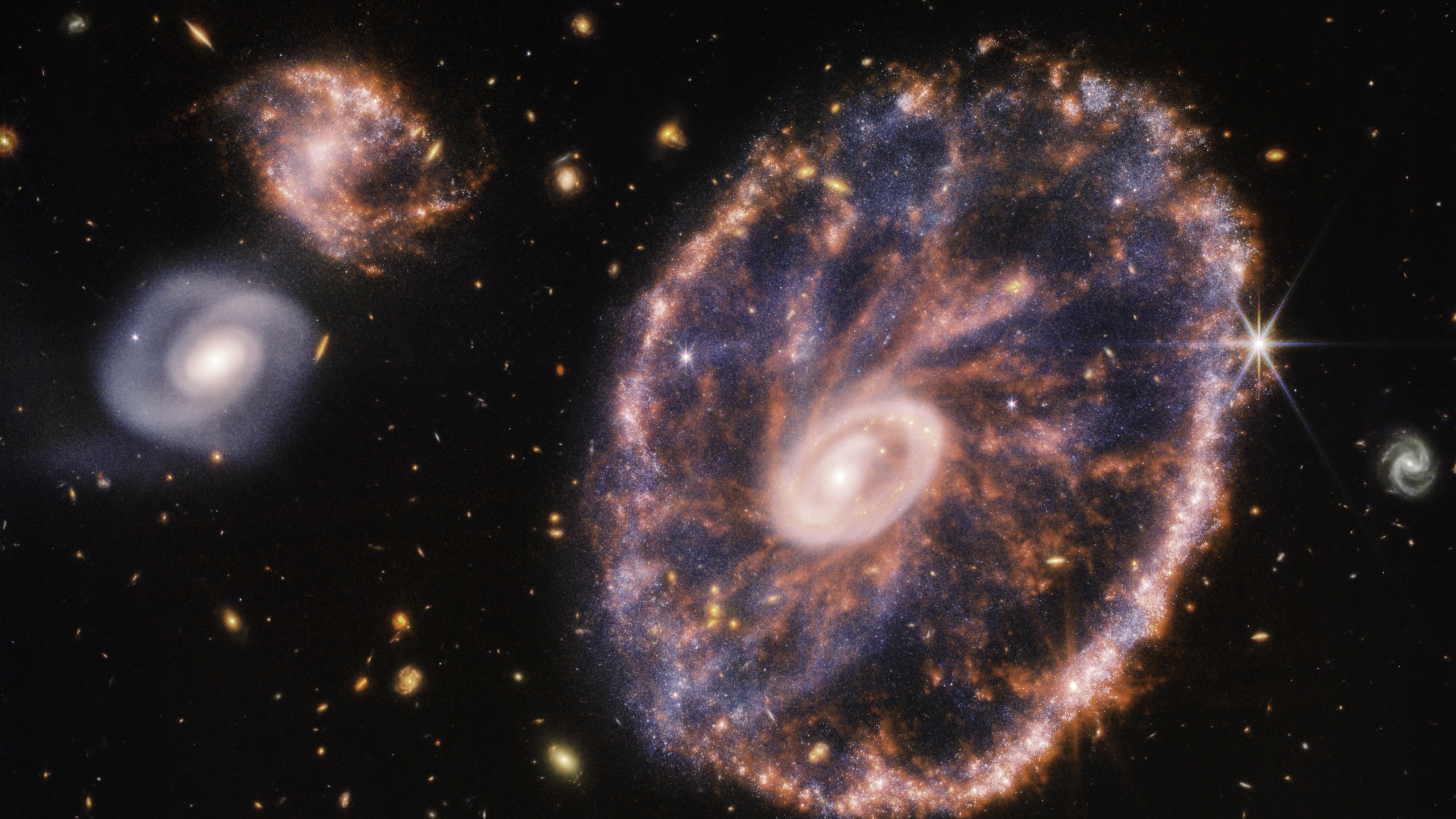
This image of the Cartwheel and its companion galaxies is a composite from Webb’s Near-Infrared Camera (NIRCam) and Mid-Infrared Instrument (MIRI), which reveals details that are difficult to see in the individual images alone. This galaxy formed as the result of a high-speed collision that occurred about 400 million years ago. The Cartwheel is composed of two rings, a bright inner ring and a colorful outer ring. Both rings expand outward from the center of the collision like shockwaves. However, despite the impact, much of the character of the large, spiral galaxy that existed before the collision remains, including its rotating arms. This leads to the “spokes” that inspired the name of the Cartwheel Galaxy, which are the bright red streaks seen between the inner and outer rings. These brilliant red hues, located not only throughout the Cartwheel, but also the companion spiral galaxy at the top left, are caused by glowing, hydrocarbon-rich dust. In this near- and mid-infrared composite image, MIRI data are colored red while NIRCam data are colored blue, orange, and yellow. Amidst the red swirls of dust, there are many individual blue dots, which represent individual stars or pockets of star formation. NIRCam also defines the difference between the older star populations and dense dust in the core and the younger star populations outside of it. Webb’s observations capture the Cartwheel in a very transitory stage. The form that the Cartwheel Galaxy will eventually take, given these two competing forces, is still a mystery. However, this snapshot provides perspective on what happened to the galaxy in the past and what it will do in the future. NIRCam was built by a team at the University of Arizona and Lockheed Martin’s Advanced Technology Center. MIRI was contributed by ESA and NASA, with the instrument designed and built by a consortium of nationally funded European Institutes (The MIRI European Consortium) in partnership with JPL and the University of Arizona.
19.3k downloads
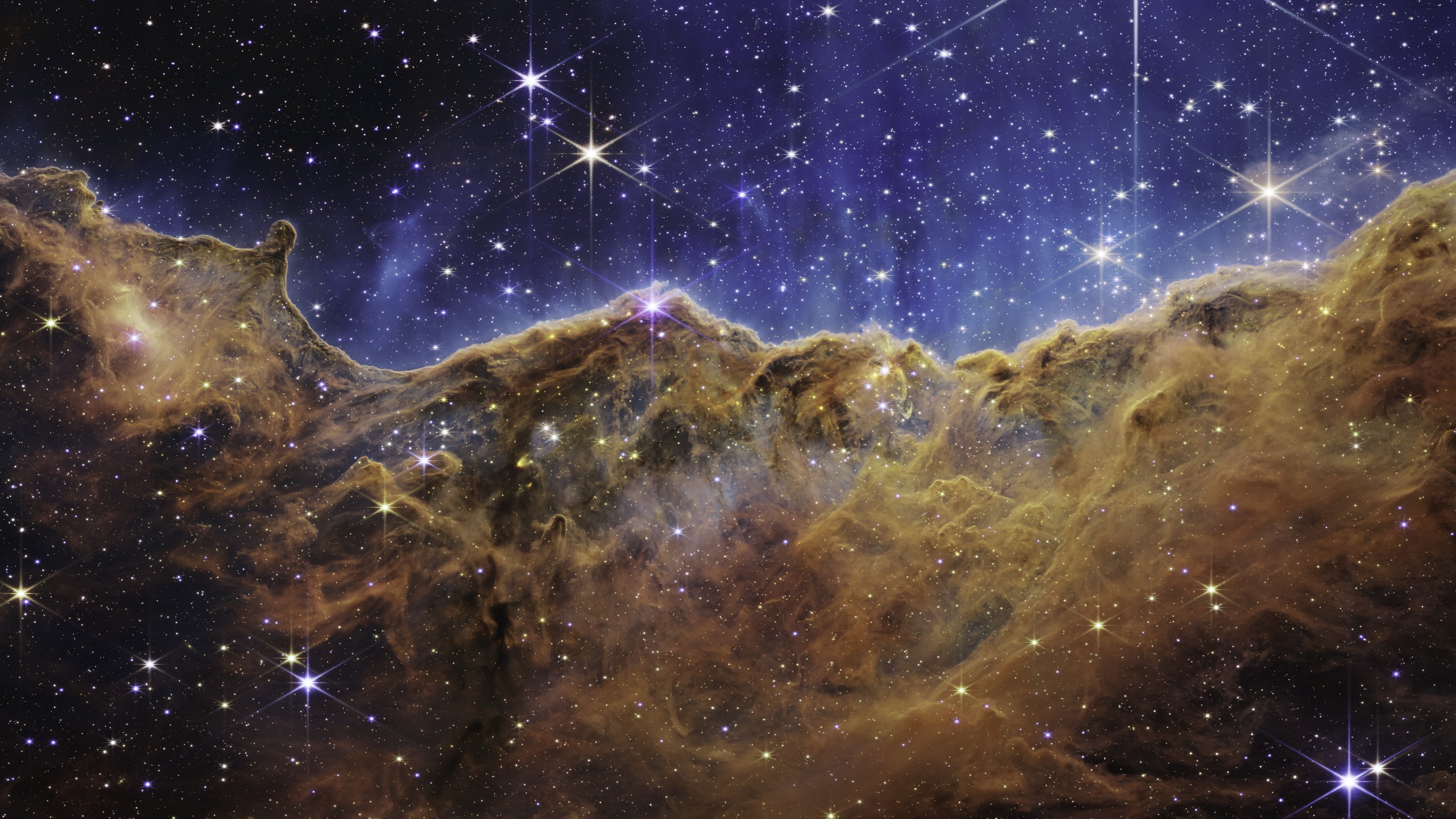
What looks like craggy mountains in moonlight is actually the edge of NGC 3324, a young star-forming region in the Carina Nebula, captured in infrared by Webb's NIRCam. Nicknamed the "Cosmic Cliffs," the region is the edge of a gigantic cavity carved by intense ultraviolet radiation and stellar winds from hot, massive young stars, revealing hundreds of previously hidden stars and background galaxies for the first time.
5.2k downloads
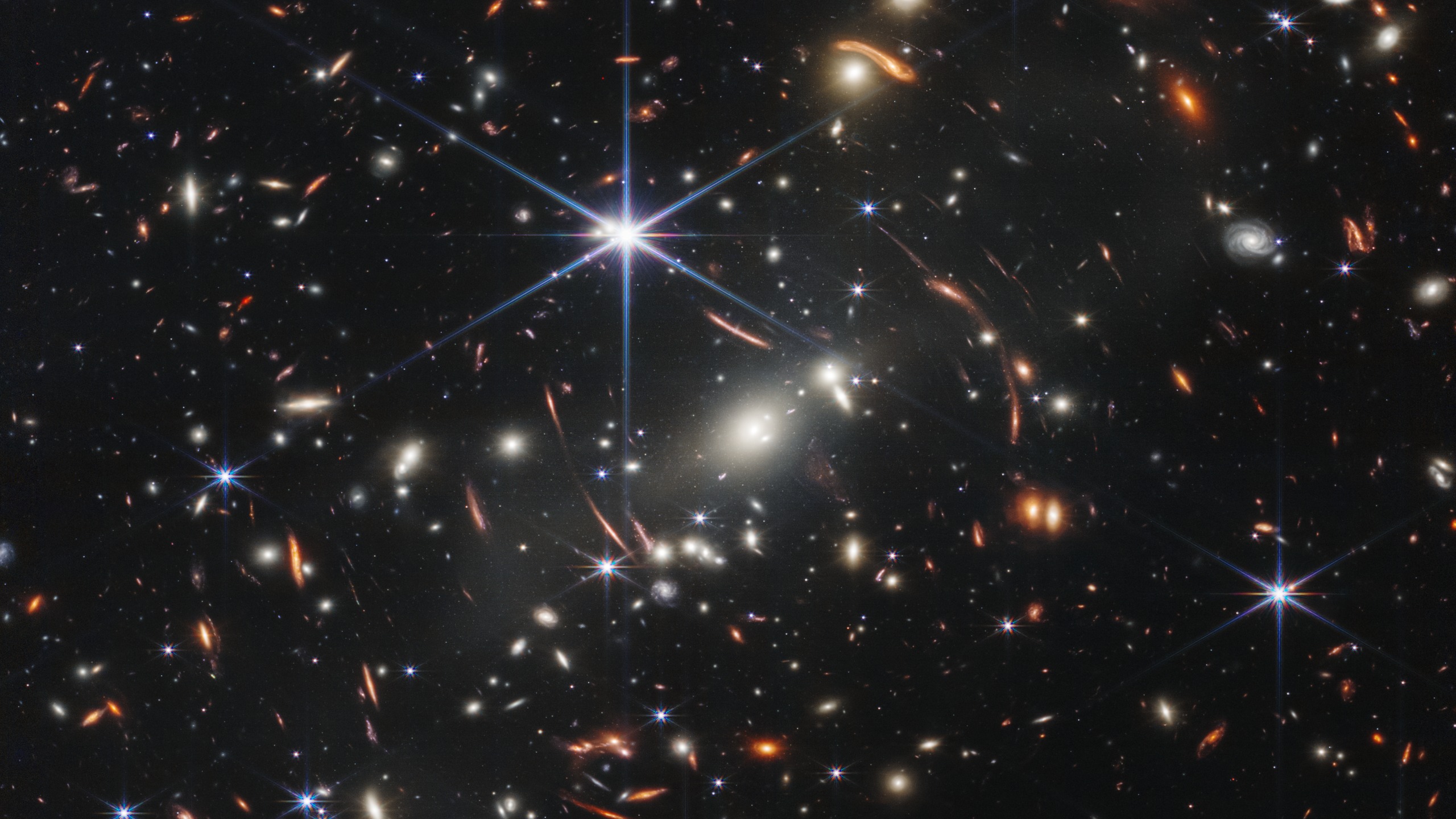
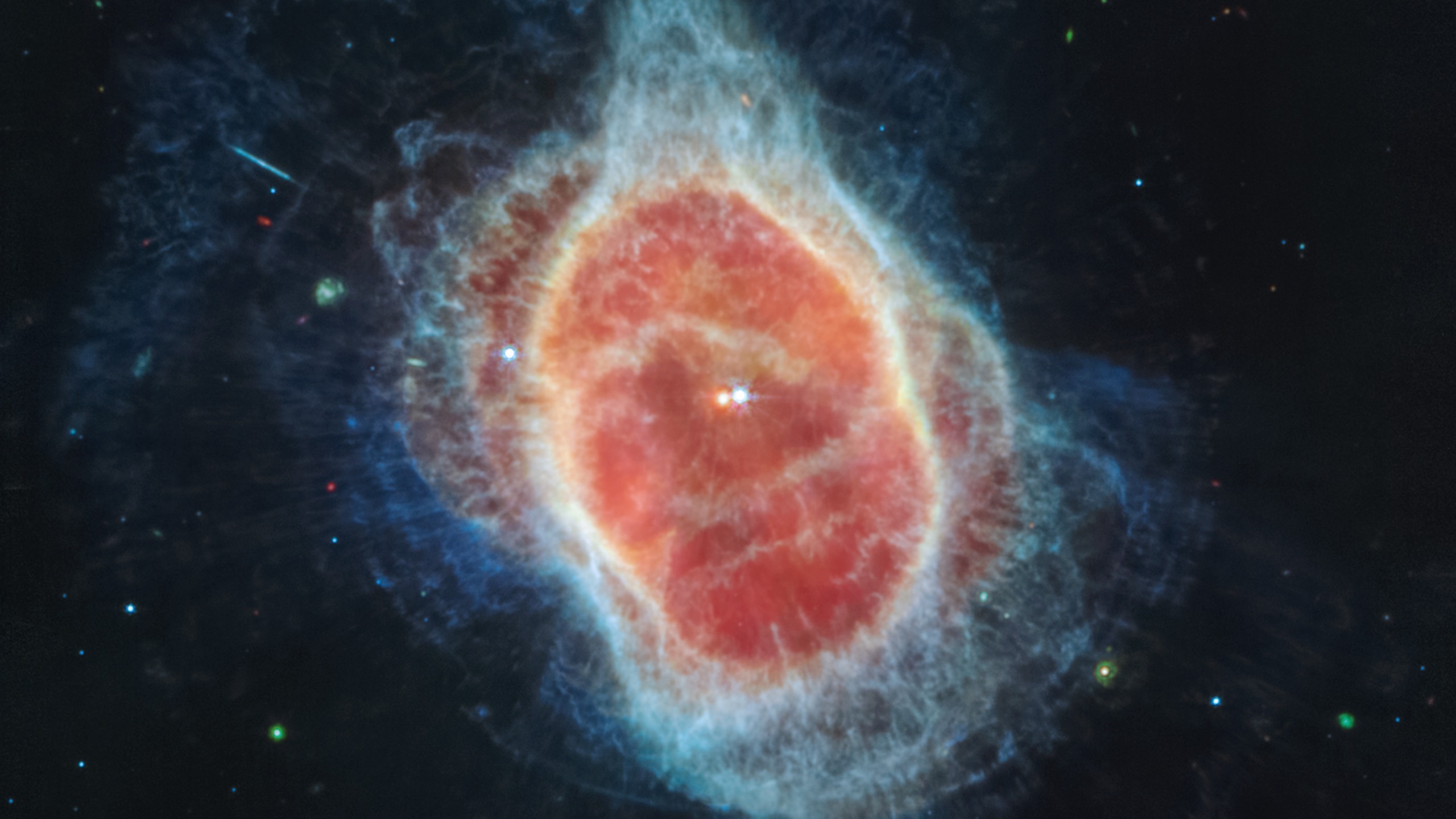
NASA's Webb Telescope has revealed the cloak of dust around the second star, shown at left in red, at the center of the Southern Ring Nebula for the first time. It is a hot, dense white dwarf star. As it transformed into a white dwarf, the star periodically ejected mass, the shells of material you see here. The bluer star at right in this image has also shaped the scene, helping stir up the ejected material. The disk around the stars is also wobbling, shooting out spirals of gas and dust over long periods of time. Webb captured this scene in mid-infrared light, most of which can only be observed from space. Mid-infrared light helps researchers detect objects enshrouded in dust, like the red star. This Mid-Infrared Instrument (MIRI) image also offers an incredible amount of detail, including a cache of distant galaxies in the background.
1k downloads
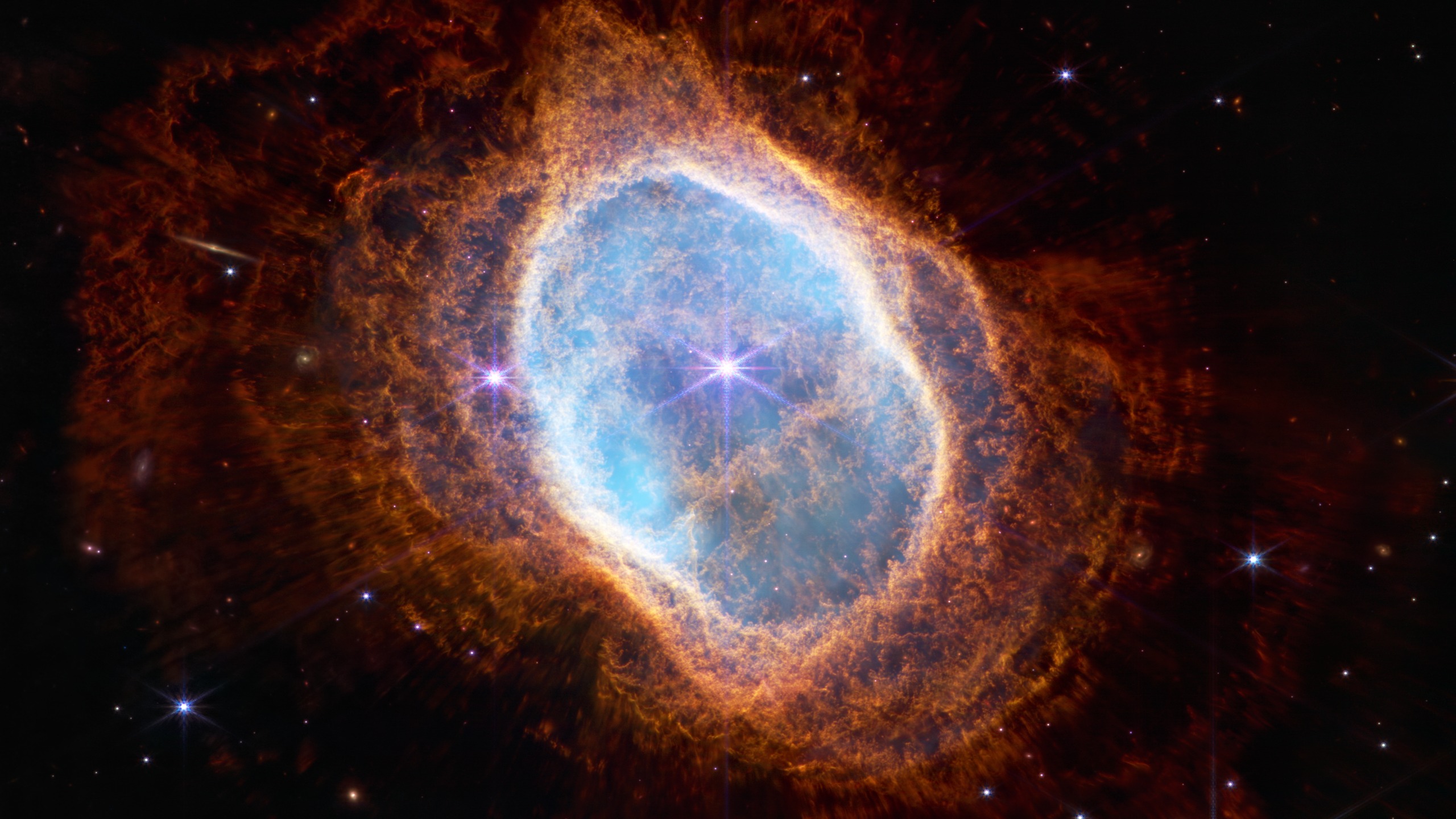
The bright star at the center of NGC 3132, the Southern Ring Nebula, plays a supporting role in sculpting the nebula's rings — a dimmer companion star hidden along one of its diffraction spikes is the true source, having ejected at least eight layers of gas and dust over thousands of years. Webb's near-infrared view also reveals countless background galaxies through the nebula's transparent regions.
2.1k downloads
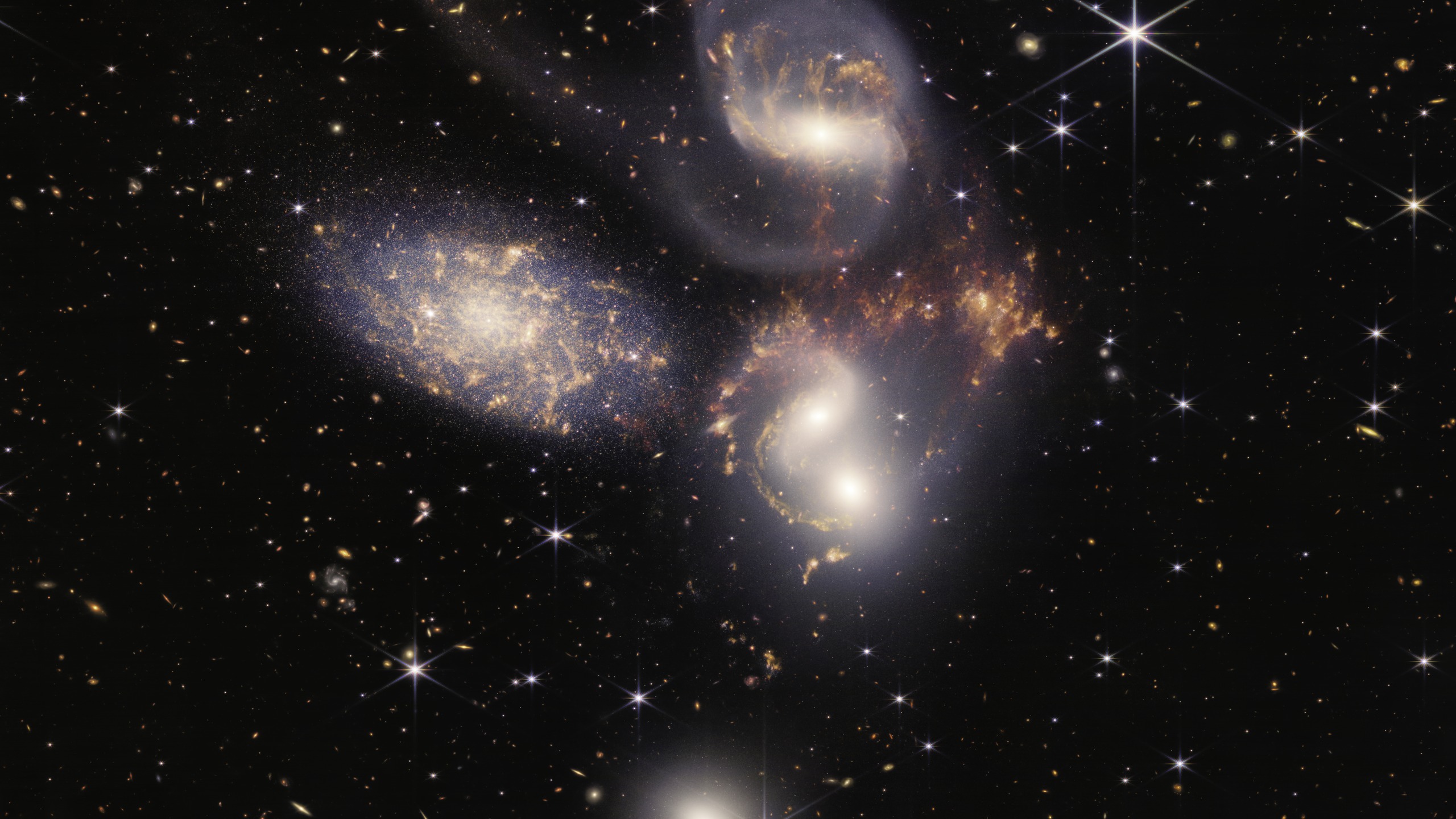
An enormous mosaic of Stephan's Quintet is the largest image to date from NASA's James Webb Space Telescope, covering about one-fifth of the Moon's diameter. It contains over 150 million pixels and is constructed from almost 1,000 separate image files. The visual grouping of five galaxies was captured by Webb's Near-Infrared Camera (NIRCam) and Mid-Infrared Instrument (MIRI). With its powerful, infrared vision and extremely high spatial resolution, Webb shows never-before-seen details in this galaxy group. Sparkling clusters of millions of young stars and starburst regions of fresh star birth grace the image. Sweeping tails of gas, dust and stars are being pulled from several of the galaxies due to gravitational interactions. Most dramatically, Webb's MIRI instrument captures huge shock waves as one of the galaxies, NGC 7318B, smashes through the cluster.
21.3k downloads
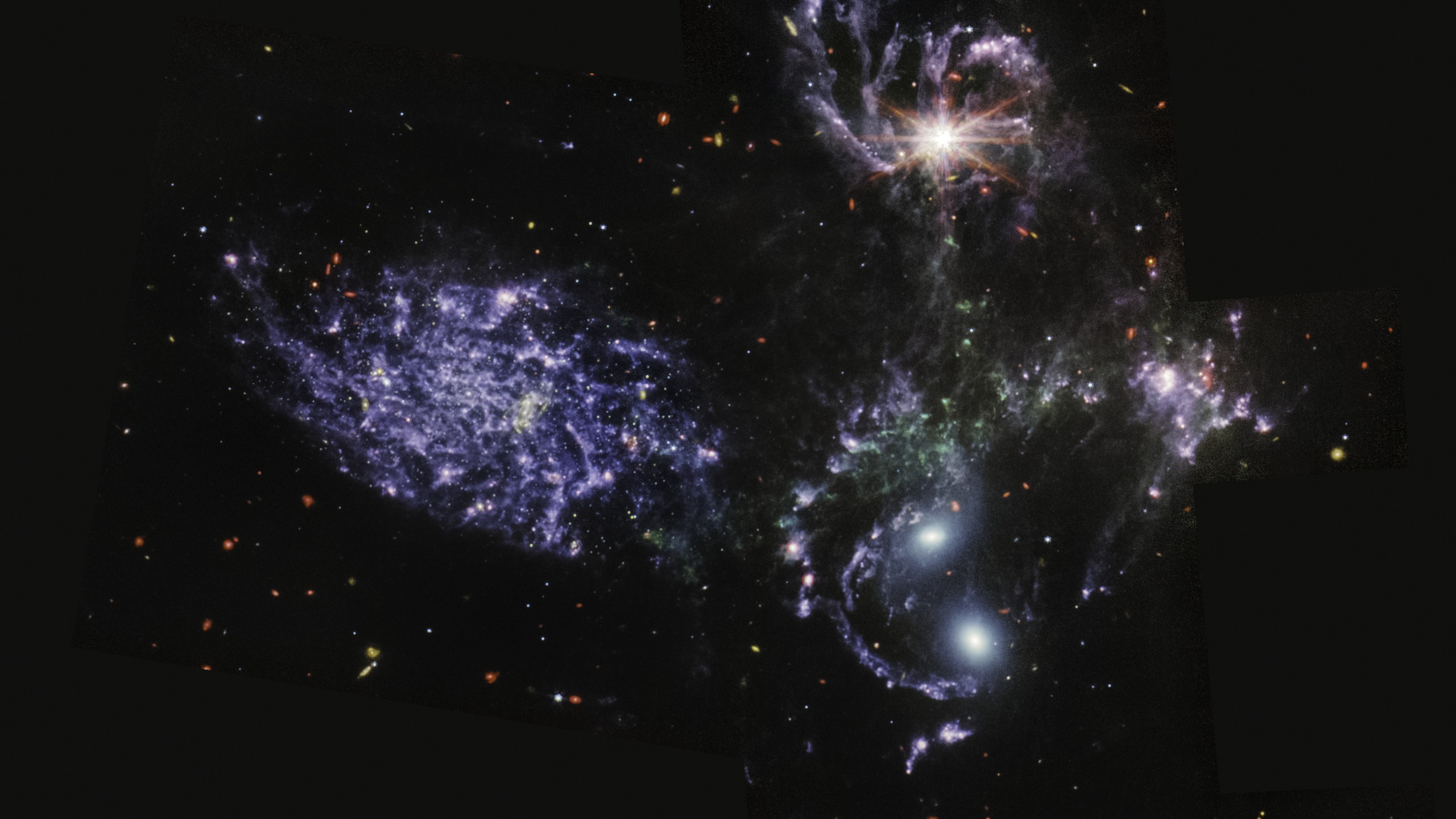
With its powerful, mid-infrared vision, the Mid-Infrared Instrument (MIRI) shows never-before-seen details of Stephan’s Quintet, a visual grouping of five galaxies. MIRI pierced through dust-enshrouded regions to reveal huge shock waves and tidal tails, gas and stars stripped from the outer regions of the galaxies by interactions. It also unveiled hidden areas of star formation. The new information from MIRI provides invaluable insights into how galactic interactions may have driven galaxy evolution in the early universe. This image contains one more MIRI filter than was used in the NIRCam-MIRI composite picture. The image processing specialists at the Space Telescope Science Institute in Baltimore opted to use all three MIRI filters and the colors red, green and blue to most clearly differentiate the galaxy features from each other and the shock waves between the galaxies. In this image, red denotes dusty, star-forming regions, as well as extremely distant, early galaxies and galaxies enshrouded in thick dust. Blue point sources show stars or star clusters without dust. Diffuse areas of blue indicate dust that has a significant amount of large hydrocarbon molecules. For small background galaxies scattered throughout the image, the green and yellow colors represent more distant, earlier galaxies that are rich in these hydrocarbons as well. Stephan’s Quintet’s topmost galaxy – NGC 7319 – harbors a supermassive black hole 24 million times the mass of the Sun. It is actively accreting material and puts out light energy equivalent to 40 billion Suns. MIRI sees through the dust surrounding this black hole to unveil the strikingly bright active galactic nucleus. As a bonus, the deep mid-infrared sensitivity of MIRI revealed a sea of previously unresolved background galaxies reminiscent of Hubble’s Deep Fields. Together, the five galaxies of Stephan’s Quintet are also known as the Hickson Compact Group 92 (HCG 92). Although called a “quintet,” only four of the galaxies are truly close together and caught up in a cosmic dance. The fifth and leftmost galaxy, called NGC 7320, is well in the foreground compared with the other four. NGC 7320 resides 40 million light-years from Earth, while the other four galaxies (NGC 7317, NGC 7318A, NGC 7318B, and NGC 7319) are about 290 million light-years away. This is still fairly close in cosmic terms, compared with more distant galaxies billions of light-years away. Studying these relatively nearby galaxies helps scientists better understand structures seen in a much more distant universe. This proximity provides astronomers a ringside seat for witnessing the merging of and interactions between galaxies that are so crucial to all of galaxy evolution. Rarely do scientists see in so much exquisite detail how interacting galaxies trigger star formation in each other, and how the gas in these galaxies is being disturbed. Stephan’s Quintet is a fantastic “laboratory” for studying these processes fundamental to all galaxies. Tight groups like this may have been more common in the early universe when their superheated, infalling material may have fueled very energetic black holes called quasars. Even today, the topmost galaxy in the group – NGC 7319 – harbors an active galactic nucleus, a supermassive black hole that is actively pulling in material. MIRI was contributed by ESA and NASA, with the instrument designed and built by a consortium of nationally funded European Institutes (The MIRI European Consortium) in partnership with JPL and the University of Arizona. For a full array of Webb’s first images and spectra, including downloadable files, please visit: https://webbtelescope.org/news/first-images
22.6k downloads
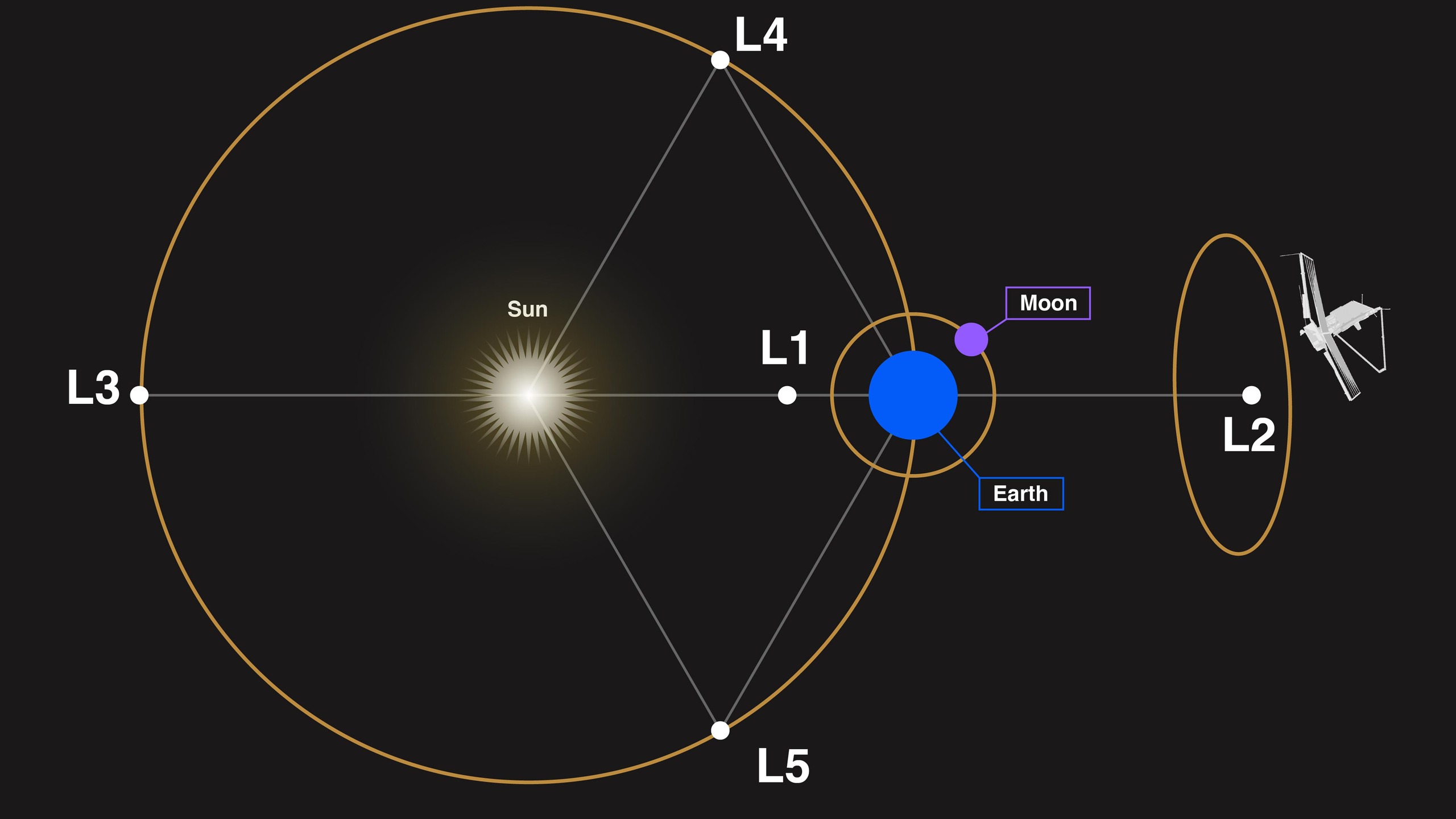
The James Webb Space Telescope orbits the Sun near Sun-Earth Lagrange point 2 (L2), approximately 1.5 million kilometers (1 million miles) from Earth. L2 is one of five Sun-Earth Lagrange points, positions in space where the gravitational pull of the Sun and Earth combine such that small objects in that region have the same orbital period (length of year) as Earth. This makes it possible for Webb to remain in constant communication with Earth. Webb is not located at L2, but instead orbits L2, completing one circuit every 168 days. This "halo orbit" around L2 is highly elliptical and is roughly perpendicular to its orbital path around the Sun. The distance between Webb and L2 varies between about 250,000 and 830,000 kilometers (150,000 - 500,000 miles). Because of this complex orbit , Webb's precise distance from Earth varies over time. Sizes and distances in this illustration are not to scale. The actual distance between the Sun and Earth is about 100 times the distance between Earth and L2. The distance between Earth and L1 is almost the same as between Earth and L2. L2 is about four times farther from Earth than the Moon. The long diameter (major axis) of the halo orbit around L2 is around the same as the distance between Earth and L2.
13.1k downloads